Forschungspublikationen

5 Ergebnisse
15.07.2026

Development of a weaving technology for the integral production of nonwoven thermally active fabrics with heating functionality

Gewebe Textilmaschinenbau Technische Textilien Smart Textiles

Zusammenfassung

Within the framework of the IGF project 01IF22817N, a novel weaving technology was developed for the integral production of highly efficient nonwoven thermally insulating fabrics with an integrated heating function. The objective of the project was to overcome the technological limitations of conventional quilted structures, particularly the occurrence of thermal bridges at seam locations and the high manufacturing effort associated with multi-stage production chains. The key innovation is a modular retrofit system that, for the first time, enables the automated inline preparation (cutting, joining, and feeding) and reliable integration of bulky nonwoven strips as weft material on rapier weaving machines.

To withstand the inertial forces acting during weft insertion, the nonwoven material is bonded to a load-bearing auxiliary yarn by means of ultrasonic welding. Based on validated MATLAB finite element simulations, a multilayer offset-chamber structure was developed that ensures the continuity of the insulation layer while minimizing thermal conduction paths. The Jacquard-based manufacturing process further enables the concealed integration of heating elements and binding warp yarns into the face layers through the targeted application of complementary weave structures.

Validation using functional prototypes demonstrated a significant improvement in thermal insulation performance, achieving a 33.9% increase compared with conventional quilted structures. Surface temperature homogeneity was substantially enhanced, with the temperature range reduced from 12.6 K to below 4 K. The developed technology offers considerable potential for the cost-effective production of highly functional insulating materials for sportswear, outdoor applications, and automotive systems.

Bericht

As part of the IGF project 01IF22817N (Nonwoven Thermo-Fabric), ITM carried out the development of advanced woven architectures and weave constructions for integrally woven insulation structures characterized by high design flexibility and a maximized volume of entrapped air. Furthermore, ITM developed the required preparation and feeding unit for the processing and the insertion of nonwoven strips in weft direction into the weaving process.

Introduction

Insulation structures are widely used in the apparel sector, particularly in sportswear and outdoor products, and form the basis for numerous leisure activities. Owing to the high demands placed on comfort and thermal insulation performance, consumers are willing to pay premium prices for functional garments intended for activities such as hiking, skiing, and horseback riding. As a result, this market segment represents a significant contributor to the overall performance of the German apparel industry [1]. Beyond clothing applications, insulation structures also play an important role in technical sectors such as the automotive industry, where they are used in roof liners and cabin insulation systems.

The prevailing construction principle for bulky thermal insulation materials in apparel applications is based on quilted structures. Their production involves a complex, multi-stage process chain comprising the manufacture of insulation, outer shell, and lining materials, textile printing and finishing, quilting, and garment assembly [2]. However, these structures exhibit an inherent design-related disadvantage that prevents the full exploitation of the insulation potential of the individual components. The quilting seams required to ensure structural integrity create locally compressed regions which, according to the principles of heat transfer, act as thermal bridges and reduce the overall insulation performance. Depending on stitch density, the thermal transmittance coefficient can increase by up to 40 % [3]. This loss in insulation efficiency is typically compensated by increased material consumption.

Furthermore, quilting seams introduce visible interruptions across the fabric surface, substantially limiting design flexibility and product customization. Various approaches, such as spacer quilting, attempt to mitigate the compression of the insulation layer by reducing thread tension during the quilting process and bridging greater material thicknesses. However, these methods achieve only a limited reduction in thermal transmittance, typically in the range of 10–14 % [4]. In addition, aesthetic considerations remain largely unaddressed.

To enhance thermal insulation performance, increase design freedom, and reduce the complexity of conventional manufacturing processes, the present research project fundamentally re-evaluated both the structural design and production of insulation materials. By implementing an integral weaving process capable of incorporating all relevant material components and by developing a structural architecture and yarn arrangement that simultaneously ensure structural integrity and enable visually appealing, highly customizable designs, it was possible to significantly reduce thermal transmittance and substantially improve the performance of textile insulation structures.

Objectives

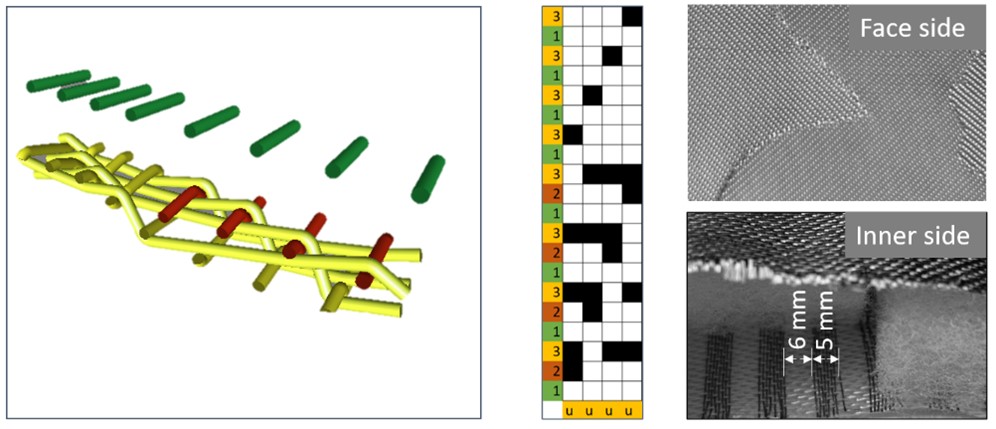
The objective of the project was the simulation-based design and development of chambered insulation structures in combination with an advanced weaving process that enables the inline integration of high-volume nonwoven strips with minimal permanent structural deformation while simultaneously incorporating a textile heating structure into the woven architecture. To achieve this objective, a thermodynamic design methodology was established, from which the arrangement of the yarn systems and the geometric configuration of the unit cells were derived. This approach enabled the identification and analysis of thermal conduction paths and facilitated the design of insulation chambers in such a way that the nonwoven strips remained largely uncompressed within the structure (Figure 1).

A systematic process chain for weave development was established, allowing the face layers to be patterned through Jacquard weaving while simultaneously ensuring the controlled guidance of the binding warp yarns required to connect the individual layers. In addition, binding solutions were developed to achieve both an aesthetically appealing integration of the binding warp yarns into the face layers and the concealed incorporation of the heating structure, masking it invisible from the fabric surface.

For the integration of nonwoven strips in weft direction, a modular preparation and feeding unit was developed. This system enables the processing of nonwoven material by cutting it into strips corresponding to the dimensions of the chamber geometry, modifying them to withstand the tensile loads occurring during weft insertion, and subsequently presenting them to the rapier system for insertion into the weaving shed.

The produced functional structures were validated qualitatively based on visual assessment criteria and through the identification of thermal bridges using infrared thermography. Quantitative evaluation was performed by determining the thermal transmittance coefficient using the Guarded Hot Plate method and comparing the results with those obtained from a conventional quilted reference structure. The developed insulation structures were manufactured on a Jacquard rapier weaving machine equipped with the modular preparation and feeding unit, thereby demonstrating the technical feasibility of the proposed process and structure concept.

Results

Process Chain for the Integral Manufacturing of Nonwoven Thermo-Fabrics

The integral production of chambered insulation structures is based on a novel approach that combines the previously separate process steps of fabric manufacturing, insulation integration (quilting), and functional integration (heating) into a single automated weaving process. The process chain developed at ITM enables the production of complex multilayer chambered structures with enhanced thermodynamic properties while simultaneously providing a high degree of design flexibility. The development process begins with the specification of material parameters, including yarn fineness and insulation characteristics, as well as target values for thermal transmittance and heating performance. Based on these requirements, a simulation-driven thermodynamic design is performed using a finite element heat conduction model implemented in MATLAB. This model allows the determination of the optimal geometric arrangement of the layers, such as offset chamber structures for minimizing thermal bridges, as well as the optimal positioning of integrated heating elements.

Structural and weave development are carried out digitally using the specialized textile design software EAT DesignScope Victor. The overall structure is divided into functional zones, including edge areas, patterned face layers, and binding warp zones. A key technological challenge is the synchronization of the weave combinations of the upper and lower layers with the trajectories of the binding warp yarns to ensure the formation of stable chambers for the integration of nonwoven strips. Through the use of complementary weave structures, both the binding points of the binding warp yarns and the integrated heating yarns can be visually concealed within the face layers.

A central element of the process chain is the automated inline preparation of the insulation material. The nonwoven material, supplied in roll form, is slit longitudinally, cut to length, and permanently bonded to a load-bearing auxiliary yarn by ultrasonic welding. This reinforcement is essential for safely withstanding the inertial forces acting during weft insertion on the rapier weaving machine and for preventing permanent deformation and necking of the nonwoven material. During the integral weaving process, all components, including the face layers, binding warp yarns, preassembled nonwoven strips, and heating yarns, are combined into a single structure. Precise control of weaving machine parameters, particularly shed closing timing and heald frame stroke, ensures the low-compression integration of the hig-bulk nonwoven strips into the fabric chambers.

Simulation-Based Thermodynamic Design of the Structures

The development of the insulation structure required a precise thermodynamic design of the multilayer offset chamber structures. The objective of the simulations was to determine heat transfer and heating performance while accounting for the complex interactions between the constituent materials. For this purpose, a two-dimensional steady-state finite element heat conduction model was implemented in MATLAB using the PDE Toolbox. The model was based on the steady-state heat conduction equation, with material-specific thermal conductivities assigned to the geometrically defined regions representing nonwoven insulation, face layers, and binding zones.

The primary objective of the simulation was to optimize the arrangement of layers and the positioning of the heating structure in order to minimize heat losses and maximize surface temperature homogeneity. Local heat fluxes were calculated using Fourier’s law, and the effective thermal transmittance coefficient was determined across the width of the representative unit cell. The fully parametric simulation environment enabled systematic variation of layer thicknesses, chamber widths, and the number and arrangement of insulation layers.

The numerical analyses revealed that heat transfer in conventional structures predominantly occurs through the binding regions, resulting in non-uniform temperature distributions. By implementing an offset arrangement of the insulation chambers, these direct heat conduction paths were effectively interrupted, thereby minimizing thermal bridges. Validation of the model was achieved through comparison of experimentally measured thermal resistances with calculated values. Iterative adjustment of structure- and process-related parameters, particularly those associated with layer contact and compression effects, resulted in a highly accurate model with a maximum deviation of only 2 %. A two-layer offset arrangement of the nonwoven strips was identified as the optimal solution and subsequently served as the basis for the weave design.

Structural and Weave Development for Multilayer Chambered Fabrics

The transfer of thermodynamic requirements into a manufacturable textile structure was achieved through the systematic organization of yarn systems and the development of a modular weave architecture. Using EAT DesignScope Victor, a color-coded design image was created and divided into functional zones that served as the basis for assigning the complex multilayer binding patterns.

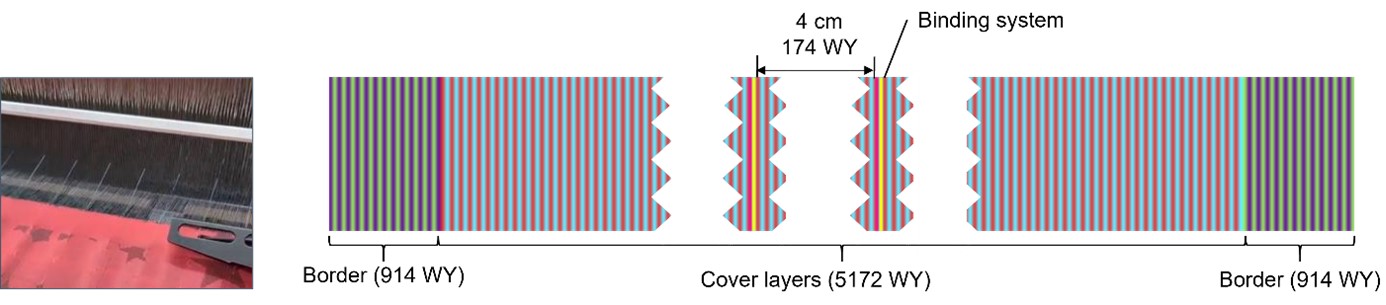
A total of 5,172 warp yarns supplied from two separate warp beams were incorporated into the developed insulation structures. The fabric width was divided into four functional regions: edge zones for fabric stabilization and weft fixation, patterned regions for the upper and lower face layers, and binding warp regions responsible for layer connection and positioning (Figure 2). This modular organization enabled independent modification of design elements and binding warp trajectories without requiring regeneration of the complete Jacquard control file.

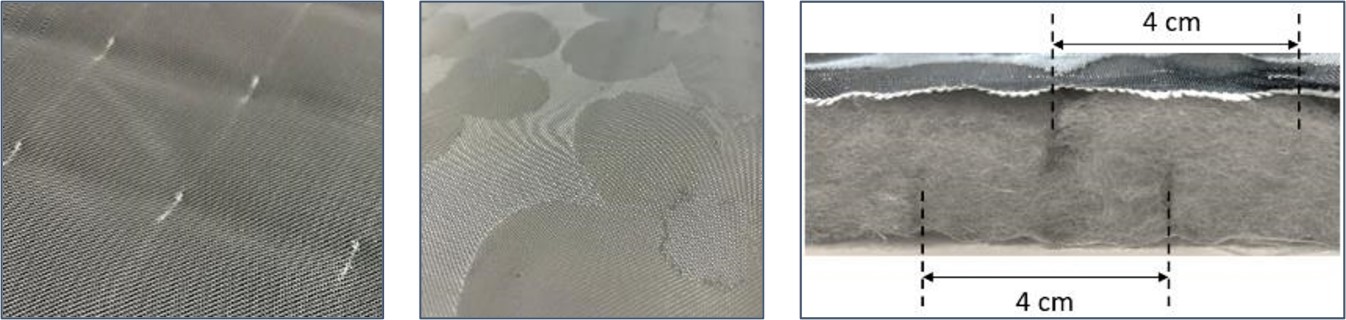
A key aspect of the weave development was the design of the binding warp paths, which ensure both structural integrity and chamber formation for nonwoven integration. The binding warp yarns were supplied separately from a creel and arranged in pairs at intervals of 4 cm, corresponding to the intended width of the nonwoven strips.

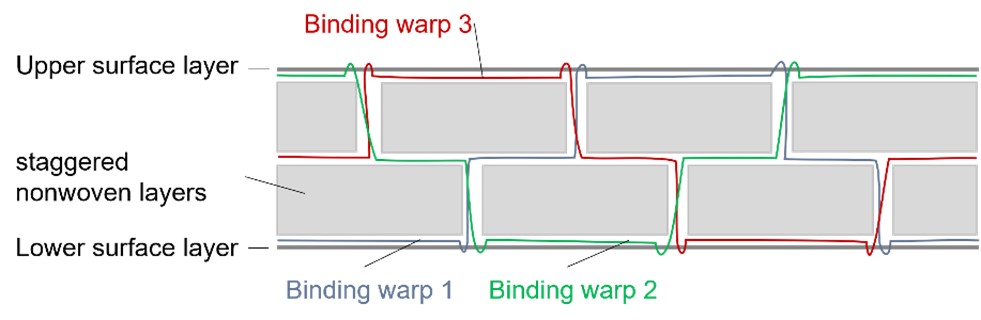
To minimize thermal bridging, a two-layer offset chamber arrangement was developed. This required a modified binding warp configuration in which the yarns are guided above, between, or below the insulation layers depending on their position within the structure. Through systematic optimization of the binding regions, surface irregularities and out-of-plane displacement of weft yarns were minimized (Figure 3).

To satisfy the high aesthetic requirements of sportswear and outdoor applications, strategies for concealing the functional components were implemented. Float-dominated weave structures, such as 4/1 satin, effectively masked the binding points of the binding warp yarns (Figure 4). Similarly, complementary weave constructions were employed for the integration of the heating structure. Conductive heating yarns were bound to the inner side of the body-facing layer, while opposite twill weaves enabled the heating yarns to be concealed beneath the surface weft yarns, rendering them invisible from the exterior.

The developed weave system was validated using four functional prototypes ranging from simple single-layer structures to highly complex multilayer fabrics with independently patterned face layers, offset insulation chambers, and integrated heating functionality.

Design and Development of the Nonwoven Integration Module

The objective of the engineering development was the realization of a modular system for the automated inline integration of nonwoven strips into chambered woven structures. A systematic design process based on VDI 2221/2222 was applied, including a detailed analysis of the available installation space around the rapier weaving machine and the geometry of the weaving shed.

The system was divided into functional modules corresponding to the process steps of feeding, cutting, joining, presentation and insertion. Circular blade cutting was identified as the preferred solution for cutting the nonwoven roll material into strips because, unlike scissors or ultrasonic cutting systems, it does not permanently compact the material edges and therefore preserves the insulation performance. Length cutting is performed using a specially designed guillotine cutter that facilitates insertion of the voluminous strips into the weaving shed.

A key technological innovation of the module is the reinforcement of the nonwoven material. To withstand the inertial forces occurring during weft insertion at machine speeds of up to 200 rpm, a load-bearing auxiliary yarn is permanently bonded to the nonwoven strip using ultrasonic welding. The resulting nonwoven-yarn composite is subsequently stored in a meander-shaped accumulator, enabling nearly resistance-free outlet during insertion and minimizing mechanical stress on the weld seam.

For precise transfer to the rapier system, the original weft presentation mechanism of the weaving machine was modified with specially designed guide elements. These ensure twist-free guidance of the nonwoven strip and reliable transfer to the rapier gripper.

Technological Implementation and Inline Production of Functional Prototypes

The developed technology was implemented on a Dornier PTS 4/J rapier weaving machine equipped with a Stäubli UNIVAL 100 Jacquard machine and the newly developed nonwoven preparation and integration module. A major focus of the technological trials was the synchronization of the individual process steps and the iterative optimization of weaving machine parameters to ensure stable production under industrially relevant conditions.

Precise adjustment of warp tensions and shed geometry was required to reliably process the voluminous nonwoven strips. Owing to their high take-up, the binding warp yarns were supplied directly from a creel at minimal tension. Experimental investigations demonstrated that excessive binding warp tension leads to local compression of the insulation material and consequently reduces thermal performance. Therefore, an optimal tension level was identified that ensured stable shed formation while minimizing compression.

Reliable insertion of the nonwoven-yarn composite further required adaptation of the shed closing sequence. While the edge regions employed an earlier shed closing to improve weft fixation, the shed closing of the binding warp yarns was deliberately delayed. This configuration prevented displacement of warp yarns by the bulky nonwoven strip during insertion and thereby preserved structural accuracy. Successful commissioning of the complete system demonstrated the feasibility of automated inline integration of high-performance insulation materials into integral woven chambered structures (Figure 5).

Thermodynamic validation

The final evaluation of the developed chambered structures involved a comprehensive characterization of their thermal and mechanical performance in comparison with conventional quilted structures. Thermal analyses were conducted using the Guarded Hot Plate method in accordance with DIN EN 12667 and supplemented by infrared thermography.

A primary objective was the reduction of thermal transmittance and the improvement of surface temperature homogeneity through the elimination of structural thermal bridges. The results demonstrated that the continuous, largely uncompressed insulation layer and the offset arrangement of the insulation chambers significantly enhanced thermal performance. While the conventional quilted reference structure exhibited a thermal conductivity of λ = 0.056 Wm−1K−1, the developed two-layer offset chamber structure achieved a value of λ = 0.037 Wm−1K−1, corresponding to an improvement of 33.9 %.

Infrared thermography further confirmed the superior temperature homogeneity of the developed structures. Whereas the quilted reference exhibited a surface temperature range of 12.6 K due to local compression at seam locations, the offset chambered nonwoven structure reduced this value to only 3.5 K.

In addition to thermal performance, the mechanical properties of the materials and structures were evaluated. Overall, the validation results demonstrate that the developed nonwoven thermo-fabrics outperform conventional quilted systems with respect to thermal efficiency, mechanical performance, and process stability.

Summary and Outlook

Within the framework of the research project, a novel weaving technology for the integral production of highly efficient chambered insulation structures with integrated heating functionality was developed. The primary objective was to overcome the technological limitations of conventional quilted insulation structures, particularly the occurrence of thermal bridges at seam locations and the high manufacturing effort associated with multi-stage production processes by the development of a process chain (Figure 6).

The core innovation of the developed technology is a modular retrofit system for the inline preparation and integration of nonwoven strips. This module enables high-performance insulation materials to be slit longitudinally, cut to length, and reinforced through a permanent bond with a load-bearing auxiliary yarn by means of ultrasonic welding. As a result, the nonwoven strips can be reliably processed as weft material on rapier weaving machines.

Based on simulation-driven thermodynamic design using a validated MATLAB finite element model, multilayer woven structures with offset chamber arrangements were developed. This specific structural configuration effectively minimizes thermally conductive pathways and substantially reduces the formation of structural thermal bridges. The technological implementation was realized on a Jacquard weaving machine. Through the use of complementary weave constructions, both the binding warp attachment points and the integrated heating structures could be visually concealed within the fabric architecture, resulting in an aesthetically homogeneous surface appearance.

Validation of functional prototypes and a vest demonstrator confirmed a significant improvement in thermal insulation performance compared with the current state of the art. The developed structures achieved a thermal conductivity of λ = 0.037 Wm−1K−1, compared to λ = 0.056 Wm−1K−1 for the conventional quilted reference structure, corresponding to an improvement of 33.9 %. Simultaneously, surface temperature homogeneity was substantially enhanced, with the temperature range decreasing from 12.6 K for the reference structure to less than 4 K.

Owing to its modular design and the process guidelines established within the project, the developed technology is readily scalable and suitable for industrial implementation, particularly by small and medium-sized enterprises operating in the sportswear, outdoor, and automotive sectors.

Acknowledgement

The IGF-Project 01IF22817N of the research association Forschungskuratorium Textil e.V., Wallstraße 58/59, 10179 Berlin, was funded by the German Federal Ministry for Economic Affairs and Energy via the German Aerospace Center (DLR) as part of the program for the promotion of Industrial Collective Research (IGF) based on a resolution of the German Bundestag.

The authors would like to thank the aforementioned institutions for providing the financial resources. The research report and further information are available from the institute of Textile Machinery and High Performance Material Technology at TU Dresden.

References

[1]      Mouwitz, P.; Larsson, J.; Peterson, J.: Beyond mass customisation : Mass individualisation.

[2]      Yu, W.; Wang, L.; Liu, H.; Rodrigue, D.; Du, Z.; Yu, W.; Wang, X.: Optimization of the quilting method and filling quality of cold-proof down clothing based on thermal insulation performance. Textile Research Journal 93(2023)21-22, S. 5007-5016

[3]      An, Y.-Y.; Tu, L.-X.; Shen, H.; Xu, G.-B.; Zhang, G.-R.; Zhu, H.-Q.; Wang, H.-C.: Numerical simulation and validation on heat transfer of four structures of sleeping bag. International Communications in Heat and Mass Transfer 129(2021), S. 105707 f.

[4]      Saeed, H.; Rödel, H.; Krzywinski, S.; Hes, L.: ‘Spacer stitching’, an innovative material feeding technology for improved thermal resistance. IOP Conf. Ser.: Mater. Sci. Eng. 254(2017)13, S. 132004 f.


AutorInnen: Jasmin Pilgrim Florian Koch Johannes Mersch Cornelia Sennewald Chokri Cherif

Technische Universität Dresden
Fakultät Maschinenwesen
Institut für Textilmaschinen und Textile Hochleistungswerkstofftechnik (ITM)
01062 Dresden

https://tu-dresden.de/mw/itm

More entries from TU Dresden, Institut für Textilmaschinen und Textile Hochleistungswerkstofftechnik ITM

02.03.2026

Development of a Weaving Technology for the integral manufacturing oft thick-walled nodal structures for media transport

Gewebe Composites

Zusammenfassung

In the IGF project 01IF22946N, a novel weaving technology was developed for the integral manufacturing of thick-walled, fiber-reinforced composite pipe joints (T- and Y-geometries) for media transportation.

The objective was to realize load-path-optimized pipe joints featuring a homogeneous wall structure and a continuous inner cavity. The core innovation is a modular, retrofittable auxiliary system for processing reversing warp yarns on shuttle weaving machines. This system enables, for the first time, the controlled redirection of defined warp yarn groups and thereby ensures the integral production of woven, pipe joints with flow capability.

Based on macro- and mesoscopic finite element simulations, load-path-oriented fiber orientations in the high-stress branch region were identified and translated into complex multilayer weave patterns. The developed process chain comprises CAD-based geometric design, 2D flattening and weave pattern development, fabrication of a 2.5D woven preform, its transformation into the three-dimensional geometry, and subsequent consolidation using the RTM process. Validation was carried out through several prototypes and a demonstrator. The results demonstrate that the integral weaving-based approach enables a constant wall thickness while eliminating the material overdimensioning in the branching region that is typically required in filament-wound solutions. Consequently, the technology provides a material-efficient, reproducible, and economically scalable route for manufacturing load resistant FRP pipe joints for media transport with significant application potential in industrial piping systems.

Bericht

Within the IGF project 01IF22946N (“Durchströmbare Rohrknoten”), the ITM conducted the complex structural and weave pattern development of a woven thick-walled T- and Y-shaped pipe joint for media transport based on the application of reversing warp yarns.

Introduction

Pipeline systems constitute essential functional components in numerous industrial applications, particularly in chemical plant engineering, mechanical and automotive engineering, as well as in energy and environmental technologies. In addition to straight pipe sections, branches in the form of T- and Y-shaped pipe joints represent safety-critical components whose structural integrity decisively determines the operational reliability of the overall system. Especially in pressure-loaded media lines, complex three-dimensional stress states arise in the transition zone between the main pipe and the branch, imposing stringent requirements on both material and structural design. While established manufacturing processes such as filament winding and centrifugal casting are available for straight fiber-reinforced composite (FRC) pipes, no integral and industrially scalable solutions currently exist for highly load-bearing, fiber-reinforced polymer (FRP) pipe joints for media transport. Fiber-reinforced polymers (FRP) offer significant potential for pipeline systems due to their low weight, high specific strength, and corrosion resistance.

Metallic pipe joints are typically manufactured by welding and are associated with high mass, susceptibility to corrosion, and mandatory inspections of weld seams. Although filament-wound composite solutions enable a higher pressure resistance, the fiber orientation in the branching region is not aligned with the principal load paths, resulting in structural overdimensioning and increased material consumption. Consequently, textile-based approaches with load-path-oriented structural design are particularly promising. In particular, the weaving technology developed at ITM enables the realization of structurally complex pipe joints through sophisticated weave architectures. However, the previously developed woven 3D node elements are, due to weave and technological constraints, internally separated and therefore unsuitable for media-conveying pipeline systems [1, 2]. This results in a fundamental conflict between integral textile manufacturing and the required flow capability of the components. Against this background, there was a substantial need for research aimed at developing a novel weaving technology incorporating a dedicated warp yarn reversal module, enabling for the first time the integral production of flow-through FRP pipe joints with load-path-optimized fiber architecture.

Objectives

The objective of the project was the development of a simulation-based process chain for the integral manufacturing of woven pipe joints for media transport up to the consolidated composite component for internally pressurized FRP pipeline systems. First, a structural-mechanical design was carried out based on macro- and mesoscopic finite element models. The aim was to determine the principal stress directions in the joint region and to derive a load-path-oriented fiber architecture, particularly within the branching zone. Based on the simulated, load-adapted fiber orientations, the complete and highly complex weave architectures of the three-dimensional pipe joints were developed.

A key technological innovation was the development and implementation of a modular add-on system for warp yarn reversal on Jacquard weaving machines. This system enables, for the first time, the controlled deflection of selected warp yarns at the fabric edge and thereby establishes the prerequisite for forming an open, flow-through branching region while simultaneously realizing a load-path-optimized reinforcement structure. Only through the implementation of the warp yarn reversal module, fiber trajectories can be aligned with the principal stress directions without structurally separating the internal cavity between the main pipe and the branch. Material overdimensioning in the branching region, that is typical of filament-wound pipe joints, was completely eliminated using this approach. Validation was carried out using three functional prototypes and a three-dimensional FRP demonstrator in the form of T- and Y-shaped pipe joints. The developed FRP pipe joints were successfully manufactured and demonstrated.

Results

Process chain for the manufacturing of woven FRP pipe joints

Integrally woven three-dimensional FRP pipe joints are based on tubular multilayer fabrics produced on a shuttle weaving machine equipped with at least four shuttles. A prerequisite for forming a tubular structure is a circumferential weft yarn insertion, i.e., a closed fabric edge, enabling a seamless pipe wall configuration. This structural feature can only be realized using shuttle weaving technology. The primary challenge in manufacturing pipe joints lies in combining a tubular structure with a branching geometry that features a continuous wall structure while maintaining an open internal cavity.

The pipe joint is initially produced in a two-dimensional state as a 2.5D woven structure. The transformation into the three-dimensional geometry is subsequently achieved by the targeted and automated removal of excess lengths of floating warp yarn within the fabric, causing the textile structure to deploy into the intended three-dimensional shape.

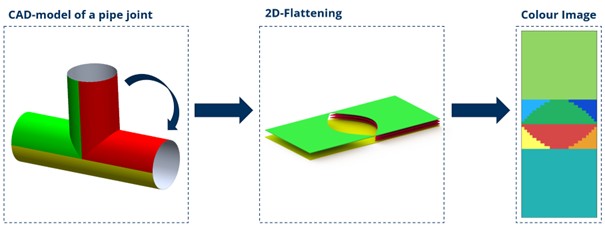
The complete manufacturing process (Figure 1) of an integrally woven pipe joint begins with the definition of the target geometry, including diameter, wall thickness, pipe lengths, and branching angle. Based on these parameters, a CAD model of the final geometry is created. The surfaces defined in the model are then flattened into the plane, taking into account the required layer architecture, in order to generate a colour-coded image from the developed surfaces.

Subsequently, an individual weave pattern is developed for each coloured area within this colour image. These partial weave patterns are combined into an overall weave pattern using weave design software (EAT DesignScope Victor). The corresponding machine control data are generated and transferred to the weaving machine. In the subsequent weaving process, the 2.5D preform is manufactured integrally according to the developed weave architecture. After completion of the weaving process, the textile preform is automatically shaped into the previously defined three-dimensional pipe joint geometry.

The final FRP component is produced by consolidating the preform using a resin transfer molding (RTM) process with a tool adapted to the outer diameter of the pipe joint. After demolding, the manufacturing process is completed by final trimming of the component.

Simulation-based design of pipe joints for media transport

The development of pipe joints for media transport requires a load-path-oriented design of the warp yarn systems. A boundary condition of the simulation was the arrangement of warp and weft yarn systems in such a way that no structural separation of the internal cavity between the main pipe and the branch occurs, thereby ensuring the flow capability of the pipe joint.

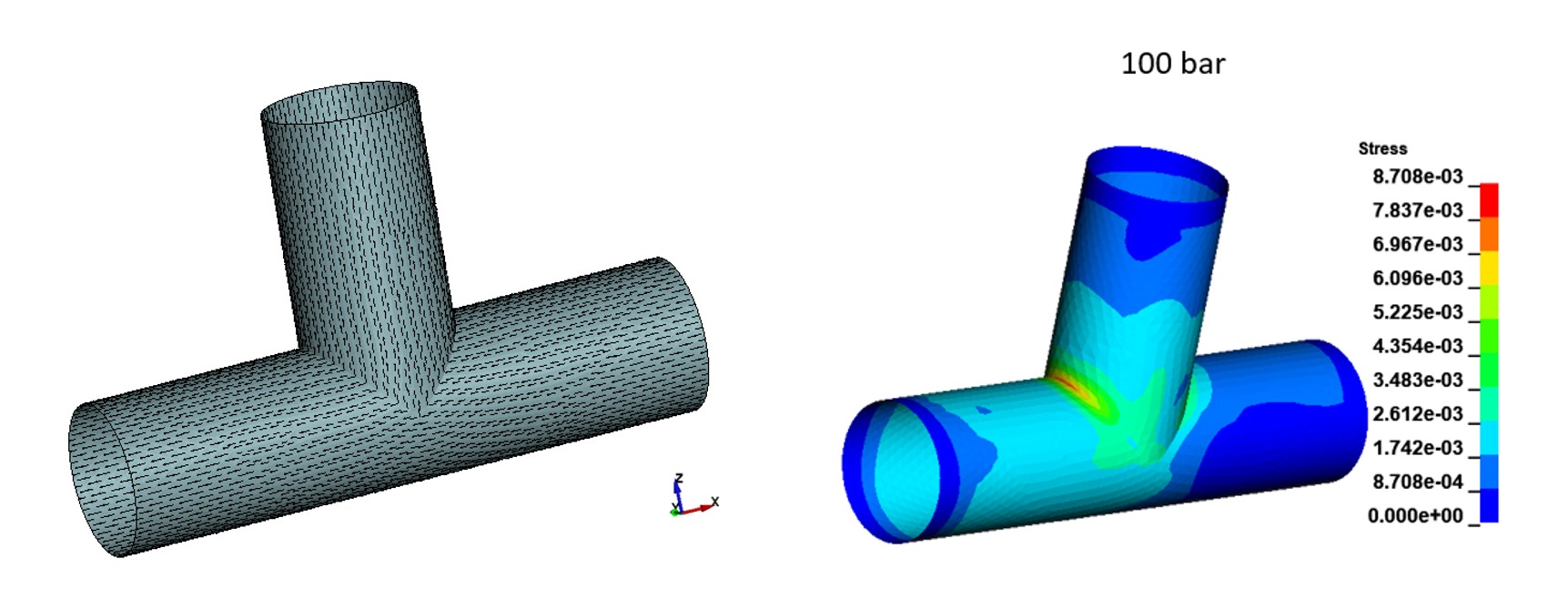
To this end, the stress distribution within the pipe joint geometry under internal pressure loading was first determined numerically. The highest stresses occur in the transition zone between the main pipe and the branch (Figure 2). This region therefore represents the governing design zone for the fiber architecture.

Based on the calculated stress distribution, a load-path-oriented architecture of the warp yarns was defined in order to fully exploit the tensile properties of the warp yarn material. This optimized warp yarn architecture forms the basis for the subsequent weave development of the pipe joints for media transport.

Development of Prototypes

The development of the weave architecture for an integrally woven pipe joint begins with a three-dimensional CAD model of the joint geometry. The simulated warp yarn systems and their trajectories are color-coded in Figure 3 (left).

Subsequently, the surfaces of the model are flattened into the plane and merged into a color-coded image. Each colored area represents a structurally induced modification within the woven architecture.

For each color-coded area, individual weave patterns are developed and subsequently combined into a unified weave pattern of an integrally woven pipe joint for media transport using the software EAT DesignScope Victor. This integration is achieved through the coordinated control of the shuttles, the fabric take-up system, and the assignment of heddles.

Development of a Warp Yarn Reversal Module

The developed weave patterns were transferred to the shuttle weaving machine “Mageba SL RTEC1200/1” and manufactured using four shuttles. In order to realize the load-path-oriented warp yarn trajectories, an additional module for processing reversing warp yarns is required. This module was designed as a CAD model, taking into account the available installation space in the take-up area of the weaving machine, and subsequently integrated into the machine. The module can be implemented cost-effectively and is adaptable and retrofittable to other weaving machines.

The functional principle for processing reversing warp yarns is based on joining two predefined warp yarns prior to the start of fabric production, thereby forming a loop. The connection point is displaced from the weaving zone toward the creel to make sure it does not become part of the woven pipe joint to be produced. This procedure is repeated until all warp yarns designated for reversal in the two fabric layers are present as loops.

To apply a warp yarn tension comparable to that of the continuously running warp yarns, the loops are integrated into the fabric take-up system by means of the module. The warp yarn tensions of both yarn types were recorded and analyzed using a warp tension measuring device. Both the controlled fixation of the warp yarn loops and their integration into the fabric take-up system represent central functions of the developed warp yarn reversal module.

Application of the module and manufacturing of the prototypes

After the formation of the warp yarn loops, the textile preform is manufactured. In the first section of the pipe joint, the loop-forming warp yarns initially remain fully floating. Following the production of the oval branching region, these warp yarns are integrated into the structure in a regular manner.

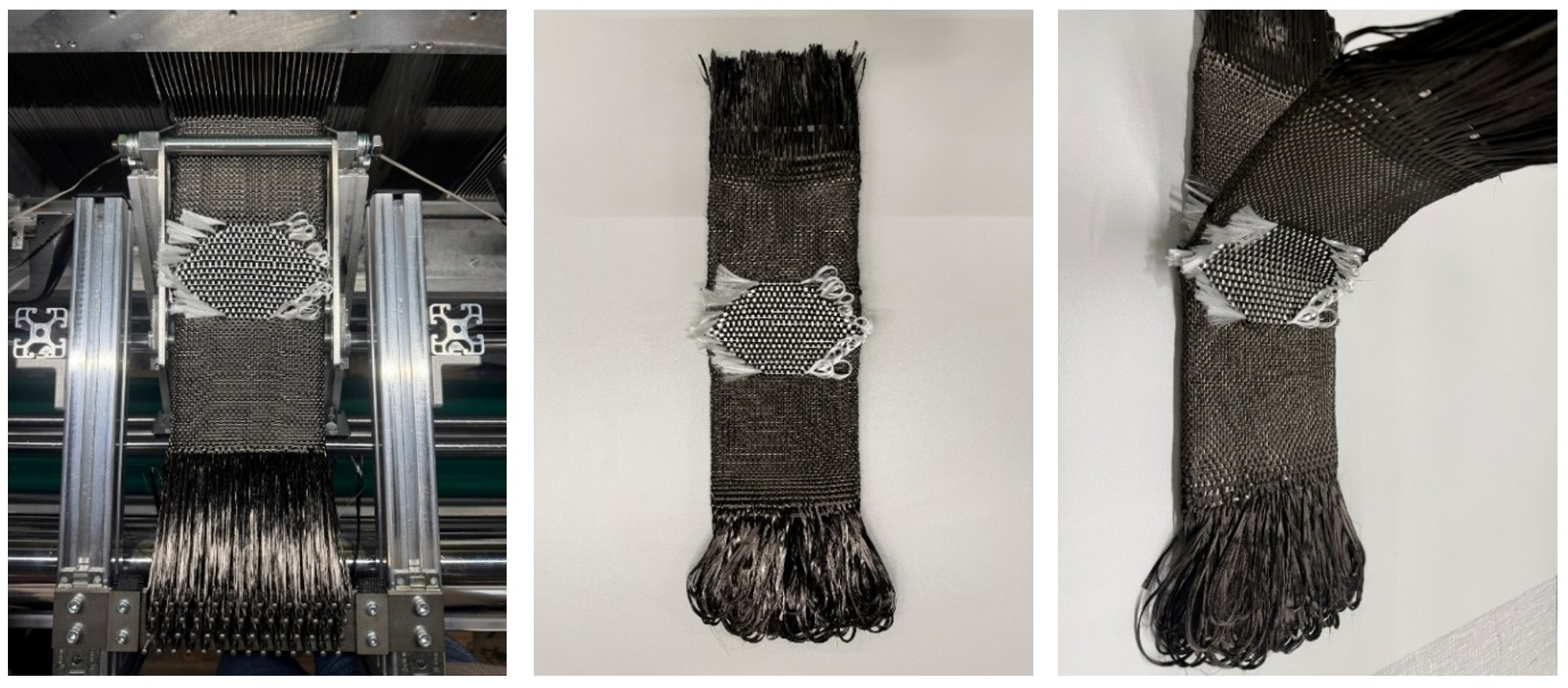
From the oval region onward, the use of four shuttles becomes necessary in order to realize the superimposed tubular fabric layers in the second section of the pipe joint. Within the oval region, one shuttle inserts a separate weft yarn that supports the formation of the oval fabric edge. The manufactured textile preform is shown in Figure 4.

For the reproducible production of this highly complex weave architecture, uniform weft insertion is essential. In particular, during the fabrication of the oval region, the weft yarns must reverse within the fabric structure rather than being inserted across the full fabric width, as is typical in conventional weft insertion. The precision of this process step significantly influences both the quality of the three-dimensional pipe joint geometry and the quality of matrix infiltration during consolidation. The textile preforms were successfully manufactured (Figure 4).

3D-shaping and consolidation of the woven prototypes

To transform the 2.5D preform into the three-dimensional structure, a dedicated 3D-shaping process developed specifically for pipe joints with flow capability is applied. A shape-defining internal core is inserted into the tubular structure, defining the target contour during the shaping process. The 3D-shaping is achieved by the targeted elimination of the excess warp yarn lengths introduced during the geometric flattening process. These excess lengths are withdrawn from the structure at the cut edge of the woven structure. A process-specific sequence to eliminate the floating warp yarns must be strictly followed in order to prevent material damage and to reproducibly achieve a precise warp yarn alignment after the shaping process. An automation concept for this shaping technology was developed.

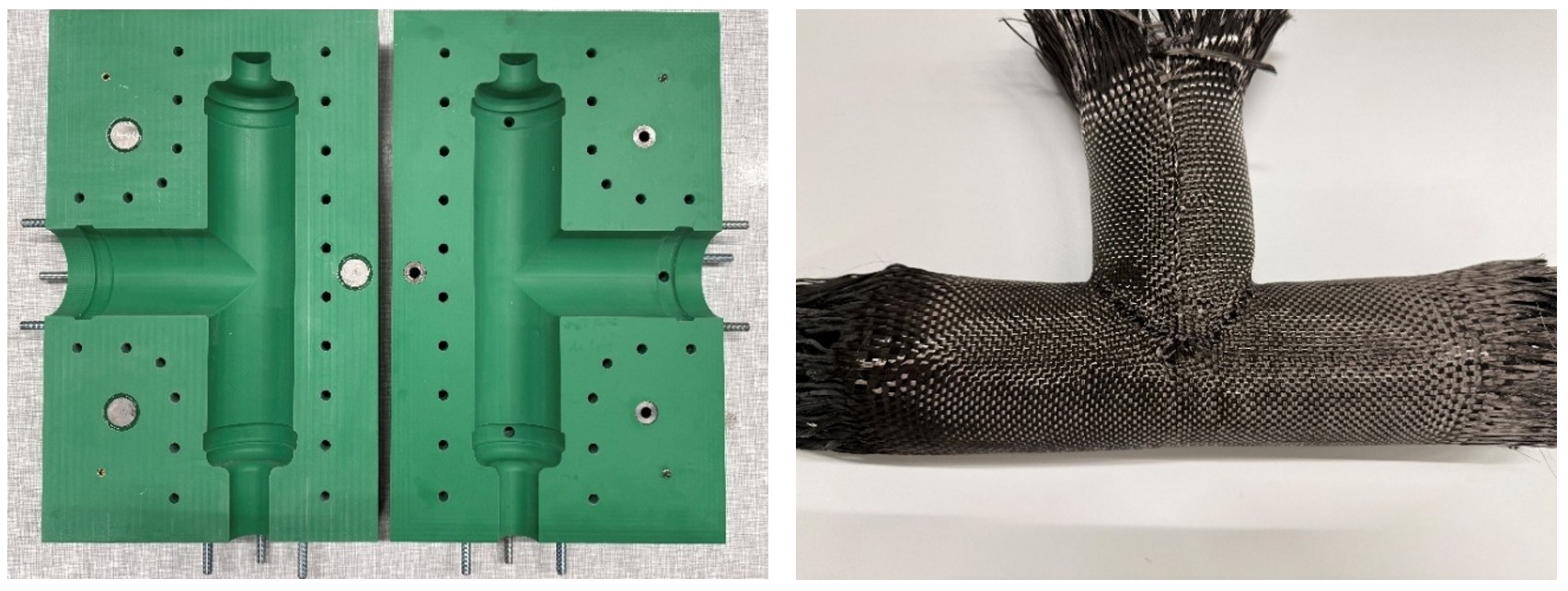
Since the warp yarn loops in the first section of the fabric remain floating up to the edge of the oval region, the corresponding warp yarn excess lengths can be withdrawn. As a result, this warp yarn system is integrated into only one half of the woven structure within the pipe joint. After the preform has been shaped into its three-dimensional configuration, consolidation is carried out. An RTM tool specifically adapted to the contour of the flow-through pipe joint was designed and manufactured (Figure 5). The result after consolidation is a fully consolidated T-joint for media transport with high surface quality and reproducible geometric accuracy.

The material overdimensioning in the branching region typical of filament-wound FRP pipe junctions was completely eliminated through the integral, fabric-based manufacturing approach employing reversing warp yarns.

Summary and Outlook

FRP pipe joints can, for the first time, be manufactured both integrally woven and flow-capable by means of an add-on module for existing shuttle weaving machines. The textile preform is produced in a single-stage weaving process. Following a 3D-shaping procedure specifically developed for the novel yarn architectures, the 2.5D preform can be consolidated into a load-bearing lightweight FRP pipe branch using established RTM processes.

The weave patterns developed, along with the underlying design methodology, can be made available to SMEs for industrial implementation. The geometry of the pipe joint (diameter, wall thickness, pipe lengths, and branching angle) can be individually adapted with minimal modification effort. In addition to T-joints, Y-shaped pipe joints can also be manufactured using the newly developed methodology and weave system, enabling application-specific realization of different topologies.

The results achieved within this project form the foundation for a scalable and load-path-optimized manufacturing technology for FRP pipe joints for media transport.


Acknowledgement

 The IGF project 01IF22946N of the research association Forschungskuratorium Textil e.V., Wallstraße 58/59, 10179 Berlin, was funded by the German Federal Ministry for Economic Affairs and Energy via the German Aerospace Center (DLR) as part of the program for the promotion of Industrial Collective Research (IGF) based on a resolution of the German Bundestag.

The authors would like to thank the aforementioned institutions for providing the financial resources. The research report and further information are available from the Institute of Textile Machinery and High Performance Material Technology at TU Dresden.


References


[1]      Matthias Hübner; Monireh Fazeli; Thomas Gereke; Chokri Cherif: Geometrical design and forming analysis of three-dimensional woven node structures. Textile Research Journal 88(2018)2, S. 213-224

[2]      Schegner, P.; Fazeli, M.; Sennewald, C.; Hoffmann, G.; Cherif, C.: Technology Development for Direct Weaving of Complex 3D Nodal Structures. Applied Composite Materials 26(2019)1, S. 423-432


AutorInnen: Anna Happel Thị Anh Mỹ Huỳnh Cornelia Sennewald Chokri Cherif

https://tu-dresden.de/ing/maschinenwesen/itm

Technische Universität Dresden

Fakultät Maschinenwesen

Institut für Textilmaschinen und Textile Hochleistungswerkstofftechnik (ITM)

01062 Dresden

More entries from TU Dresden, Institut für Textilmaschinen und Textile Hochleistungswerkstofftechnik ITM

11.06.2025

PE-based, spun-dyed and sustainable clothing made from organic raw materials

Fasern Garne Gestricke & Gewirke Recycling Nachhaltigkeit Fashion

Zusammenfassung

The bioPEtex project in the BIOTEXFUTURE Innovation Space aims to develop sustainable clothing made from bio-based raw materials in the form of spun-dyed T-shirts. In an industry heavily dominated by fossil-based polymers such as polyester, bio-based polyethylene (bioPE), a bio-based polymer made from fermented starches or sugars, offers an environmentally friendly alternative. BioPE has the same properties as fossil-based PE and is fully recyclable. The use of spun-dyed bioPE also reduces energy and water consumption by 50 % and CO2 emissions by 60 %. The project involves the development of sustainably dyed compounds from bioPE for the spun-dyeing process and the development of multifilament yarns through melt spinning and false-twist texturing. The yarns are knitted on seamless machines and a T-shirt demonstrator is manufactured, which is finished with a sustainable elastic finish. The results will not only reduce the ecological footprint of the textile industry, but also promote innovative approaches to the circular economy.

Bericht

Introduction

The global annual man-made fibre production is growing steadily and is expected to exceed 100 million tonnes by 2030. Polyethylene terephthalate (PET) from the polyester (PES) family is the most widely used polymer, with an 80 % market share. Global clothing production alone almost doubled between 2000 and 2015. More than 80 % of all fibres produced are now used for clothing. Between 30 and 60 % of PET produced worldwide is used in clothing, i.e. approx. 18 to 36 million tonnes. This makes PET the most widely used material for clothing (as of 2021). The textile industry therefore faces enormous ecological challenges, particularly due to the high proportion of fossil raw materials used in textile production. Fossil-based polyesters account for around 52 % of the market and have a significant negative impact on the environment and resource consumption. Synthetic fibres in clothing are largely made from these fossil-based polyesters, the main component of which is PET, which is not yet 100 % bio-based. Clothing made from 100 % biopolymers has so far only been shown in studies and flagship projects, as it is too expensive for the mass market and not available in sufficient quantities. The bioPEtex project aims to establish 100 % bio-based polyethylene (bioPE) in the clothing market. The large-volume thermoplastic drop-in polymer is used to produce mono material, thermomechanically recyclable clothing. To achieve this, the challenge that PE is not produced for continuous fibre production and that there are no designated types for this purpose and no textile plant technology designed for the polymer must be solved. Based on preliminary work at the Institute für Textiltechnik (ITA), the current project status and Alberghini et al., it is foreseeable that the project will be successful. The consortium's expertise is ideally suited for rapid implementation. [Tex22; AHL+21; SB20Materials and Methods

In the scope of this project, commercially available bio-based polyethylenes are selected, procured and modified (see Figure 1).

Spinnable compounds made from BioPE are then developed. For subsequent spin dyeing in the melt spinning process, colour masterbatches with bio-based colour pigments are developed by our industry partner TECNARO GmbH, Ilsfeld, Germany, in order to realise a sustainable alternative to conventional dyeing with dyes. In addition, conventional dyeing of PE is challenging [BBO+13]. Various textured multifilament yarns with up to 100 filaments are developed from these bioPE compounds using melt spinning and texturing processes on a semi-industrial scale, so that a bio-based T-shirt can be manufactured. Until now, PE has only been used in the industry for staple fibres, highly drawn fibres for technical applications or for carbon fibres – but not yet as yarn in clothing [Fou99; Pei18; Wor17]. In addition to the elasticity provided by the meshes in the knitted fabric, innovative, pre-competitive, sustainable textile finishes are being tested and further developed.

Results

Initial results show promising progress in the processing of bioPE into spun-dyed yarns with suitable properties for textile applications. BioPE can be processed into multifilament yarns in stable melt spinning processes. Process development with dyed bioPE compounds is currently underway (see Figure 2).

The resulting partially oriented yarns (POY) with currently 96 filaments and a single filament titre of approx. 1 dtex have suitable properties for subsequent false-twist texturing (see Figure 3). Production speeds for melt spinning are currently in the industrial range (2,500 m/min). In a next step, yarns with 30 filaments and a higher single filament titre will be spun in order to give the resulting textile more stability in combination with the fine yarns.

Tensile strengths of approx. 20 cN/tex have been achieved to date, thus already meeting the target values derived from PET-POY. False-twist texturing on a laboratory scale (ITA) and on a semi-industrial scale (BB Engineering GmbH, Remscheid, Germany) has also been successful. The mechanical properties of the textured yarns (draw-textured yarn, DTY) are thus improved and the yarn volume and heat retention capacity are increased (see Figure 4). The close-up image of the DTY below shows that no tangling was introduced on a laboratory scale and that the yarn cohesion is therefore not yet ideal. However, the DTY can already be processed into a knitted fabric without any problems. These shortcomings are also remedied on a semi-industrial scale.

The resulting natural fibre-like, cool feel now makes it possible to use the yarn in textiles. Initial knitting trials with the lab-scale DTY have been successful at our industrial partner FALKE KGaA in Schmallenberg, Germany, once again confirming the cooling sensation when the textile is touched. Further yarns are being developed so that the next step can be to produce a T-shirt for sports applications using semi-industrial yarns and validate it as a demonstrator. The development of the bio-based elastic finish is also currently underway.

Summary

The bioPEtex project represents an innovative approach to producing sustainable clothing from bio-based materials. Targeted research and development aims to achieve both ecological and economic benefits. The results achieved could contribute to significantly reducing the ecological footprint of the textile industry and setting new standards for recyclability in the fashion industry. So far, developments with bio-based PE compounds have been successful, and smooth, partially oriented as well as textured yarns can be produced on a semi-industrial scale and processed into a cooling knit fabric. Validation as a demonstrator in the form of a seamless, bio-based T-shirt with elastic bio-based finishing is still pending in the further course of the project.

Acknowledgement

We thank the Federal Ministry of Research, Technology and Space for funding the Innovation Space BIOTEXFUTURE and the research project bioPEtex (031B1496). Furthermore, we would also like to thank everyone involved in this project for their contributions and commitment.

Bibliography

[AHL+21] Alberghini, M.; Hong, S.; Lozano, L. M.; Korolovych, V.; Huang, Y.; Signorato, F.; Zandavi, S. H.; Fucetola, C.; Uluturk, I.; Tolstorukov, M. Y.; Chen, G.; Asinari, P.; Osgood, R. M.; Fasano, M.; Boriskina, S. V.:
Sustainable polyethylene fabrics with engineered moisture transport for passive cooling
Nature Sustainability 4 (2021), H. 8, S. 715–724

[BBO+13] Baur, E.; Brinkmann, S.; Osswald, T. A.; Rudolph, N.; Schmachtenberg, E.; Saechtling, H.:
Saechtling Kunststoff Taschenbuch. 31. Ausgabe, [komplett überarb., aktualisiert und zum ersten Mal in Farbe]Aufl..- München: Hanser, 2013

[Fou99] Fourné, F.:
Synthetic Fibers. Hanser, München, 1999

[Pei18] Peijs, T.:
1.5 High Performance Polyethylene Fibers:
Comprehensive Composite Materials II: Elsevier, 2018, S. 86–126

[SB20] Siracusa, V.; Blanco, I.:
Bio-Polyethylene (Bio-PE), Bio-Polypropylene (Bio-PP) and Bio-Poly(ethylene terephthalate) (Bio-PET): Recent Developments in Bio-Based Polymers Analogous to Petroleum-Derived Ones for Packaging and Engineering Applications
Polymers 12 (2020), H. 8

[Tex22] Textile Exchange:
Preferred Fiber and Materials Market Report 2022
Burbank, California: 10/2022

[Wor17] Wortberg, G.:
Entwicklung polyethylenbasierter Precursoren für die thermochemische Stabilisierung zur Carbonfaserherstellung. Shaker Verlag, Dissertation
,


AutorInnen: M. Ortega J. Langer R. Morgenroth M. van Haren G. Mourgas A. Langer T. Gries

ITA Institut für Textiltechnik der RWTH Aachen University, Otto-Blumenthal-Straße 1, 52074 Aachen, Germany

Clothtech SportTec Oekotech

More entries from ITA Institut für Textiltechnik der RWTH Aachen University

20.06.2023

Development of heavy tows from recycled carbon fibers for low-cost and high performance thermoset composites (rCF heavy tows)

Rohstoffe Fasern Garne Composites Textilmaschinenbau Recycling Nachhaltigkeit Kreislaufwirtschaft Technische Textilien

Zusammenfassung

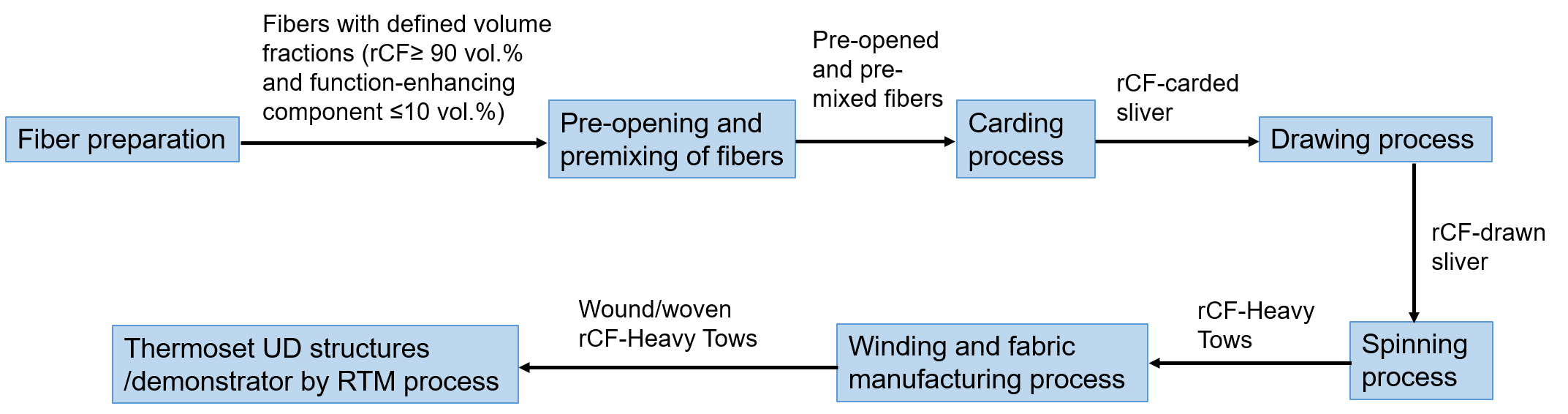
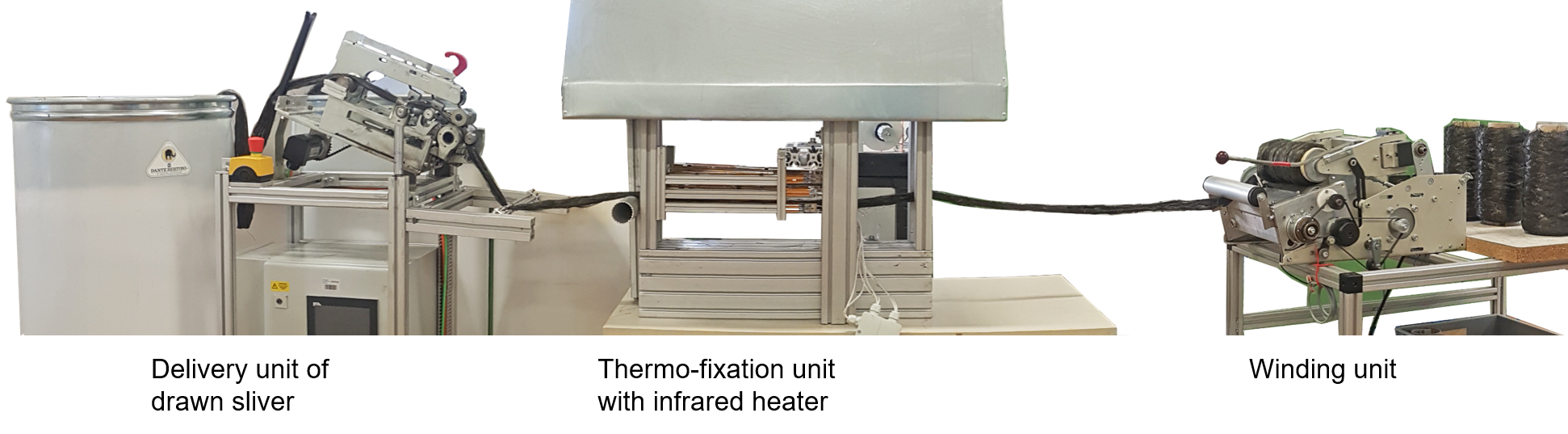
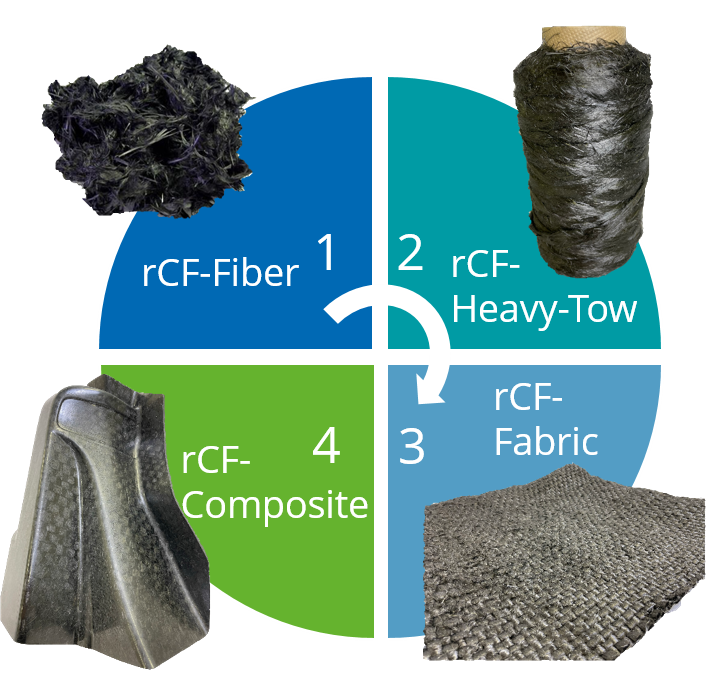
Within the framework of the IGF research project (21612 BR), the entire process chain for the industrial production of novel twist-free rCF heavy tows was developed at ITM. In particular, a novel technology for the production of rCF heavy tows based on recycled carbon (rCF ≥ 90 vol.%) and hot melt adhesive fibers (< 10 vol.%) was designed, constructed and successfully implemented. This includes fiber preparation, the carding process for card sliver formation, the stretching process for drawn sliver formation, and the final fabrication of the rCF heavy tows from rCF and hot melt adhesive fibers in a newly developed test set-up. The suitability of the developed technology is demonstrated by the implementation of rCF heavy tows with different rCF types, fiber lengths and fiber volume contents and a demonstrator. The developed rCF heavy tows with finenesses between 3000-7000 tex and their further processability into textile semi-finished products were successfully demonstrated. The developed rCF Heavy Tows and composites based on them exhibit a maximum composite tensile strength and a maximum Young’s modulus of 1158±72 MPa and 80±5.7 GPa, respectively. The rCF Heavy Tows are thus applicable for low-cost thermoset composites with high performance and complex geometry. Thus, the developed rCF Heavy Tows offer a very high innovation and market potential in the fields of materials and materials, lightweight construction, environmental and sustainability research, and resource efficiency. This opens up the opportunity for SMEs in the textile industry to develop new products and technologies for the fiber composite market and to establish themselves as suppliers for the automotive, mechanical engineering and aerospace, medical and sports equipment industries.

Bericht

Introduction, problem definition and aim of the project

Carbon fiber-reinforced plastics (CFRP) are increasingly used in lightweight applications due to their high stiffness and strength as well as low density, especially in aerospace, transportation, wind energy, sports equipment or construction. Global demand of CFRP is predicted to increase to 197,000 t/a by 2024, almost tripling compared to 2011. This shows an urgent need for solutions to recycle the high quality carbon fiber (rCF) in terms of the circular economy. This is necessary not only due to strict legal regulations, but also for ecological and economic reasons. In recent years, numerous research institutes and companies developed solutions for the reuse of rCF in the fields of nonwovens, injection molding or as hybrid yarns. However, the majority of these works involve the use of rCF in combination with thermoplastic fibers for thermoplastic composites. In the field of rCF-based thermoset CFRP, mainly rCF nonwovens made of 100% rCF have been so far developed. Since the fibers in the nonwovens mostly have a limited length and a low orientation and process-related additional high fiber damage occurs, with these materials only maximum 30% of the composite characteristic values of CFRP components made of carbon filament yarns can be so far achieved.

Currently, the matrix systems used in the field of high mechanical loaded CFRPs are predominantly thermoset. Such components exhibit high dimensional stability, high stiffness and strength as well as are suitable for the implementation of complex component geometries due to low-viscosity matrix systems. However, primary carbon filament yarns are particularly used for these components due to the insufficient properties of rCF. In addition to low sustainability, the utilization of these filament yarns result in at least 200 % higher cost. The production of primary carbon filament yarn requires a high-energy demand of about 230 MJ/kg with a CO2 emission equivalent to 20 kg CO2/kg CF. Here, a significant improvement of the CO2 balance is required to make a substantial contribution to the envisaged climate protection goals of the Federal Republic of Germany and the EU. For this reason, the focus of the project work is the development of novel, sustainable rCF heavy tows made of recycled carbon fibers (rCF) and associated manufacturing technologies for the implementation of cost-effective thermoset composites with high mechanical performance.

Acknowledgments

The IGF project 21612 BR of the Research Association Forschungskuratorium Textil e.V. was funded by the Federal Ministry of Economics and Climate Protection (BMWK) via the AiF within the framework of the program for the promotion of joint industrial research and development (IGF) on the basis of a resolution of the German Bundestag. We would like to thank the above-mentioned institutions for providing the financial resources.

AutorInnen: Mahmud Hossain, Anwar Abdkader und Chokri Cherif

Technische Universität Dresden
Fakultät Maschinenwesen
Institut für Textilmaschinen und Textile Hochleistungswerkstofftechnik (ITM)
01062 Dresden

https://tu-dresden.de/mw/itm

rCF fiber yarn Composite textile machine

More entries from TU Dresden, Institut für Textilmaschinen und Textile Hochleistungswerkstofftechnik ITM

06.03.2023

Technology Development for the Sustainable Production of High-purity Chitosan Filament Yarns with High Performance and Functionality (Chion)

Rohstoffe Fasern Garne Nachhaltigkeit

Zusammenfassung

In the IGF project 21168 BR ‘Chion’, a technology for the manufacturing of chitosan multifilament yarns from ionic liquids was developed, enabling the tailoring of the yarn properties regarding their performance and functionality in all process stages. The material costs, the field of application and the functionalities achievable by the multifilament yarns are defined by the raw material selection. By using ionic liquids, it was possible for the first time to process lower-cost chitosans in various qualities and degree of deacetylation < 90%, previously unavailable with conventional spinning processes. From the achieved and extensively evaluated project results, required process parameters for the successful transfer of the elaborated fundamentals to a pilot scale as well as the process development for the spinning of chitosan multifilament yarns with high performance and strengths up to 28 cN/tex on a pilot solvent wet spinning plant were derived and implemented. To demonstrate the textile processability of the multifilament yarns, textile demonstrators were successfully fabricated for the first time in conventional textile weaving, knitting or braiding processes on standard industrial textile machines.

Bericht

Introduction and Objective

In the 21st century, society's high level of interest in using products that are manufactured in a sustainable way and minimize environmental impact grows constantly. In this context, the textile and fiber industry has the opportunity to accelerate the development of organic products from renewable raw materials, such as chitin and chitosan, in order to respond to the social, national and international demand for organic products.

The biopolymer chitin and its derivative chitosan are versatile and well-known materials used in (bio-)medicine and pharmacy. However, they are rarely available as a pure textile product. Chitin is the second abundant biopolymer after cellulose with 1.5-105 t/a [1]. The semi-crystalline structure and stable network of molecular bonds limit the solubility of chitin significantly. Therefore, chitin derivative chitosan is being primarily addressed by research and material development. The chitosan class of materials demonstrates excellent biological and antibacterial properties as well as cell colonizability and biodegradability [2, 3]. In the last few years, considerable research efforts have been made to develop efficient chitosan products; nevertheless, the availability of pure chitosan multifilament yarns with long-term stability is currently extremely limited [4]. Likewise, a robust, scalable process for manufacturing of high-performance chitosan filament yarns is urgently needed, as current products are severely limited in terms of mechanical properties. Due to the natural provenance and variability of raw material properties, such as degree of deacetylation (DD), molecular weight (Mw), etc. There are still major challenges in producing of chitosan multifilament yarns using the acid- and alkali-dominated manufacturing processes established so far.

The aim of the IGF research project ‘Chion’ (21168 BR) was therefore to develop a robust wet-spinning process based on ionic solvents for manufacturing of multifilament yarns from 100 % chitosan with high performance and functionality.

Obtained Results

By using ionic liquids (IL), lower cost chitosans with lower Mw and DD < 90% became accessible to the wet-spinning process for the first time. A high content of acetamide groups in chitosan with low DD (< 90%) leads to the increase of intermolecular interactions, which resulted in improved mechanical performance with tensile strengths up to 28 cN/tex and proper textile processing of chitosan multifilament yarns. The extensive research of chitosan-IL-systems with different chitosan proveniences, Mw and DD 60 – 90% with imidazol-based IL was initially carried out on a laboratory scale for monofilaments. Based on the results, important process parameters and promising chitosan-IL combinations were obtained and the developed process was successfully transferred to the multifilament scale. A structural-mechanical adjustment of the properties of the chitosan multifilament yarns was a fundamental object of the research work: Each development step was systematically monitored by material and process characterizations and analyses. Further investigations included the solubility of chitosan in IL, viscosity studies, fiber morphology and geometry, chemical and physical material properties, crystallinity and degradation behavior, as well as on the influence of controlled fiber drawing during the spinning process according the adjustment of the textile-physical properties. By integrating acid- and temperature-sensitive agents into the spinning dope, the functionality of the chitosan multifilament yarns was demonstrated. As a result of the precise tailoring of the molecular fiber properties and the developed spinning process parameters, a robust, scalable wet-spinning process is now available for manufacturing of pure chitosan multifilament yarns in pilot scale. Finally, the textile processability of the chitosan multifilament yarns was investigated and demonstrated by knitting, weaving and braiding processes.

Investigation of the solubility of chitosan in IL and spinning dope preparation

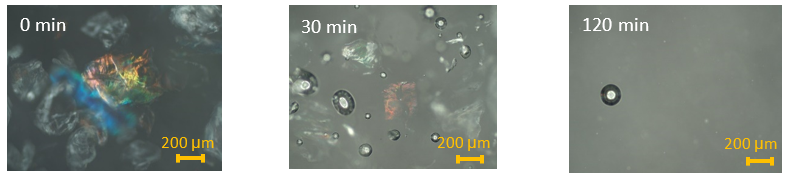
Initially, the dissolving ability of IL for chitosan was investigated and evaluated. Through systematic experiments, 19 commercially available chitosan materials of different qualities (e.g. medical grade chitosan, industrial grade chitosan, etc.), provenance (e.g. shrimps, crabs, fungal-based chitosan), degree of DD (60 – 90%) and Mw were characterized and their solubility evaluated in promising imidazole-based ILs. It was demonstrated that especially short-chain ILs in combination with acetate anions possess excellent solubility for all investigated chitosans (Figure 1). From the results of the dissolution tests, promising chitosan-IL combinations were defined for further process development steps.

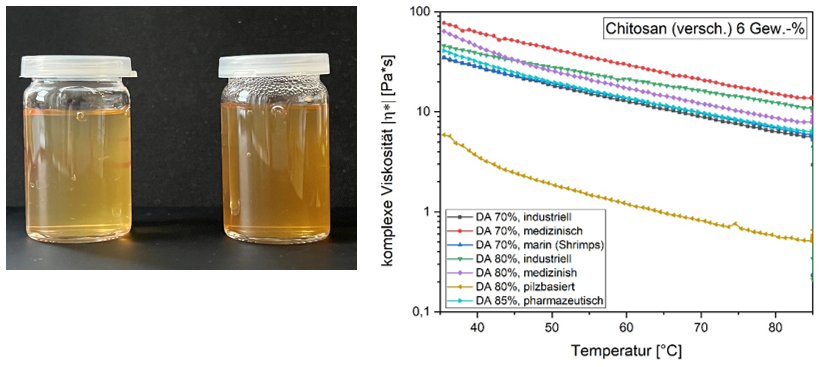
The preparation of the chitosan-IL spinning dopes (Figure 2, left) was carried out using thermal processing in solids concentrations of up to 8 wt.-% and was monitored and evaluated by rheological investigations as a function of the temperature and shear rate (Figure 2, right). To investigate the stability, processability and spinnability of the homogeneous chitosan-IL-solutions, the spinning dopes were processed into monofilaments on a laboratory scale. In particular, fiber formation was analyzed as a function of the chitosan raw materials and process parameters, such as solid content, temperature, diffusion rate and residence time in the coagulation medium. The obtained results demonstrated, that all investigated chitosan-IL-combinations can be processed into pure chitosan fibers. Therefore, it was successfully proved that ILs are a suitable and promising solvent for the manufacturing of chitosan multifilament yarns.

Wet-spinning of the chitosan multifilament yarns

In the following step, the basic methods developed on the laboratory scale were successfully transferred to a wet-spinning process on a pilot scale. The chitosan multifilament yarns were spun on the wet-spinning plant (Fourné Maschinenbau GmbH) of the ITM. The pilot spinning plant is specially designed for R&D process developments and enables, in particular, test trials with 2 – 60 liters of spinning dope.

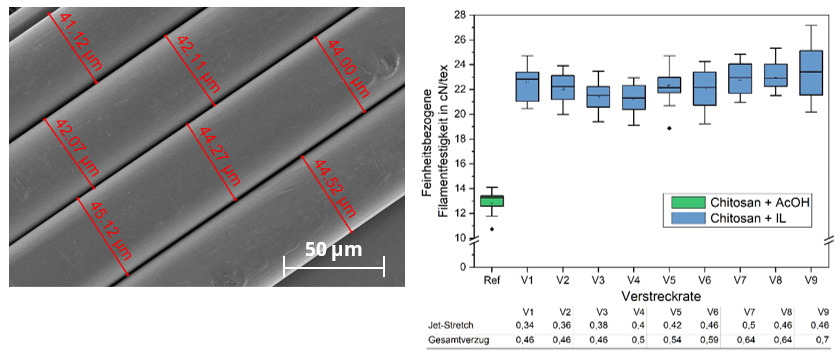
For the spinning trials, chitosan-IL spinning dope was first filtered and degassed under specific temperature and pressure conditions. Different spinneret geometries were used for multifilament spinning, including 78 holes of 90 μm (90 µm/78f) and 24 holes of 160 μm (160 µm/12f), respectively. The prepared tempered spinning dope was extruded into a coagulation bath with deionized water as medium. Overall yarn counts of about 50 – 65 tex and filament diameters of about 30 – 50 µm were achieved depending on the spinneret geometry. In order to achieve tailored functionalities, such as high mechanical strength and crystallinity as well as improved molecular orientation, the influence of fiber drawing during the spinning process was systematically investigated. The produced yarns were analyzed for their mechanical and textile-physical properties and compared with conventionally produced acetic acid (AcOH) based chitosan yarns. The DD of the raw material has an important role in this context: a high content of acetamide groups in chitosan with low DD (< 90%) leads to an increase in intermolecular interactions, resulting in improved mechanical properties. The results obtained demonstrate a high functionality as well as significantly improved mechanical properties of the IL spun chitosan multifilament yarns compared to the conventional chitosan fibers (DD 90%) (Figure 3, right). By means of elaborated drawing parameters, tailor-made textile-physical properties, such as elasticity or tensile strength, can be adjusted according to defined requirements.

Textile processing of the chitosan multifilament yarns

During the final phase of the project, the textile processing of the chitosan multifilament yarns from IL into knitted and woven patterns and braids was successfully implemented (Figure 4). The technical processing of conventional chitosan yarns on textile machines has always been a challenge due to insufficient mechanical strength and knot tearing forces. Trouble-free processing in weaving, knitting or braiding processes without special yarn pretreatment or machine adaptations could not be realized so far using conventional chitosan multifilament yarns. In contrast, the chitosan multifilament yarn produced by IL offers sufficient mechanical stability and flexibility to be processed into knitted, woven or braided structures in conventional textile processes on standard industrial production machines. Additional yarn functionalization, such as sizing, further improves the processability of the material and the quality of the finished product.

Acknowledgement

The IGF project 21168 BR of the Research Association Forschungskuratorium Textil e.V. was funded by the Federal Ministry of Economics and Climate Protection via the AiF within the framework of the program for the promotion of joint industrial research (IGF) on the basis of a resolution of the German Bundestag. We would like to thank the above-mentioned institutions for providing the financial resources. Furthermore, we want to thank the member of the ‘Projektbegleitender Ausschuss’ (project accompanying committee) for their support during the project.

The complete publication is available as download.

AutorInnen: Kuznik, Irina; Kruppke, Iris; Cherif, Chokri

Technische Universität Dresden
Fakultät Maschinenwesen
Institut für Textilmaschinen und Textile Hochleistungswerkstofftechnik (ITM)
01062 Dresden

https://tu-dresden.de/mw/itm

chitosan multifilament yarns

More entries from TU Dresden, Institut für Textilmaschinen und Textile Hochleistungswerkstofftechnik ITM