

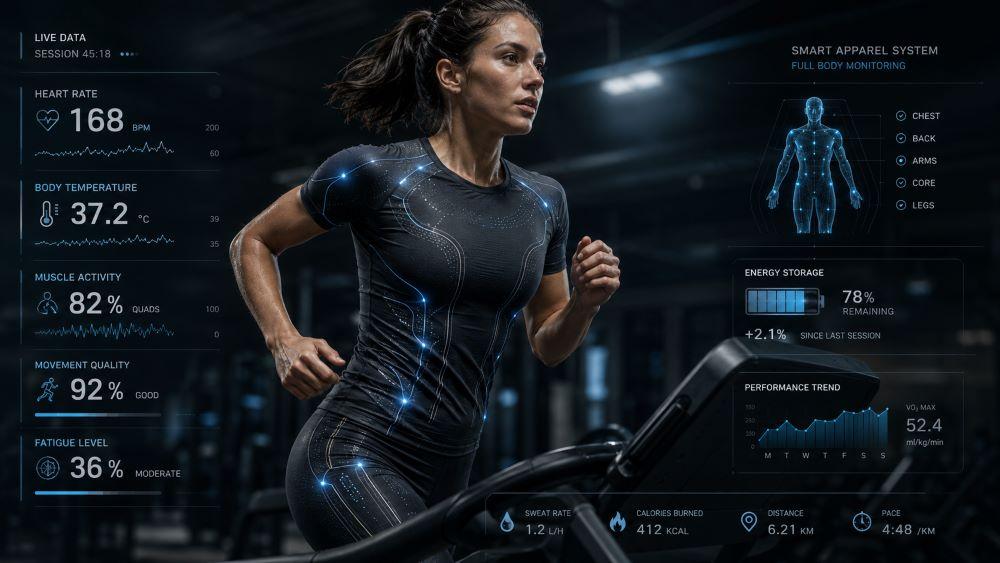


Smart textiles: flexible supercapacitors could power sensors directly in sportswear
An international research team involving De Montfort University Leicester is examining how flexible supercapacitors could be integrated into sports clothing. The concept goes beyond adding another sensor to a garment. Instead, the textile would become part of the energy architecture: it could store electricity and supply distributed sensors embedded across the garment. Combined with technologies that harvest energy from body movement or heat, running tops, cycling kit or gym wear could eventually generate and store part of the power needed for continuous monitoring.
The researchers identify knitted structures and conductive yarns as particularly promising because they can combine electrical functionality with stretch, flexibility and breathability. Carbon-based electrode materials such as graphene and carbon nanotubes are also considered because of their energy-storage potential and mechanical flexibility. Compared with conventional batteries, supercapacitors can charge and discharge very rapidly, while potentially being made light and flexible enough for body-worn applications.
The potential use case extends beyond sport. A sensor-rich garment could monitor heart rate, body temperature, muscle activity, movement and fatigue at several points on the body rather than relying on a single wrist-mounted device. In healthcare, similar garments could support continuous monitoring and provide clinicians with information collected from different body regions. The textile would therefore shift from being a passive carrier to acting as a distributed sensing and energy platform.
Crucially, the DMU source does not present a finished smart garment. The underlying paper sets out a technological framework that brings together developments in electronics, materials science, manufacturing and flexible textiles. Considerable barriers remain. Electronic fabrics would have to tolerate sweat, repeated stretching and bending and regular laundering without losing performance. They must also remain comfortable and breathable, and eventually be manufactured at a cost and scale compatible with mainstream clothing.
Circularity is another design requirement. The study discusses recyclable or biodegradable materials, greener manufacturing and garment architectures that allow electronic components to be recovered at end of life rather than creating another stream of electronic waste. The next step is therefore practical development and funding, not commercial launch. That distinction is important: the work is a credible roadmap for e-textile integration, but its industrial maturity still has to be demonstrated.
Smart textiles E-Textiles supercapacitors conductive yarns knitted fabrics graphene nanotubes Sportswear Healthcare
De Montfort University (DMU)