Forschungspublikationen

4 Ergebnisse
28.08.2026

A new take on form-fitting design - Non-metallic braided rib structures for carbon concrete

Composites Textilmaschinenbau Technische Textilien

Zusammenfassung

Braided structures made from carbon filament yarn have the potential to achieve composite strengths on a comparable level to steel reinforcement. At the Institute of Textile Machinery and High Performance Material Technology (ITM) at Dresden University of Technology, work is being carried out as part of the IGF research project (01IF24911N) to set new standards for concrete reinforcement through the targeted modification of braiding technology. The modified braiding technology enables the development of integral braided rib structures without any interruptions in the fibre orientation. Based on simulation-aided designs, the so-called GRip-Bars, with composite strengths in the range of 25-30 MPa, are being developed for use as longitudinal reinforcement in slabs, beams or columns. The new rebars also offer great potential for use in critical infrastructure such as bridges and tunnels. Due to their extended lifetime, they can contribute to reducing maintenance costs.

Bericht

Introduction

Carbon concrete is a key technology for resource-efficient construction, enabling concrete savings of up to 80 % and reducing CO₂ emissions by around 50 %. The crucial factor for industrial market entry lies not only in material properties but also in the standardisation and certifiability of semi-finished products and processes. Braiding, an established industrial manufacturing process, produces reproducible, geometrically defined fibre architectures with high process stability, providing a robust basis for design calculations in approval procedures like ZiE or abZ.

Background

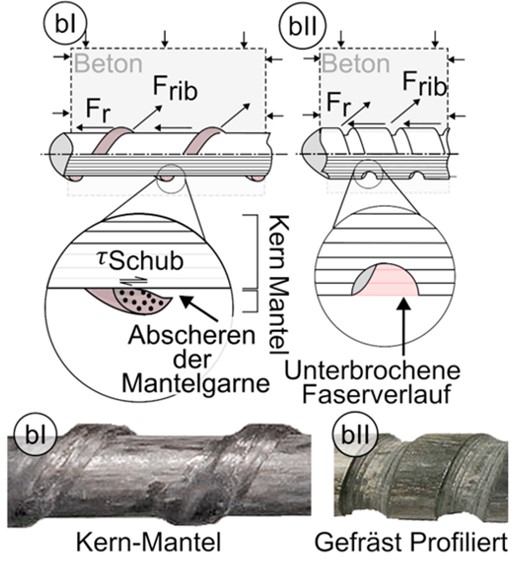
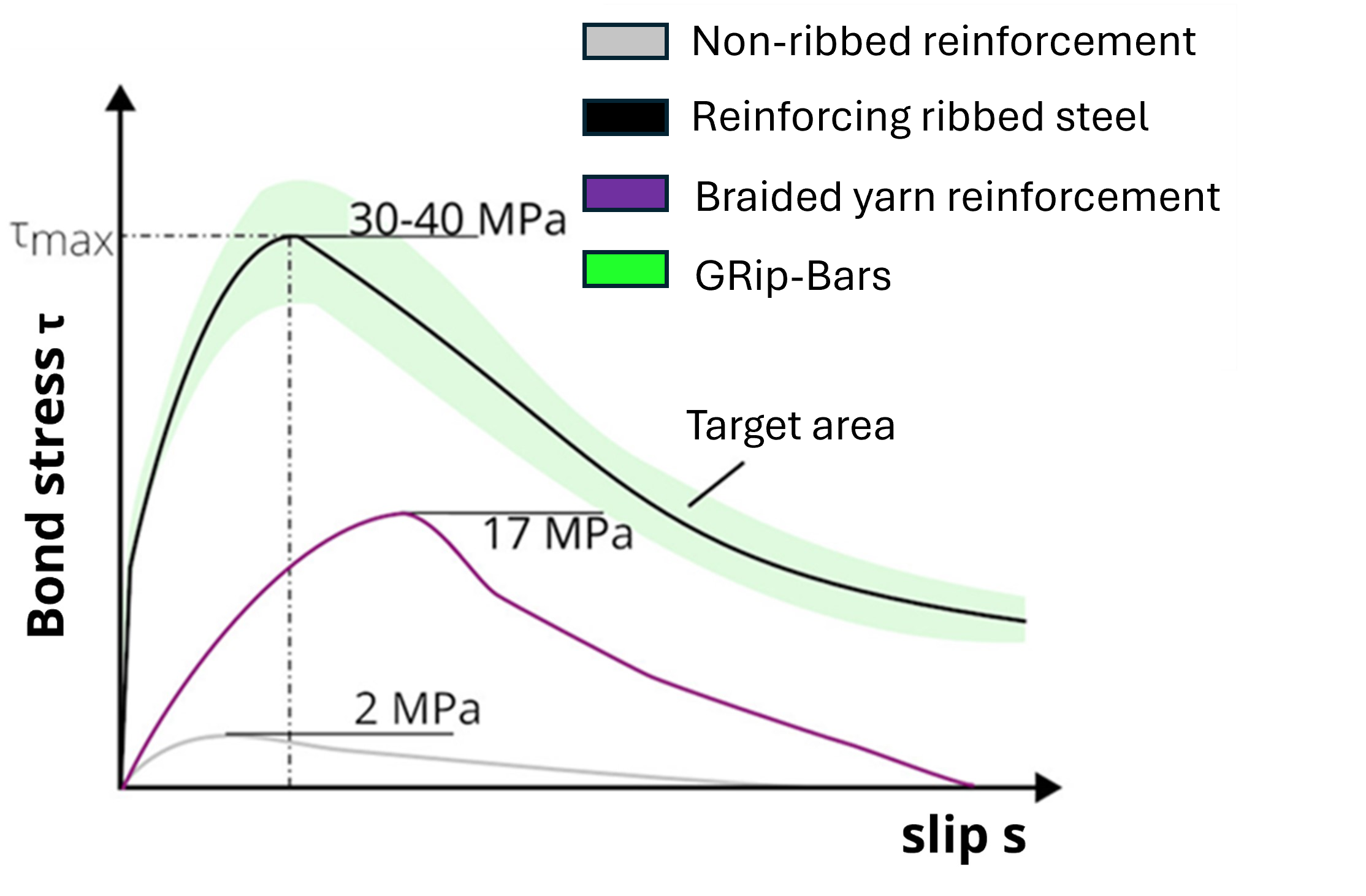
Historically, longitudinally ribbed structural steel BST 500 has been the construction industry standard, with bond strengths of 30-40 MPa and concrete compressive strength of 90-120 MPa. The mechanical interlocking of rib rows with the concrete matrix ensures a high structural integration and bond strength. Currently, CFRP reinforcement bars do not meet the requirements for bond strength. This is due to the subtractive or additive manufacturing processes used to create the surface structures (Fig. 1). In subtractive manufacturing, the load-bearing cross-section is reduced and the fibre orientation is interrupted - force transmission takes place entirely via the matrix between the edge and core filaments. Additively applied core-shell structures feature additional interfaces which, under low shear stresses, lead to delamination and premature shearing of the profiled fibres.

Innovation of Braiding Technology

Single-stage manufacturing technologies enable profiled surface geometries without interrupting fibre orientation, ensuring all fibres are firmly anchored without a core-shell structure that is likely to fail prematurely. The established braiding technique allows for standardised, targeted mechanical interlocks between bar ribs and concrete (Fig. 2). This significantly improves the bond strength of non-metallic reinforcement and reduces the gap compared to steel reinforcement (CFRP < 20 MPa). The production of standardised non-metallic reinforcement bars using braiding technology offers significant advantages:

  • Targeted shifts in the braiding centre produce variable braided cross-sections and enable precise adjustment of process parameters (e.g. filament tension),
  • High tensile strengths with full load-bearing capacity of the fibre cross-section are comparable to those of established rebar,
  • High material variability and the potential for sensor integration into the fibre structure enable early failure detection.

Based on a simulations-based design, the research project is developing modified and standardisable braided structures that can be used as impregnated non-metallic reinforcement bars in the construction industry.

Outlook

The targeted bond strength of the GRip-Bars, ranging from 25-30 MPa, combined with the high tensile strengths of rebar and the scalability for large reinforcement cross-sections (diameter of 6-20 mm), makes the new braided reinforcement suitable for use as longitudinal reinforcement in ceilings, beams and columns. This reinforcement system contributes to sustainable construction and enables slim, resource-efficient and corrosion-resistant load-bearing structures that meet the requirements of a sustainable construction industry. Particularly in critical infrastructure such as bridges and tunnels, its high durability and corrosion resistance ensure an extended lifetime while significantly reducing maintenance costs.

Acknowledgement

The IGF project “Textile-reinforced, form-fitting braided rib structures for high-strength fibre-reinforced concrete structures” (IGF-No.: 01IF23608N) by the Textile Research Council e.V. at TU Dresden is funded by the Federal Ministry for Economic Affairs and Energy via the DLR as part of the programme to promote industrial collaborative research (IGF).

The authors would like to thank the before mentioned institution for providing the financial resources. The research report and further information are available from the institute of Textile Machinery and High Performance Material Technology at TU Dresden.

AutorInnen: Laura Chiara Wittich Matthias Overberg Anwar Abdkader Danny Friese Chokri Cherif

Technische Universität Dresden
Fakultät Maschinenwesen
Institut für Textilmaschinen und Textile Hochleistungswerkstofftechnik (ITM)
01062 Dresden

https://tu-dresden.de/mw/itm

More entries from TU Dresden, Institut für Textilmaschinen und Textile Hochleistungswerkstofftechnik ITM

31.07.2025

Development of Hybrid Yarn Structures from Carbon, Stainless Steel, and Elastomer Fibers for Composite Applications

Fasern Garne Composites Recycling Nachhaltigkeit

Zusammenfassung

As part of the IGF research project 01IF22916N, a complete, industry-ready process chain for producing three-component hybrid yarns from rCF, MF, and EF was successfully developed at the ITM of TU Dresden. The process chain comprises fiber preparation, carding, and drafting to form slivers, followed by modified flyer spinning to produce hybrid yarns.

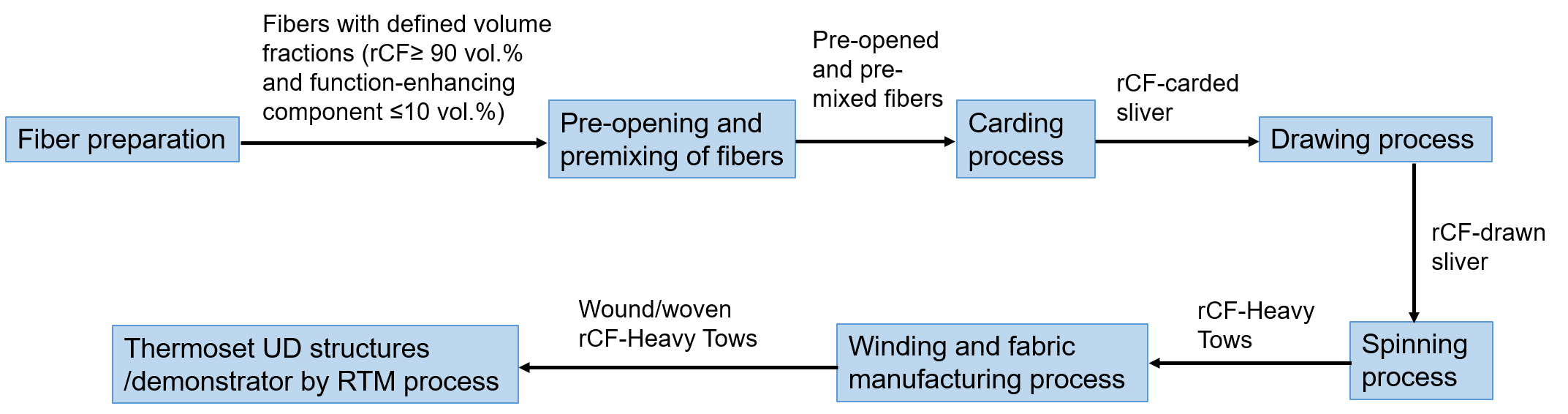
Proof of concept was provided through the production of hybrid yarns with defined fiber volume contents and a functional demonstrator. Fig. 3 illustrates the full process chain from fiber preparation to demonstrator production from rCF, MF and EF at ITM. The resulting yarns ranged from 1500 to 3500 tex and were successfully processed into textile preforms. The resulting composites demonstrated excellent mechanical performance: a maximum flexural strength of 806 ± 18 MPa, flexural modulus of 83 ± 4 GPa, and an impact strength of up to 117 ± 17 kJ/m².

The results show that yarn twist significantly influences composite mechanical properties: moderate twist enhances flexural behavior, while higher twist improves impact resistance. By adjusting the yarn twist level, the mechanical performance of hybrid composites can be effectively tailored.

These novel hybrid yarns are particularly suited for producing cost-efficient, high-performance thermoset composites with complex geometries. Their application-specific performance and process-integrated production offer high innovation and market potential, especially in the fields of materials engineering, lightweight design, sustainability, and resource efficiency. For small and medium-sized enterprises (SMEs) in the textile industry, this technology provides opportunities to develop advanced fiber-reinforced products and establish themselves as key suppliers in sectors such as automotive, mechanical engineering, wind energy, aerospace, medical technology, and sports equipment.

Bericht

Introduction

The size of the CF-CFRP (carbon fiber-reinforced plastics) market was estimated at USD 21.12 billion in 2023. It is projected to grow from USD 22.57 billion in 2024 to USD 38.4 billion by 2032, with a CAGR of approximately 6.86% during the forecast period (2024–2032) [1]. Due to their high specific stiffness and strength, CFRPs are widely used in the automotive, sports, leisure, and aerospace industries [2]. However, CFRP components are brittle under impact loading, which can result in catastrophic failure and severe splintering [3]. This brittleness raises concerns for the use of thermoset CFRP structures in safety-critical components such as wind turbine blades or automotive B-pillars.

Current hybridization concepts aim to combine materials with high stiffness, strength, and ductility [4]. Existing approaches integrate carbon fibers (CF) with stainless steel fibers (MF) or elastomer fibers (EF) using metal or elastomer films in fiber-metal laminates (FMLs), such as CARALL [5–8], or in elastomer-based laminates, such as KRAIBON [9–14]. Metal films offer higher energy absorption due to their plastic deformability and elongation at break of up to 20%, surpassing CFRP and carbon/aramid hybrid composites [15–17]. Elastomer films reduce hazardous splintering under dynamic loading due to their elastic deformation behavior [9]. While such multilayer systems improve impact and splinter resistance, they also carry a high risk of delamination [18]. Moreover, there is a lack of cost-effective and sustainable composites with enhanced impact and splinter properties that fully utilize the benefits of their individual components.

Objective

The goal of this research project was the simulation-based development of novel three-component hybrid yarns with micro-scale hybridization using three distinct material concepts. These yarns were then used to produce functional composite structures for sustainable lightweight applications. By strategically combining ductile metal fibers (MF), highly elastic elastomer fibers (EF), and high-stiffness, high-strength recycled carbon fibers (rCF), scalable composites with tailored mechanical properties were developed.

The developed hybrid yarns form the basis for application-specific composites with high energy absorption capacity and improved damage resistance.


Hybrid Yarn Structures and Related Composites: Development and Characterization

Development and Production of Hybrid Yarns Using Flyer Spinning Technology

Starting from the selected and characterized rCF and EF fiber materials with an average fiber length of 80 mm and defined blend ratios, the fibers were prepared using mechanical pre-opening and blending units. The pre-opened and pre-mixed fibers were processed using a lab-scale carding machine to produce card slivers of rCF and EF. Characterization of these slivers revealed a CF damage level of 10–25%, while EF fibers showed no length reduction.

To avoid damaging the stainless steel fibres during carding, card slivers were firstly produced that were either 100% rCF or a blend of rCF and EF. These were combined with 100% MF slivers to develop sandwich-type structures (rCF/MF or rCF/EF/MF slivers), which served as feed material for the drafting process. The slivers were drafted multiple times to enhance fiber blending and homogeneity. These drafted slivers were then used to produce hybrid yarns.

The ITM’s specialized flyer spinning machine was modified to optimize drafting mechanics, sliver feed, and machine settings to avoid fiber misalignment. Based on experimental investigations, optimal settings were determined, and hybrid yarns with a yarn count of 1500 tex and twist levels ranging from 40 to 150 T/m were produced. These yarns were characterized in accordance with DIN EN ISO 13934-1, evaluating unevenness, yarn structure, and tensile behavior, and were subsequently used to produce composite.

Manufacturing of Recycled Carbon Fiber-Reinforced Composite

Using the developed hybrid yarns, unidirectional (UD) composites were produced via the resin transfer molding (RTM) process. The hybrid yarns were wound under constant tension onto a frame and consolidated under optimized parameters. The resin system consisted of Hexion RIMH 135 and hardener Hexion RIMH 137.

Composite characterization followed standardized test methods. Tensile specimens were prepared based on DIN EN ISO 527-5/A/2, with tensile testing conducted according to             DIN EN ISO 527-4. The flexural properties were evaluated in accordance with DIN EN ISO 14125 and impact resistance was assessed using DIN EN ISO 179-2 (Charpy method). The compression-after-impact (CAI) performance was measured following DIN ISO 18352. Additionally, a custom test rig was developed to analyze splintering behavior using a ZwickRoell HTM 5020 high-speed testing machine. Puncture resistance was evaluated according to DIN EN ISO 6603-2.

Selected Results and Discussion

Fig. 1 presents the relationship between flexural strength and modulus for various twist levels in hybrid yarn-based composites at a constant fiber volume content of 50 vol%. Both a CF-filament-based reference composite and three UD composites made from rCF/MF hybrid yarns (90 wt% rCF / 10 wt% MF) were investigated, differing only in yarn twist (40, 80 and 120 T/m). The reference composite achieved 725 ± 35 MPa flexural strength and a modulus of 74 ± 8 GPa. Notably, the T40 hybrid variant surpassed these values, reaching 806 ± 18 MPa and 83 ± 4 GPa, respectively.

However, increasing the yarn twist (80 and 120 T/m) led to a continuous decline in flexural properties. The intensified helical structure reduces fiber alignment in the load direction, which weakens load transfer and overall flexural performance.

Fig. 2 shows the impact strength of composites made from rCF/MF hybrid yarns at varying yarn twist levels. Results indicate a trend of increasing impact strength with higher twist (40 → 120 T/m), from 85 kJ/m² to 117 kJ/m². This improvement is attributed to a more compact yarn structure, enhanced fiber cohesion, and improved energy absorption during impact. Additionally, the tighter fiber arrangement enhances load transfer and structural integrity by reducing the number of loose fiber ends, resulting in greater resistance to sudden loads.

Summary

As part of the IGF research project 01IF22916N, a complete, industry-ready process chain for producing three-component hybrid yarns from rCF, MF, and EF was successfully developed at the ITM of TU Dresden. The process chain comprises fiber preparation, carding, and drafting to form slivers, followed by modified flyer spinning to produce hybrid yarns.

Proof of concept was provided through the production of hybrid yarns with defined fiber volume contents and a functional demonstrator. Fig. 3 illustrates the full process chain from fiber preparation to demonstrator production from rCF, MF and EF at ITM. The resulting yarns ranged from 1500 to 3500 tex and were successfully processed into textile preforms. The resulting composites demonstrated excellent mechanical performance: a maximum flexural strength of 806 ± 18 MPa, flexural modulus of 83 ± 4 GPa, and an impact strength of up to 117 ± 17 kJ/m².

The results show that yarn twist significantly influences composite mechanical properties: moderate twist enhances flexural behavior, while higher twist improves impact resistance. By adjusting the yarn twist level, the mechanical performance of hybrid composites can be effectively tailored.

These novel hybrid yarns are particularly suited for producing cost-efficient, high-performance thermoset composites with complex geometries. Their application-specific performance and process-integrated production offer high innovation and market potential, especially in the fields of materials engineering, lightweight design, sustainability, and resource efficiency. For small and medium-sized enterprises (SMEs) in the textile industry, this technology provides opportunities to develop advanced fiber-reinforced products and establish themselves as key suppliers in sectors such as automotive, mechanical engineering, wind energy, aerospace, medical technology, and sports equipment.

Acknowledgements

The IGF project 01IF22916N of the research association Forschungskuratorium Textil e.V. was funded via the DLR within the framework of the program for the promotion of industrial collaborative research and development (IGF) by the German Federal Ministry for Economic Affairs and Climate Action, based on a resolution of the German Bundestag. We thank the aforementioned institutions for their financial support.


References

  1. WiseGuyReports. (n.d.). CF & CFRP Market Report. Accessed on 29.07.2025, https://www.wiseguyreports.com/de/reports/cf-cfrp-market
  2. E. Witten; V. Mathes; M. Sauer; M. Kühnel: Composites-Marktbericht 2023 - Marktentwicklun-gen, Trends, Ausblicke und Herausforderungen. Deutsche Fachverband für Faserverbundkunststoffe/Composites - AVK, 2023
  3. J. Striewe; C. Reuter; K.-H. Sauerland; T. Tröster: Manufacturing and crashworthiness of fabric-reinforced thermoplastic composites. Thin-Walled Structures 123(2018), Pp. 501-508. https://doi.org/10.1016/j.tws.2017.11.011
  4. D. Nestler: Beitrag zum Thema Verbundwerkstoffe - Werkstoffverbunde: Status quo und For-schungsansätze. Chemnitz: Univ.-Verl., 2014. – ISBN 9783944640129
  5. ZHU, W.; XIAO, H.; WANG, J.; LI, X.: Effect of Different Coupling Agents on Interfacial Properties of Fibre-Reinforced Aluminum Laminates. Materials (Basel, Switzerland) 14(2021)4. https://doi.org/10.3390/ma14041019
  6. GUPTA, R. K.; MAHATO, A.; BHATTACHARYA, A.: Notch Shape Influence on Damage Evolution of Al/CFRP Laminates Under Tensile Loading: Experimental and Numerical Analysis. Appl Compos Mater (2022). https://doi.org/10.1007/s10443-022-10051-2
  7. TRZEPIECIŃSKI, T.; NAJM, S. M.; SBAYTI, M.; BELHADJSALAH, H.; SZPUNAR, M.; LEMU, H. G.: New Advances and Future Possibilities in Forming Technology of Hybrid Metal–Polymer Composites Used in Aerospace Applications. J. Compos. Sci. 5(2021)8, Pp. 217 f. https://doi.org/10.3390/jcs5080217
  8. PONNARENGAN, H.; KAMARAJ, L.; BALACHANDRAN, S. R.; KATHAR BASHA, S.: Evaluation of me-chanical properties of novel GLARE laminates filled with nanoclay. Polym. Compos. 42(2021)8, Pp. 4015-4028. https://doi.org/10.1002/pc.26113
  9. KRAIBON®: https://www.kraiburg-rubber-compounds.com/kraibon (31.07.2025)
  10. D. Düring; L. Weiß; D. Stefaniak; N. Jordan; C. Hühne: Low-velocity impact response of composi-te laminates with steel and elastomer protective layer. Composite Structures 134(2015), Pp. 18-26. https://doi.org/10.1016/j.compstruct.2015.08.001
  11. E. Stelldinger; A. Kühhorn; M. Kober: Experimental evaluation of the low-velocity impact dama-ge resistance of CFRP tubes with integrated rubber layer. Composite Structures 139(2016), Pp. 30-35. https://doi.org/10.1016/j.compstruct.2015.11.069
  12. E. Sarlin; M. Apostol; M. Lindroos; V.-T. Kuokkala; J. Vuorinen; T. Lepistö; M. Vippola: Impact properties of novel corrosion resistant hybrid structures. Composite Structures 108(2014), Pp. 886-893. https://doi.org/10.1016/j.compstruct.2013.10.023
  13. LI, Z.; ZHANG, J.; JACKSTADT, A.; KÄRGER, L.: Low-velocity impact behavior of hybrid CFRP-elastomer-metal laminates in comparison with conventional fiber-metal laminates. 02638223 287(2022), Pp. 115340 f. https://doi.org/10.1016/j.compstruct.2022.115340
  14. FLEISCHER, J. (HRSG.): Intrinsische Hybridverbunde für Leichtbautragstrukturen – Grundlagen der Fertigung, Charakterisierung und Auslegung. Berlin, Heidelberg: Springer Vieweg, 2021. – ISBN 978-3-662-62832-4
  15. Y. Swolfs; P. De Cuyper; M.G. Callens; I. Verpoest; L. Gorbatikh: Hybridisation of two ductile materials Steel fibre and self-reinforced polypropylene composites. Composites Part A: Applied Science and Manufacturing 100(2017), Pp. 48-54. https://doi.org/10.1016/j.compositesa.2017.05.001
  16. H.J. Koslowski: Chemiefaser-Lexikon. Deutscher Fachverlag, 2008. – ISBN 3871508764
  17. H. Schürmann: Konstruieren mit Faser-Kunststoff-Verbunden. Springer-Verlag GmbH, 2007. – ISBN 3540721894
  18. N. Montinaro; D. Cerniglia; G. Pitarresi: Evaluation of interlaminar delaminations in titanium-graphite fibre metal laminates by infrared NDT techniques. NDT & E International 98(2018), Pp. 134-146. https://doi.org/10.1016/j.ndteint.2018.05.004


AutorInnen: Mahmud Hossain Anwar Abdkader Tobias Lang Thomas Gereke Chokri Cherif

Technische Universität Dresden
Fakultät Maschinenwesen
Institut für Textilmaschinen und Textile Hochleistungswerkstofftechnik (ITM)
01062 Dresden

https://tu-dresden.de/mw/itm

More entries from TU Dresden, Institut für Textilmaschinen und Textile Hochleistungswerkstofftechnik ITM

20.06.2023

Development of heavy tows from recycled carbon fibers for low-cost and high performance thermoset composites (rCF heavy tows)

Rohstoffe Fasern Garne Composites Textilmaschinenbau Recycling Nachhaltigkeit Kreislaufwirtschaft Technische Textilien

Zusammenfassung

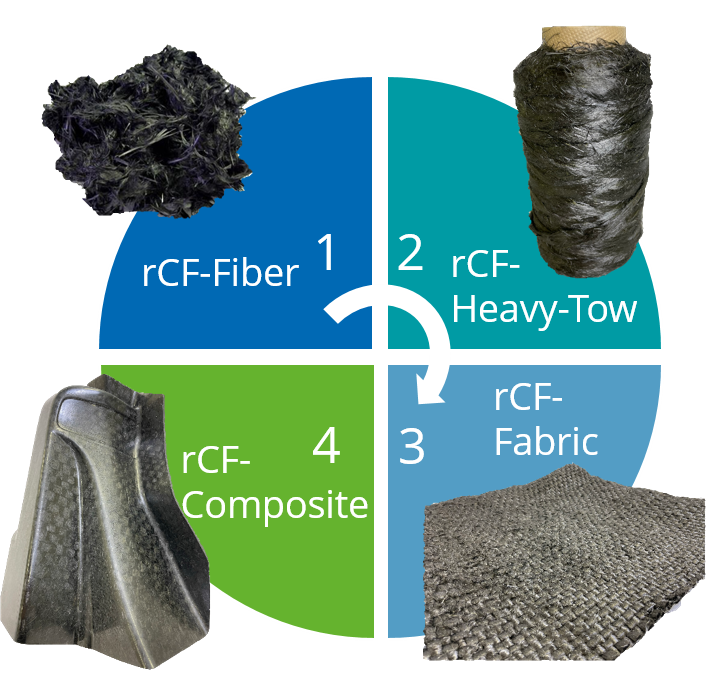
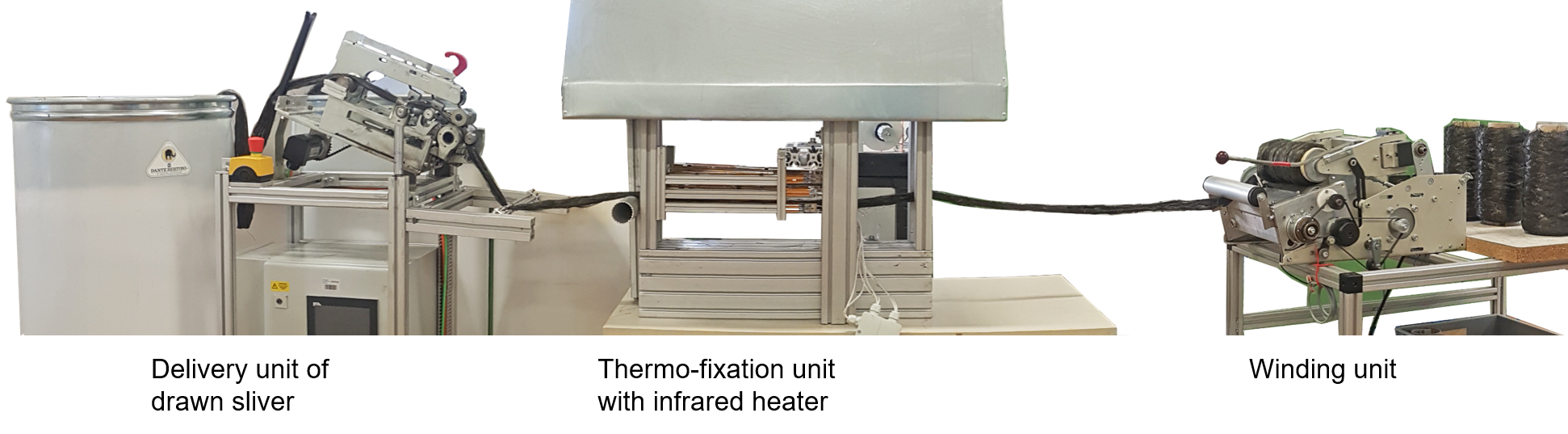
Within the framework of the IGF research project (21612 BR), the entire process chain for the industrial production of novel twist-free rCF heavy tows was developed at ITM. In particular, a novel technology for the production of rCF heavy tows based on recycled carbon (rCF ≥ 90 vol.%) and hot melt adhesive fibers (< 10 vol.%) was designed, constructed and successfully implemented. This includes fiber preparation, the carding process for card sliver formation, the stretching process for drawn sliver formation, and the final fabrication of the rCF heavy tows from rCF and hot melt adhesive fibers in a newly developed test set-up. The suitability of the developed technology is demonstrated by the implementation of rCF heavy tows with different rCF types, fiber lengths and fiber volume contents and a demonstrator. The developed rCF heavy tows with finenesses between 3000-7000 tex and their further processability into textile semi-finished products were successfully demonstrated. The developed rCF Heavy Tows and composites based on them exhibit a maximum composite tensile strength and a maximum Young’s modulus of 1158±72 MPa and 80±5.7 GPa, respectively. The rCF Heavy Tows are thus applicable for low-cost thermoset composites with high performance and complex geometry. Thus, the developed rCF Heavy Tows offer a very high innovation and market potential in the fields of materials and materials, lightweight construction, environmental and sustainability research, and resource efficiency. This opens up the opportunity for SMEs in the textile industry to develop new products and technologies for the fiber composite market and to establish themselves as suppliers for the automotive, mechanical engineering and aerospace, medical and sports equipment industries.

Bericht

Introduction, problem definition and aim of the project

Carbon fiber-reinforced plastics (CFRP) are increasingly used in lightweight applications due to their high stiffness and strength as well as low density, especially in aerospace, transportation, wind energy, sports equipment or construction. Global demand of CFRP is predicted to increase to 197,000 t/a by 2024, almost tripling compared to 2011. This shows an urgent need for solutions to recycle the high quality carbon fiber (rCF) in terms of the circular economy. This is necessary not only due to strict legal regulations, but also for ecological and economic reasons. In recent years, numerous research institutes and companies developed solutions for the reuse of rCF in the fields of nonwovens, injection molding or as hybrid yarns. However, the majority of these works involve the use of rCF in combination with thermoplastic fibers for thermoplastic composites. In the field of rCF-based thermoset CFRP, mainly rCF nonwovens made of 100% rCF have been so far developed. Since the fibers in the nonwovens mostly have a limited length and a low orientation and process-related additional high fiber damage occurs, with these materials only maximum 30% of the composite characteristic values of CFRP components made of carbon filament yarns can be so far achieved.

Currently, the matrix systems used in the field of high mechanical loaded CFRPs are predominantly thermoset. Such components exhibit high dimensional stability, high stiffness and strength as well as are suitable for the implementation of complex component geometries due to low-viscosity matrix systems. However, primary carbon filament yarns are particularly used for these components due to the insufficient properties of rCF. In addition to low sustainability, the utilization of these filament yarns result in at least 200 % higher cost. The production of primary carbon filament yarn requires a high-energy demand of about 230 MJ/kg with a CO2 emission equivalent to 20 kg CO2/kg CF. Here, a significant improvement of the CO2 balance is required to make a substantial contribution to the envisaged climate protection goals of the Federal Republic of Germany and the EU. For this reason, the focus of the project work is the development of novel, sustainable rCF heavy tows made of recycled carbon fibers (rCF) and associated manufacturing technologies for the implementation of cost-effective thermoset composites with high mechanical performance.

Acknowledgments

The IGF project 21612 BR of the Research Association Forschungskuratorium Textil e.V. was funded by the Federal Ministry of Economics and Climate Protection (BMWK) via the AiF within the framework of the program for the promotion of joint industrial research and development (IGF) on the basis of a resolution of the German Bundestag. We would like to thank the above-mentioned institutions for providing the financial resources.

AutorInnen: Mahmud Hossain, Anwar Abdkader und Chokri Cherif

Technische Universität Dresden
Fakultät Maschinenwesen
Institut für Textilmaschinen und Textile Hochleistungswerkstofftechnik (ITM)
01062 Dresden
https://tu-dresden.de/mw/itm

rCF fiber yarn Composite textile machine

More entries from TU Dresden, Institut für Textilmaschinen und Textile Hochleistungswerkstofftechnik ITM

16.01.2023

Increased performance and sustainability through the use of profiled textile reinforcements for concrete applications

Fasern Garne Gestricke & Gewirke Textilmaschinenbau Nachhaltigkeit Technische Textilien

Zusammenfassung

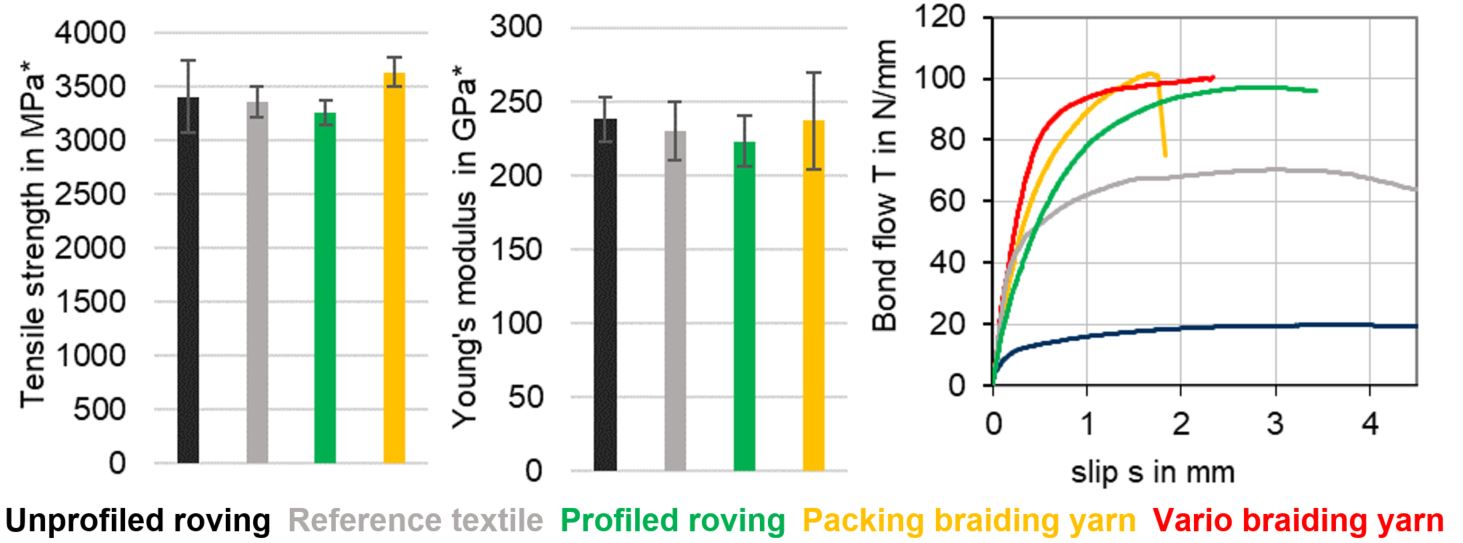
At the ITM of the TU Dresden, new, bond optimized reinforcement yarns were developed on the basis of braiding and forming technology, which can transmit up to 500 % higher bond forces in concrete than yarns without profile. The profiled rovings and braided yarns show at a bond length of only 50 mm a full anchoring. With the forming technology developed at the ITM, profiled rovings could be manufactured which, due to the patented tetrahedral geometry, can almost completely exploit the tensile potential of the carbon fibers. In the course of developing the braiding yarns, a new vario braiding structure was developed, with nearly eliminated structural elongation under load. This made it possible to manufacture profiled reinforcement yarns with very high tensile properties, which is a basic requirement for use in concrete. In addition, the multiaxial warp knitting technology has been further developed in such a way that the new bond optimized reinforcement yarns (profiled rovings and braiding yarns) can be processed without damage into profiled, grid-like textile reinforcements. This results in a significantly higher material efficiency of the textile reinforcement, so that previous necessary disproportionate oversizing and large overlapping lengths can be significantly reduced. This is of enormous importance, especially in view of the energy-intensive production of carbon fibers and consequently for the sustainability goal of the future-oriented carbon concrete technology, in order to make concrete constructions of the future resource saving and sustainable.

The project results achieved also represent a significant contribution to the production of extremely resilient textile-reinforced concrete structures with significantly improves bond properties, arising new prospects in the construction industry for component production in the field of renovation and new construction.

Bericht

Abstract
Building in a resource-saving way and still exploiting a high performance potential, is that even possible? At the Institute for Textile Machinery and High Performance Material Technology (ITM) at the TU Dresden, such composite optimized profiled textile reinforcements for concrete applications and the related manufacturing technology were developed as part of the research project IGF 21375 BR. On the basis of braiding and forming technology, a new generation of profiled reinforcement yarns was developed with the help of simulation-based investigations. Like ribbed steel reinforcements, these profiled yarns have a very high bond with the concrete matrix, but despite the profiling they almost fully exploit the performance potential of the carbon fibers in terms of tensile properties. In this way, the bond length required for complete force transmission between the textile reinforcement and the concrete can be reduced to just a few centimeters, and up to 80 % of the component-dependent oversizing of the textile reinforcement can be saved. The further development of the multiaxial warp knitting technology for the requirement-based and fiber-friendly processing of the profiled yarns into grid-like reinforcement structures enables the production of profiled textile reinforcement structures with the highest bond properties for use in carbon-reinforced concrete components with maximum material and resource efficiency.

Initial situation and problem definition
As is generally known, climate change is the greatest challenge of the 21st century, which can only be successfully overcome by consistently saving resources and CO2 emissions. Since the construction industry, with a share of approx. 38 % of global CO2 emissions, has made a significant contribution to global warming to date, in particular due to the enormous cement consumption [1], a change to more energy and resource efficiency as well as a growing awareness of sustainability is absolutely necessary. In the course of this, a resource-efficient carbon concrete, consisting of a corrosion-resistant textile reinforcement in combination with a significantly reduced concrete cover, is established in the construction industry as a convincing alternative to conventional steel reinforced concrete [2,3].

Due to the high load-bearing capacity of the textile reinforcement with the smaller concrete cross-sections required, the bond between the textile and the concrete is extremely important. So far, R&D has focused on the development of impregnations and impregnation systems for improved material bond with the concrete matrix [4]. However, only small forces with a shear flow of about 5 - 40 N/mm can be transferred, an efficient utilization of the textile reinforcement is not possible. Solutions with profiling of the yarn surface promise significant improvements in the transmission of bond forces [5]. Therefore, new technologies for the continuous and reproducible production of profiled textile high-performance fiber yarns and their further processing into reinforcement structures were developed within a research project at the ITM of the TU Dresden. These innovative, profiled reinforcements are characterized by their ability to transmit significantly higher bond forces in concrete [6,7]. In particular, this was realized by a form-fitting effect between the textile and the concrete, that meets the specific requirements of a stiff and symmetrical surface profile of the reinforcement yarns in order to guarantee a constant and high force transmission. To generate the yarn profiling, solutions based on braiding technology and forming processes were developed and implemented with the help of simulation-supported studies. The premises were a permanently stable textile structure and a profile with a symmetrical structure. The realization of grid-like reinforcement structures, consisting of the profiled reinforcement yarns, was carried out using the multiaxial warp knitting technology. This was developed further on a modular basis with regard to the existing processes (yarn feeding, weft yarn insertion, knitting process, impregnation and winding) in accordance with the necessary adaptation measures for the fiber-friendly and requirement-based further processing of the profiled reinforcement yarns into grid-like structures.

Development of the innovative profiled reinforcement yarns
For the development of bond optimized profiled reinforcement yarns for concrete applications, a simulation-supported yarn development was carried out on the basis of braiding and forming technology. In particular, the main challenge was to realize profiled yarns with minimal structural elongation, so that, an initial force transmission of the textile reinforcement is possible and the concrete crack widths are minimized [3] if the concrete matrix fails at approx. 0.2 % elongation. For this purpose, a new type of varying braiding structure was developed. Moreover the braiding technology was further developed to enable a low-undulation and pre-stabilization of the braiding yarn structure during the braiding process, yet still ensuring further textile processing. As a result, it is now possible to implement novel vario braiding yarns as well as conventional packing braided yarns, consisting of carbon fibers with nearly eliminated structural elongation, minimal fiber damage and the required pre-stabilization of the yarn structure (see Table 1).

...

Performance potential of the new profiled reinforcement yarns
The newly developed profiled reinforcement yarns are characterized by nearly unchanged tensile properties, yet up to 500 % higher bond properties compared to carbon rovings without profile or rovings extracted from reference textiles (see Figure 1). In addition, they do not show any noticeable structural elongation, so that an initial force transmission is possible without additional crack opening after the failure of the concrete matrix. However, an increase in bond strength of more than 500 % from approx. 20 N/mm of the carbon rovings without a profile to over 100 N/mm of the profiled reinforcement yarns was achieved, which is accompanied by a significant increase in material efficiency (see Figure 1). The vario braiding yarns in particular are characterized by very high bond stiffness, which is of particular interest for an initial force transmission. The packing braiding yarns and the profiled rovings with tetrahedral geometry have almost the same bond properties. The bond stiffness is marginally lower compared to the vario braiding yarns, whereas their production is more productive than the vario braiding yarns.

Development of the multiaxial-warp knitting process
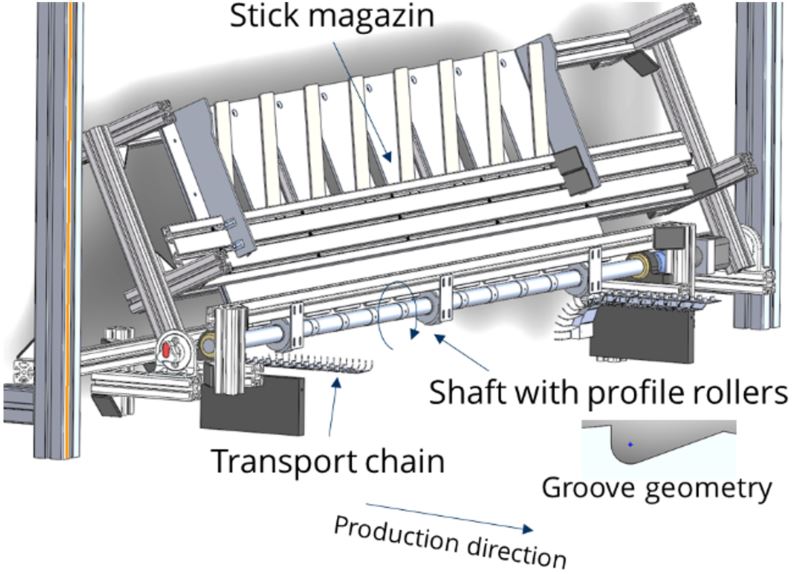
To process the newly profiled reinforcement yarns into a grid-like reinforcement structure, a biaxial warp knitting machine Malimo 14022 at the ITM and the corresponding sub-processes (yarn feeding, weft yarn insertion, knitting process, impregnation and winding) were adapted and further developed so that on the one hand the pre-stabilized braiding yarns and the consolidated tetrahedral-shaped profiled rovings can be processed further. For this purpose, the weft thread laying process in particular was modified by developing a new type of weft thread guide for the laying of the pre-stabilized braiding yarns. Since the rigid profiled rovings could not be processed with the conventional weft laying process, a new type stick placement system consisting of a stick magazine and a shaft with profile rollers was developed (see Figure 2). The pre-cut sticks were individually inserted via the stick placement system into a transport chain modified with new fixing elements.

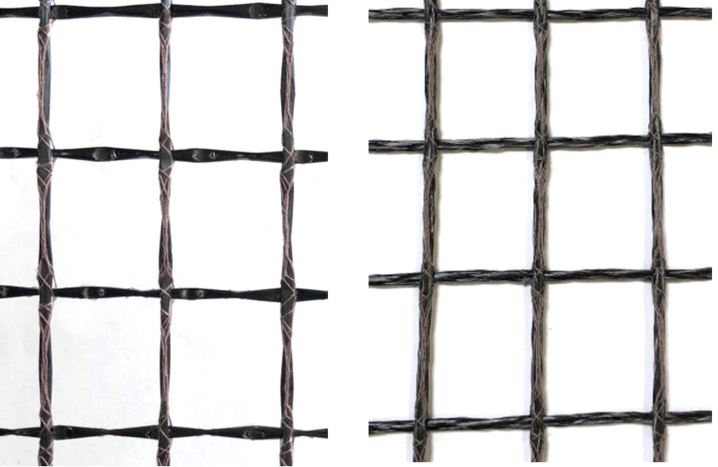
In order to guarantee textile processing, the pre-stabilized braiding yarns were impregnated and consolidated after the warp knitting process, contrary to the rigid profiled rovings, which do not require any further impregnation.. On the basis of extensive production tests, a new type of impregnation system was developed based on the kiss coater process with an additional coating roller for applying an impregnation agent to both sides of the pre-stabilized braiding yarns. Various reinforcement structures were manufactured and characterized with the implemented system technology. Figure 3 shows a new type of profiled textile reinforcement consisting of prefabricated profiled rovings with tetrahedral shape.

Acknowledgments
The IGF research project 21375 BR of the Forschungsvereinigung Forschungskuratorium Textil e. V. is funded through the AiF within the program for supporting the „Industriellen Gemeinschaftsforschung (IGF)“ from funds of the Federal Ministry for Economic Affairs and Climate Action on the basis of a decision by the German Bundestag.

The complete publication is available as download.

AutorInnen: Penzel, Paul; Hahn, Lars; Abdkader, Anwar; Cherif, Chokri

Technische Universität Dresden
Fakultät Maschinenwesen
Institut für Textilmaschinen und Textile Hochleistungswerkstofftechnik (ITM)
01062 Dresden
https://tu-dresden.de/mw/itm

More entries from TU Dresden, Institut für Textilmaschinen und Textile Hochleistungswerkstofftechnik ITM