From the Sector

Reset
The hycuTEC hydrocharging unit reduces the pressure drop of a typical FFP2 filter medium to less than a quarter, thereby achieving filtration efficiency of over 99.99%. Photo Neumag Nonwoven
The hycuTEC hydrocharging unit reduces the pressure drop of a typical FFP2 filter medium to less than a quarter, thereby achieving filtration efficiency of over 99.99%.
02.04.2026

Neumag Nonwoven at FILTECH 2026: Focus on Nonwovens for Filter Media

Under its Neumag brand, Barmag will present its technologies for the production of nonwovens for filter media at this year’s FILTECH. The main focus is on solutions for producing high-performance filter media at competitive costs. Here, Neumag excels in both the meltblown sector and with its spunbond solutions. 

Meltblown technology for the highest quality requirements 
Neumag’s meltblown technology enables the efficient and straightforward production of high - performance nonwovens for filtration, insulation, and sorption applications. A wide variety of polymers can be processed—from classic polyolefins such as PP and PE, through PET, PLA, PBT, and PA, to specialty plastics like PPS or TPU. All of these and other raw materials can be processed safely and reliably using the Neumag meltblown process. 

Under its Neumag brand, Barmag will present its technologies for the production of nonwovens for filter media at this year’s FILTECH. The main focus is on solutions for producing high-performance filter media at competitive costs. Here, Neumag excels in both the meltblown sector and with its spunbond solutions. 

Meltblown technology for the highest quality requirements 
Neumag’s meltblown technology enables the efficient and straightforward production of high - performance nonwovens for filtration, insulation, and sorption applications. A wide variety of polymers can be processed—from classic polyolefins such as PP and PE, through PET, PLA, PBT, and PA, to specialty plastics like PPS or TPU. All of these and other raw materials can be processed safely and reliably using the Neumag meltblown process. 

The hycuTEC hydrocharging technology, which was honored with the Edana Filtrex Innovation Award, enables the production of particularly high-performance electret filter media. This allows the pressure drop of a typical FFP2 filter medium to be reduced to less than a quarter. “Filtration efficiencies of over 99.99% are easily achievable with standard media weighing around 35 g/m² and a maximum pressure drop of 35 Pa,” explains Andreas Frisch, Regional Sales Director Nonwoven. “Furthermore, the additional drying step is eliminated in most applications—another advantage of this innovative technology,” he adds. 

Spunbond solutions for high-performance filter concepts 
Spunbond nonwovens are becoming increasingly important in filtration—both as carrier materials and as standalone filter media. By tailoring nonwoven structures specifically to the task at hand, customer - specific requirements can be precisely met. It is also possible to combine multiple functions within a single layer. 

In particular, the company’s long-standing expertise in bicomponent spinning processes opens up new possibilities in the design of innovative nonwoven structures. The Neumag Bico spunbond process allows for the combination of different fiber cross-sections as well as the simultaneous production of different fibers from one or more polymers on a single line. The spectrum ranges from classic core-sheath and side-by-side filaments to split fibers and so-called mixed fibers.

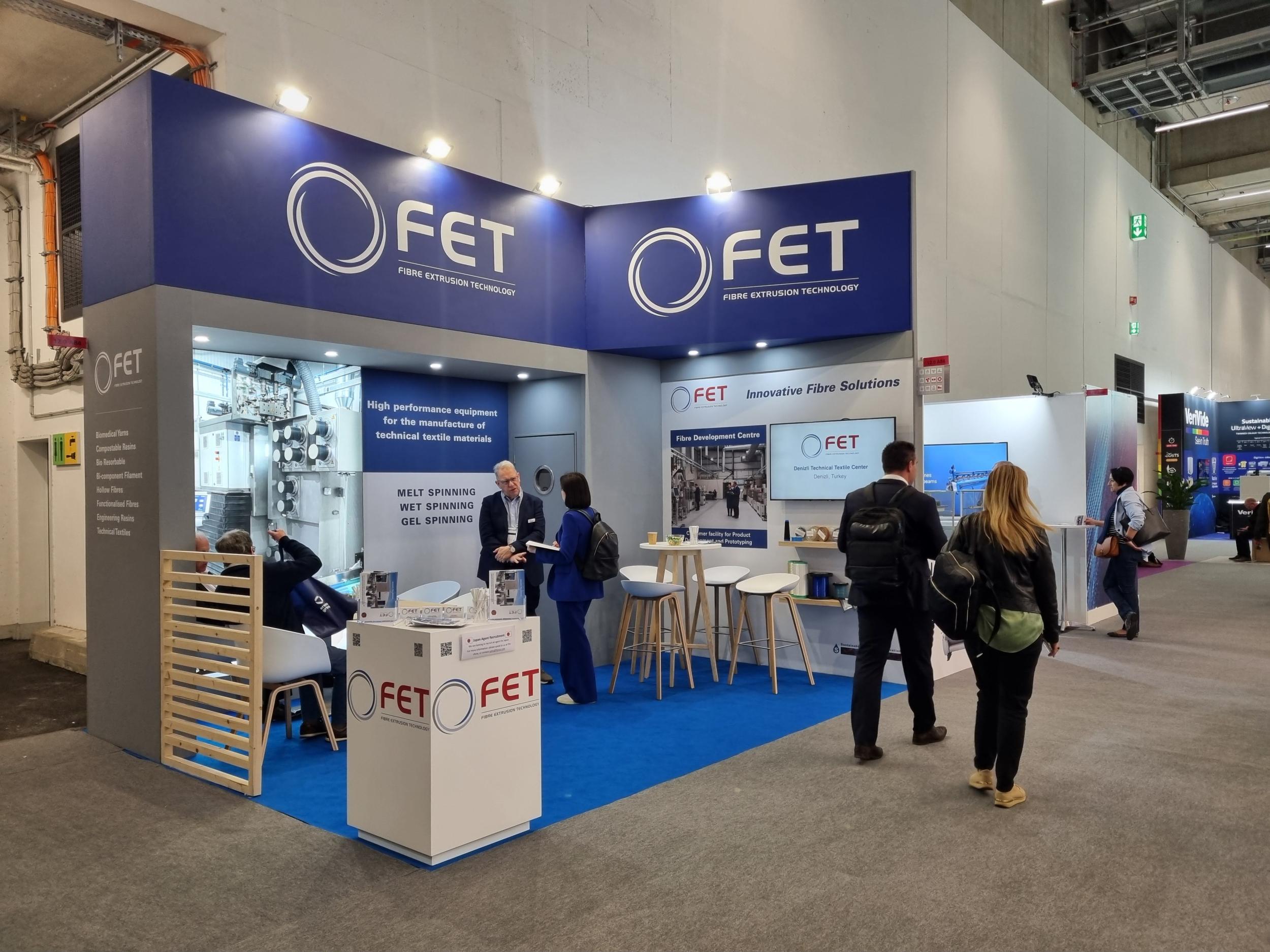
Fibre Extrusion Technology Limited at Techtextil (c) Fibre Extrusion Technology Limited
02.04.2026

FET at Techtextil 2026

Fibre Extrusion Technology Limited (FET) will be exhibiting once again at Techtextil 2026 in Frankfurt, which runs from April 21 – 24. Techtextil attracts major international companies at the cutting edge of technology, which are seeking innovative solutions to technical challenges, so this event represents an ideal opportunity to demonstrate FET’s strength in helping customers achieve their goals.

FET is an acknowledged leader in laboratory and pilot melt spinning equipment for a vast range of applications. These include precursor materials used in high value technical textiles, sportswear, medical devices and specialised novel fibres from exotic and difficult to process polymers. 

Where melt spinning solutions are not suitable, FET provides a viable alternative with pilot and small scale production wet spinning systems. In addition, FET has also recently launched its FET-500 Series of gel spinning systems. These systems have the potential to revolutionise the research and development of UHMWPE fibres, with significant savings in cost, footprint and environmental factors.

Fibre Extrusion Technology Limited (FET) will be exhibiting once again at Techtextil 2026 in Frankfurt, which runs from April 21 – 24. Techtextil attracts major international companies at the cutting edge of technology, which are seeking innovative solutions to technical challenges, so this event represents an ideal opportunity to demonstrate FET’s strength in helping customers achieve their goals.

FET is an acknowledged leader in laboratory and pilot melt spinning equipment for a vast range of applications. These include precursor materials used in high value technical textiles, sportswear, medical devices and specialised novel fibres from exotic and difficult to process polymers. 

Where melt spinning solutions are not suitable, FET provides a viable alternative with pilot and small scale production wet spinning systems. In addition, FET has also recently launched its FET-500 Series of gel spinning systems. These systems have the potential to revolutionise the research and development of UHMWPE fibres, with significant savings in cost, footprint and environmental factors.

As part of the launch of the FET-500 series, FET’s Senior Scientist Dr Kristoffer Kortsen will be a speaker at the Techtextil Forum on Wednesday 22 April. All visitors are invited to come along and find out more about FET’s new process exploiting super-critical fluids. To date, FET has successfully processed over 130 different polymer types in multifilament, monofilament and nonwoven formats, collaborating with specialist companies worldwide to promote greater sustainability through innovative manufacturing processes.

FET’s Fibre Development Centre further enhances this service, allowing clients to trial their own products in an ideal environment. Resident equipment in the Fibre Development Centre reflects the wide range of fibre extrusion and other systems offered by FET to clients worldwide and will enable continued growth of the company through innovation.  

Managing Director Richard Slack and his technical team will be in attendance on the stand. Slack commented. “We have now exhibited at over 10 Techtextil exhibitions around the world and we again look forward to meeting customers face-to-face to discuss their fibre technology requirements.”

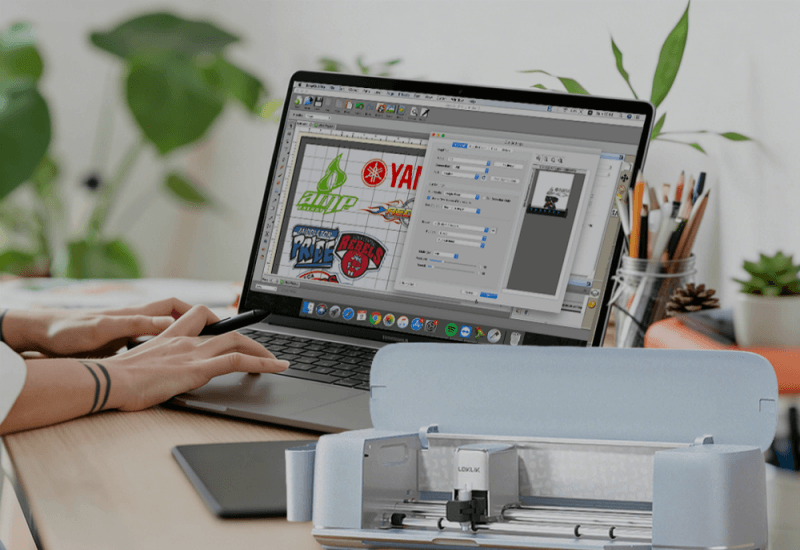
Photo EasyCut
01.04.2026

EasyCut Pro Now Compatible with Siser, LOKLiK and Roland GX Vinyl Cutters

EasyCut, a leader in professional sign‑making and specialty graphics software, announces a key upgrade to its flagship EasyCut Pro solution. The latest version has completed full compatibility testing and officially supports Siser Juliet, Siser Romeo, LOKLiK iCraft, and Roland CAMM‑1 Pro GX Series vinyl cutters, delivering a smooth, integrated workflow for users of these popular cutting plotter devices.

EasyCut Pro serves as an all‑in‑one platform for drawing, designing, printing, print‑and‑cut production, and direct‑to‑vinyl output. The update fine‑tunes the software to fully leverage the performance of each supported cutter and media type, boosting cutting precision, print quality, and overall production efficiency. It also includes a full set of bug fixes, new functional features, and detailed usability improvements to streamline daily creative and manufacturing workflows.

EasyCut, a leader in professional sign‑making and specialty graphics software, announces a key upgrade to its flagship EasyCut Pro solution. The latest version has completed full compatibility testing and officially supports Siser Juliet, Siser Romeo, LOKLiK iCraft, and Roland CAMM‑1 Pro GX Series vinyl cutters, delivering a smooth, integrated workflow for users of these popular cutting plotter devices.

EasyCut Pro serves as an all‑in‑one platform for drawing, designing, printing, print‑and‑cut production, and direct‑to‑vinyl output. The update fine‑tunes the software to fully leverage the performance of each supported cutter and media type, boosting cutting precision, print quality, and overall production efficiency. It also includes a full set of bug fixes, new functional features, and detailed usability improvements to streamline daily creative and manufacturing workflows.

More information:
EasyCut Studio Software sign-making
Source:

EasyCut

Exemplary picture of a filter cake with deposited microplastic fibers. Photo: DITF
Exemplary picture of a filter cake with deposited microplastic fibers.
30.03.2026

Textile Cascade Filter for Removing Microplastics from Wastewater

Microplastics are now found almost everywhere, even in remote regions of Antarctica. They enter the human body through the food chain. Studies indicate that microplastics may have negative effects on the human health.

One important source of microplastic pollution is the washing of textiles made from synthetic fibers. During washing, significant amounts of microplastics are released into wastewater and then enter aquatic ecosystems. To address this problem, the German Institutes of Textile and Fiber Research Denkendorf (DITF) have developed a textile-based cascade filter system.

The amount of microfibers released per wash cycle and per kilogram of textiles is estimated to range from 12 and 1,400 milligrams. Wastewater treatment plants are already able to remove a large portion of microplastic particles from wastewater, with removal rates of up to 99 percent. However, because of the high volume of wastewater discharged every day, these plants can still contribute significantly to microplastic pollution in the environment.

Microplastics are now found almost everywhere, even in remote regions of Antarctica. They enter the human body through the food chain. Studies indicate that microplastics may have negative effects on the human health.

One important source of microplastic pollution is the washing of textiles made from synthetic fibers. During washing, significant amounts of microplastics are released into wastewater and then enter aquatic ecosystems. To address this problem, the German Institutes of Textile and Fiber Research Denkendorf (DITF) have developed a textile-based cascade filter system.

The amount of microfibers released per wash cycle and per kilogram of textiles is estimated to range from 12 and 1,400 milligrams. Wastewater treatment plants are already able to remove a large portion of microplastic particles from wastewater, with removal rates of up to 99 percent. However, because of the high volume of wastewater discharged every day, these plants can still contribute significantly to microplastic pollution in the environment.

To date, various mechanical and chemical technologies have been used in wastewater treatment. Filter cascades, on the other hand, have mainly been applied for the analysis and characterization of microplastic particles. In their study, the DITF researchers demonstrated that specialized textile-based filter cascades are also capable of effectively removing microplastics from rinse water in industrial laundries. This is possible even at low water pressure. In addition, the system has a simplified design and requires little maintenance.

The cascade microfilter developed by the Denkendorf research team consists of three filtration stages. Each stage uses a three-dimensional textile sandwich composite made of polypropylene fabric and a 3D spacer knit. The stages have progressively smaller pore sizes, allowing the removal of microplastic particles down to 1.5 μm.

A compressed-air backwashing system is integrated to clean the filter and restore its performance. Because the filter cake moves from the fabric to the spacer layer, backwashing is needed less often, and the operating time can be increased by up to 155 percent.

Field trials at an industrial laundry and a municipal wastewater treatment plant confirmed a separation efficiency of 89.7 percent and 98.5 percent for the microfilter cascade. It can thus make a significant contribution to reducing microplastic pollution.

The high microplastic separation efficiency and the long service life of the filter medium make the system a promising solution for wastewater treatment. It is cost-effective, space-saving, and can be adapted to different applications and scales.

The textile composite medium developed at the DITF can be tailored to meet a variety of filtration requirements beyond its application in microplastic filtration.

Source:

Deutsche Institute für Textil- und Faserforschung Denkendorf

25.03.2026

Italian Textile Machinery Innovation Takes Center Stage at Techtextil 2026

The Italian textile machinery industry is gearing up for a key event on the international trade fair calendar: Techtextil 2026, taking place from April 21–24 in Frankfurt, Germany. A prestigious representation of Italian companies will participate in the German exhibition—a global benchmark for technical and innovative textiles—to present cutting-edge technologies dedicated to an ever-expanding market.

Italy confirms its position among the world leaders in the textile machinery sector, thanks to a solid and highly specialized production system. The industry stands out for its strong international vocation, with a predominant share of production destined for foreign markets (86% of its sales) and a consolidated presence in over 130 countries. This places the country among the top global exporters of textile technology, renowned for its quality, innovation, and reliability.

The Italian textile machinery industry is gearing up for a key event on the international trade fair calendar: Techtextil 2026, taking place from April 21–24 in Frankfurt, Germany. A prestigious representation of Italian companies will participate in the German exhibition—a global benchmark for technical and innovative textiles—to present cutting-edge technologies dedicated to an ever-expanding market.

Italy confirms its position among the world leaders in the textile machinery sector, thanks to a solid and highly specialized production system. The industry stands out for its strong international vocation, with a predominant share of production destined for foreign markets (86% of its sales) and a consolidated presence in over 130 countries. This places the country among the top global exporters of textile technology, renowned for its quality, innovation, and reliability.

In the first eleven months of 2025, sales in Germany have already reached 81 million euros. Among the most requested technologies, accessories stand out (36%), followed by finishing machinery (33%)—the latter being essential for the production processes of the most innovative textile sectors.

The strength of Italian textile machinery lies in its dynamic structure, composed of small-to-medium-sized companies that are heavily oriented toward Research & Development. This flexibility allows Italian manufacturers to collaborate closely with end-users, transforming customer needs into highly personalized and versatile technological solutions.

“The growing demand for innovative textiles across various industrial fields is further consolidating our manufacturers’ position,” emphasizes Marco Salvadè, President of ACIMIT. “At Techtextil 2026, the Italian offering will once again demonstrate how the combination of high technology and customization capabilities is the key to meeting the challenges of the technical textiles sector.”

Italian expertise, rooted in historic districts such as Bergamo, Biella, Brescia, Como, Milan, Prato, and Vicenza, continues to guarantee standards of quality and reliability that make Made in Italy a point of reference for the entire global industry.

The ACIMIT associate companies present in the Italy Pavilion include: Aeris S.r.l., Aigle S.r.l., Beschi S.r.l., Bettarini & Serafini S.r.l., Bonino S.r.l., Castello S.r.l., Ferraro S.p.A., Gemata S.p.A., Gualchieri e Gualchieri S.r.l., Guarneri Technology S.r.l., Idealtech S.r.l., IMA S.p.A., Lonati S.p.A., Mariplast S.p.A., MCS Officina Meccanica S.p.A., Monti-Mac S.r.l., M.T.V. S.r.l., Noseda S.r.l., OMMI S.r.l., Ramatex Italia S.r.l., Ramina S.r.l., Salvadè S.r.l., Simet S.r.l., S.R.S. Spindle Research & Service S.r.l., Stalam S.p.A., Tecnomeccanica Biellese S.r.l., Tecnorama S.r.l., Texera S.r.l., Ugolini S.r.l., Unitech Industries S.r.l., Zanfrini S.r.l..

The strength of the Italian presence is further confirmed by ACIMIT associate members exhibiting at individual stands or through local retailers, including:  A.Piovan S.r.l., Autefa Solutions Italy, Bianco S.p.A., Cormatex S.r.l., Dell’orco & Villani S.r.l., Emme S.r.l., Fadis S.p.A., Itema S.p.A., Lawer S.p.A., LGL Electronics S.p.A., Mesdan S.p.A., Monti Antonio S.p.A., O.M.R. S.r.l., Ratti Luino S.r.l., Siltex S.r.l., Texilmesa S.r.l., Texnology S.r.l., Toscana Spazzole Industriali S.r.l., Willy Italiana S.r.l., Zappa Macchine S.r.l..

More information:
ACIMIT Techtextil Italy
Source:

ACIMIT 

James Coogan Photo Hexcel Corporation
James Coogan
24.03.2026

Hexcel: New Chief Financial Officer

Hexcel Corporation announced that James (Jamie) Coogan has been appointed Executive Vice President and Chief Financial Officer effective May 1, 2026. He will report to Tom Gentile, Hexcel Chairman, CEO and President. Coogan succeeds Mike Lenz who has been serving as interim Chief Financial Officer.  Lenz will remain for a period of time when Coogan joins the company as a Senior Advisor to assist with the transition.

“Jamie brings the experience and the financial leadership that will help Hexcel build on our momentum as we enter a period of growth with rising commercial aircraft production rates and an expanding defense and space market,” said Tom Gentile, Chairman, CEO and President, Hexcel Corporation. “His experience in aerospace and defense companies and broader industrial manufacturing organizations will enable him to make a meaningful impact quickly on Hexcel’s strategic priorities.”

Hexcel Corporation announced that James (Jamie) Coogan has been appointed Executive Vice President and Chief Financial Officer effective May 1, 2026. He will report to Tom Gentile, Hexcel Chairman, CEO and President. Coogan succeeds Mike Lenz who has been serving as interim Chief Financial Officer.  Lenz will remain for a period of time when Coogan joins the company as a Senior Advisor to assist with the transition.

“Jamie brings the experience and the financial leadership that will help Hexcel build on our momentum as we enter a period of growth with rising commercial aircraft production rates and an expanding defense and space market,” said Tom Gentile, Chairman, CEO and President, Hexcel Corporation. “His experience in aerospace and defense companies and broader industrial manufacturing organizations will enable him to make a meaningful impact quickly on Hexcel’s strategic priorities.”

Coogan most recently served as Executive Vice President and Chief Financial Officer at Axcelis Technologies, a supplier in the semiconductor industry, having joined the company in September 2023. Previously he served as Senior Vice President, Chief Financial Officer at Kaman Corporation (formerly traded on the NYSE under the symbol KAMN). During his 15 years at Kaman, he held various management positions including Vice President, Investor Relations and Corporate Development, Assistant Vice President, External Reporting and SEC Compliance, and Director, External Reporting and SEC Compliance.

Coogan has more than 20 years of finance, accounting and investor relations experience across multiple industries, including aerospace and defense. After starting his career at PwC, he held several financial management roles at Ann Taylor Stores Corporation and Mohegan Tribal Gaming Authority before joining Kaman. 

Coogan holds an MBA from the Yale School of Management, an M.S. in Accounting and a B.S. in Business Administration, Accounting from the University of Connecticut.

Source:

Hexcel Corporation

specialty chemical solutions Getty Images for CHT Group
23.03.2026

CHT Group at Techtextil 2026: Intelligent specialty chemical solutions for technical textiles

At this year's Techtextil in Frankfurt on the Main, the CHT Group will be presenting its comprehensive portfolio of tailor-made specialty chemicals and process solutions for technical textiles. As a reliable partner to the global textile industry, CHT offers innovative products and in-depth technical expertise across all areas of the textile value chain – from pretreatment, dyeing, and printing to finishing, coating, and fiber auxiliaries.

The focus of the trade fair presentation will be on solutions that meet the highest standards of functionality, sustainability, and quality. CHT's specialty chemicals are used in a wide range of industrial applications – from high-performance coating systems and pure, recyclable product solutions to innovative composite materials.

Expertise along the entire value chain
With decades of experience in the development and application of specialty chemicals, CHT supports its customers from the initial idea to successful industrial implementation. The goal is to work together to design the products of tomorrow and enable sustainable textile innovations.

At this year's Techtextil in Frankfurt on the Main, the CHT Group will be presenting its comprehensive portfolio of tailor-made specialty chemicals and process solutions for technical textiles. As a reliable partner to the global textile industry, CHT offers innovative products and in-depth technical expertise across all areas of the textile value chain – from pretreatment, dyeing, and printing to finishing, coating, and fiber auxiliaries.

The focus of the trade fair presentation will be on solutions that meet the highest standards of functionality, sustainability, and quality. CHT's specialty chemicals are used in a wide range of industrial applications – from high-performance coating systems and pure, recyclable product solutions to innovative composite materials.

Expertise along the entire value chain
With decades of experience in the development and application of specialty chemicals, CHT supports its customers from the initial idea to successful industrial implementation. The goal is to work together to design the products of tomorrow and enable sustainable textile innovations.

The CHT Group's solutions are used in numerous application segments:

Mobiltech

  • Flame-retardant finishes and coatings for interior textiles, carpets, seat covers, and technical composites
  • Special adhesives for flocking

Medtech

  • Coatings and finishes for mattress protection and surgical textiles
  • Special fiber auxiliaries for hygiene and medical products

Protech

  • Flame-retardant, chemical-resistant, and weatherproof finishes and coatings
  • Solutions for industrial and protective clothing for public authorities

Hometech / Interior

  • Coatings and finishes for advertising and event textiles, banner fabrics, trade fair coverings
  • Solutions for furniture covers, carpets, and cleaning textiles

Indutech

  • High-performance coatings and finishes for filter media, conveyor belts, and technical fabrics

Buildtech

  • Coatings for architectural membranes, facades, and functional light protection systems
  • Applications for textile-reinforced concrete, insulation materials, and sewer rehabilitation

Sporttech & Outdoor 

  • Finishing and coating systems for awnings, tents, and protective Covers

Innovative product ranges for modern textile applications
The portfolio includes both water-based and silicone-based printing and coating systems, in particular from the well-known ALPATEC range, which opens up new functional possibilities for technical textiles – and all this reliably from a single source.

There is a particular focus on sustainable solutions:
Circular economy as a strategic guiding principle

The CHT Group consistently integrates the principles of the circular economy into its research and development. A single-type end product – such as carpets, filters, or technical nets – is much easier to recycle and return to the recycling cycle. With our TUBICOAT PET range, CHT offers a coating line specially developed for single-type polyester materials.

PFC-free hydrophobic agents
The ECOPERL product range offers high-performance, PFC-free DWR solutions, some with a high share of bio-based components, suitable for a wide range of technical applications.
Numerous products naturally comply with leading international standards such as ZDHC, bluesign®, GOTS, Oeko-Tex® Standard 100, Cradle to Cradle® Material Health Certificate, GRS – a clear commitment to quality, transparency, and sustainability.

The framework allows for programmable deformation patterns, shown here with the MIT logo. Credits: Image courtesy of the researchers
The framework allows for programmable deformation patterns, shown here with the MIT logo.
18.03.2026

3D-printed metamaterials that stretch and fail by design

Metamaterials — materials whose properties are primarily dictated by their internal microstructure, and not their chemical makeup — have been redefining the engineering materials space for the last decade. To date, however, most metamaterials have been lightweight options designed for stiffness and strength.

New research from the MIT Department of Mechanical Engineering introduces a computational design framework to support the creation of a new class of soft, compliant, and deformable metamaterials. These metamaterials, termed 3D woven metamaterials, consist of building blocks that are composed of intertwined fibers that self-contact and entangle to endow the material with unique properties.

“Soft materials are required for emerging engineering challenges in areas such as soft robotics, biomedical devices, or even for wearable devices and functional textiles,” explains Carlos Portela, the Robert N. Noyce Career Development Professor and associate professor of mechanical engineering.

Metamaterials — materials whose properties are primarily dictated by their internal microstructure, and not their chemical makeup — have been redefining the engineering materials space for the last decade. To date, however, most metamaterials have been lightweight options designed for stiffness and strength.

New research from the MIT Department of Mechanical Engineering introduces a computational design framework to support the creation of a new class of soft, compliant, and deformable metamaterials. These metamaterials, termed 3D woven metamaterials, consist of building blocks that are composed of intertwined fibers that self-contact and entangle to endow the material with unique properties.

“Soft materials are required for emerging engineering challenges in areas such as soft robotics, biomedical devices, or even for wearable devices and functional textiles,” explains Carlos Portela, the Robert N. Noyce Career Development Professor and associate professor of mechanical engineering.

In an open-access paper published Jan. 26 in the journal Nature Communications, researchers from Portela’s lab provide a universal design framework that generates complex 3D woven metamaterials with a wide range of properties. The work also provides open-source code that allows users to create designs to fit specifications and generate a file for printing or simulating the material using a 3D printer.

“Normal knitting or weaving have been constrained by the hardware for hundreds of years — there’s only a few patterns that you can make clothes out of, for example — but that changes if hardware is no longer a limitation,” Portela says. “With this framework, you can come up with interesting patterns that completely change the way the textile is going to behave.”

Possible applications include wearable sensors that move with human skin, fabrics for aerospace or defense needs, flexible electronic devices, and a variety of other printable textiles.

The team developed general design rules — in the form of an algorithm — that first provide a graph representation of the metamaterial. The attributes of this graph eventually dictate how each fiber is placed and connected within the metamaterial. The fundamental building blocks are woven unit cells that can be functionally graded via control of various design parameters, such as the radius and pitch of the fibers that make up the woven struts.

“Because this framework allows these metamaterials to be tailored to be softer in one place and stiffer in another, or to change shape as they stretch, they can exhibit an exceptional range of behaviors that would be hard to design using conventional soft materials,” says Molly Carton, lead author of the study. Carton, a former postdoc in Portela’s lab, is now an assistant research professor in mechanical engineering at the University of Maryland.

Further, the simulation framework also allows users to predict the deformation response of these materials, capturing complex phenomena such as self-contact within fibers and entanglement, and design to predict and resist deformation or tearing patterns.

“The most exciting part was being able to tailor failure in these materials and design arbitrary combinations,” says Portela. “Based on the simulations, we were able to fabricate these spatially varying geometries and experiment on them at the microscale.”

This work is the first to provide a tool for users to design, print, and simulate an emerging class of metamaterials that are extensible and tough. It also demonstrates that through tuning of geometric parameters, users can control and predict how these materials will deform and fail, and presents several new design building blocks that substantially expand the property space of woven metamaterials.

“Until now, these complex 3D lattices have been designed manually, painstakingly, which limits the number of designs that anyone has tested,” says Carton. “We’ve been able to describe how these woven lattices work and use that to create a design tool for arbitrary woven lattices. With that design freedom, we’re able to design the way that a lattice changes shape as it stretches, how the fibers entangle and knot with each other, as well as how it tears when stretched to the limit.”

Carton says she believes the framework will be useful across many disciplines. “In releasing this framework as a software tool, our hope is that other researchers will explore what’s possible using woven lattices and find new ways to use this design flexibility,” she says. “I’m looking forward to seeing what doors our work can open.”

The paper, “Design framework for programmable three-dimensional woven metamaterials,” is available now in the journal Nature Communications. Its other MIT-affiliated authors are James Utama Surjadi, Bastien F. G. Aymon, and Ling Xu.

This work was performed, in part, through the use of MIT.nano’s fabrication and characterization facilities.

Source:

MIT, Anne Wilson | Department of Mechanical Engineering

17.03.2026

Deemed Importer obligations must not be delayed to 2028

16 industry associations published a joint statement on deemed importer obligations to urge the EU and its Member States to put in place such a Regulation without delay:

European traders and industry are deeply concerned about the rise of imports of small consignments. The introduction of the ‘deemed importer’ in 2028 comes too late. We call upon the EU and its Member States to introduce a legal obligation on foreign operators to appoint a legally responsible person or entity in the EU for e-commerce imports without any further delay. 

The extraordinary growth of e-commerce in recent years has led to an exponential number of small packages of low-valued goods entering the EU, each of which needs to be accompanied by an individual customs declaration since the entry into force of new VAT rules for e-commerce in 2021. In 2022, for example, almost 1 billion customs declarations for low-value goods were filed. The sheer volumes of e-commerce are testing customs' limits. 

16 industry associations published a joint statement on deemed importer obligations to urge the EU and its Member States to put in place such a Regulation without delay:

European traders and industry are deeply concerned about the rise of imports of small consignments. The introduction of the ‘deemed importer’ in 2028 comes too late. We call upon the EU and its Member States to introduce a legal obligation on foreign operators to appoint a legally responsible person or entity in the EU for e-commerce imports without any further delay. 

The extraordinary growth of e-commerce in recent years has led to an exponential number of small packages of low-valued goods entering the EU, each of which needs to be accompanied by an individual customs declaration since the entry into force of new VAT rules for e-commerce in 2021. In 2022, for example, almost 1 billion customs declarations for low-value goods were filed. The sheer volumes of e-commerce are testing customs' limits. 

Many of the products arriving here contravene the rules in force in the EU. Infringements like VAT fraud, breaching health and safety EU standards, violation of intellectual property rights and misleading claims fuel unfair competition within the Single Market, disadvantaging businesses that follow the EU’s high standards. Such unfair trade practices, linked to small consignments, are corroding entire industrial value chains, eroding our economic strength and resilience and put the consumer health at risk. Additionally, they threaten shops all over the EU, accelerating the depopulation of town centres. 

Against this background, we welcome that the EU, with the new Union Customs Code (UCC), plans to introduce the so-called “deemed importer”, i.e. holding platforms responsible for ensuring that customs duties and VAT are paid at purchase as well as for non-financial obligations. 

However, if the “deemed importer” is introduced only in 2028, this will come too late. In 2025 alone, 5.8 billion parcels were imported into the EU. In the coming years, the pressure on our industries of competing with non-compliant traders which bear no responsibility for non-compliance, will mount to an unbearable extent and threaten the livelihood of even more economic operators, with massive consequential job losses. 

The introduction of an obligation to appoint a legally responsible person or entity in the European Union who can be held accountable is long overdue. This can be established much earlier than 2028 by a simple EU Regulation at short notice, long before the ‘deemed importer’ and other elements of the UCC are introduced. Technically easily feasible, it is just a question of political will. 

We also acknowledge the forthcoming European Product Act, which aims to further strengthen the overall framework for product compliance and market surveillance. We stress that compliance with European Union Extended Producer Responsibility (EPR) obligations must be effectively enforced, including in relation to online sales and third-country sellers. Online marketplaces and any legally responsible EU representative should be subject to clear and binding enforcement mechanisms to ensure that products placed on the EU market comply with applicable EPR requirements (including packaging, WEEE, batteries and textiles), thereby preventing free-riding and safeguarding a level playing field. These initiatives will only deliver their full effect in the medium term. 
If properly defined and implemented, these new concepts have the potential to help address gaps in online product compliance. 

List of Signatories:
Applia – Home Appliance Europe
CEC – European Footwear Confederation
Cosmetics Europe - The personal care association
EBCA - European Branded Clothing Association
ECOS – European Coalition on Standards
EFIC - European Furniture Industries Confederation
EURATEX - European Apparel and Textile Confederation
EXPRA – Extended Producer Responsibility Alliance
Independent Retail Europe
LightingEurope – The voice of the Lighting Industry
Repair&Share
Svensk Handel – Swedish Commerce
TIE - Toy Industries of Europe
WEEE Forum
ZERO – Associação Sistema Terrestre Sustentável
EucoLight

Source:

European Apparel and Textile Confederation EURATEX