
Research publications

1 result
28.08.2026

A new take on form-fitting design - Non-metallic braided rib structures for carbon concrete

Composites Textile machinery Technical Textiles

Abstract

Braided structures made from carbon filament yarn have the potential to achieve composite strengths on a comparable level to steel reinforcement. At the Institute of Textile Machinery and High Performance Material Technology (ITM) at Dresden University of Technology, work is being carried out as part of the IGF research project (01IF24911N) to set new standards for concrete reinforcement through the targeted modification of braiding technology. The modified braiding technology enables the development of integral braided rib structures without any interruptions in the fibre orientation. Based on simulation-aided designs, the so-called GRip-Bars, with composite strengths in the range of 25-30 MPa, are being developed for use as longitudinal reinforcement in slabs, beams or columns. The new rebars also offer great potential for use in critical infrastructure such as bridges and tunnels. Due to their extended lifetime, they can contribute to reducing maintenance costs.

Report

Introduction

Carbon concrete is a key technology for resource-efficient construction, enabling concrete savings of up to 80 % and reducing CO₂ emissions by around 50 %. The crucial factor for industrial market entry lies not only in material properties but also in the standardisation and certifiability of semi-finished products and processes. Braiding, an established industrial manufacturing process, produces reproducible, geometrically defined fibre architectures with high process stability, providing a robust basis for design calculations in approval procedures like ZiE or abZ.

Background

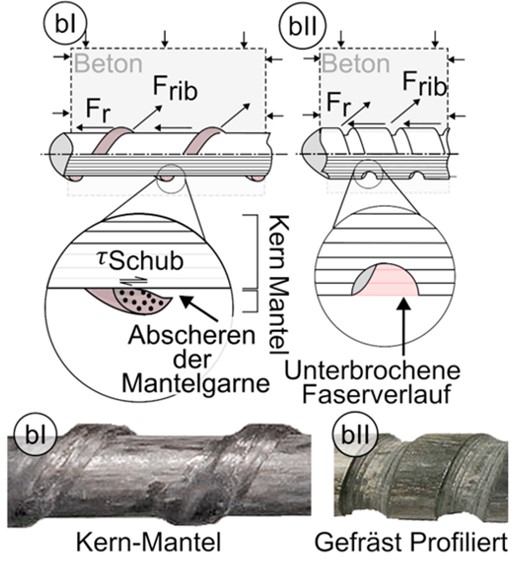
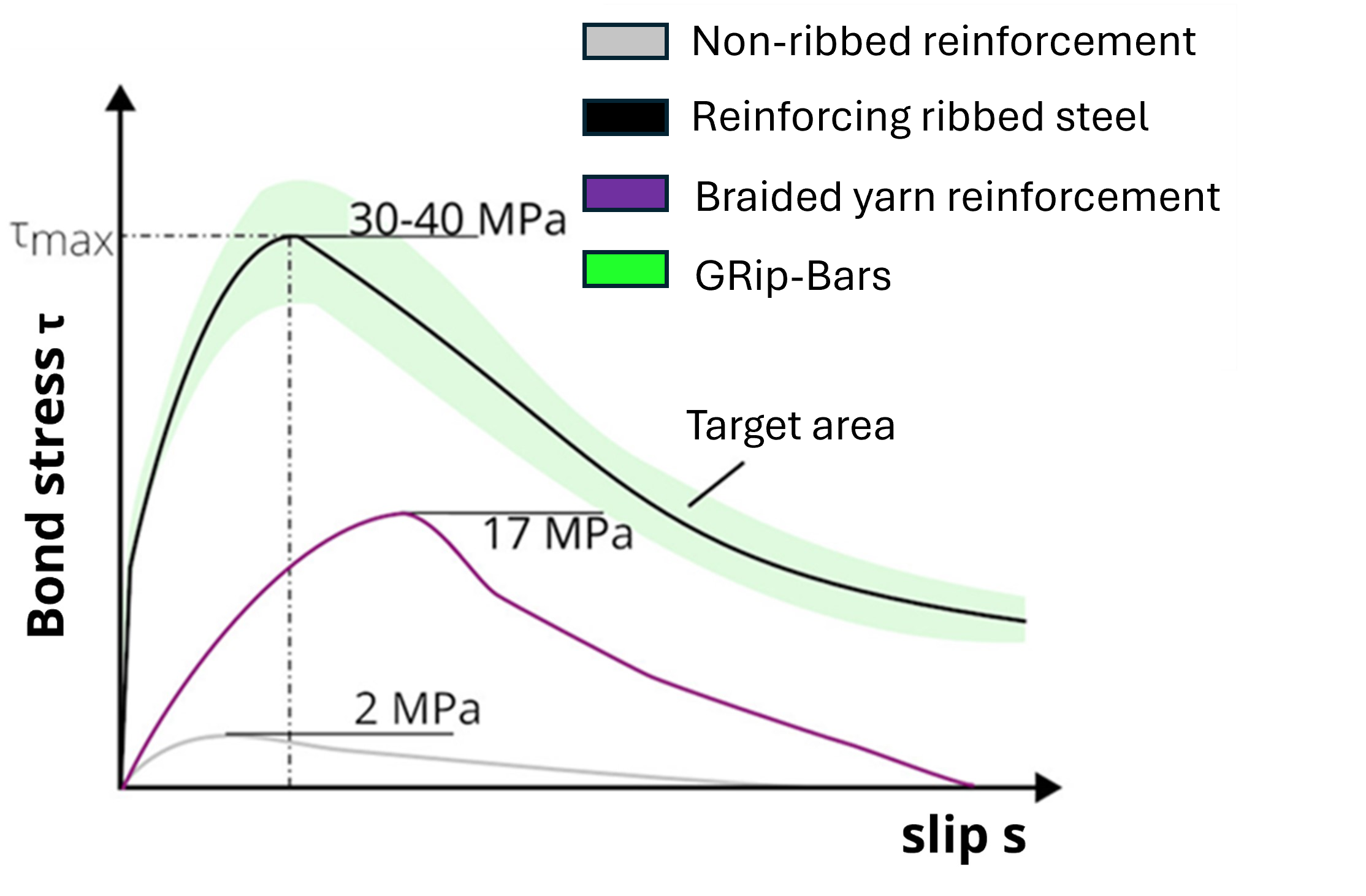
Historically, longitudinally ribbed structural steel BST 500 has been the construction industry standard, with bond strengths of 30-40 MPa and concrete compressive strength of 90-120 MPa. The mechanical interlocking of rib rows with the concrete matrix ensures a high structural integration and bond strength. Currently, CFRP reinforcement bars do not meet the requirements for bond strength. This is due to the subtractive or additive manufacturing processes used to create the surface structures (Fig. 1). In subtractive manufacturing, the load-bearing cross-section is reduced and the fibre orientation is interrupted - force transmission takes place entirely via the matrix between the edge and core filaments. Additively applied core-shell structures feature additional interfaces which, under low shear stresses, lead to delamination and premature shearing of the profiled fibres.

Innovation of Braiding Technology

Single-stage manufacturing technologies enable profiled surface geometries without interrupting fibre orientation, ensuring all fibres are firmly anchored without a core-shell structure that is likely to fail prematurely. The established braiding technique allows for standardised, targeted mechanical interlocks between bar ribs and concrete (Fig. 2). This significantly improves the bond strength of non-metallic reinforcement and reduces the gap compared to steel reinforcement (CFRP < 20 MPa). The production of standardised non-metallic reinforcement bars using braiding technology offers significant advantages:

  • Targeted shifts in the braiding centre produce variable braided cross-sections and enable precise adjustment of process parameters (e.g. filament tension),
  • High tensile strengths with full load-bearing capacity of the fibre cross-section are comparable to those of established rebar,
  • High material variability and the potential for sensor integration into the fibre structure enable early failure detection.

Based on a simulations-based design, the research project is developing modified and standardisable braided structures that can be used as impregnated non-metallic reinforcement bars in the construction industry.

Outlook

The targeted bond strength of the GRip-Bars, ranging from 25-30 MPa, combined with the high tensile strengths of rebar and the scalability for large reinforcement cross-sections (diameter of 6-20 mm), makes the new braided reinforcement suitable for use as longitudinal reinforcement in ceilings, beams and columns. This reinforcement system contributes to sustainable construction and enables slim, resource-efficient and corrosion-resistant load-bearing structures that meet the requirements of a sustainable construction industry. Particularly in critical infrastructure such as bridges and tunnels, its high durability and corrosion resistance ensure an extended lifetime while significantly reducing maintenance costs.

Acknowledgement

The IGF project “Textile-reinforced, form-fitting braided rib structures for high-strength fibre-reinforced concrete structures” (IGF-No.: 01IF23608N) by the Textile Research Council e.V. at TU Dresden is funded by the Federal Ministry for Economic Affairs and Energy via the DLR as part of the programme to promote industrial collaborative research (IGF).

The authors would like to thank the before mentioned institution for providing the financial resources. The research report and further information are available from the institute of Textile Machinery and High Performance Material Technology at TU Dresden.

Authors: Laura Chiara Wittich Matthias Overberg Anwar Abdkader Danny Friese Chokri Cherif

Technische Universität Dresden
Fakultät Maschinenwesen
Institut für Textilmaschinen und Textile Hochleistungswerkstofftechnik (ITM)
01062 Dresden

https://tu-dresden.de/mw/itm

More entries from TU Dresden, Institut für Textilmaschinen und Textile Hochleistungswerkstofftechnik ITM