



Europe is losing its textile industry
Every week, textile factories close across Europe. Behind each closure: jobs lost, communities affected, strategic capabilities gone.
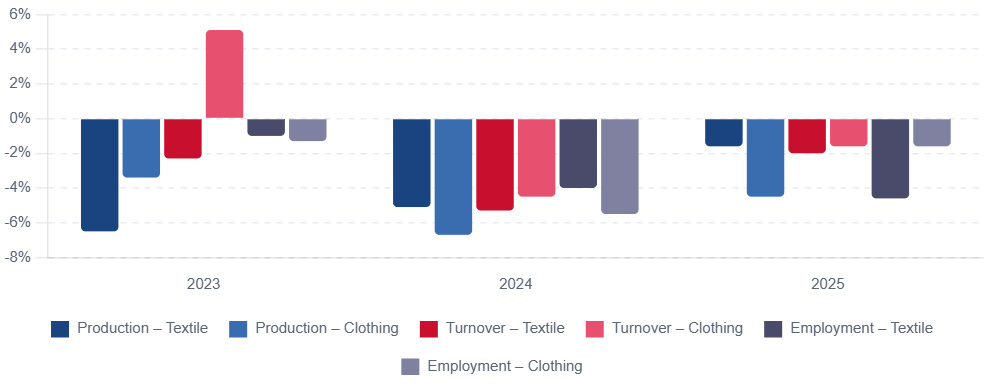
EURATEX has released its latest Economic Update on the performance of the European textile and apparel industry in 2025. For the third consecutive year, the sector recorded negative results across all key indicators — production, turnover and employment — confirming a continued erosion of competitiveness across Europe.
The causes are clear: structurally high energy costs, weak consumer demand, growing import pressure from Asia, unfair competition from online platforms, and an increasingly heavy regulatory burden on European producers.
The EU is preparing several policy responses — the Industrial Accelerator Act, reform of the Union Customs Code, the Energy Union. However, many companies cannot wait. Europe needs immediate action to reduce energy costs, simplify regulation, strengthen market surveillance and restore a genuine level playing field.
Textiles is a strategic industrial ecosystem for Europe. Beyond fashion — clothing, footwear and home textiles that define European identity and craftsmanship — it supplies critical value chains: healthcare, defence, mobility, construction and agriculture, while supporting circularity through reuse and recycling. This is not a sector Europe can afford to lose. EURATEX calls on the European Commission and Member States to take concrete action before the end of 2026.
“If Europe is serious about maintaining its manufacturing base, it must act faster and more decisively. Every week, textile companies are closing. Production moves elsewhere, dependency increases, and the carbon footprint grows. That is the opposite of what Europe wants to achieve.” Mario Jorge Machado — President, EURATEX
European Apparel and Textile Confederation EURATEX