
From the Sector

Reset
Blade2Poly Kick-Off Meeting on September 17, 2026, at the Composite Circularity Lab in Leipzig (from left to right): Andrej Fehler (HTWK), Dr. Philipp Johst (HTWK), Olaf Thannheiser (KomRec-ReCond), Christian Schmaus (Schmaus Kunststoffaufbereitung), Prof. Robert Böhm (HTWK – participating online, not pictured) © HTWK Leipzig © HTWK Leipzig
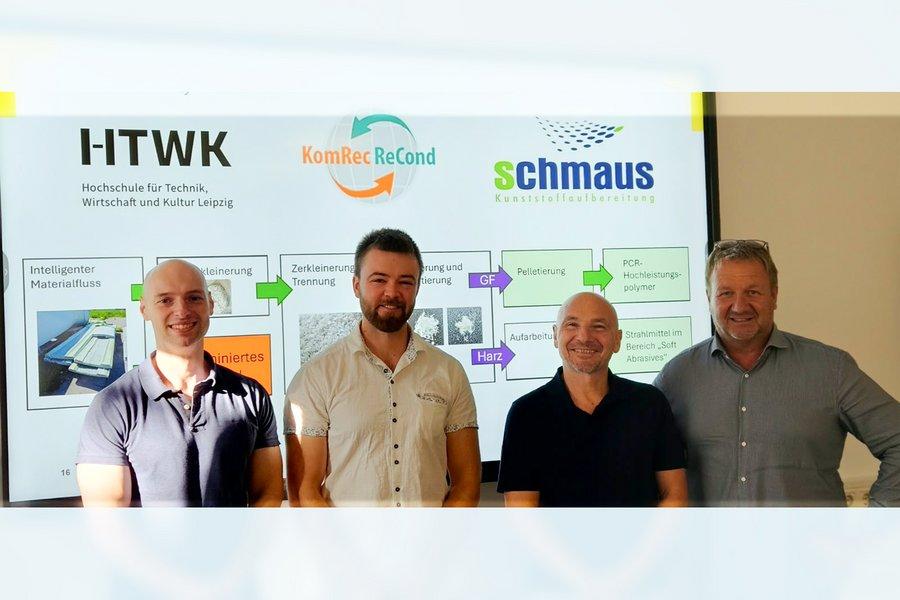
Blade2Poly Kick-Off Meeting on September 17, 2026, at the Composite Circularity Lab in Leipzig (from left to right): Andrej Fehler (HTWK), Dr. Philipp Johst (HTWK), Olaf Thannheiser (KomRec-ReCond), Christian Schmaus (Schmaus Kunststoffaufbereitung), Prof. Robert Böhm (HTWK – participating online, not pictured) © HTWK Leipzig
22.09.2026

Blade2Poly targets rotor blades for injection moulding

HTWK Leipzig has launched Blade2Poly with KomRec-ReCond and Schmaus Kunststoffaufbereitung to develop an energy-efficient recycling chain for end-of-life wind-turbine blades. The goal is to recover glass-fibre-reinforced plastics as higher-value secondary raw materials for new injection-moulding applications.

The route starts with material characterisation and categorisation, followed by mechanical processing, intelligent material-flow control and combination of recovered glass fibres with recycled polymers to create post-consumer recycled compounds.

Rotor blades are a demanding circularity case because large, durable composite structures must ultimately be converted into heterogeneous waste streams. Blade2Poly therefore addresses not only size reduction but the quality of recovered material and its compatibility with a new industrial process.

The collaborative R&D project runs from June 2026 to January 2029 under Germany's ZIM programme.

HTWK Leipzig has launched Blade2Poly with KomRec-ReCond and Schmaus Kunststoffaufbereitung to develop an energy-efficient recycling chain for end-of-life wind-turbine blades. The goal is to recover glass-fibre-reinforced plastics as higher-value secondary raw materials for new injection-moulding applications.

The route starts with material characterisation and categorisation, followed by mechanical processing, intelligent material-flow control and combination of recovered glass fibres with recycled polymers to create post-consumer recycled compounds.

Rotor blades are a demanding circularity case because large, durable composite structures must ultimately be converted into heterogeneous waste streams. Blade2Poly therefore addresses not only size reduction but the quality of recovered material and its compatibility with a new industrial process.

The collaborative R&D project runs from June 2026 to January 2029 under Germany's ZIM programme.