Home
Highlights
Jobs
Companies and Headhunters are looking for ...
N E U: Sales Manager / Account Manager (m/w/d) - Technische Textilien
N E U: Geschäftsführer / General Manager (w/m/d) - Technische Textilien
Leitung Entwicklung Flachstrick (m / w / d)
Leitung Gewebeentwicklung (m/w/d) - Technische Textilien
Bekleidungstechniker (m/w/d) Nähtechnik / Konfektionstechnik
Nähmaschinen - Techniker (m/w/d)
Qualitätsmanager (m/w/d) - Belgien
Director of Innovation & Processes (m/f/d) - Belgium
Cross-functional Quality Manager (m/f/d) - Belgium
Leiter Innovation und Prozessmanagement (m/w/d) - Belgien

News
Companies and Markets
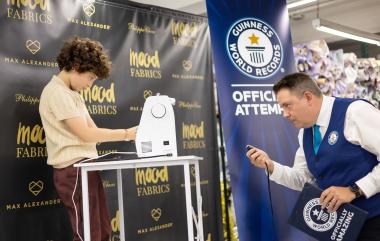
Mood Fabrics launches 15-piece fabric line with Max Alexander
Mood Fabrics has launched a 15-fabric collection with ten-year-old designer Max Alexander. The Mood × Max Alexander line debuted in New York on 14 September and is being sold online and through Mood's U.S. retail locations.
The company lists BCI cotton, EcoVero viscose, European flax linen and recycled-polyester faux fur among the materials. The range combines prints and textured fashion fabrics with several fibre choices already associated with established sourcing or recycling programmes.
Alexander selected and annotated the fabrics. The collaboration therefore starts at material choice, leaving the collection open to further garment design and making rather than presenting a fixed apparel capsule.
INDA Hires Ben Muller as Executive Director
INDA, the Association of the Nonwoven Fabrics Industry, announced today that Ben Muller has joined the association as executive director. Mr. Muller brings more than 20 years of progressive leadership experience spanning nonprofit organizations, corporations and trade associations.
Most recently, Mr. Muller served on the senior executive team of the High Point Market Authority, where he led marketing, public relations and educational programming for one of the world’s largest trade shows. Previously, he held senior brand and marketing leadership positions with Hanesbrands and Kayser-Roth, gaining extensive experience in textile and apparel supply chains. He began his career serving mission-driven organizations, including the American Cancer Society and the National Multiple Sclerosis Society.
Tony Fragnito, INDA’s current president and CEO, will transition to an executive consultant role in January 2027 to support the leadership transition and focus on projects and initiatives designed to expand the reach and participation of the Global Nonwovens Alliance (GNA). His planned retirement will occur in December 2027.
Heidi O’Neill starts lululemon reset
Heidi O’Neill has taken over as chief executive of lululemon. In her first employee message, published in the company newsroom, she places product, brand clarity and operational execution at the centre of the next phase.
O’Neill says her initial weeks will focus on listening to teams, partners, guests and communities before translating ideas into changes. She identifies a need to re-establish the brand’s core and to create more innovative and distinctive product that gives consumers a stronger reason to choose lululemon. She also points to improving operations and how the company connects with its communities.
The appointment matters beyond corporate governance. O’Neill spent more than 25 years at Nike, including leadership across product, design, merchandising, brand and global marketplace operations. At lululemon, that experience meets a business whose differentiation depends heavily on fabric development, fit, functional apparel and a tightly integrated direct-retail model.
Shanghai draws 36,000 home-textile buyers
Intertextile Shanghai Home Textiles – Autumn Edition reports more than 900 exhibitors from 19 countries and regions and nearly 36,000 visitors representing 113 markets. The show covered more than 100,000 square metres and included bedding, upholstery fabrics, curtains, carpets and design-led collections.
Messe Frankfurt says sustainability, new technologies and supply-chain transparency were increasingly visible in buying discussions. Exhibitors presented established sourcing categories alongside functional textiles, more sustainable materials and technology-enabled solutions. Buyer representation was especially strong from Greater China and Southeast Asia, with growing participation from Central Asia.
The fringe programme also moved beyond trend forecasting into operational questions. Sessions covered AI implementation in the home-textile sector, urban renewal, product development, changing lifestyles and opportunities in Latin America. The mix suggests that home-textile sourcing is becoming more closely linked to material innovation, digital tools and verifiable sustainability requirements.
Wound care becomes more textile-integrated
Freudenberg Performance Materials and Foshan United Medical Technologies (UMT) will make their first joint appearance at the WUWHS congress in Kuala Lumpur since Freudenberg acquired the Chinese wound-care specialist at the end of July. The combined platform stretches from fibre and nonwoven technologies to finished advanced wound-care solutions.
UMT’s primary dressings include alginate, carboxymethylcellulose (CMC) and chitosan technologies. Alginate variants include silver-containing options for antimicrobial protection, while CMC is used for moisture management and gel formation. Chitosan brings haemostatic and bacteriostatic properties. UMT is also presenting a non-invasive wound-closure system.
s.Oliver brings the 90s back
Editorial relevance: Medium – a current brand-positioning and retail story supported by a product capsule.
s.Oliver has launched a new hero campaign, “Casual Since Forever,” featuring Heidi Klum meeting a younger version of herself from the 1990s. The concept uses the time shift to reinforce the brand’s positioning around enduring casual style.
The campaign is accompanied by a limited-edition vintage capsule that reinterprets 1990s references through casual basics and vintage-inspired designs. The pieces are being sold online and in selected s.Oliver stores, turning the campaign narrative into an immediate product and retail activation.
Established fashion brands increasingly use archive aesthetics and cultural nostalgia not only for communication but as a direct product-development and traffic-driving mechanism.
ELIE SAAB joins H&M
H&M has named ELIE SAAB as its next designer collaborator. The collection will bring the Beirut-founded couture house’s codes into a mass-market collaboration covering womenswear, menswear, accessories and footwear.
The range is set to include embellished gowns, shimmering separates and tailored pieces, with details such as lace, gradient sequins and monograms. The project extends H&M’s long-running collaboration model, in which luxury and designer brands are translated into limited retail collections with broad consumer reach.
The collection launches in selected stores and online on 22 October 2026. For the fashion and retail market, the partnership is a further example of how high-fashion brand equity, scarcity and cross-price-segment collaboration are used to create traffic and global media visibility.
Lusatia builds a regional fibre economy
A new German research project is exploring how Lusatia can build a regional natural-fibre economy as the former lignite region undergoes structural transformation. Over three years, IÖW and Zittau/Görlitz University of Applied Sciences will examine value chains based on flax, industrial hemp, fibre nettle, miscanthus and residues such as straw and municipal leaves.
The focus is explicitly on industrial applications rather than conventional apparel textiles. Potential outlets include natural-fibre-reinforced plastics, specialty papers, lightweight panels, composites, automotive components and new packaging materials. A regionally resolved material-flow model will map feedstock availability, processing routes, land-use conflicts and possible bottlenecks.
The project treats raw-material availability and industrialisation as one system. Workshops with farmers, processors, manufacturers, municipalities and economic-development actors are intended to produce practical transformation pathways for a circular bioeconomy.
Airborne microfibres enter soil and water
Researchers from Empa, Eawag and Agroscope have produced the first systematic estimate of how much microplastic is deposited from the atmosphere across Switzerland. For areas below 2,000 metres, the study estimates annual deposition of about 219 tonnes, including roughly 78 tonnes on agricultural land and around ten tonnes directly into water bodies.
The official release identifies loose fibres from functional clothing among the sources that can enter the environment, alongside PET bottles and other plastic products. Sampling was conducted for a full year at five locations, with particles between 20 and 215 micrometres analysed using imaging infrared microspectroscopy. PET, polyethylene and polypropylene were the most frequently detected polymers.
For textiles, the findings matter because they add atmospheric transport to the better-known discussion around fibre release through washing. The work provides a new evidence base for assessing material emissions and mitigation priorities, while the researchers stress that long-term environmental and health effects remain under investigation.
Wool turns sunlight into clean water
Cornell University researchers have demonstrated that polydopamine-dyed wool can serve as a low-cost, renewable material for solar-driven water purification. The approach uses interfacial solar vapor generation, concentrating solar heat at the water surface while a textile structure transports water and converts it into vapor.
The strongest configuration used ultrablack wool positioned vertically and illuminated from both sides. It produced 2.43 kilograms of water per square metre of fabric per hour, while polydopamine-only wool achieved 2.21 kilograms. Both rates were nearly twice those reported for conventional horizontal two-dimensional evaporation systems. The material also operated continuously for ten hours without salt accumulation.
Performance depends on fibre choice, dye chemistry, surface structure and textile geometry acting together. Salt levels in the collected water were below the World Health Organization drinking-water threshold. Future work will test rainwater and wastewater and improve water-collection designs.
Business
Study - Asia
Technical University Darmstadt conducts study
"India and China as procurement markets". A comparative study for the German textile industry
Textination members can request the results of the study under the keyword China-India by mail: news@textination.de.
Study - Austria
Bank Austria presents study on textile and clothing industry
In May 2017 the bank presented its industry report on the Austrian textile and clothing industry.
You can find the download link for the study in our newsline from 18 July 2017.
Good
to Know
TexCampus
TexCampus – the
knowledge database for
research publications
R & D is a decisive competitive factor.
Find out as early as possible what the research landscape is working on.
Find information quickly and specifically in our online database.
Benefit from the time advantage: final reports, scientific-technical documentations and editorial contributions on research projects available 24/7.
Stay informed about innovations in your sector.
Feel free to contact us by email, if you are interested in becoming a part of TexCampus.
Downcheck
Welcome to DownCheck
Bundled knowledge around the topic "feathers & down".
Regardless of whether you need tips on purchase or care of bedding or have questions about materials and origin or brands and licenses, you can find here answers to your questions.
And should you ever have further inquiries, we look forward to your mail to daunencheck@textination.de.
Tenders
Get your weekly update of European tenders
You are welcome to subscribe to our tender service:
- Textiles
- Clothing
- Textile service
Apply to our mailing service and order your test mail free of charge.

Sustainability