
From the Sector

Reset
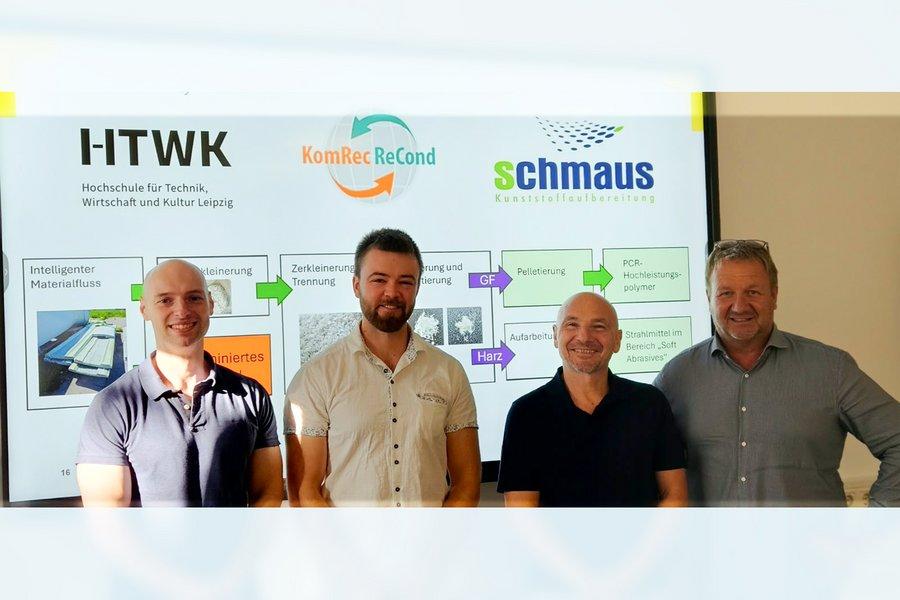
Blade2Poly Kick-Off Meeting on September 17, 2026, at the Composite Circularity Lab in Leipzig (from left to right): Andrej Fehler (HTWK), Dr. Philipp Johst (HTWK), Olaf Thannheiser (KomRec-ReCond), Christian Schmaus (Schmaus Kunststoffaufbereitung), Prof. Robert Böhm (HTWK – participating online, not pictured) © HTWK Leipzig © HTWK Leipzig
Blade2Poly Kick-Off Meeting on September 17, 2026, at the Composite Circularity Lab in Leipzig (from left to right): Andrej Fehler (HTWK), Dr. Philipp Johst (HTWK), Olaf Thannheiser (KomRec-ReCond), Christian Schmaus (Schmaus Kunststoffaufbereitung), Prof. Robert Böhm (HTWK – participating online, not pictured) © HTWK Leipzig
22.09.2026

Blade2Poly targets rotor blades for injection moulding

HTWK Leipzig has launched Blade2Poly with KomRec-ReCond and Schmaus Kunststoffaufbereitung to develop an energy-efficient recycling chain for end-of-life wind-turbine blades. The goal is to recover glass-fibre-reinforced plastics as higher-value secondary raw materials for new injection-moulding applications.

The route starts with material characterisation and categorisation, followed by mechanical processing, intelligent material-flow control and combination of recovered glass fibres with recycled polymers to create post-consumer recycled compounds.

Rotor blades are a demanding circularity case because large, durable composite structures must ultimately be converted into heterogeneous waste streams. Blade2Poly therefore addresses not only size reduction but the quality of recovered material and its compatibility with a new industrial process.

The collaborative R&D project runs from June 2026 to January 2029 under Germany's ZIM programme.

HTWK Leipzig has launched Blade2Poly with KomRec-ReCond and Schmaus Kunststoffaufbereitung to develop an energy-efficient recycling chain for end-of-life wind-turbine blades. The goal is to recover glass-fibre-reinforced plastics as higher-value secondary raw materials for new injection-moulding applications.
The route starts with material characterisation and categorisation, followed by mechanical processing, intelligent material-flow control and combination of recovered glass fibres with recycled polymers to create post-consumer recycled compounds.

Rotor blades are a demanding circularity case because large, durable composite structures must ultimately be converted into heterogeneous waste streams. Blade2Poly therefore addresses not only size reduction but the quality of recovered material and its compatibility with a new industrial process.

The collaborative R&D project runs from June 2026 to January 2029 under Germany's ZIM programme.

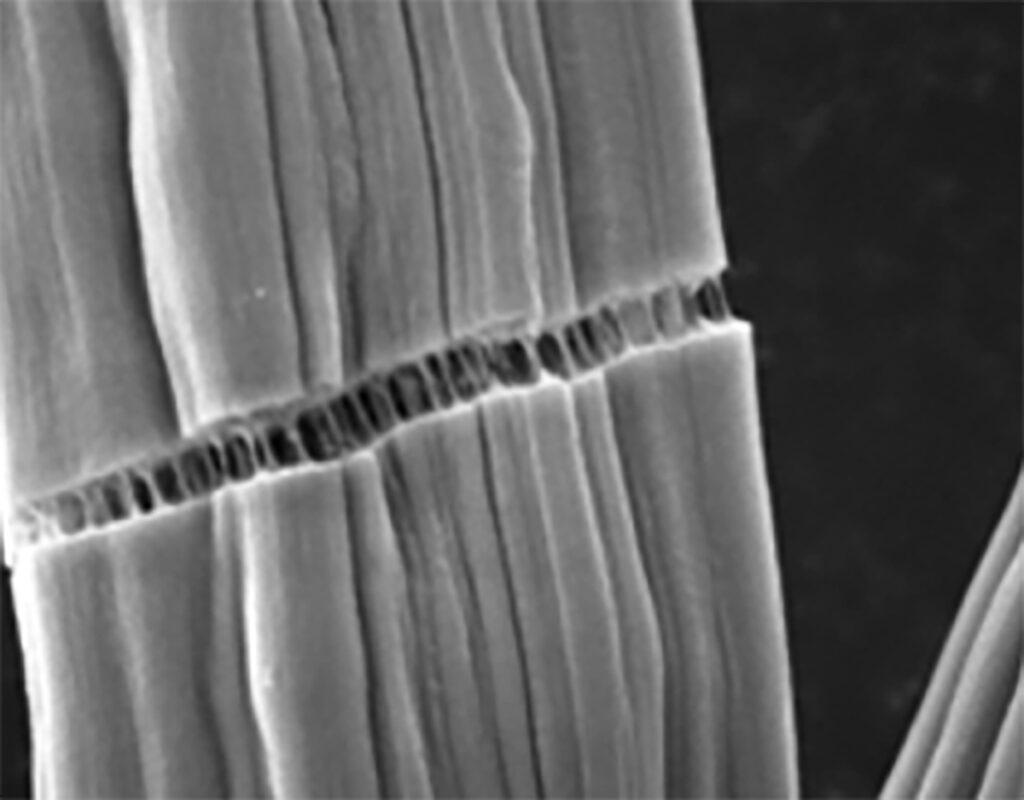
Microscopic “rebar” adds strength to a new kind of carbon fiber material that features functionalized single-walled carbon nanotubes. WashU engineers developed the manufacturing process to make use of the waste material lignin and to further strengthen carbon fiber for use in the automotive and energy industries. Photo: Yuan-Labor
Microscopic “rebar” adds strength to a new kind of carbon fiber material that features functionalized single-walled carbon nanotubes. WashU engineers developed the manufacturing process to make use of the waste material lignin and to further strengthen carbon fiber for use in the automotive and energy industries.
22.09.2026

Lignin cuts PAN content in carbon fibre

Researchers at Washington University in St. Louis have developed a route in which lignin replaces a substantial share of the polyacrylonitrile (PAN) normally used in carbon fibre. Lignin is generated in large volumes as a by-product of pulp and biorefinery operations. The university reports that PAN use can be cut by half, with corresponding potential reductions in production cost and emissions.

The central technical challenge is mechanical performance. The team functionalises single-walled carbon nanotubes and incorporates them into the lignin-PAN matrix. The nanotubes act as nanoscale reinforcement and promote stronger crystalline alignment during spinning and thermal treatment.

The precursor solution is wet-spun, tension-assisted heat-treated and carbonised. The researchers report that the resulting renewable carbon fibre can reach quality requirements relevant to automotive manufacturing. Aerospace, energy infrastructure, sporting goods and wind energy are cited as additional markets.

Researchers at Washington University in St. Louis have developed a route in which lignin replaces a substantial share of the polyacrylonitrile (PAN) normally used in carbon fibre. Lignin is generated in large volumes as a by-product of pulp and biorefinery operations. The university reports that PAN use can be cut by half, with corresponding potential reductions in production cost and emissions.

The central technical challenge is mechanical performance. The team functionalises single-walled carbon nanotubes and incorporates them into the lignin-PAN matrix. The nanotubes act as nanoscale reinforcement and promote stronger crystalline alignment during spinning and thermal treatment.

The precursor solution is wet-spun, tension-assisted heat-treated and carbonised. The researchers report that the resulting renewable carbon fibre can reach quality requirements relevant to automotive manufacturing. Aerospace, energy infrastructure, sporting goods and wind energy are cited as additional markets.

Source:

Washington University in St. Louis