
From the Sector

Reset
Danish partnership extends the lifespan of wool-nylon textiles Photo: Ben Kerckx, Pixabay
02.04.2026

Danish partnership extends the lifespan of wool-nylon textiles

Carpets and upholstery fabrics from ships and hotels have significant recycling potential that is not currently being fully utilised. A Danish partnership aims to change that.

Many offices, hotels, ships and other public spaces are fitted with carpets and upholstery fabrics made from wool-nylon blends. The combination of materials gives the products a very long lifespan, but complicates the recycling process when they are replaced. Manufacturers, researchers and knowledge partners have joined forces in the UnBlend partnership, which aims to make textiles easier to reuse and recycle.

Aiming to extend the lifespan of wool-nylon textiles
Tons of high-quality carpets and upholstery fabrics go up in smoke when offices, hotels, ships, libraries, theatres and other public spaces refurbish their interiors. In the EU alone, an estimated 1.6 million tonnes of carpets are disposed of every year, and the vast majority are incinerated or end up in landfill.

Carpets and upholstery fabrics from ships and hotels have significant recycling potential that is not currently being fully utilised. A Danish partnership aims to change that.

Many offices, hotels, ships and other public spaces are fitted with carpets and upholstery fabrics made from wool-nylon blends. The combination of materials gives the products a very long lifespan, but complicates the recycling process when they are replaced. Manufacturers, researchers and knowledge partners have joined forces in the UnBlend partnership, which aims to make textiles easier to reuse and recycle.

Aiming to extend the lifespan of wool-nylon textiles
Tons of high-quality carpets and upholstery fabrics go up in smoke when offices, hotels, ships, libraries, theatres and other public spaces refurbish their interiors. In the EU alone, an estimated 1.6 million tonnes of carpets are disposed of every year, and the vast majority are incinerated or end up in landfill.

The challenge with carpets and upholstery fabrics is that the textiles often consist of complex blended materials such as wool and nylon, which are currently difficult to recycle, even though the material quality is high. It’s a shame, says Business Manager Julie Brender Trads from Danish Technological Institute, who heads the UnBlend partnership:

– Wool-nylon blends are high-quality materials that are easily overlooked because they make up only a small part of the total textile stream. On the other hand, it is a large and uniform textile stream that can be collected when a hotel or ship changes its interior or undergoes renovation. A cruise ship can easily be covered with enough carpet to cover 5–10 football pitches. These large quantities are an advantage when the ambition is large-scale recycling.

From circular design to unique products
UnBlend takes a holistic approach to the challenge of wool-nylon blends. Rather than focusing solely on a single technical solution, the project partners are working in parallel on three tracks: better design, creative reuse and recycling technologies.

The design track explores how products can be constructed more intelligently, for example using fewer types of adhesive and more appropriate material combinations, facilitating later disassembly and recycling among other things. At the same time, the partners are experimenting with reusing and redesigning textile scraps into unique products. Finally, existing and new recycling technologies are being tested to find effective methods for separating wool and nylon, so that the two fibres can be recycled separately and returned to the cycle.

– If we succeed in separating wool and nylon effectively, we can ensure the continuous recycling of high-quality materials. By recycling materials in a closed loop, we can simultaneously reduce the environmental impact significantly compared to wool and nylon produced from new raw materials, says Jeppe Emil Mogensen, Design Director at the textile company Gabriel.

Interdisciplinary collaboration as a prerequisite
The UnBlend partnership was established by Danish Technological Institute, which has brought together textile manufacturers (Gabriel, Dansk Wilton, SheWorks), researchers and knowledge partners (DTU and Danish Technological Institute) and designers (Design School Kolding).

– For many years, we have been working in various ways on solutions within circularity and recycling, but there is a lack of commercial solutions for our type of material composition. That is why it is relevant for us to be part of UnBlend, which brings together many areas of expertise and enables new solutions, says Lone Ditmer, CEO at Dansk Wilton, a global manufacturer of carpets for the international hospitality industry.

About UnBlend
UnBlend is supported by just under DKK 11 million from TRACE and will run for two years. TRACE is a mission-driven research and innovation partnership working to create a circular economy for plastics and textiles by 2050.

Partners: Gabriel, SheWorks, Dansk Wilton, DTU, Design School Kolding and the Danish Technological Institute.

Wool-nylon blends are currently used in large quantities on cruise ships, in hotels, offices and public buildings, particularly in carpets and furniture upholstery. Yet tonnes of high-quality carpets and furniture textiles are sent for incineration or landfill when interiors are replaced.

Source:

Danish Technological Institute

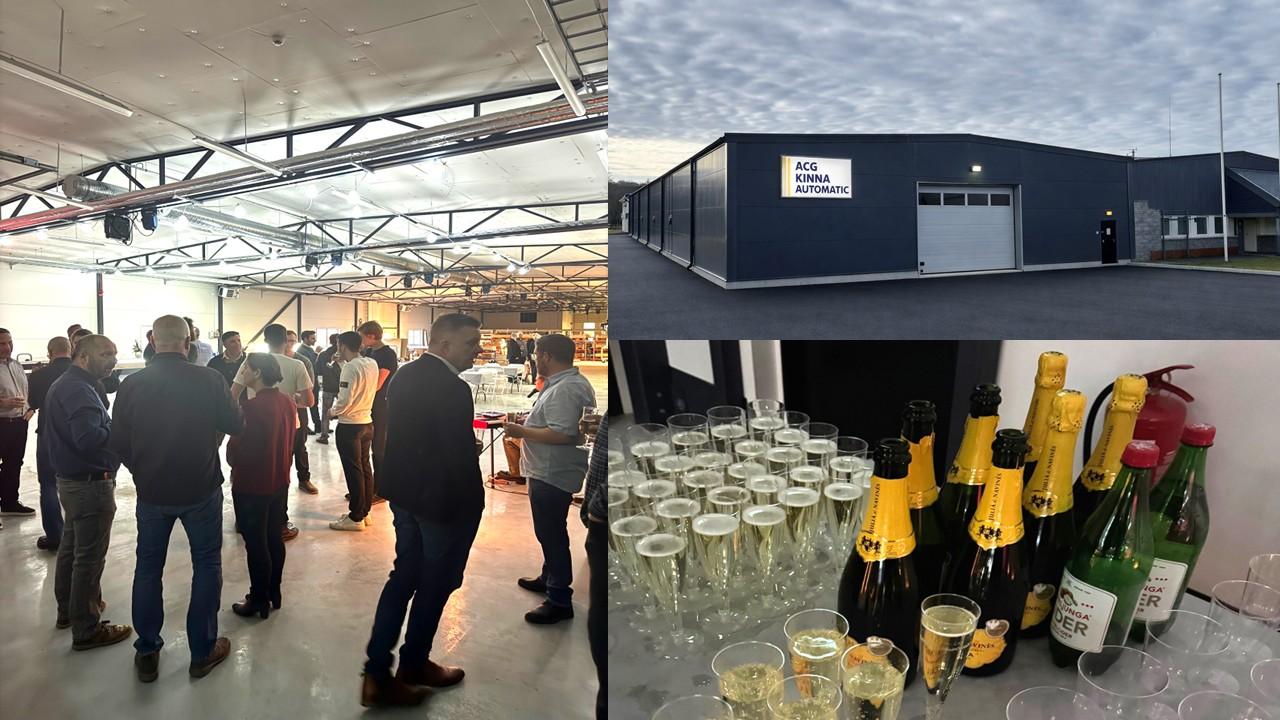
New plant and inauguration Photo ACG Kinna
24.03.2026

Major expansion for ACG Kinna follows record year

In response to growing demand for its full textile and finished product line automation services, ACG Kinna – a member of TMAS, the Swedish textile machinery association – has inaugurated a 1,000-square-metre expansion at its headquarters in Skene, Sweden.

“Following a number of acquisitions in recent years, we needed to either relocate or expand, and opted to remain here in Skene,” explains Sales and Marketing Manager Tomas Aspenskog. “The expansion is directly connected to our existing headquarters and is enabling us to relocate some staff to this centralised location, as well as providing plenty of additional specialised assembly space. It will improve logistics for us and simplify and speed up operations for the company, our suppliers and our customers.”

Automation benefits
ACG Kinna had a record year in 2025 as manufacturers of pillows and duvets for the home furnishings sector are increasingly recognising the benefits of full automation. 

In response to growing demand for its full textile and finished product line automation services, ACG Kinna – a member of TMAS, the Swedish textile machinery association – has inaugurated a 1,000-square-metre expansion at its headquarters in Skene, Sweden.

“Following a number of acquisitions in recent years, we needed to either relocate or expand, and opted to remain here in Skene,” explains Sales and Marketing Manager Tomas Aspenskog. “The expansion is directly connected to our existing headquarters and is enabling us to relocate some staff to this centralised location, as well as providing plenty of additional specialised assembly space. It will improve logistics for us and simplify and speed up operations for the company, our suppliers and our customers.”

Automation benefits
ACG Kinna had a record year in 2025 as manufacturers of pillows and duvets for the home furnishings sector are increasingly recognising the benefits of full automation. 

Under its trademarked slogan ‘Complete Process – One Supplier’, the company has pioneered the development of complete robotic pillow lines from the handling and opening of filling material to sewing, digital quality control and packaging.

In parallel, ACG Kinna is also now making further inroads into the finished filter bag market and will be demonstrating its latest advances in this field at the forthcoming Filtech 2026 exhibition in Cologne, Germany from June 30th to July 2nd.

Acquisitions growth
Part of the highly diversified and still family owned ACG Group since 2013, ACG Kinna significantly expanded its services five years ago, with the acquisition of Finland-based Nowo Machinery, the long-established specialist in technologies for fibre and raw material processing and manufacturer of the highly successful Nowo pillow filling system and ball fibre machines. 

More recently, the acquisitions of two other Swedish companies, EyeTech, a developer of machine vision solutions for manufacturing, warehouse and factory automation, and Styrteknik Europe, a manufacturer of industrial sewing machines for home furnishings, has further expanded ACG Kinna’s scope of offered services.

Source:

ACG Kinna

17.03.2026

Deemed Importer obligations must not be delayed to 2028

16 industry associations published a joint statement on deemed importer obligations to urge the EU and its Member States to put in place such a Regulation without delay:

European traders and industry are deeply concerned about the rise of imports of small consignments. The introduction of the ‘deemed importer’ in 2028 comes too late. We call upon the EU and its Member States to introduce a legal obligation on foreign operators to appoint a legally responsible person or entity in the EU for e-commerce imports without any further delay. 

The extraordinary growth of e-commerce in recent years has led to an exponential number of small packages of low-valued goods entering the EU, each of which needs to be accompanied by an individual customs declaration since the entry into force of new VAT rules for e-commerce in 2021. In 2022, for example, almost 1 billion customs declarations for low-value goods were filed. The sheer volumes of e-commerce are testing customs' limits. 

16 industry associations published a joint statement on deemed importer obligations to urge the EU and its Member States to put in place such a Regulation without delay:

European traders and industry are deeply concerned about the rise of imports of small consignments. The introduction of the ‘deemed importer’ in 2028 comes too late. We call upon the EU and its Member States to introduce a legal obligation on foreign operators to appoint a legally responsible person or entity in the EU for e-commerce imports without any further delay. 

The extraordinary growth of e-commerce in recent years has led to an exponential number of small packages of low-valued goods entering the EU, each of which needs to be accompanied by an individual customs declaration since the entry into force of new VAT rules for e-commerce in 2021. In 2022, for example, almost 1 billion customs declarations for low-value goods were filed. The sheer volumes of e-commerce are testing customs' limits. 

Many of the products arriving here contravene the rules in force in the EU. Infringements like VAT fraud, breaching health and safety EU standards, violation of intellectual property rights and misleading claims fuel unfair competition within the Single Market, disadvantaging businesses that follow the EU’s high standards. Such unfair trade practices, linked to small consignments, are corroding entire industrial value chains, eroding our economic strength and resilience and put the consumer health at risk. Additionally, they threaten shops all over the EU, accelerating the depopulation of town centres. 

Against this background, we welcome that the EU, with the new Union Customs Code (UCC), plans to introduce the so-called “deemed importer”, i.e. holding platforms responsible for ensuring that customs duties and VAT are paid at purchase as well as for non-financial obligations. 

However, if the “deemed importer” is introduced only in 2028, this will come too late. In 2025 alone, 5.8 billion parcels were imported into the EU. In the coming years, the pressure on our industries of competing with non-compliant traders which bear no responsibility for non-compliance, will mount to an unbearable extent and threaten the livelihood of even more economic operators, with massive consequential job losses. 

The introduction of an obligation to appoint a legally responsible person or entity in the European Union who can be held accountable is long overdue. This can be established much earlier than 2028 by a simple EU Regulation at short notice, long before the ‘deemed importer’ and other elements of the UCC are introduced. Technically easily feasible, it is just a question of political will. 

We also acknowledge the forthcoming European Product Act, which aims to further strengthen the overall framework for product compliance and market surveillance. We stress that compliance with European Union Extended Producer Responsibility (EPR) obligations must be effectively enforced, including in relation to online sales and third-country sellers. Online marketplaces and any legally responsible EU representative should be subject to clear and binding enforcement mechanisms to ensure that products placed on the EU market comply with applicable EPR requirements (including packaging, WEEE, batteries and textiles), thereby preventing free-riding and safeguarding a level playing field. These initiatives will only deliver their full effect in the medium term. 
If properly defined and implemented, these new concepts have the potential to help address gaps in online product compliance. 

List of Signatories:
Applia – Home Appliance Europe
CEC – European Footwear Confederation
Cosmetics Europe - The personal care association
EBCA - European Branded Clothing Association
ECOS – European Coalition on Standards
EFIC - European Furniture Industries Confederation
EURATEX - European Apparel and Textile Confederation
EXPRA – Extended Producer Responsibility Alliance
Independent Retail Europe
LightingEurope – The voice of the Lighting Industry
Repair&Share
Svensk Handel – Swedish Commerce
TIE - Toy Industries of Europe
WEEE Forum
ZERO – Associação Sistema Terrestre Sustentável
EucoLight

Source:

European Apparel and Textile Confederation EURATEX

13.03.2026

WACKER to raise prices for Polymers’ product range

The recent military conflict in the Middle East has led to significant distortions in commodity markets worldwide. Consequently, prices for oil, natural gas, raw materials and logistics have significantly risen. WACKER’s global polymers business is especially affected by this development. 

To compensate higher raw material and freight costs, WACKER will significantly raise its prices for polymer dispersions, resins and dispersible polymer powders, effective from April 1, 2026. The extent of the necessary price adjustment depends on where the respective product is sourced and on existing contractual agreements. Primarily products sourced at WACKER’s production sites in Europe and Asia are affected by the increase.

The recent military conflict in the Middle East has led to significant distortions in commodity markets worldwide. Consequently, prices for oil, natural gas, raw materials and logistics have significantly risen. WACKER’s global polymers business is especially affected by this development. 

To compensate higher raw material and freight costs, WACKER will significantly raise its prices for polymer dispersions, resins and dispersible polymer powders, effective from April 1, 2026. The extent of the necessary price adjustment depends on where the respective product is sourced and on existing contractual agreements. Primarily products sourced at WACKER’s production sites in Europe and Asia are affected by the increase.

More information:
Wacker polymers pricing
Source:

Wacker Chemie AG

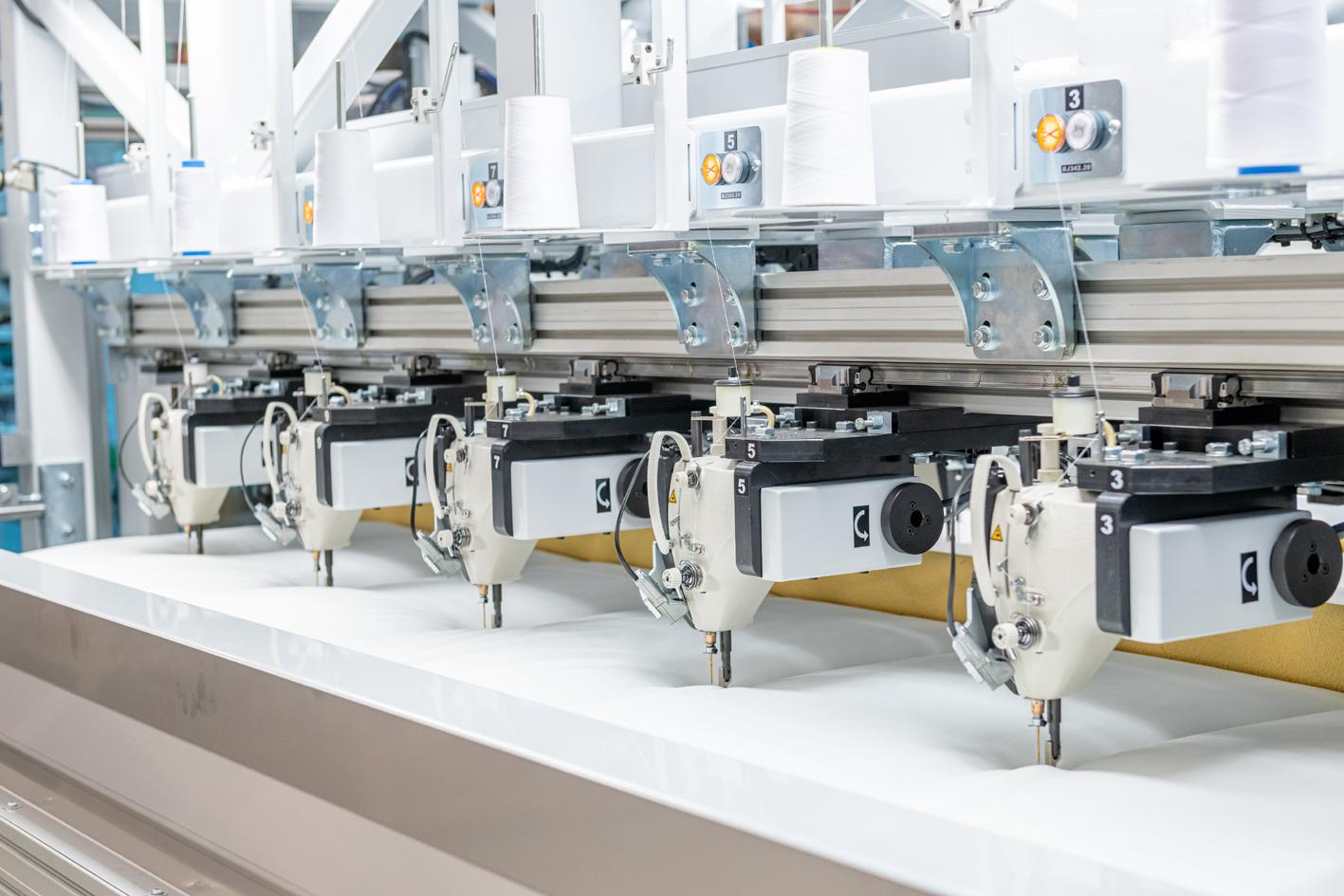
The quilting module is equipped with twelve modified servo-driven lock stitch sewing heads. Photo AWOL
The quilting module is equipped with twelve modified servo-driven lock stitch sewing heads.
11.03.2026

New quilting machine doubles productivity

Having achieved rapid market success with its fully automated fitted sheet system, Automatex, a member of TMAS, the Swedish textile machinery association, has developed a quilting machine which doubles productivity compared to what has previously been achievable.

The P12-PB Automatic Lock Stitch Quilting Unit is engineered to deliver continuous, programmable quilting while reducing manual intervention in the stitching of bedding and padded home textiles.

“Across our member companies we are seeing automation move beyond individual machines towards intelligent, interconnected production environments,” says TMAS General Secretary Therese Premler-Andersson. “Solutions like this demonstrate how textile technology manufacturers are pushing the boundaries of consistency, productivity and digital control in areas that were traditionally dependent on operator skill.”

Having achieved rapid market success with its fully automated fitted sheet system, Automatex, a member of TMAS, the Swedish textile machinery association, has developed a quilting machine which doubles productivity compared to what has previously been achievable.

The P12-PB Automatic Lock Stitch Quilting Unit is engineered to deliver continuous, programmable quilting while reducing manual intervention in the stitching of bedding and padded home textiles.

“Across our member companies we are seeing automation move beyond individual machines towards intelligent, interconnected production environments,” says TMAS General Secretary Therese Premler-Andersson. “Solutions like this demonstrate how textile technology manufacturers are pushing the boundaries of consistency, productivity and digital control in areas that were traditionally dependent on operator skill.”

Maximising uptime
Designed for high-volume manufacturers, the new P12-PB platform feeds fabric and filling directly into a quilting module equipped with twelve modified servo-driven lock stitch sewing heads. Arranged in two programmable banks of six, the heads allow producers to switch between straight line quilting and different shaped patterns without mechanical changeover, enabling flexible production runs while maintaining consistent stitch geometry. 

At the core of the Automatex system is an automation architecture focused on maximising uptime. Each sewing head incorporates an automatic bobbin case changer supported by a retrieval system, allowing uninterrupted production during thread depletion. Thread break detectors further minimise defects, while servo indexing ensures accurate needle positioning across the working width. A colour touch screen interface simplifies pattern programming and machine operation and remote access capability enables troubleshooting and technical support without on-site intervention. 

Operating at speeds of up to 12 metres per minute, the P12-PB is suitable for filling weights from 100-450 gsm with stitch lengths between 3-4 mm. The machine produces various stitching patterns and straight lines at 21.7 cm needle spacing, supporting a wide range of quilt constructions. It has been engineered for installation within standard industrial utility frameworks. 

“The P12-PB can be connected directly in-line with our automated sewing and folding systems to form a continuous production chain, from fibre processing through to finished product handling,” says Automatex Director of Business Development Chuck deSousa. 

Source:

Automatex 

UNIFI®: A Linen-Inspired, Easy-Care Performance Yarn Image: UNIFI
UNIFI®: A Linen-Inspired, Easy-Care Performance Yarn
06.03.2026

UNIFI introduces Luxel™: A linen-inspired, easy-care performance yarn

UNIFI, Inc. launches Luxel™, a yarn technology that combines the luxurious look and feel of linen with high-performance, easy-care, and textile-to-textile recycled materials. 

Luxel captures the natural look and feel of linen while offering advanced performance features such as moisture-wicking, wrinkle resistance, and odor control. This innovative technology is built directly into the yarn, providing exceptional versatility across a wide range of fabric constructions ranging from apparel and footwear to home furnishings, work wear, and accessories, empowering material developers to innovate across multiple categories with ease. 

Luxel is available globally and made with REPREVE recycled polyester yarn, including 30% REPREVE Takeback™, reinforcing UNIFI®’s commitment to sustainability and circularity in the textile industry. By incorporating recycled content, including textile waste, Luxel helps brands reduce environmental impact while delivering high-performance, stylish fabrics. 

Key Benefits of Luxel: 

UNIFI, Inc. launches Luxel™, a yarn technology that combines the luxurious look and feel of linen with high-performance, easy-care, and textile-to-textile recycled materials. 

Luxel captures the natural look and feel of linen while offering advanced performance features such as moisture-wicking, wrinkle resistance, and odor control. This innovative technology is built directly into the yarn, providing exceptional versatility across a wide range of fabric constructions ranging from apparel and footwear to home furnishings, work wear, and accessories, empowering material developers to innovate across multiple categories with ease. 

Luxel is available globally and made with REPREVE recycled polyester yarn, including 30% REPREVE Takeback™, reinforcing UNIFI®’s commitment to sustainability and circularity in the textile industry. By incorporating recycled content, including textile waste, Luxel helps brands reduce environmental impact while delivering high-performance, stylish fabrics. 

Key Benefits of Luxel: 

  • Luxurious feel and breathability: Delivers a natural, linen-inspired texture with a smooth finish. 
  • Enhanced function and performance: Provides moisture management and built-in odor control for effortless maintenance. 
  • Wrinkle resistance: Maintains a polished, fresh appearance with minimal effort. 
  • Sustainable and traceable: Made with REPREVE recycled polyester including 30% REPREVE Takeback circular polyester embedded with our proprietary FiberPrint® tracer technology and verified by U-TRUST® to certify recycled content.