From the Sector

Reset
Graphic Futureprint
15.01.2026

Industrial Inkjet Print Technology Showcase in Munich

As manufacturers look for new growth, margins and business models, industrial print emerges as a profit-enabling production platform
 
A new sold-out industrial inkjet print showcase taking place in Munich this month is sending a clear signal that industrial print technologies are entering a new phase of commercial adoption, as manufacturers increasingly integrate inkjet into production-scale environments.
 
FuturePrint Industrial Print, which takes place on 21–22 January 2026, has officially sold out all exhibitor space ahead of its inaugural edition. The response reflects growing global demand for production-ready industrial inkjet technologies across packaging, décor, electronics, product customisation and functional manufacturing.
 

As manufacturers look for new growth, margins and business models, industrial print emerges as a profit-enabling production platform
 
A new sold-out industrial inkjet print showcase taking place in Munich this month is sending a clear signal that industrial print technologies are entering a new phase of commercial adoption, as manufacturers increasingly integrate inkjet into production-scale environments.
 
FuturePrint Industrial Print, which takes place on 21–22 January 2026, has officially sold out all exhibitor space ahead of its inaugural edition. The response reflects growing global demand for production-ready industrial inkjet technologies across packaging, décor, electronics, product customisation and functional manufacturing.
 
Industry analysts forecast strong sustained growth for the sector. Market research from Fortune Business Insights indicates that the global industrial inkjet printer market is projected to reach nearly USD 12 billion by 2034, driven by accelerating adoption across manufacturing, packaging, product decoration and industrial production environments. Against this backdrop, the sell-out highlights a market that is moving beyond pilots and proofs of concept, toward scalable deployment, strategic investment and measurable commercial impact.
 
For manufacturers, converters and technology providers, this shift represents a major business and profit opportunity. Industrial print is no longer simply an alternative imaging process. It is increasingly a manufacturing platform that can reshape how products are designed, produced and monetised.
 
Crucially, industrial inkjet is now being adopted not only to improve efficiency, but to improve manufacturing economics. By removing tooling constraints, reducing set-up times, cutting waste and enabling late-stage differentiation, industrial inkjet technology is allowing companies to respond profitably to shorter runs, unlock premium pricing, protect margins and make complex, customised or functional products commercially viable at scale.
 
For manufacturing performance, the real opportunity lies in what industrial inkjet makes possible. From mass customisation and digital inventory to functional integration and direct-to-product manufacturing, industrial inkjet is opening routes to new revenue streams, higher-value applications and entirely new business models. For converters and print businesses, this includes a pathway into manufacturing services and higher-margin industrial markets. For manufacturers, it enables faster product innovation, more responsive supply chains and the ability to monetise speed, flexibility and product differentiation.
 
The exhibitor profile in Munich reflects this shift. More than 50 selected companies are presenting technologies spanning additive and functional inkjet, direct-to-product manufacturing, decorative surfaces, packaging, labels and direct-to-shape production. For visitors, this creates a rare opportunity to evaluate enabling technologies side-by-side, explore real manufacturing applications and identify where industrial print is already delivering commercial value.
 
Alongside the exhibition, a high-level conference programme brings together 40+ speakers from across the industrial print and advanced manufacturing ecosystem, addressing real-world deployment across electronics, 3D inkjet, décor, packaging and smart surfaces. A dedicated AI for Industrial Print Conference on 22 January examines how artificial intelligence is amplifying industrial print’s business impact, from automation and predictive quality control to throughput optimisation and data-driven production decision-making. For delegates, the emphasis is firmly on practical insight linked to commercial outcomes.
 
The strong response to this new Munich event also reflects a broader change in buyer behaviour. Decision-makers now arrive informed, commercially focused and actively evaluating where digital processes can deliver competitive advantage, revenue growth and margin improvement. As a result, demand is growing for focused, insight-led events that connect technology capability directly to manufacturing strategy and profit potential.
 
Hosted at Motorworld Munich inside the historic Kohlebunker venue, FuturePrint Industrial Print has been designed around this need - offering an industrial, human-scale setting intended to support in-depth technical exchange, peer-to-peer learning and strategic discussion between technology developers and end-user manufacturers.
 
With exhibitor space fully booked and delegate registrations accelerating from across the global manufacturing ecosystem, the sell-out is being widely viewed as a further indication that industrial inkjet is moving into a new phase of relevance - not as a future option, but as a present-day driver of profitable manufacturing models.
 
FuturePrint Industrial Print takes place 21–22 January 2026 at Motorworld Munich. Attendance is limited and advance registration is strongly recommended.

Source:

Futureprint

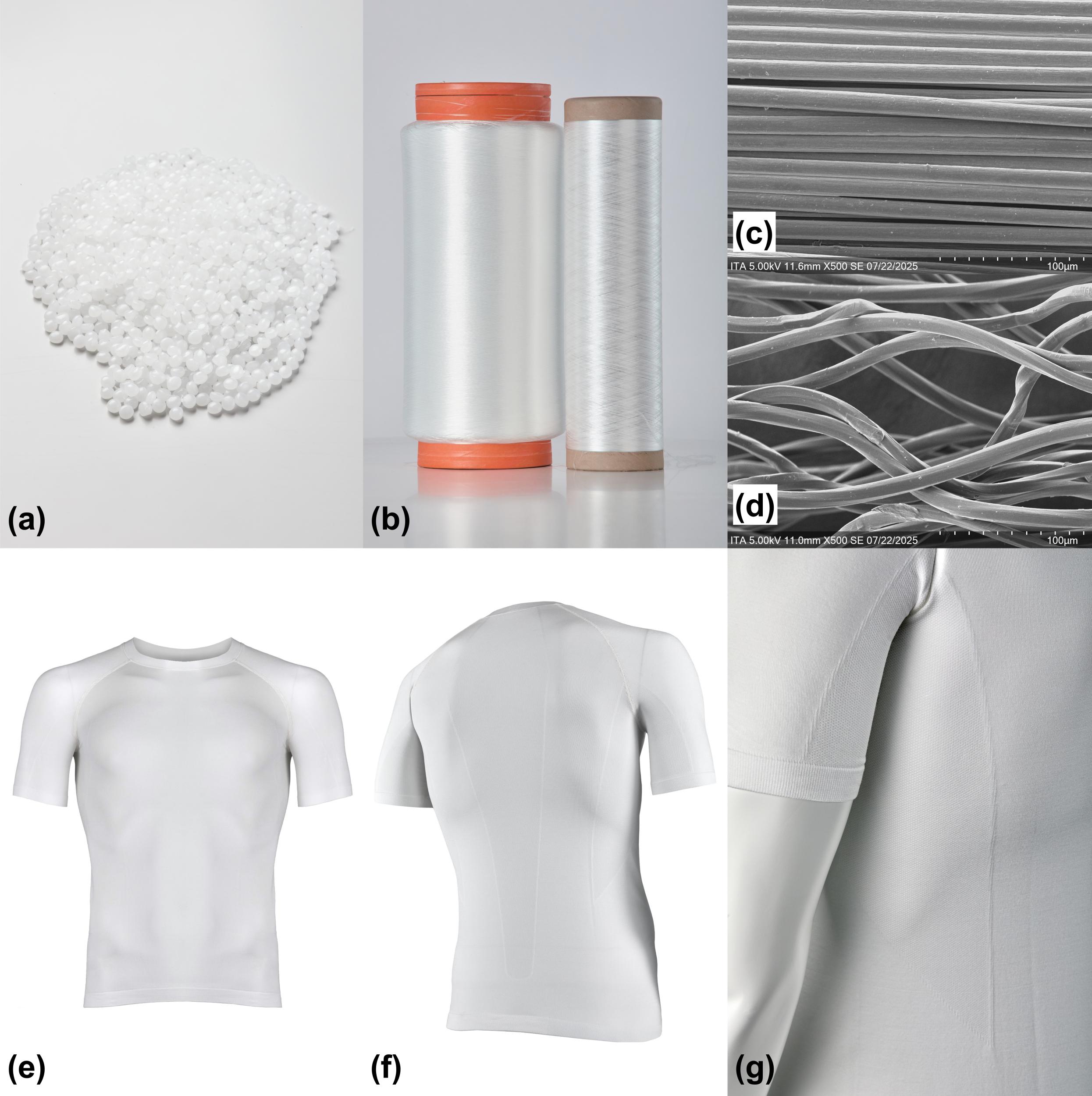
(a) bioPE granule, source: FALKE; (b) bioPE-POY and bioPE-DTY, source: FALKE; (c) REM image of bioPE-POY, source: ITA; (d) REM image of bioPE-DTY, source: ITA; (e) T-shirt made primarily from bioPE yarns (front), source: FALKE; (f) Back of the T-shirt, source: FALKE; (g) Close-up of the T-shirt, source: FALKE
15.01.2026

Sustainable Athletic Wear Made from Bio-Based Polyethylene

Conventional sports textiles made from petroleum-based synthetic fibres are to be replaced in the future by sustainable, bio-based, cooling textiles. Polyethylene, previously used mainly in the packaging industry, is thus qualified for use in textiles and, as a bio-based drop-in solution, offers a cost-effective, sustainable alternative for the future.

TECNARO (Ilsfeld/Germany), BB Engineering (Remscheid/Germany), FALKE (Schmallenberg/Germany) and the Institut für Textiltechnik (ITA) of RWTH Aachen University have developed textiles from bio-based polyethylene (bioPE) in the bioPEtex project of the BIOTEXFUTURE Innovation Space.

TECNARO develops the bio-based PE compounds and handles their dyeing. ITA is concentrating on the process development for melt spinning (partially-oriented yarn, POY) and false-twist texturing (draw-textured yarn, DTY) of the bioPE yarns. BB Engineering implements the false-twist texturing on an industrial scale, and FALKE is developing the final T-shirt, which will be treated with a bio-based finish for improved elasticity.

Conventional sports textiles made from petroleum-based synthetic fibres are to be replaced in the future by sustainable, bio-based, cooling textiles. Polyethylene, previously used mainly in the packaging industry, is thus qualified for use in textiles and, as a bio-based drop-in solution, offers a cost-effective, sustainable alternative for the future.

TECNARO (Ilsfeld/Germany), BB Engineering (Remscheid/Germany), FALKE (Schmallenberg/Germany) and the Institut für Textiltechnik (ITA) of RWTH Aachen University have developed textiles from bio-based polyethylene (bioPE) in the bioPEtex project of the BIOTEXFUTURE Innovation Space.

TECNARO develops the bio-based PE compounds and handles their dyeing. ITA is concentrating on the process development for melt spinning (partially-oriented yarn, POY) and false-twist texturing (draw-textured yarn, DTY) of the bioPE yarns. BB Engineering implements the false-twist texturing on an industrial scale, and FALKE is developing the final T-shirt, which will be treated with a bio-based finish for improved elasticity.

The successful creation of a first T-shirt from the yarns developed in this project underscores their promising characteristics. This represents a key milestone and forms the basis for investigating potential market readiness in subsequent phases. Above all, the white BioPE T-shirt impresses with its pleasantly cool and soft touch. However, additional development, characterisation, and optimisation steps are necessary to make a market introduction possible.

Source:

ITA – Institut für Textiltechnik of RWTH Aachen University

International Textile Machinery Exhibition Photo International Textile Machinery Exhibition
15.01.2026

ITM 2026: Green Transformation and Digital Future in the Textile Industry

Shaping the transformation of the textile industry, the ITM 2026 International Textile Machinery Exhibition is set to lead the sector into the future with a strong focus on sustainable production and digital technologies. From environmentally friendly machinery to smart manufacturing systems, from energy-efficient solutions to artificial intelligence–supported applications, ITM 2026 will present a broad vision that defines the roadmap of textile technologies for the industry.

The ITM 2026 Exhibition, which will be organized in collaboration with Tüyap Tüm Fuarcılık Yapım A.Ş. and Teknik Fuarcılık A.Ş. and in partnership with Textile Machinery and Accessories Industrialists Association (TEMSAD), will welcome visitors at the Tüyap Fair and Congress Center from June 9–13, 2026. Bringing together leading manufacturers of textile technologies, ITM 2026 will focus this year on the industry’s two most critical agenda items: Green Technologies and Digital Integration.

Shaping the transformation of the textile industry, the ITM 2026 International Textile Machinery Exhibition is set to lead the sector into the future with a strong focus on sustainable production and digital technologies. From environmentally friendly machinery to smart manufacturing systems, from energy-efficient solutions to artificial intelligence–supported applications, ITM 2026 will present a broad vision that defines the roadmap of textile technologies for the industry.

The ITM 2026 Exhibition, which will be organized in collaboration with Tüyap Tüm Fuarcılık Yapım A.Ş. and Teknik Fuarcılık A.Ş. and in partnership with Textile Machinery and Accessories Industrialists Association (TEMSAD), will welcome visitors at the Tüyap Fair and Congress Center from June 9–13, 2026. Bringing together leading manufacturers of textile technologies, ITM 2026 will focus this year on the industry’s two most critical agenda items: Green Technologies and Digital Integration.

A Climate-Friendly Future in Textiles Takes Shape at ITM 2026
In line with global climate goals, the textile industry is undergoing a profound transformation. As a pioneer of this change, ITM 2026 will bring visitors a wide range of innovations—from dyeing technologies that minimize water consumption to weaving looms engineered for maximum energy efficiency. The “Green Machines” to be showcased throughout the exhibition will not only reduce carbon footprints but will also breathe new life into the circular economy with their superior performance in processing recycled raw materials.

Sustainable Production at the Center of ITM 2026
At a time when environmental responsibility is gaining increasing importance on a global scale, sustainable production in the textile industry is no longer a choice but a necessity. ITM 2026 will showcase the most tangible examples of this transformation. Durable, high-performance machines that contribute to the conservation of natural resources will form the backbone of the exhibition’s green technology vision. Energy-saving systems, solutions enabling closed-loop water usage and environmentally responsible chemical applications will strongly reflect ITM 2026’s sustainability approach. The exhibition will offer manufacturers the opportunity to explore technologies that create added value both environmentally and economically.

The Latest Technologies from Artificial Intelligence to Digital Twins 
ITM 2026 will highlight the transformative power of digitalization in textile manufacturing. Machines equipped with artificial intelligence, automation, data analytics, and digital twin technologies will stand out with solutions that deliver speed, quality, and flexibility in production. Through digital integration, real-time process monitoring, increased efficiency, and reduced error rates will become achievable. Playing a critical role in the transition to smart factories, these technologies will not only be showcased at ITM 2026 but will also provide an inspiring platform for knowledge and experience sharing among industry professionals.

A Strategic Platform for Global Investors
Bringing together the world’s leading textile machinery manufacturers, industry representatives, investors, and professionals in Istanbul, the ITM 2026 Exhibition will serve as a strategic business development platform for global investors. Company owners and industry professionals will have the opportunity to hear directly from experts about the latest technological solutions needed to future-proof their facilities and to experience next-generation R&D developments firsthand. Visitors will be able to closely explore innovations developed around sustainability and digital transformation in the textile industry, enabling them to make informed decisions that shape their investments.