
From the Sector

Reset
11 results
Photo: (c) UK Fashion & Textile Association UKFT
18.11.2026

UKFT seeks export grants and stronger overseas business networks

The UK Fashion & Textile Association is asking the British government to restore direct support for exporters, particularly small businesses and emerging brands. In evidence submitted to a House of Commons committee, UKFT identifies customs costs, VAT that businesses cannot recover, regulatory complexity and high domestic manufacturing costs as obstacles to international sales.

The association wants financial assistance for participation in overseas trade fairs, stronger commercial expertise in embassies and consulates, and better access to buyers and agents. It argues that trade promotion and new agreements need practical support if companies are to turn market opportunities into orders.

UKFT also calls for changes to the operation of trade agreements, including rules of origin and the treatment of import VAT. Its concerns include British brands that manufacture collections outside the UK and face additional barriers when selling into the EU.

The campaign is supported by Export Partners UK, chaired by UKFT’s Paul Alger. The organisation brings together more than 30 trade associations. Its members represent over 7,000 companies and organise trade-fair participation, market visits and other export activities. It is calling for grants and better-resourced embassy and consulate teams to help smaller firms compete internationally.

17.11.2026

EURATEX and 3 Egyptian textile associations sign Memorandum of Understanding

The European Apparel and Textile Confederation (EURATEX) has signed a Memorandum of Understanding (MoU) with three leading Egyptian industry organisations: the Apparel Export Council of Egypt (AEC), the Textile Export Council of Egypt (TEC) and the Egyptian Exporters Association (EXPOLINK). 

The agreement was signed in Cairo during Destination Africa 2026, one of the region's major textile and apparel trade events, in the presence of EURATEX President Mario Jorge Machado and representatives of the Egyptian textile industry. 

The MoU marks an important step towards strengthening cooperation between the European and Egyptian textile and clothing sectors, with a shared objective of improving competitiveness, facilitating investment and developing more resilient and sustainable value chains. 

Under the agreement, the four organisations will work together on several priorities, including: 

  • Sustainability and regulatory cooperation: supporting Egyptian manufacturers in understanding and complying with European legislation, including requirements on circularity, waste management and Digital Product Passports. 
  • Industrial transformation: promoting sustainable production practices and advocating for an Industrial Greening Fund to support the sector's green transition. 
  • Trade and investment: facilitating business-to-business contacts, encouraging partnerships between European and Egyptian manufacturers and addressing customs-related challenges. 
  • Innovation and skills: exchanging industrial expertise, developing training initiatives and exploring joint participation in European projects. 

To ensure concrete follow-up, the agreement establishes a Joint Committee on Textiles and Clothing, which will meet at least twice a year to identify common priorities, develop projects and monitor cooperation. 

The partnership also reflects a broader ambition to reinforce economic relations across the Euro-Mediterranean region. With increasingly interconnected supply chains and growing demand for sustainable production, closer industrial cooperation can help European and Mediterranean manufacturers respond to common challenges while creating new business opportunities. 

Mario Jorge Machado, President of EURATEX, commented: 
"Egypt is an increasingly important partner for the European textile and clothing industry. At a time when our companies face increased global competition and pressure to transform their production models, strengthening cooperation with our Mediterranean neighbours is a strategic priority. This agreement is about creating concrete opportunities for businesses on both sides, supporting investment and building a more competitive and sustainable Euro-Mediterranean textile value chain."

Adrian Wilson
17.11.2026

Special TMAS forum aims to strengthen ties with India

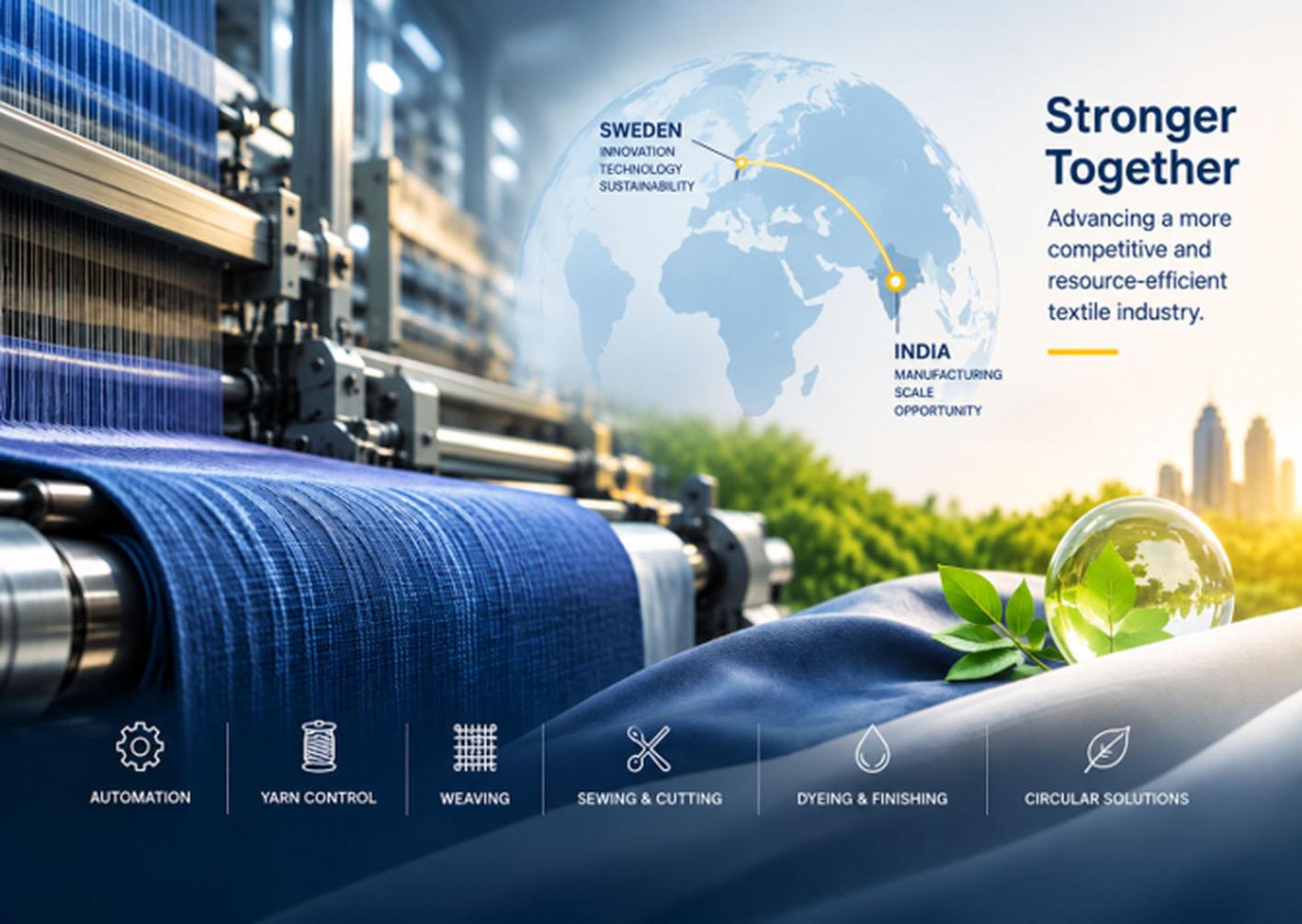
Leading Swedish textile technology companies will showcase their latest developments at the Sweden-India Textile Technology & Innovation Forum which will take place on Monday December 7th, 2026, at the India Expo Centre & Mart in Greater Noida.

Organised by Business Sweden and TMAS – the Swedish textile machinery association – the event will be held alongside India ITME 2026, in collaboration with the Confederation of Indian Textile Industry (CITI). 

It will bring together Swedish technology suppliers, Indian textile manufacturers, international brands and industry representatives to explore investment needs, technological developments and new business opportunities.

A key market 
“As one of the world’s largest textile manufacturing countries, India’s leading companies are now looking to invest in automation and more resource-efficient production and the demand for advanced manufacturing technology is creating opportunities for specialised Swedish suppliers,” says Therese Premler-Andersson, Secretary General of TMAS. “Developing business in a market like India, however, requires the right contacts and a good understanding of local needs, which is exactly what we want to support through this initiative.”

Meeting industry needs
The technology requirements and investment priorities of India’s textile industry will be first on the agenda, followed by a panel discussion between well-known Swedish fashion brands including Lindex and Rusta, exploring what international brands expect from their manufacturing partners.

A dedicated Swedish Technology Showcase will give each participating company an opportunity to present its innovations and applications for the Indian market.

The participating companies – ACG Kinna Automatic, BW Converting, Eltex ES Automatex, imogo and Vandewiele Sweden have developed highly automated and resource-efficient technologies relevant to several areas of textile production.

Their solutions include precision spray technology for dyeing and finishing, automated cutting and sewing, production systems for home and technical textiles, yarn feeding systems and electronic yarn monitoring and control.

Together, the companies demonstrate how specialised Swedish technology is contributing to more efficient, competitive and resource-conscious textile manufacturing.

The afternoon will conclude with business networking, providing opportunities for direct discussions.

The initiative forms part of the India-Sweden Sustainability Partnership, a Team Sweden initiative supporting collaboration between Swedish companies and Indian stakeholders.

“By working with Business Sweden and Indian industry organisations, we can reach the companies most likely to benefit from the technologies of our members, ” Premler-Andersson concludes. “Our ambition is to turn these meetings into long-term business relationships.”

About the event:
Sweden-India Textile Technology & Innovation Forum
Date: 7 December 2026
Time: 14:00–17:00 IST
Venue: Sapphire Hall 2, India Expo Centre & Mart, Greater Noida, India

Source:

Adrian Wilson

09.11.2026

INDA: New Name for International Fiber Journal

The magazine will become Fibers&Nonwovens in January 2027, reflecting its established coverage of fiber innovation and the global nonwovens industry.

INDA, the Association of the Nonwoven Fabrics Industry, and its publishing arm INDA Media announced that International Fiber Journal (IFJ) will become Fibers&Nonwovens with Issue 1, 2027. The new name reflects the magazine’s longstanding focus on fiber innovation and its coverage of the materials, technologies and markets shaping the global nonwovens industry.

Under its new name, the magazine will continue to deliver the industry reporting, market insights and technical perspectives that IFJ readers rely on.

“Fibers, materials science, nonwovens and engineered materials have long been part of the same story for our readers,” said Rachael Davis, publisher and chief content officer, INDA Media. “An advance in fiber technology can change how a nonwoven is made, how it performs and where it can be used. Our job is to follow those connections and help readers understand what new developments mean for their work. The name Fibers&Nonwovens makes that editorial focus clear while carrying forward the technical reporting and industry perspectives readers have come to expect from International Fiber Journal.”

INDA acquired International Fiber Journal and International Filtration News in October 2018. At the time, IFJ covered man-made fibers, technical textiles and nonwovens, connecting producers of engineered materials and machinery with fiber and yarn users in more than 90 countries.

Current subscribers will continue to receive the new magazine without interruption. 

Source:

INDA Association of the Nonwoven Fabrics Industry

26.10.2026

INDA announces finalists for 2026 Hygienix Innovation Award™

INDA, the Association of the Nonwoven Fabrics Industry, today announced the finalists for the 2026 Hygienix Innovation Award™: Anabio Technologies, Confitex Technology, The LYCRA Company and Youth Crews.

The finalists will present their innovations at Hygienix, an annual event for absorbent hygiene professionals, Nov. 16-19 at the Hyatt Regency Houston. The winner will be announced Thursday, Nov. 19, at 11:30 a.m.

Anabio Technologies: Flushable Sanitary Pad
Every sanitary pad used today can outlive us by an estimated 500 years. Anabio’s patented flushable pad changes that. Its multilayer architecture protects for 12 hours, then disperses when flushed. Independently tested to meet IWSFG flushability requirements, it is designed for flush toilets, septic systems and pit latrines and runs on standard converting lines, offering a practical route to scalable, sustainable, convenient and affordable menstrual care.

Confitex Technology: Washable Nonwoven Car Seat Protectors
Confitex Technology has cemented its reputation as the tech leader in reusable absorbent hygiene by extending the application of its transformative washable nonwoven AHPs into the automotive category. Its world-first washable nonwoven car seat protectors are independently verified to absorb and hold 24 fl oz (700 ml) inside a patented leak-resistant frame and keep performing after 30+ washes. Made from 100% nonwoven materials, they open up a new market segment for the nonwovens industry.

The LYCRA Company: Lycra® Adaptiv Fiber
LYCRA® ADAPTIV fiber reimagines stretch for absorbent hygiene products by leveraging technology originally developed for apparel to personal care. Designed to adapt dynamically to the wearer, this revolutionary spandex polymer with its unique chemistry delivers all-day comfort, inclusive sizing, easier on-and-off wear, and a second-skin fit, helping transform the wearing experience in personal care.

Youth Crews: Youth Crews Diapers
Youth Crews makes tab-style diapers for disabled kids ages 4 to 17 who outgrew baby diapers but don’t fit adult products. Sizes 9 through 12 are built for an older kid’s body: a pulp-free core, leg gathers cut for sitting, and a profile designed to fit under clothes. Founded by a dad who couldn’t find a diaper for his daughter. Free samples available at youthcrews.com.

2025 Award Winner
Confitex Technology Ltd. won the 2025 Innovation Award for its washable nonwoven sanitary pad, which the company says is the world’s first designed for sustainability and scalability without superabsorbent polymers.

“Hygienix Innovation Award finalists represent the future of absorbent hygiene,” said Matt O’Sickey, INDA’s director of education and technical affairs. “These companies are pushing boundaries with solutions that address consumer needs, sustainability goals and performance demands. Their work highlights the innovative spirit that drives our industry forward.”

Source:

INDA Association of the Nonwoven Fabrics Industry

23.10.2026

Italian Textile Machinery Orders in Q3 2026

Order intake for Italian textile machinery manufacturers increased by 7% in the third quarter of 2026, compared with the same period of 2025. Growth was driven by demand from international markets, where orders rose by 8%, while the domestic market remained weak, posting a 4% decline.

Compared with the previous quarter, overall order intake decreased by 4%, reflecting the uncertainty that continues to affect investment decisions across the global textile sector. The textile machinery orders index for the July-September period reached 44.6 points (base year 2021 = 100).

Italian manufacturers reported an average order backlog equivalent to 3.5 months of production, while capacity utilisation stood at 72.4%.

Sector-by-sector data show that order trends were generally stable or declining during the quarter, both in the domestic and export markets. Expectations for the final quarter of 2026 remain cautious, with most companies anticipating either stable or lower levels of order intake.

Marco Salvadè, President of ACIMIT, commented:
“Despite the widespread caution among manufacturers, fuelled by international uncertainty and rising energy costs, foreign markets continue to provide positive signals. This is particularly encouraging, as exports account for around 80% of the order intake of Italian textile machinery manufacturers.”

“The domestic market, however, remains subdued. The industry is looking for stronger investment momentum from Italian companies, supported by the incentives available under the Transition 5.0 scheme, which offers improved planning opportunities for industrial investments.”

More information:
order intake Italy quarter
Source:

ACIMIT

12.10.2026

Nike, Patagonia and other brands join new Microfiber Action Alliance

The Nature Conservancy has launched the Microfiber Action Alliance, bringing together Nike, Patagonia, Under Armour, lululemon, Cotopaxi, REI Co-op and other companies to accelerate practical measures against microfiber pollution.

The initiative is designed to complement existing scientific work by The Microfibre Consortium. Participating companies will apply and refine interventions within their own supply chains, generate evidence on what works and share implementation lessons with the wider industry. TNC emphasises prevention because both synthetic and treated natural fibers can contribute to microfiber pollution and released particles are difficult to remove from the environment.

Potential interventions include changes in material selection and textile construction, manufacturing-process improvements and filtration. The Alliance therefore shifts attention from measuring fiber fragmentation alone to integrating low-shedding design and manufacturing decisions into operational practice.

FiltXPO™ Innovation Award Graphic (c) Association of the Nonwoven Fabrics Industry INDA
23.09.2026

Finalists for the FiltXPO™ 2026 Innovation Awards published

INDA, the Association of the Nonwoven Fabrics Industry, in partnership with International Filtration News, has announced the finalists for the FiltXPO™ 2026 Innovation Awards. The awards recognize innovative new products introduced to the filtration industry since the last FiltXPO event in 2025.

The FiltXPO Innovation Awards celebrate advancements in filtration technology for air and gas and water and liquid applications. Entries are evaluated on creativity, novelty of approach, uniqueness and technical sophistication.

The winners will be announced during FiltXPO 2026, the premier global event for the filtration industry, Oct. 28-29 at the Minneapolis Convention Center in Minneapolis.

The FiltXPO 2026 Innovation Award finalists are: 

FiltXPO Innovation in Air/Gas Filtration Award 

  • Hifyber: CombiNano
  • Leanfil Oy: Leanfil®
  • Solberg Manufacturing, Inc.: Fully Automated Liquid Management System

 FiltXPO Innovation in Water/Liquid Filtration Award 

  • Acuriant Technologies Inc.: CUF Flow - More Water, Same Footprint
  • Ahlstrom: Ahlstrom OptiPad™
  • Gessner, a Mativ Brand: GESSNER PFAS Filter Media

Voting for the winner in each category is open on the International Filtration News website. Winners will be announced Oct. 28 at FiltXPO 2026.

Source:

Association of the Nonwoven Fabrics Industry INDA

16.09.2026

EURATEX warns of a missing sense of urgency on Europe’s industrial competitiveness

EURATEX, the European Apparel and Textile Confederation, welcomes today’s State of the Union Address by European Commission President, Ursula von der Leyen, and in particular her recognition of Europe’s need to rebalance unfair trade, cut red tape, and strengthen its industrial and strategic autonomy. 

EURATEX now calls on the Commission and Member States to translate these commitments into concrete action for the textile and apparel value chain.

At the same time, we regret that industrial competitiveness received comparatively limited attention in an otherwise wide-ranging address. EURATEX urges the Commission to match today’s political commitments with an equal sense of urgency on industrial competitiveness, and to place manufacturing sectors, such as textiles, more firmly at the centre of its agenda in the months ahead.

"Europe cannot build a strong defence, lead the green and digital transitions, or protect its social model on a weakening industrial base. Competitiveness is not just one chapter of the European project – it is the foundation all the others are built on; when we get that right, everything else becomes possible.”, states Dirk Vantyghem, Director General EURATEX.

On trade, EURATEX shares the President’s assessment that the EU’s growing trade deficit with China – now standing at €1 billion a day – has reached a tipping point. The textile and apparel sector has been on the front line of this “second China shock” for years, and we advocate the Commission to move swiftly from dialogue to concrete trade-defence measures, including stronger customs enforcement and imports monitoring for textile products.

EURATEX also welcomes the pledge to cut administrative burden and forge a “pact against gold-plating” with Member States. Textile companies, the vast majority SMEs, are disproportionately affected by overlapping and often diverging national implementation of EU rules, and genuine simplification would meaningfully improve their competitiveness.

Looking ahead to the next Multiannual Financial Framework (MFF), EURATEX stresses the need of dedicated support for the textile industry, reflecting its role as a strategic manufacturing sector for Europe's green, digital, and defence transitions, and ensuring the sector is not left without targeted instruments as EU funding priorities are reshaped.

EURATEX commends the President’s announcement of a new “European Instrument for Strategic Enablers” to strengthen European defence capabilities. Technical and defence-related textiles – from protective equipment and ballistic materials to smart textiles for soldier systems – are an integral part of Europe’s defence industrial base, and we stand ready to ensure the sector is fully recognised in this effort.

On international partnerships, we note with interest the President’s proposal to deepen the EU-Canada relationship through an “Alliance for the Future”. EURATEX has recently signed Memoranda of Understanding with its Canadian counterparts, the Canadian Textiles Industry Association (CTIA) and the Canadian Apparel Federation (CAF), and is well-placed to build on this cooperation as EU-Canada industrial ties are strengthened.

Finally, EURATEX supports the announcement of a new Mediterranean Youth Skills and Jobs initiative. We are already active in this domain through our role in the Pact for Skills, and have ongoing engagement across the Mediterranean region. Therefore, we are ready to contribute with our expertise to ensure the initiative delivers meaningful opportunities for young people in the textile and apparel value chain.

Source:

European Apparel and Textile Confederation EURATEX

Ben Muller (c) INDA Association of the Nonwoven Fabrics Industry
15.09.2026

INDA Hires Ben Muller as Executive Director

INDA, the Association of the Nonwoven Fabrics Industry, announced today that Ben Muller has joined the association as executive director. Mr. Muller brings more than 20 years of progressive leadership experience spanning nonprofit organizations, corporations and trade associations.

Most recently, Mr. Muller served on the senior executive team of the High Point Market Authority, where he led marketing, public relations and educational programming for one of the world’s largest trade shows. Previously, he held senior brand and marketing leadership positions with Hanesbrands and Kayser-Roth, gaining extensive experience in textile and apparel supply chains. He began his career serving mission-driven organizations, including the American Cancer Society and the National Multiple Sclerosis Society.

Tony Fragnito, INDA’s current president and CEO, will transition to an executive consultant role in January 2027 to support the leadership transition and focus on projects and initiatives designed to expand the reach and participation of the Global Nonwovens Alliance (GNA). His planned retirement will occur in December 2027.

The creation of the executive director position follows the formation of the GNA by INDA and EDANA and represents the next step in the evolution of INDA’s staff leadership to support the alliance. Mr. Muller’s broad leadership experience, strategic marketing expertise and deep understanding of member and industry engagement will be valuable as he leads INDA’s strategic initiatives, oversees operations and represents the interests of the nonwovens industry across the Americas.

“I am honored to join INDA at such a pivotal moment for the industry,” said Mr. Muller. “The formation of the Global Nonwovens Alliance creates an exciting opportunity to strengthen collaboration and expand the value we provide to members. I look forward to listening to our members, learning from their expertise and ensuring INDA continues to be a strong advocate and resource for the industry throughout the Americas.”

“Tony has provided outstanding leadership to INDA during a transformational period for both the association and the global nonwovens industry,” said Mark A. Thornton, chair of the INDA Board of Directors and vice president, Baby Care, Fem Care and Family Care Quality Assurance, The Procter & Gamble Company. “The Board is deeply appreciative of his leadership, commitment to our members and role in helping establish the Global Nonwovens Alliance. As we look ahead, we are confident Ben brings the strategic thinking, industry experience and collaborative leadership needed to build on that strong foundation and guide INDA into its next chapter.”

“Ben’s appointment represents an important step in bringing the vision of the Global Nonwovens Alliance to life,” said Murat Dogru, CEO, GNA. “The strength of the Alliance will depend on combining a truly global perspective with strong regional leadership that understands the priorities of its members. I am very pleased to welcome him and look forward to working closely together as we build the next chapter of the Alliance.”

“Leading INDA has been one of the most rewarding experiences of my career, and I am grateful for the opportunity to work with such a dedicated staff, Board, and membership,” said Fragnito. “It has been a meaningful way to cap off my career, and I look forward to working closely with Ben to ensure a seamless transition of INDA’s business operations and member relationships. I am excited to support him as he helps lead INDA and a partner with Murat as he leads the Global Nonwovens Alliance.”

Source:

INDA Association of the Nonwoven Fabrics Industry

07.09.2026

EURATEX calls for €10 EU handling fee on low-value e-commerce imports

The European Apparel and Textile Confederation (EURATEX) is calling for an EU handling fee of around €10 on low-value e-commerce consignments entering the European market. The association argues that the fee should contribute to the costs of customs controls, market surveillance and product-safety enforcement associated with the rapidly growing volume of direct-to-consumer imports.

Low-value e-commerce imports into the European Union have increased sharply in recent years. According to the European Commission, around 5.9 billion low-value e-commerce items entered the EU in 2025, up 26% from 2024. The growth of direct shipments from non-EU online retailers and marketplaces has increased the workload for customs and market-surveillance authorities and intensified the debate about compliance with European product, safety and customs requirements.

Since 1 July 2026, the EU has applied a temporary customs duty of €3 to low-value consignments of up to €150. The measure replaced the previous customs-duty exemption for such imports and is intended as a transitional arrangement until the new EU Customs Data Hub becomes operational. It is separate from the EU-wide handling fee for small e-commerce consignments provided for under the broader reform of the EU customs framework.

Following the latest agreement on the customs reform, the handling fee is to be introduced by 1 November 2026. Its level will be determined by the European Commission before the member states begin applying it.

Against this background, EURATEX used Première Vision in Paris to argue that the handling fee should be set at a level that more closely reflects the actual enforcement costs associated with the large number of individual consignments entering the Single Market.

The association proposes a benchmark of around €10 per parcel. According to EURATEX, the amount should ultimately be based on a detailed assessment of the costs incurred by customs authorities, market-surveillance bodies and other public authorities involved in checking imported goods.

Processing large numbers of small consignments requires customs declarations to be assessed, risks to be analysed and compliance requirements to be checked. Market-surveillance authorities are also responsible for identifying unsafe or non-compliant products and enforcing EU product-safety rules.

EURATEX therefore argues that the handling fee should primarily be viewed as an enforcement instrument rather than simply as a trade or taxation measure. Revenues generated by the fee should, in the association's view, be linked to additional resources for customs controls, market surveillance, product-safety enforcement and risk-analysis systems.

The proposed €10 level is a EURATEX position and has not been adopted by the European Union. The European Commission is responsible for determining the actual amount of the forthcoming EU handling fee.

The customs reform also changes the responsibilities of companies involved in distance selling to EU consumers. Online platforms and sellers covered by the new rules are to be treated as importers for customs purposes and will therefore assume greater responsibility for customs formalities and duty payments rather than leaving these obligations with individual consumers.

EURATEX considers stronger platform responsibility an important element in addressing non-compliant imports but also points to the risk of alternative logistics structures being used to circumvent controls. More intensive checks on individual direct-to-consumer parcels should not, according to the association, result in goods simply being channelled through bulk imports, EU warehouses or fulfilment centres instead.

Effective enforcement would therefore need to cover different logistics models and provide customs and market-surveillance authorities with sufficiently detailed information on both business-to-consumer and business-to-business flows.

The European textile and clothing industry comprises nearly 200,000 companies in the EU-27 and employs around 1.2 million people. The sector generates annual turnover of approximately €166 billion. Most companies are small and medium-sized enterprises.

For EURATEX, the debate about low-value imports is consequently also a question of competitive conditions. The association is calling for companies selling products to European consumers, irrespective of their country of establishment or distribution model, to be identifiable and subject to comparable customs, product-safety and market-surveillance requirements.


Source:

European Apparel and Textile Confederation EURATEX