
From the Sector

Reset
09.10.2026

GRAPHERGIA turns graphene-coated polyester into self-charging textile architectures

Two GRAPHERGIA research teams received poster awards at Graphene Week 2026 for work on energy harvesting, sensing and storage. One project uses graphene-based triboelectric nanogenerators in aerospace composite structures to convert mechanical movement into electrical signals for real-time monitoring.

The second development is directly textile-based. Researchers at FORTH/ICE-HT use a laser-assisted process to convert graphene-oxide-coated polyester textiles into conductive architectures.
Continuous conductive tracks serve as current collectors or electrodes for triboelectric nanogenerators, while laser-patterned interdigitated structures form micro-flexible supercapacitor electrodes.

The objective is to couple energy generation and storage in one self-charging textile platform that can support IoT integration. The work therefore moves beyond attaching electronics to fabric: the textile itself becomes part of the electrical architecture.
The project is funded under Horizon Europe and brings together partners including Adamant Composites and FORTH/ICE-HT.


Two GRAPHERGIA research teams received poster awards at Graphene Week 2026 for work on energy harvesting, sensing and storage. One project uses graphene-based triboelectric nanogenerators in aerospace composite structures to convert mechanical movement into electrical signals for real-time monitoring.

The second development is directly textile-based. Researchers at FORTH/ICE-HT use a laser-assisted process to convert graphene-oxide-coated polyester textiles into conductive architectures.
Continuous conductive tracks serve as current collectors or electrodes for triboelectric nanogenerators, while laser-patterned interdigitated structures form micro-flexible supercapacitor electrodes.

The objective is to couple energy generation and storage in one self-charging textile platform that can support IoT integration. The work therefore moves beyond attaching electronics to fabric: the textile itself becomes part of the electrical architecture.
The project is funded under Horizon Europe and brings together partners including Adamant Composites and FORTH/ICE-HT.


Source:

GRAPHERGIA Horizon Europe project / Adamant Composites / FORTH-ICE/HT
UNIFI, Inc.
09.10.2026

UNIFI combines spun-yarn hand with filament performance and adds fluorine-free water resistance

UNIFI has introduced Cofira™, a yarn platform designed to combine the visual and tactile character of spun yarns with filament-yarn functionality. The construction can incorporate other UNIFI technologies and is offered in virgin and REPREVE polyester, including REPREVE Takeback. 

Recycled options can be traced through FiberPrint and are linked to U-TRUST, GRS and SCS certification claims. The company is also expanding its water-resistant portfolio with Resist2O™ Pro. Rather than relying on a conventional topical durable-water-repellent finish, the technology is engineered for different forms of fabric construction and is described as fluorine-free and PFOA-free below 5 ppb.

UNIFI positions the two developments for apparel, furnishings, gear, accessories and industrial applications. Both will be presented in October at Performance Days in Munich and Functional Fabric Fair in Portland, giving the technologies immediate exposure to performance-material developers.


UNIFI has introduced Cofira™, a yarn platform designed to combine the visual and tactile character of spun yarns with filament-yarn functionality. The construction can incorporate other UNIFI technologies and is offered in virgin and REPREVE polyester, including REPREVE Takeback. 

Recycled options can be traced through FiberPrint and are linked to U-TRUST, GRS and SCS certification claims. The company is also expanding its water-resistant portfolio with Resist2O™ Pro. Rather than relying on a conventional topical durable-water-repellent finish, the technology is engineered for different forms of fabric construction and is described as fluorine-free and PFOA-free below 5 ppb.

UNIFI positions the two developments for apparel, furnishings, gear, accessories and industrial applications. Both will be presented in October at Performance Days in Munich and Functional Fabric Fair in Portland, giving the technologies immediate exposure to performance-material developers.


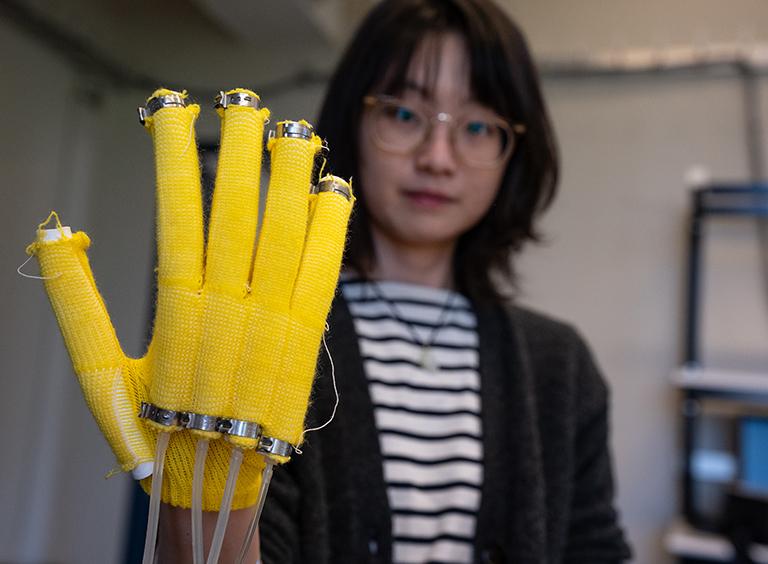
Luo demonstrates a digitally machine-knitted assistive glove, designed to support hand movement. Photo University Of Washington
Luo demonstrates a digitally machine-knitted assistive glove, designed to support hand movement.
22.09.2026

Smart textiles learn the sense of touch

The University of Washington's Wearable Intelligence Lab is advancing textile structures as tactile sensing systems for healthcare, robotics and human-computer interaction. A new university profile of Yiyue Luo shows how digital fabrication, conductive yarns, sensing and AI are being combined.

One example is MultiSensKnit, a sensor-packed knitted sleeve designed for rehabilitation assessment. Other projects range from smart gloves for tactile capture and robot learning to machine-knitted magnetoactive textiles that provide sensing and haptic feedback.

The textile form factor is functional rather than decorative: knits can cover large body areas, conform to movement and capture physical information in situations where cameras or conventional rigid electronics are limited. Luo uses digital knitting machines to integrate conductive yarns and functional structures reproducibly into fabrics.

The work also illustrates a broader transition in smart textiles from isolated demonstrators towards integrated systems in which material, textile construction, electronics and data processing are developed together.

The University of Washington's Wearable Intelligence Lab is advancing textile structures as tactile sensing systems for healthcare, robotics and human-computer interaction. A new university profile of Yiyue Luo shows how digital fabrication, conductive yarns, sensing and AI are being combined.

One example is MultiSensKnit, a sensor-packed knitted sleeve designed for rehabilitation assessment. Other projects range from smart gloves for tactile capture and robot learning to machine-knitted magnetoactive textiles that provide sensing and haptic feedback.

The textile form factor is functional rather than decorative: knits can cover large body areas, conform to movement and capture physical information in situations where cameras or conventional rigid electronics are limited. Luo uses digital knitting machines to integrate conductive yarns and functional structures reproducibly into fabrics.

The work also illustrates a broader transition in smart textiles from isolated demonstrators towards integrated systems in which material, textile construction, electronics and data processing are developed together.

Source:

University of Washington, Department of Electrical & Computer Engineering

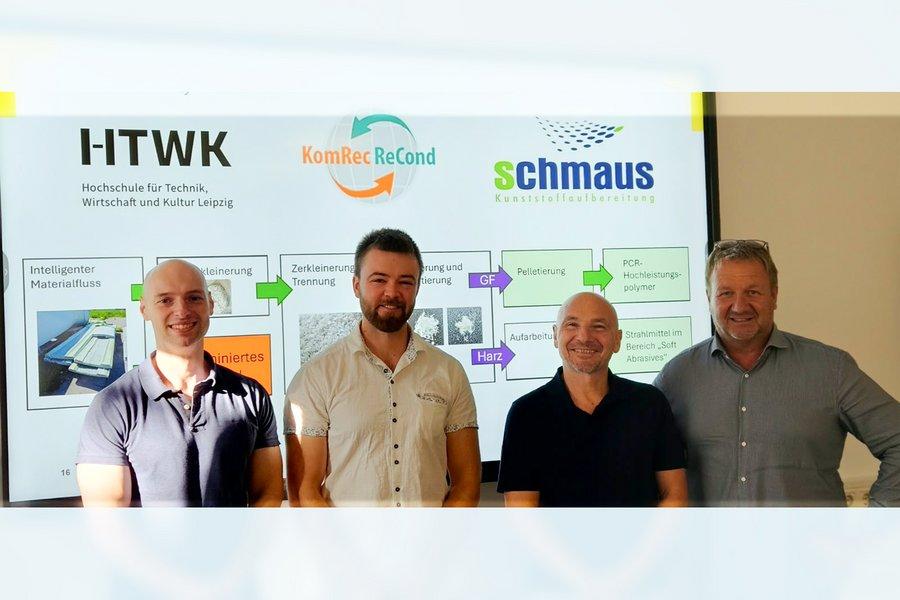
Blade2Poly Kick-Off Meeting on September 17, 2026, at the Composite Circularity Lab in Leipzig (from left to right): Andrej Fehler (HTWK), Dr. Philipp Johst (HTWK), Olaf Thannheiser (KomRec-ReCond), Christian Schmaus (Schmaus Kunststoffaufbereitung), Prof. Robert Böhm (HTWK – participating online, not pictured) © HTWK Leipzig © HTWK Leipzig
Blade2Poly Kick-Off Meeting on September 17, 2026, at the Composite Circularity Lab in Leipzig (from left to right): Andrej Fehler (HTWK), Dr. Philipp Johst (HTWK), Olaf Thannheiser (KomRec-ReCond), Christian Schmaus (Schmaus Kunststoffaufbereitung), Prof. Robert Böhm (HTWK – participating online, not pictured) © HTWK Leipzig
22.09.2026

Blade2Poly targets rotor blades for injection moulding

HTWK Leipzig has launched Blade2Poly with KomRec-ReCond and Schmaus Kunststoffaufbereitung to develop an energy-efficient recycling chain for end-of-life wind-turbine blades. The goal is to recover glass-fibre-reinforced plastics as higher-value secondary raw materials for new injection-moulding applications.

The route starts with material characterisation and categorisation, followed by mechanical processing, intelligent material-flow control and combination of recovered glass fibres with recycled polymers to create post-consumer recycled compounds.

Rotor blades are a demanding circularity case because large, durable composite structures must ultimately be converted into heterogeneous waste streams. Blade2Poly therefore addresses not only size reduction but the quality of recovered material and its compatibility with a new industrial process.

The collaborative R&D project runs from June 2026 to January 2029 under Germany's ZIM programme.

HTWK Leipzig has launched Blade2Poly with KomRec-ReCond and Schmaus Kunststoffaufbereitung to develop an energy-efficient recycling chain for end-of-life wind-turbine blades. The goal is to recover glass-fibre-reinforced plastics as higher-value secondary raw materials for new injection-moulding applications.

The route starts with material characterisation and categorisation, followed by mechanical processing, intelligent material-flow control and combination of recovered glass fibres with recycled polymers to create post-consumer recycled compounds.

Rotor blades are a demanding circularity case because large, durable composite structures must ultimately be converted into heterogeneous waste streams. Blade2Poly therefore addresses not only size reduction but the quality of recovered material and its compatibility with a new industrial process.

The collaborative R&D project runs from June 2026 to January 2029 under Germany's ZIM programme.

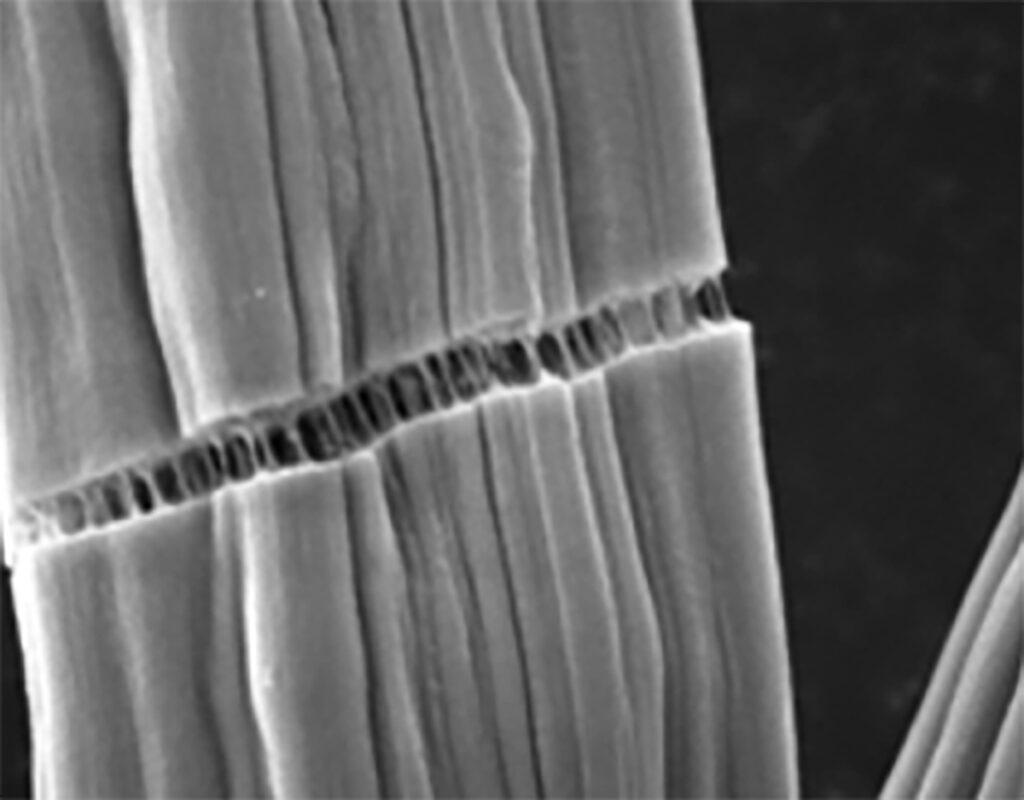
Microscopic “rebar” adds strength to a new kind of carbon fiber material that features functionalized single-walled carbon nanotubes. WashU engineers developed the manufacturing process to make use of the waste material lignin and to further strengthen carbon fiber for use in the automotive and energy industries. Photo: Yuan-Labor
Microscopic “rebar” adds strength to a new kind of carbon fiber material that features functionalized single-walled carbon nanotubes. WashU engineers developed the manufacturing process to make use of the waste material lignin and to further strengthen carbon fiber for use in the automotive and energy industries.
22.09.2026

Lignin cuts PAN content in carbon fibre

Researchers at Washington University in St. Louis have developed a route in which lignin replaces a substantial share of the polyacrylonitrile (PAN) normally used in carbon fibre. Lignin is generated in large volumes as a by-product of pulp and biorefinery operations. The university reports that PAN use can be cut by half, with corresponding potential reductions in production cost and emissions.

The central technical challenge is mechanical performance. The team functionalises single-walled carbon nanotubes and incorporates them into the lignin-PAN matrix. The nanotubes act as nanoscale reinforcement and promote stronger crystalline alignment during spinning and thermal treatment.

The precursor solution is wet-spun, tension-assisted heat-treated and carbonised. The researchers report that the resulting renewable carbon fibre can reach quality requirements relevant to automotive manufacturing. Aerospace, energy infrastructure, sporting goods and wind energy are cited as additional markets.

Researchers at Washington University in St. Louis have developed a route in which lignin replaces a substantial share of the polyacrylonitrile (PAN) normally used in carbon fibre. Lignin is generated in large volumes as a by-product of pulp and biorefinery operations. The university reports that PAN use can be cut by half, with corresponding potential reductions in production cost and emissions.

The central technical challenge is mechanical performance. The team functionalises single-walled carbon nanotubes and incorporates them into the lignin-PAN matrix. The nanotubes act as nanoscale reinforcement and promote stronger crystalline alignment during spinning and thermal treatment.

The precursor solution is wet-spun, tension-assisted heat-treated and carbonised. The researchers report that the resulting renewable carbon fibre can reach quality requirements relevant to automotive manufacturing. Aerospace, energy infrastructure, sporting goods and wind energy are cited as additional markets.

Source:

Washington University in St. Louis

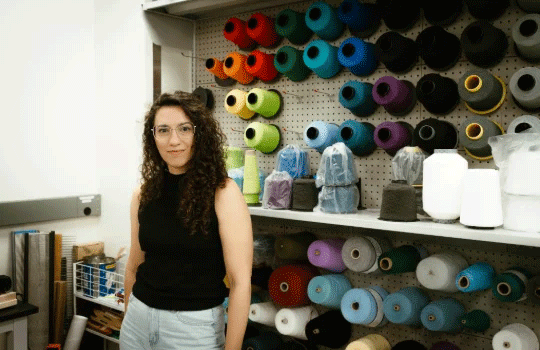
Vanessa Sanchez in ihrem Labor Foto (c) Rice University
18.09.2026

When the knit becomes the robot

Rice University mechanical engineer Vanessa Sanchez is developing knitted structures in which sensing, movement and mechanical behaviour are programmed into the textile rather than attached as separate components. Her project, “Programmable 3D-Knitted Soft Robotic Textiles for Human-Centered Mobility,” has received a Toyota Programmable System Innovation Fellowship.

Rice points to applications including vehicle seats that reshape around occupants, garments that assist walking and soft safety systems capable of responding to impending impacts.

The work uses knitting as a manufacturing architecture. By varying yarns, stitch geometry and local structural behaviour, the textile can be designed to produce functions that conventional soft-robotic systems may achieve with separate sensors, actuators or rigid elements.

Three-dimensional knitting is particularly important because form can be created during manufacture rather than assembled from multiple flat components. That approach could reduce seams and interfaces while retaining the softness and conformity expected from textiles.

Rice University mechanical engineer Vanessa Sanchez is developing knitted structures in which sensing, movement and mechanical behaviour are programmed into the textile rather than attached as separate components. Her project, “Programmable 3D-Knitted Soft Robotic Textiles for Human-Centered Mobility,” has received a Toyota Programmable System Innovation Fellowship.

Rice points to applications including vehicle seats that reshape around occupants, garments that assist walking and soft safety systems capable of responding to impending impacts.

The work uses knitting as a manufacturing architecture. By varying yarns, stitch geometry and local structural behaviour, the textile can be designed to produce functions that conventional soft-robotic systems may achieve with separate sensors, actuators or rigid elements.

Three-dimensional knitting is particularly important because form can be created during manufacture rather than assembled from multiple flat components. That approach could reduce seams and interfaces while retaining the softness and conformity expected from textiles.

Sanchez will use the fellowship to develop the programmable structures further and explore mobility-oriented applications.

Ravel - shredded polyester/elastane material ready for processing (c) Ravel
18.09.2026

Ravel raises $8.2m to scale blended-textile recycling

Ravel has closed an oversubscribed $8.2 million seed round led by One Small Planet, with participation from AP Ventures, Overlay Capital, Lichen Ventures and existing investors. The funding is intended to move the Seattle-based recycling company from pilot operation towards commercial readiness.

Its Purification Recycling process is aimed at one of apparel recycling's persistent problems: stretch blends. Elastane is widely used in activewear, denim, underwear and other garments, yet even relatively small percentages can interfere with established recycling routes.

Rather than treating the whole textile as a single feedstock, Ravel is developing a separation and purification route for polyester/elastane blends. The company says recovered material can be converted into recycled plastic pellets for renewed use as a raw material.

The next phase will test more than chemistry. Commercial viability depends on throughput, feedstock variability, separation efficiency, energy and chemical inputs, and the quality of the recovered fractions. Ravel plans to validate the process at production scale with textile partners.

Ravel has closed an oversubscribed $8.2 million seed round led by One Small Planet, with participation from AP Ventures, Overlay Capital, Lichen Ventures and existing investors. The funding is intended to move the Seattle-based recycling company from pilot operation towards commercial readiness.

Its Purification Recycling process is aimed at one of apparel recycling's persistent problems: stretch blends. Elastane is widely used in activewear, denim, underwear and other garments, yet even relatively small percentages can interfere with established recycling routes.

Rather than treating the whole textile as a single feedstock, Ravel is developing a separation and purification route for polyester/elastane blends. The company says recovered material can be converted into recycled plastic pellets for renewed use as a raw material.

The next phase will test more than chemistry. Commercial viability depends on throughput, feedstock variability, separation efficiency, energy and chemical inputs, and the quality of the recovered fractions. Ravel plans to validate the process at production scale with textile partners.

The financing adds capacity at a point where recyclers are increasingly trying to tackle blends that mechanical systems cannot readily return to fibre.

(c) Archroma / Lameirinho
16.09.2026

Dye, fix and soften in one step

Archroma and Portuguese home-textile manufacturer Lameirinho have moved the InOneGO continuous dyeing process into commercial production. Lameirinho's first bed-linen collection made with the technology is now available worldwide.

InOneGO combines coloration, fixation and softening in a single pad-dry application. It was developed for woven cellulosic textiles including denim, fashion fabrics and home textiles, and works with Archroma sulfur-dye systems including DIRESUL RDT, EarthColors and FiberColors.

Archroma's ONE WAY Impact Calculator indicates reductions of up to 81% in process time, 97% in water consumption, 65% in energy use and 75% in CO2 emissions when a defined InOneGO/DIRESUL RDT scenario is compared with conventional cold pad-batch reactive dyeing plus pigment top-dye finishing. These are supplier calculations for a specified benchmark, not universal mill values.

The process runs on stenter and Thermosol lines. That makes the industrial proposition particularly relevant: mills may be able to remove several wet and dry processing stages without replacing the core line architecture.


Archroma and Portuguese home-textile manufacturer Lameirinho have moved the InOneGO continuous dyeing process into commercial production. Lameirinho's first bed-linen collection made with the technology is now available worldwide.

InOneGO combines coloration, fixation and softening in a single pad-dry application. It was developed for woven cellulosic textiles including denim, fashion fabrics and home textiles, and works with Archroma sulfur-dye systems including DIRESUL RDT, EarthColors and FiberColors.

Archroma's ONE WAY Impact Calculator indicates reductions of up to 81% in process time, 97% in water consumption, 65% in energy use and 75% in CO2 emissions when a defined InOneGO/DIRESUL RDT scenario is compared with conventional cold pad-batch reactive dyeing plus pigment top-dye finishing. These are supplier calculations for a specified benchmark, not universal mill values.

The process runs on stenter and Thermosol lines. That makes the industrial proposition particularly relevant: mills may be able to remove several wet and dry processing stages without replacing the core line architecture.


Source:

Archroma / Lameirinho

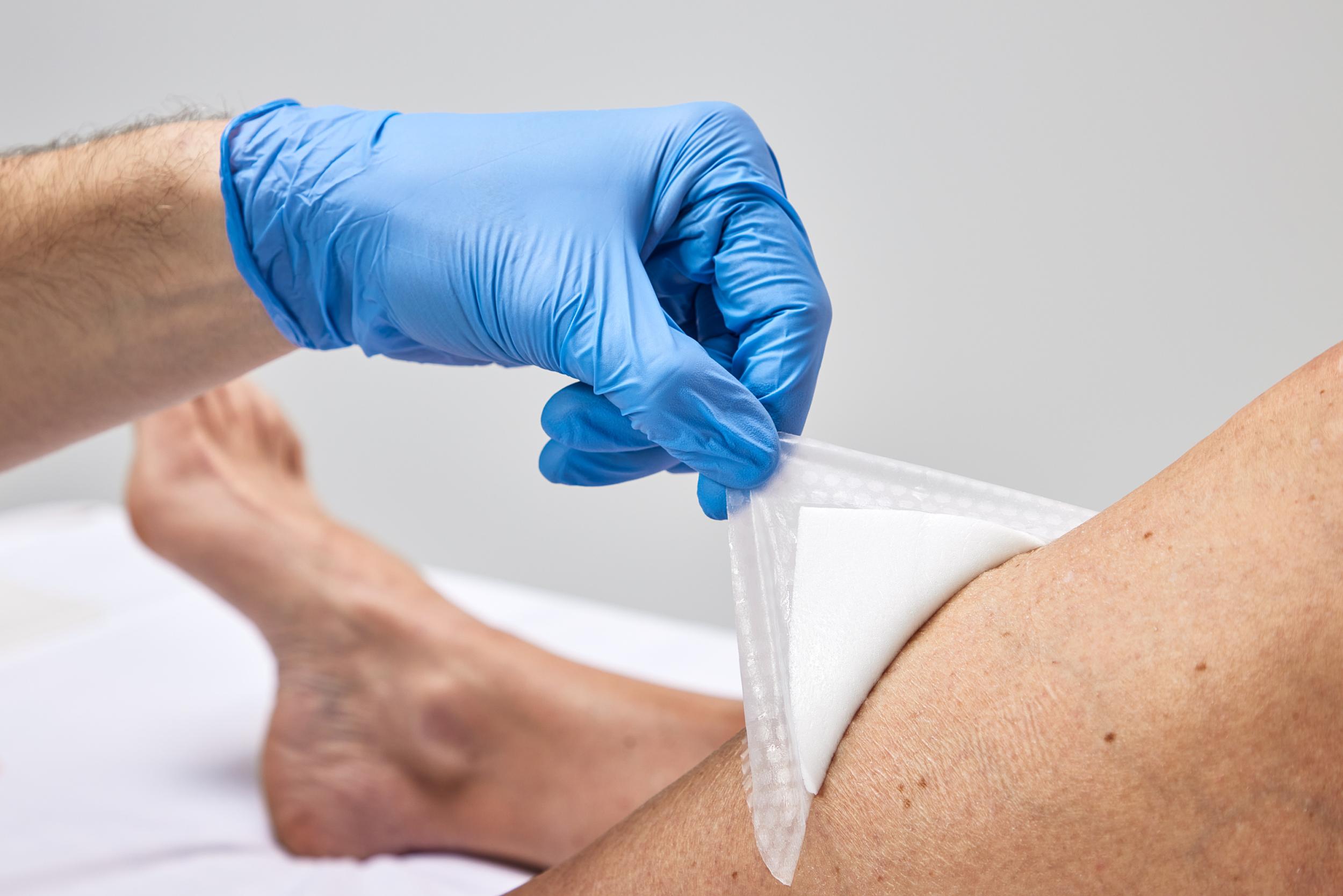
Tacnera: Freudenberg’s innovative technology for silicone-coated secondary foam dressings. © Freudenberg Performance Materials
Tacnera: Freudenberg’s innovative technology for silicone-coated secondary foam dressings.
14.09.2026

Wound care becomes more textile-integrated

Freudenberg Performance Materials and Foshan United Medical Technologies (UMT) will make their first joint appearance at the WUWHS congress in Kuala Lumpur since Freudenberg acquired the Chinese wound-care specialist at the end of July. The combined platform stretches from fibre and nonwoven technologies to finished advanced wound-care solutions.

UMT’s primary dressings include alginate, carboxymethylcellulose (CMC) and chitosan technologies. Alginate variants include silver-containing options for antimicrobial protection, while CMC is used for moisture management and gel formation. Chitosan brings haemostatic and bacteriostatic properties. UMT is also presenting a non-invasive wound-closure system.

Freudenberg Performance Materials and Foshan United Medical Technologies (UMT) will make their first joint appearance at the WUWHS congress in Kuala Lumpur since Freudenberg acquired the Chinese wound-care specialist at the end of July. The combined platform stretches from fibre and nonwoven technologies to finished advanced wound-care solutions.

UMT’s primary dressings include alginate, carboxymethylcellulose (CMC) and chitosan technologies. Alginate variants include silver-containing options for antimicrobial protection, while CMC is used for moisture management and gel formation. Chitosan brings haemostatic and bacteriostatic properties. UMT is also presenting a non-invasive wound-closure system.

Freudenberg complements these primary-care products with Tacnera®, its patented silicone-coated foam-dressing technology. A dual-silicone construction combines secure edge adhesion with a gentler wound-contact layer, while a wave-pattern coating is designed to improve flexibility and exudate management. The wider industrial story is vertical integration: UMT’s capabilities run from fibre production and functionalisation through nonwovens, packaging, sterilisation and regulatory approval.

Source:

Freudenberg Performance Materials Holding GmbH