

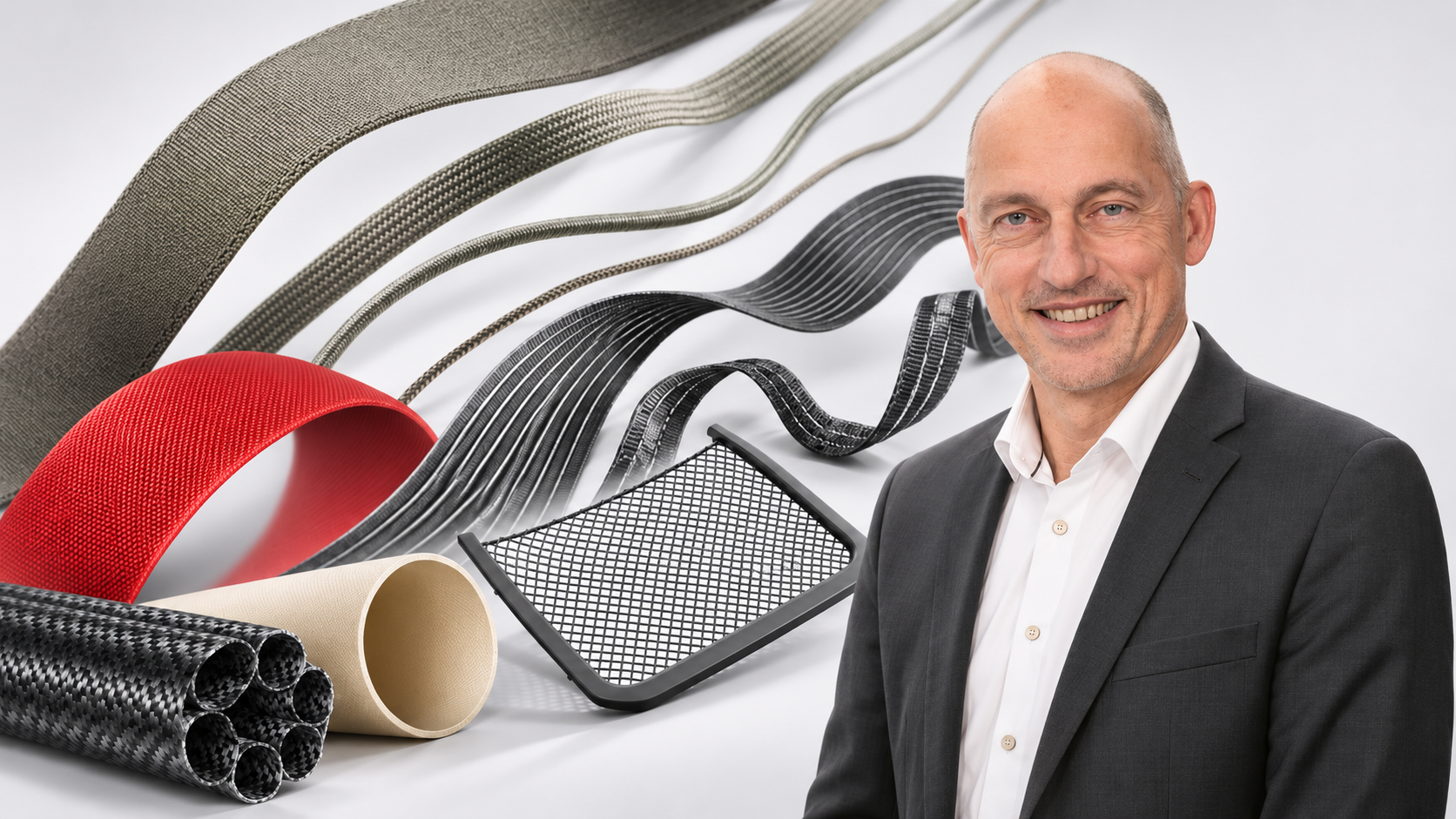
“For us, there is a clear economic case for manufacturing in Germany.”
The Textation Group is investing in a new production site in Wuppertal. Textination spoke to CSO Stefan Ickler about the new dual leadership structure, technical textiles and the future of industrial production in Germany.
Back to the world of technical textiles
Mr Ickler, you joined the Textation Group at the beginning of 2026. The economic environment is currently challenging for medium-sized manufacturers, and the Federation of German Industries (BDI) continues to describe sentiment among industrial SMEs as subdued. What attracted you to the role at the Textation Group at this particular time?
A great deal! First and foremost, the nature of the work. Unfortunately, there are some misguided stereotypes about the textile industry. Stereotype number one: textiles almost always come from China. Stereotype number two: textiles are almost always cheap, simple mass-produced goods. Neither applies to the Textation Group. We manufacture high-quality, bespoke technical textiles in Germany. And even in the current environment, sentiment within the group is good to very good. So, after 14 years in the mobility sector, I was very happy to return to the world of technical textiles.
As technical textile manufacturers, we deal with a wide range of industries, customers and applications. At the Textation Group, we are constantly encountering new challenges. Then there is the nature of the group as a family-owned business: things can move quickly here. Management and shareholders are closely connected within the Textation Group. This means decisions can be made as soon as we identify new market opportunities. And not least, the company's commitment to Germany as a manufacturing base and its willingness to invest make the group interesting to me. With a new production site in Wuppertal-Varresbeck, the Textation Group is currently demonstrating its confidence as a strong, forward-looking player in the industry.
In short, the diversity of the work, the high degree of flexibility and the Textation Group's long-term approach to business are what make the role so appealing to me.
Andreas Kielholz stepped down from operational management in the summer. The Textation Group is now led by Patrick Kielholz as COO and you as CSO. Dual leadership is often justified by the desire to bring different areas of expertise closer together. Where does this arrangement actually speed things up, and where does it require particularly clear responsibilities?
The group's management got together early on to put the leadership team on a sound footing for the future and organise a transition that was both well thought out and smooth. The aim from the outset was to establish a dual leadership structure with distinct areas of responsibility. What was needed alongside COO Patrick Kielholz was a fellow managing director with a clear focus on sales. Initially, the three of us, including Andreas Kielholz, led the group together for six months. That ensured continuity. And continuity is particularly important when the market is changing rapidly.
As joint leaders, Patrick Kielholz and I each bring different perspectives and experience to the management team. We complement each other. That adds considerable value in terms of expertise. Dual leadership also gives us greater flexibility, as we can share certain tasks and stand in for each other, which makes us faster. At the same time, of course, it requires coordination. We discuss our respective issues in weekly meetings. But dual leadership also has to work well on a personal level. Working and leadership styles should be compatible in the key areas. My impression after just over a hundred days of dual leadership is that we are a good fit. We work well together. And in the wider management team, CTO Kevin Kielholz and CFO Ralph Cammerath contribute their expertise too. With this broad-based leadership team, we can drive the group forward with foresight and momentum.
Many industries.
Many perspectives.
Official economic data currently paint a mixed picture. In July, new orders in manufacturing rose by 2.5 per cent compared with the previous month, but fell by 1.4 per cent excluding large-scale orders. In the automotive industry, orders actually fell by 12.5 per cent. How do you see current market conditions from a sales perspective, and how differently are the customer industries that matter to your group performing?
Your description of the situation is absolutely right, but as I said, our order books are healthy and morale is good. At the Textation Group, we are less affected by the crisis in the automotive industry than other suppliers. Firstly, our automotive products are needed in all vehicles, regardless of their propulsion system. Secondly, as I mentioned, JUMBO-Textil and vombaur supply a wide range of industries. This means we can always serve growth sectors too, even when turnover in one sector is declining, as is currently the case in automotive.
Particularly in technically demanding B2B markets, many suppliers are finding that customers are making decisions at shorter notice whilst demanding greater flexibility, technical advice and security of supply. What has changed most noticeably among your customers over the past twelve to eighteen months?
As suppliers today, we must provide solutions to demanding challenges very quickly. That is only possible with a deep understanding of our customers, their products and their challenges. I am a firm advocate of a segment-based structure: we must define the various markets we want to serve and then develop in-depth expertise in those areas. In other words, we must understand the markets and our customers across the entire value chain. We need to know not only our direct customers and their issues, processes and challenges, but also their customers. That makes the task complex. By taking the entire supply chain into account, we are effectively thinking in several dimensions.
Read the full interview in our Newsline magazine (PDF).
Textation Textation Group vombaur Technical Textiles industrial site Germany Jumbo-Textil Manufacturing in Germany
Textination