

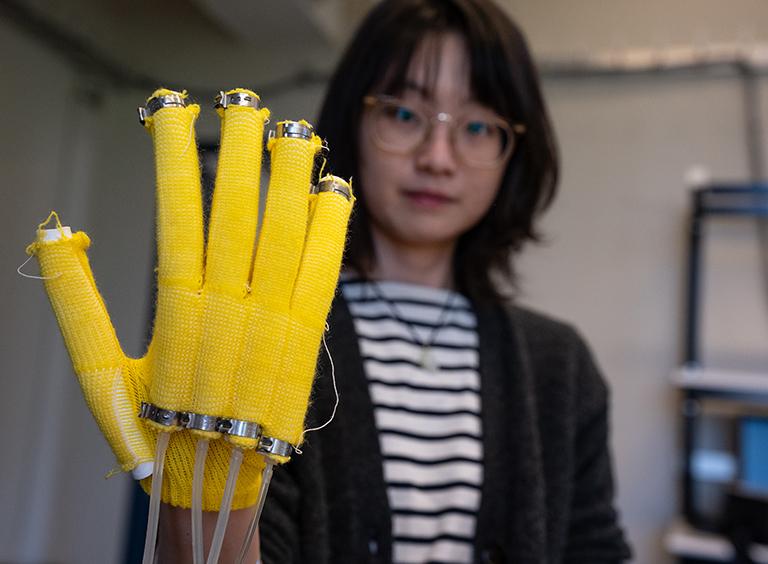

Smart textiles learn the sense of touch
The University of Washington's Wearable Intelligence Lab is advancing textile structures as tactile sensing systems for healthcare, robotics and human-computer interaction. A new university profile of Yiyue Luo shows how digital fabrication, conductive yarns, sensing and AI are being combined.
One example is MultiSensKnit, a sensor-packed knitted sleeve designed for rehabilitation assessment. Other projects range from smart gloves for tactile capture and robot learning to machine-knitted magnetoactive textiles that provide sensing and haptic feedback.
The textile form factor is functional rather than decorative: knits can cover large body areas, conform to movement and capture physical information in situations where cameras or conventional rigid electronics are limited. Luo uses digital knitting machines to integrate conductive yarns and functional structures reproducibly into fabrics.
The work also illustrates a broader transition in smart textiles from isolated demonstrators towards integrated systems in which material, textile construction, electronics and data processing are developed together.
Wearable Intelligence Lab MultiSensKnit digital knitting Smart textiles rehabilitation robotics
University of Washington, Department of Electrical & Computer Engineering