From the Sector

Reset
15.09.2026

TrusTrace Launches New Platform to Turn Supply Chain Data Into Insight and Action

As mandatory sustainability and due diligence regulations multiply, global brands managing complex, multi-tier supply chains face a widening gap between the data they collect and their ability to understand and act on it at scale. TrusTrace, a global leader in supply chain traceability and compliance, today announced the launch of a new platform built to close that gap. 
 
The new platform builds on TrusTrace's enterprise-proven traceability and compliance foundation, making supply chain data directly accessible for insight and decision-making while automating the multi-step programs that act on it. Teams can understand what needs attention faster and automate operational work, from assessments and evidence collection through to follow-up and corrective action. 
 
At the foundation is TrusTrace's real-time, lot-level forward traceability with AI-powered backward chain-of-custody data, across materials and sourcing models, providing the complete and trustworthy data needed to generate meaningful intelligence.
 

As mandatory sustainability and due diligence regulations multiply, global brands managing complex, multi-tier supply chains face a widening gap between the data they collect and their ability to understand and act on it at scale. TrusTrace, a global leader in supply chain traceability and compliance, today announced the launch of a new platform built to close that gap. 
 
The new platform builds on TrusTrace's enterprise-proven traceability and compliance foundation, making supply chain data directly accessible for insight and decision-making while automating the multi-step programs that act on it. Teams can understand what needs attention faster and automate operational work, from assessments and evidence collection through to follow-up and corrective action. 
 
At the foundation is TrusTrace's real-time, lot-level forward traceability with AI-powered backward chain-of-custody data, across materials and sourcing models, providing the complete and trustworthy data needed to generate meaningful intelligence.
 
“Every regulation ultimately asks the same question: can you prove it? But proving compliance starts much earlier, with understanding your supply chain, knowing where the gaps are and acting before they become problems,” said Shameek Ghosh, CEO and Co-Founder of TrusTrace.
 
The platform rolls out in phases starting this month and has been built and validated over the past year with a number of the world's leading brands. Its first focus is Supply Chain Intelligence: brands can ask questions in natural language across suppliers, facilities, products, materials, and supply chain relationships, surfacing gaps and patterns and generating insights and reports in seconds. 
 
Over subsequent phases, TrusTrace will strengthen this further by adding regulatory intelligence and enterprise intelligence, connecting external regulatory requirements and brands' own policies and standards with their supply chain data, so brands can understand which requirements impact them, identify gaps earlier, and act before they become compliance failures. 
 
Alongside Supply Chain Intelligence, TrusTrace is introducing a program builder and orchestrator that automates the workflows behind Supplier Compliance, TrusTrace's existing solution for managing whether suppliers meet a brand's requirements. Brands can now run vendor onboarding, continuous supplier monitoring, assessments, evidence requests, follow-ups, and corrective actions automatically, replacing manual, repetitive work with a system that runs on the brand's own data.
 
Supply Chain Intelligence is one of three connected solution areas on the TrusTrace platform. Supplier Compliance manages whether suppliers meet a brand's requirements; Supply Chain Intelligence helps brands understand their supply chain, identify what needs attention, and make better-informed decisions; and Product Compliance determines whether a specific product meets applicable requirements and provides the evidence needed to prove it. This launch introduces Supply Chain Intelligence, the newest addition to the platform, along with the automation capabilities that connect all three. 
 
The new platform is built around four pillars: 

  • One unified data foundation: Suppliers submit data once, in any format or language, and TrusTrace extracts, validates, and links it into one trusted foundation. Data and evidence can be reused across use cases, reducing duplicate requests and supplier fatigue. 
  • Supply Chain Intelligence: Brands can ask questions about their suppliers, facilities, products, materials and supply chain relationships, as described above, and receive live insights and reports grounded in their own TrusTrace data. Regulatory, enterprise and risk intelligence will add further context as the platform evolves.
  • Automated operations: A program builder and orchestrator help brands build and run multi-step workflows such as vendor onboarding and continuous supplier monitoring, automating assessments, evidence requests, follow-ups and corrective actions across the supplier base. 
  • One connected compliance platform: TrusTrace brings supplier requirements, regulatory obligations, and product compliance together on one platform, powered by the same supply chain data and evidence foundation. Information can be reused across requirements and programs, reducing duplication for both brands and suppliers. 

AI runs throughout the platform, from data extraction and validation to natural-language access to supply chain information and the automation of multi-step programs, so both brands and their suppliers spend less time on manual work and more time acting on insights they can stand behind. 
 
A new program can go live in as little as three days, with the first supplier data request sent in week one. TrusTrace's data foundation spans more than 120,000 suppliers across more than 80 countries. 
 
The new platform is designed for brands of every size, from global enterprises to mid-sized companies scaling compliance programs with lean teams, with further intelligence and automation capabilities to follow as the rollout continues. 


Source:

TrusTrace 

Photo (c) Kappahl Group
15.09.2026

Kappahl backs a longer-lasting wardrobe

Kappahl is launching its Autumn 2026 campaign across all markets on 16 September. Built around the existing “We Are Family” platform, the campaign presents a wardrobe of pieces intended to be easy to combine and relevant beyond short trend cycles.

The assortment spans womenswear, XLNT and menswear, with knitwear, denim, tailoring, lace and outerwear. The coat has a specific heritage role, linking the current collection to the company’s origins in Gothenburg in 1953, when founder Per-Olof Ahl opened a store focused on coats.

This is not, by itself, a technical sustainability claim. The editorial signal is how a large fashion retailer is using longevity and versatility as part of brand and assortment positioning. The campaign will run across digital channels, marketing activities and stores.

Kappahl is launching its Autumn 2026 campaign across all markets on 16 September. Built around the existing “We Are Family” platform, the campaign presents a wardrobe of pieces intended to be easy to combine and relevant beyond short trend cycles.

The assortment spans womenswear, XLNT and menswear, with knitwear, denim, tailoring, lace and outerwear. The coat has a specific heritage role, linking the current collection to the company’s origins in Gothenburg in 1953, when founder Per-Olof Ahl opened a store focused on coats.

This is not, by itself, a technical sustainability claim. The editorial signal is how a large fashion retailer is using longevity and versatility as part of brand and assortment positioning. The campaign will run across digital channels, marketing activities and stores.

Source:

Kappahl Group

Foto Kraig Biocraft Laboratories, Inc.
15.09.2026

Spinnenseide sucht den Maßstab

Kraig Biocraft Laboratories rückt seine rekombinante Spinnenseide gezielt in den Kontext von Mode und Performance-Textilien. Das Unternehmen nutzt gentechnisch veränderte Seidenraupen, die Spinnenseidenproteine direkt in der Seidenfaser erzeugen. Anders als Verfahren, bei denen Proteine zunächst fermentativ hergestellt und anschließend zu Fasern verarbeitet werden, soll damit vorhandene Infrastruktur der Seidenindustrie genutzt werden können.

Für die textile Industrie ist vor allem die Skalierungsfrage relevant. Kraig Labs verweist auf rund 3,2 Tonnen rekombinante Spinnenseidenkokons aus einem einzelnen Produktionszyklus. Damit verschiebt sich die Diskussion von Laborproben hin zu reproduzierbarer Produktion in industriell interessanter Größenordnung. Als mögliche Einsatzfelder nennt das Unternehmen Luxus- und Modetextilien, Performance Apparel sowie Schutzmaterialien.

Kraig Biocraft Laboratories rückt seine rekombinante Spinnenseide gezielt in den Kontext von Mode und Performance-Textilien. Das Unternehmen nutzt gentechnisch veränderte Seidenraupen, die Spinnenseidenproteine direkt in der Seidenfaser erzeugen. Anders als Verfahren, bei denen Proteine zunächst fermentativ hergestellt und anschließend zu Fasern verarbeitet werden, soll damit vorhandene Infrastruktur der Seidenindustrie genutzt werden können.

Für die textile Industrie ist vor allem die Skalierungsfrage relevant. Kraig Labs verweist auf rund 3,2 Tonnen rekombinante Spinnenseidenkokons aus einem einzelnen Produktionszyklus. Damit verschiebt sich die Diskussion von Laborproben hin zu reproduzierbarer Produktion in industriell interessanter Größenordnung. Als mögliche Einsatzfelder nennt das Unternehmen Luxus- und Modetextilien, Performance Apparel sowie Schutzmaterialien.

Ben Muller (c) INDA Association of the Nonwoven Fabrics Industry
15.09.2026

INDA Hires Ben Muller as Executive Director

INDA, the Association of the Nonwoven Fabrics Industry, announced today that Ben Muller has joined the association as executive director. Mr. Muller brings more than 20 years of progressive leadership experience spanning nonprofit organizations, corporations and trade associations.

Most recently, Mr. Muller served on the senior executive team of the High Point Market Authority, where he led marketing, public relations and educational programming for one of the world’s largest trade shows. Previously, he held senior brand and marketing leadership positions with Hanesbrands and Kayser-Roth, gaining extensive experience in textile and apparel supply chains. He began his career serving mission-driven organizations, including the American Cancer Society and the National Multiple Sclerosis Society.

Tony Fragnito, INDA’s current president and CEO, will transition to an executive consultant role in January 2027 to support the leadership transition and focus on projects and initiatives designed to expand the reach and participation of the Global Nonwovens Alliance (GNA). His planned retirement will occur in December 2027.

INDA, the Association of the Nonwoven Fabrics Industry, announced today that Ben Muller has joined the association as executive director. Mr. Muller brings more than 20 years of progressive leadership experience spanning nonprofit organizations, corporations and trade associations.

Most recently, Mr. Muller served on the senior executive team of the High Point Market Authority, where he led marketing, public relations and educational programming for one of the world’s largest trade shows. Previously, he held senior brand and marketing leadership positions with Hanesbrands and Kayser-Roth, gaining extensive experience in textile and apparel supply chains. He began his career serving mission-driven organizations, including the American Cancer Society and the National Multiple Sclerosis Society.

Tony Fragnito, INDA’s current president and CEO, will transition to an executive consultant role in January 2027 to support the leadership transition and focus on projects and initiatives designed to expand the reach and participation of the Global Nonwovens Alliance (GNA). His planned retirement will occur in December 2027.

The creation of the executive director position follows the formation of the GNA by INDA and EDANA and represents the next step in the evolution of INDA’s staff leadership to support the alliance. Mr. Muller’s broad leadership experience, strategic marketing expertise and deep understanding of member and industry engagement will be valuable as he leads INDA’s strategic initiatives, oversees operations and represents the interests of the nonwovens industry across the Americas.

“I am honored to join INDA at such a pivotal moment for the industry,” said Mr. Muller. “The formation of the Global Nonwovens Alliance creates an exciting opportunity to strengthen collaboration and expand the value we provide to members. I look forward to listening to our members, learning from their expertise and ensuring INDA continues to be a strong advocate and resource for the industry throughout the Americas.”

“Tony has provided outstanding leadership to INDA during a transformational period for both the association and the global nonwovens industry,” said Mark A. Thornton, chair of the INDA Board of Directors and vice president, Baby Care, Fem Care and Family Care Quality Assurance, The Procter & Gamble Company. “The Board is deeply appreciative of his leadership, commitment to our members and role in helping establish the Global Nonwovens Alliance. As we look ahead, we are confident Ben brings the strategic thinking, industry experience and collaborative leadership needed to build on that strong foundation and guide INDA into its next chapter.”

“Ben’s appointment represents an important step in bringing the vision of the Global Nonwovens Alliance to life,” said Murat Dogru, CEO, GNA. “The strength of the Alliance will depend on combining a truly global perspective with strong regional leadership that understands the priorities of its members. I am very pleased to welcome him and look forward to working closely together as we build the next chapter of the Alliance.”

“Leading INDA has been one of the most rewarding experiences of my career, and I am grateful for the opportunity to work with such a dedicated staff, Board, and membership,” said Fragnito. “It has been a meaningful way to cap off my career, and I look forward to working closely with Ben to ensure a seamless transition of INDA’s business operations and member relationships. I am excited to support him as he helps lead INDA and a partner with Murat as he leads the Global Nonwovens Alliance.”

Source:

INDA Association of the Nonwoven Fabrics Industry

Heidi O’Neill (c) lululemon athletica inc.
14.09.2026

Heidi O’Neill starts lululemon reset

Heidi O’Neill has taken over as chief executive of lululemon. In her first employee message, published in the company newsroom, she places product, brand clarity and operational execution at the centre of the next phase.

O’Neill says her initial weeks will focus on listening to teams, partners, guests and communities before translating ideas into changes. She identifies a need to re-establish the brand’s core and to create more innovative and distinctive product that gives consumers a stronger reason to choose lululemon. She also points to improving operations and how the company connects with its communities.

The appointment matters beyond corporate governance. O’Neill spent more than 25 years at Nike, including leadership across product, design, merchandising, brand and global marketplace operations. At lululemon, that experience meets a business whose differentiation depends heavily on fabric development, fit, functional apparel and a tightly integrated direct-retail model.

Heidi O’Neill has taken over as chief executive of lululemon. In her first employee message, published in the company newsroom, she places product, brand clarity and operational execution at the centre of the next phase.

O’Neill says her initial weeks will focus on listening to teams, partners, guests and communities before translating ideas into changes. She identifies a need to re-establish the brand’s core and to create more innovative and distinctive product that gives consumers a stronger reason to choose lululemon. She also points to improving operations and how the company connects with its communities.

The appointment matters beyond corporate governance. O’Neill spent more than 25 years at Nike, including leadership across product, design, merchandising, brand and global marketplace operations. At lululemon, that experience meets a business whose differentiation depends heavily on fabric development, fit, functional apparel and a tightly integrated direct-retail model.

Source:

lululemon athletica inc.

(c) Messe Frankfurt
14.09.2026

Shanghai draws 36,000 home-textile buyers

Intertextile Shanghai Home Textiles – Autumn Edition reports more than 900 exhibitors from 19 countries and regions and nearly 36,000 visitors representing 113 markets. The show covered more than 100,000 square metres and included bedding, upholstery fabrics, curtains, carpets and design-led collections.

Messe Frankfurt says sustainability, new technologies and supply-chain transparency were increasingly visible in buying discussions. Exhibitors presented established sourcing categories alongside functional textiles, more sustainable materials and technology-enabled solutions. Buyer representation was especially strong from Greater China and Southeast Asia, with growing participation from Central Asia.

The fringe programme also moved beyond trend forecasting into operational questions. Sessions covered AI implementation in the home-textile sector, urban renewal, product development, changing lifestyles and opportunities in Latin America. The mix suggests that home-textile sourcing is becoming more closely linked to material innovation, digital tools and verifiable sustainability requirements.

Intertextile Shanghai Home Textiles – Autumn Edition reports more than 900 exhibitors from 19 countries and regions and nearly 36,000 visitors representing 113 markets. The show covered more than 100,000 square metres and included bedding, upholstery fabrics, curtains, carpets and design-led collections.

Messe Frankfurt says sustainability, new technologies and supply-chain transparency were increasingly visible in buying discussions. Exhibitors presented established sourcing categories alongside functional textiles, more sustainable materials and technology-enabled solutions. Buyer representation was especially strong from Greater China and Southeast Asia, with growing participation from Central Asia.

The fringe programme also moved beyond trend forecasting into operational questions. Sessions covered AI implementation in the home-textile sector, urban renewal, product development, changing lifestyles and opportunities in Latin America. The mix suggests that home-textile sourcing is becoming more closely linked to material innovation, digital tools and verifiable sustainability requirements.

Source:

Messe Frankfurt (HK) Ltd / Intertextile Shanghai Home Textiles

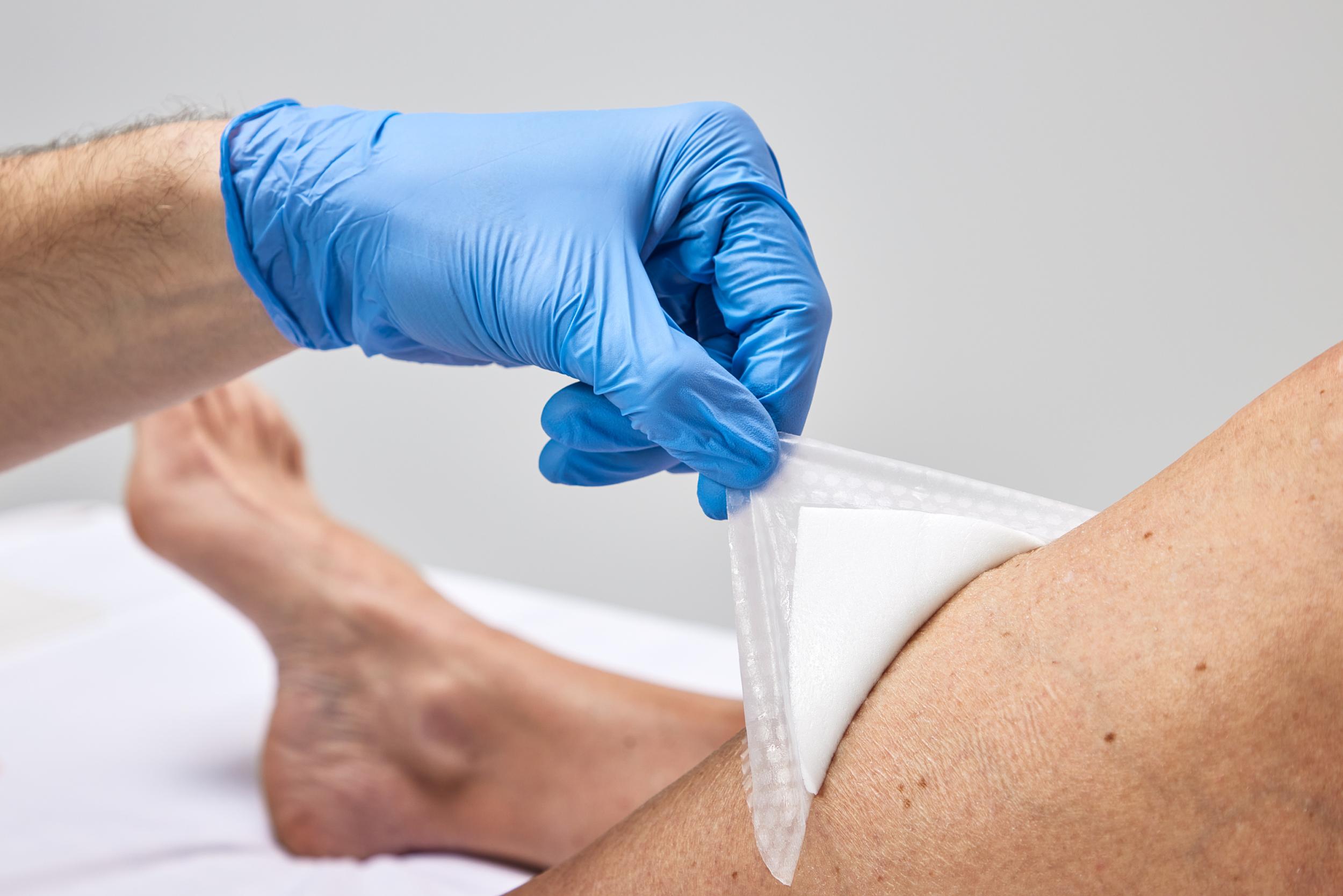
Tacnera: Freudenberg’s innovative technology for silicone-coated secondary foam dressings. © Freudenberg Performance Materials
Tacnera: Freudenberg’s innovative technology for silicone-coated secondary foam dressings.
14.09.2026

Wound care becomes more textile-integrated

Freudenberg Performance Materials and Foshan United Medical Technologies (UMT) will make their first joint appearance at the WUWHS congress in Kuala Lumpur since Freudenberg acquired the Chinese wound-care specialist at the end of July. The combined platform stretches from fibre and nonwoven technologies to finished advanced wound-care solutions.

UMT’s primary dressings include alginate, carboxymethylcellulose (CMC) and chitosan technologies. Alginate variants include silver-containing options for antimicrobial protection, while CMC is used for moisture management and gel formation. Chitosan brings haemostatic and bacteriostatic properties. UMT is also presenting a non-invasive wound-closure system.

Freudenberg Performance Materials and Foshan United Medical Technologies (UMT) will make their first joint appearance at the WUWHS congress in Kuala Lumpur since Freudenberg acquired the Chinese wound-care specialist at the end of July. The combined platform stretches from fibre and nonwoven technologies to finished advanced wound-care solutions.

UMT’s primary dressings include alginate, carboxymethylcellulose (CMC) and chitosan technologies. Alginate variants include silver-containing options for antimicrobial protection, while CMC is used for moisture management and gel formation. Chitosan brings haemostatic and bacteriostatic properties. UMT is also presenting a non-invasive wound-closure system.

Freudenberg complements these primary-care products with Tacnera®, its patented silicone-coated foam-dressing technology. A dual-silicone construction combines secure edge adhesion with a gentler wound-contact layer, while a wave-pattern coating is designed to improve flexibility and exudate management. The wider industrial story is vertical integration: UMT’s capabilities run from fibre production and functionalisation through nonwovens, packaging, sterilisation and regulatory approval.

Source:

Freudenberg Performance Materials Holding GmbH

KeyVisual s.Oliver
11.09.2026

s.Oliver brings the 90s back

Editorial relevance: Medium – a current brand-positioning and retail story supported by a product capsule.
s.Oliver has launched a new hero campaign, “Casual Since Forever,” featuring Heidi Klum meeting a younger version of herself from the 1990s. The concept uses the time shift to reinforce the brand’s positioning around enduring casual style.

The campaign is accompanied by a limited-edition vintage capsule that reinterprets 1990s references through casual basics and vintage-inspired designs. The pieces are being sold online and in selected s.Oliver stores, turning the campaign narrative into an immediate product and retail activation.

The editorial relevance lies in the combination of heritage storytelling and merchandising. Established fashion brands increasingly use archive aesthetics and cultural nostalgia not only for communication but as a direct product-development and traffic-driving mechanism.

Editorial relevance: Medium – a current brand-positioning and retail story supported by a product capsule.
s.Oliver has launched a new hero campaign, “Casual Since Forever,” featuring Heidi Klum meeting a younger version of herself from the 1990s. The concept uses the time shift to reinforce the brand’s positioning around enduring casual style.

The campaign is accompanied by a limited-edition vintage capsule that reinterprets 1990s references through casual basics and vintage-inspired designs. The pieces are being sold online and in selected s.Oliver stores, turning the campaign narrative into an immediate product and retail activation.

The editorial relevance lies in the combination of heritage storytelling and merchandising. Established fashion brands increasingly use archive aesthetics and cultural nostalgia not only for communication but as a direct product-development and traffic-driving mechanism.

ELIE SAAB joins H&M Photo H&M
11.09.2026

ELIE SAAB joins H&M

H&M has named ELIE SAAB as its next designer collaborator. The collection will bring the Beirut-founded couture house’s codes into a mass-market collaboration covering womenswear, menswear, accessories and footwear.

The range is set to include embellished gowns, shimmering separates and tailored pieces, with details such as lace, gradient sequins and monograms. The project extends H&M’s long-running collaboration model, in which luxury and designer brands are translated into limited retail collections with broad consumer reach.

The collection launches in selected stores and online on 22 October 2026. For the fashion and retail market, the partnership is a further example of how high-fashion brand equity, scarcity and cross-price-segment collaboration are used to create traffic and global media visibility.


H&M has named ELIE SAAB as its next designer collaborator. The collection will bring the Beirut-founded couture house’s codes into a mass-market collaboration covering womenswear, menswear, accessories and footwear.

The range is set to include embellished gowns, shimmering separates and tailored pieces, with details such as lace, gradient sequins and monograms. The project extends H&M’s long-running collaboration model, in which luxury and designer brands are translated into limited retail collections with broad consumer reach.

The collection launches in selected stores and online on 22 October 2026. For the fashion and retail market, the partnership is a further example of how high-fashion brand equity, scarcity and cross-price-segment collaboration are used to create traffic and global media visibility.


Photo Richard Harnisch, IÖW
11.09.2026

Lusatia builds a regional fibre economy

A new German research project is exploring how Lusatia can build a regional natural-fibre economy as the former lignite region undergoes structural transformation. Over three years, IÖW and Zittau/Görlitz University of Applied Sciences will examine value chains based on flax, industrial hemp, fibre nettle, miscanthus and residues such as straw and municipal leaves.

The focus is explicitly on industrial applications rather than conventional apparel textiles. Potential outlets include natural-fibre-reinforced plastics, specialty papers, lightweight panels, composites, automotive components and new packaging materials. A regionally resolved material-flow model will map feedstock availability, processing routes, land-use conflicts and possible bottlenecks.

The project is relevant to technical textiles and composites because it treats raw-material availability and industrialisation as one system. Workshops with farmers, processors, manufacturers, municipalities and economic-development actors are intended to produce practical transformation pathways for a circular bioeconomy.


A new German research project is exploring how Lusatia can build a regional natural-fibre economy as the former lignite region undergoes structural transformation. Over three years, IÖW and Zittau/Görlitz University of Applied Sciences will examine value chains based on flax, industrial hemp, fibre nettle, miscanthus and residues such as straw and municipal leaves.

The focus is explicitly on industrial applications rather than conventional apparel textiles. Potential outlets include natural-fibre-reinforced plastics, specialty papers, lightweight panels, composites, automotive components and new packaging materials. A regionally resolved material-flow model will map feedstock availability, processing routes, land-use conflicts and possible bottlenecks.

The project is relevant to technical textiles and composites because it treats raw-material availability and industrialisation as one system. Workshops with farmers, processors, manufacturers, municipalities and economic-development actors are intended to produce practical transformation pathways for a circular bioeconomy.


Source:

Institut für ökologische Wirtschaftsforschung (IÖW) / Hochschule Zittau/Görlitz

Photo EMPA
11.09.2026

Airborne microfibres enter soil and water

Researchers from Empa, Eawag and Agroscope have produced the first systematic estimate of how much microplastic is deposited from the atmosphere across Switzerland. For areas below 2,000 metres, the study estimates annual deposition of about 219 tonnes, including roughly 78 tonnes on agricultural land and around ten tonnes directly into water bodies.

The official release identifies loose fibres from functional clothing among the sources that can enter the environment, alongside PET bottles and other plastic products. Sampling was conducted for a full year at five locations, with particles between 20 and 215 micrometres analysed using imaging infrared microspectroscopy. PET, polyethylene and polypropylene were the most frequently detected polymers.

For textiles, the findings matter because they add atmospheric transport to the better-known discussion around fibre release through washing. The work provides a new evidence base for assessing material emissions and mitigation priorities, while the researchers stress that long-term environmental and health effects remain under investigation.


Researchers from Empa, Eawag and Agroscope have produced the first systematic estimate of how much microplastic is deposited from the atmosphere across Switzerland. For areas below 2,000 metres, the study estimates annual deposition of about 219 tonnes, including roughly 78 tonnes on agricultural land and around ten tonnes directly into water bodies.

The official release identifies loose fibres from functional clothing among the sources that can enter the environment, alongside PET bottles and other plastic products. Sampling was conducted for a full year at five locations, with particles between 20 and 215 micrometres analysed using imaging infrared microspectroscopy. PET, polyethylene and polypropylene were the most frequently detected polymers.

For textiles, the findings matter because they add atmospheric transport to the better-known discussion around fibre release through washing. The work provides a new evidence base for assessing material emissions and mitigation priorities, while the researchers stress that long-term environmental and health effects remain under investigation.


Source:

Empa / Eawag / Agroscope; publiziert über die Schweizer Bundesbehörden

11.09.2026

Recycled polyester heads to New York

Indorama Ventures is supplying fabrics woven with deja™ recycled polyester yarn to Thai label KH Editions. Two looks and accessories from the ten-look Spring/Summer 2027 collection will be shown in New York on 15 September during New York Fashion Week.

The collaboration builds on Indorama Ventures’ RECO programme, launched in 2011 and expanded into RECO Collective in 2023. The initiative combines recycled materials and industry support with emerging designers, aiming to demonstrate that circular inputs can meet the quality and aesthetic requirements of internationally presented fashion.

For the wider value chain, the project is a useful example of material innovation being connected to design, brand building and market access rather than remaining a stand-alone recycling story. Commercial scaling will ultimately depend on consistent quality, available volumes and the ability of recycled yarns to work within established fabric and garment production.

Indorama Ventures is supplying fabrics woven with deja™ recycled polyester yarn to Thai label KH Editions. Two looks and accessories from the ten-look Spring/Summer 2027 collection will be shown in New York on 15 September during New York Fashion Week.

The collaboration builds on Indorama Ventures’ RECO programme, launched in 2011 and expanded into RECO Collective in 2023. The initiative combines recycled materials and industry support with emerging designers, aiming to demonstrate that circular inputs can meet the quality and aesthetic requirements of internationally presented fashion.

For the wider value chain, the project is a useful example of material innovation being connected to design, brand building and market access rather than remaining a stand-alone recycling story. Commercial scaling will ultimately depend on consistent quality, available volumes and the ability of recycled yarns to work within established fabric and garment production.

Source:

Indorama Ventures Public Company Limited


Photo: BASF
11.09.2026

BASF targets circular footwear

BASF will use SIMAC 2026 in Milan to present polyurethane and thermoplastic-polyurethane concepts spanning the footwear life cycle. The portfolio includes Elastopan SpringPURe for thermoformed midsoles together with Elastollan and Infinergy solutions.

Working with Gusbi, BASF has developed an automated heat-press process for lightweight midsoles designed to combine low density, design freedom and durable comfort with almost waste-free processing. With DESMA, the company is also showing a closed-loop concept that combines PU and TPU and links mechanical and chemical recycling. Three concept shoes illustrate separation and recycling routes.

The company is also introducing Infinergy Revolution, an energy-efficient heat-press processing route for expanded TPU. The approach is intended to enable lighter components, new surface designs and improved recyclability. The broader signal is that footwear development is increasingly bringing performance, disassembly, material recovery and processing energy into the same engineering discussion.

BASF will use SIMAC 2026 in Milan to present polyurethane and thermoplastic-polyurethane concepts spanning the footwear life cycle. The portfolio includes Elastopan SpringPURe for thermoformed midsoles together with Elastollan and Infinergy solutions.

Working with Gusbi, BASF has developed an automated heat-press process for lightweight midsoles designed to combine low density, design freedom and durable comfort with almost waste-free processing. With DESMA, the company is also showing a closed-loop concept that combines PU and TPU and links mechanical and chemical recycling. Three concept shoes illustrate separation and recycling routes.

The company is also introducing Infinergy Revolution, an energy-efficient heat-press processing route for expanded TPU. The approach is intended to enable lighter components, new surface designs and improved recyclability. The broader signal is that footwear development is increasingly bringing performance, disassembly, material recovery and processing energy into the same engineering discussion.

KeyVisual bluesign technologies ag
11.09.2026

bluepass prepares for EmpCo

bluesign has set out how its bluepass certification scheme is intended to meet the EU Empowering Consumers for the Green Transition Directive, which becomes enforceable on 27 September 2026. The rules tighten the conditions for environmental and social claims and for certification schemes behind consumer-facing sustainability labels.

According to bluesign, bluepass separates standard setting, assessment and product certification. Consumer-facing products are certified by an independent conformity-assessment body accredited to ISO/IEC 17065. The system also includes publicly available requirements, annual surveillance with product testing, equal access conditions and structured stakeholder consultation.

For existing System Partners, bluesign says current certifications remain valid. Existing bluesign PRODUCT and APPROVED labels do not need to be withdrawn immediately; the move to bluepass can take place with the next label-production cycle. The key compliance point remains that legal responsibility for a claim rests with the company placing the product on the EU market.

bluesign has set out how its bluepass certification scheme is intended to meet the EU Empowering Consumers for the Green Transition Directive, which becomes enforceable on 27 September 2026. The rules tighten the conditions for environmental and social claims and for certification schemes behind consumer-facing sustainability labels.

According to bluesign, bluepass separates standard setting, assessment and product certification. Consumer-facing products are certified by an independent conformity-assessment body accredited to ISO/IEC 17065. The system also includes publicly available requirements, annual surveillance with product testing, equal access conditions and structured stakeholder consultation.

For existing System Partners, bluesign says current certifications remain valid. Existing bluesign PRODUCT and APPROVED labels do not need to be withdrawn immediately; the move to bluepass can take place with the next label-production cycle. The key compliance point remains that legal responsibility for a claim rests with the company placing the product on the EU market.

Source:

bluesign technologies ag

11.09.2026

Wool turns sunlight into clean water

Editorial relevance: Very high – a measurable functional-textile application combining natural fibre and surface engineering.
Cornell University researchers have demonstrated that polydopamine-dyed wool can serve as a low-cost, renewable material for solar-driven water purification. The approach uses interfacial solar vapor generation, concentrating solar heat at the water surface while a textile structure transports water and converts it into vapor.

The strongest configuration used ultrablack wool positioned vertically and illuminated from both sides. It produced 2.43 kilograms of water per square metre of fabric per hour, while polydopamine-only wool achieved 2.21 kilograms. Both rates were nearly twice those reported for conventional horizontal two-dimensional evaporation systems. The material also operated continuously for ten hours without salt accumulation.

Editorial relevance: Very high – a measurable functional-textile application combining natural fibre and surface engineering.
Cornell University researchers have demonstrated that polydopamine-dyed wool can serve as a low-cost, renewable material for solar-driven water purification. The approach uses interfacial solar vapor generation, concentrating solar heat at the water surface while a textile structure transports water and converts it into vapor.

The strongest configuration used ultrablack wool positioned vertically and illuminated from both sides. It produced 2.43 kilograms of water per square metre of fabric per hour, while polydopamine-only wool achieved 2.21 kilograms. Both rates were nearly twice those reported for conventional horizontal two-dimensional evaporation systems. The material also operated continuously for ten hours without salt accumulation.

The work is relevant to technical textiles because performance depends on fibre choice, dye chemistry, surface structure and textile geometry acting together. Salt levels in the collected water were below the World Health Organization drinking-water threshold. Future work will test rainwater and wastewater and improve water-collection designs.


Source:

Cornell University / Cornell Chronicle

Credit: Design Zentrum Hamburg
10.09.2026

Hamburg Textile Week puts future fabrics on show

Hamburg Textile Week will present 14 projects from Germany, the Netherlands and Sweden from 1 to 11 October 2026 under the theme “Stoffe mit Zukunft” – Fabrics with a Future. The program focuses on new materials, processes and technologies, including textile energy systems, bio-based materials and interactive fabrics.

Projects range from SkySails kites that generate electricity from high-altitude wind and revoltech’s hemp-residue-based LOVR material to “Talking Textiles,” which translates touch into sound in real time. A Stühmer|Scholz exoskeleton uses textile components as the interface between body and technology. Other exhibits include a curtain woven with thin-film solar cells and work on bio-based dyeing.

Design Zentrum Hamburg is joined by the FABRIC – Future Fashion Lab for talks and workshops, with HAW Hamburg, AMD Akademie Mode & Design, Made auf Veddel and Greenpeace also participating. The format brings research, design, production and circular-design questions into one city-wide textile program.

Hamburg Textile Week will present 14 projects from Germany, the Netherlands and Sweden from 1 to 11 October 2026 under the theme “Stoffe mit Zukunft” – Fabrics with a Future. The program focuses on new materials, processes and technologies, including textile energy systems, bio-based materials and interactive fabrics.

Projects range from SkySails kites that generate electricity from high-altitude wind and revoltech’s hemp-residue-based LOVR material to “Talking Textiles,” which translates touch into sound in real time. A Stühmer|Scholz exoskeleton uses textile components as the interface between body and technology. Other exhibits include a curtain woven with thin-film solar cells and work on bio-based dyeing.

Design Zentrum Hamburg is joined by the FABRIC – Future Fashion Lab for talks and workshops, with HAW Hamburg, AMD Akademie Mode & Design, Made auf Veddel and Greenpeace also participating. The format brings research, design, production and circular-design questions into one city-wide textile program.

Source:

Design Zentrum Hamburg / Hamburg Kreativ Gesellschaft

10.09.2026

Textile Exchange raises the bar on materials

Textile Exchange has published new guidance setting out the next requirements for brands and retailers in its Action Cohort. From 2027, participating companies will be required to report material sourcing volumes through the Materials Benchmark and set measurable targets for the share of materials sourced through standards, certification or other programs that verify preferred production practices.

The targets should cover relevant key materials accounting for at least 80% of a company’s material portfolio. Textile Exchange identifies common intervention areas including pesticide and fertilizer reduction, deforestation and conversion, animal welfare, recycled feedstocks with a focus on textile inputs, and human-rights due diligence.

Aggregate cohort results will be made public, while more detailed results will be shared with participating brands. The framework therefore tightens the connection between voluntary membership, quantitative materials data and verifiable sourcing objectives, increasing the need for brands and suppliers to document material strategies with comparable evidence.

Textile Exchange has published new guidance setting out the next requirements for brands and retailers in its Action Cohort. From 2027, participating companies will be required to report material sourcing volumes through the Materials Benchmark and set measurable targets for the share of materials sourced through standards, certification or other programs that verify preferred production practices.

The targets should cover relevant key materials accounting for at least 80% of a company’s material portfolio. Textile Exchange identifies common intervention areas including pesticide and fertilizer reduction, deforestation and conversion, animal welfare, recycled feedstocks with a focus on textile inputs, and human-rights due diligence.

Aggregate cohort results will be made public, while more detailed results will be shared with participating brands. The framework therefore tightens the connection between voluntary membership, quantitative materials data and verifiable sourcing objectives, increasing the need for brands and suppliers to document material strategies with comparable evidence.

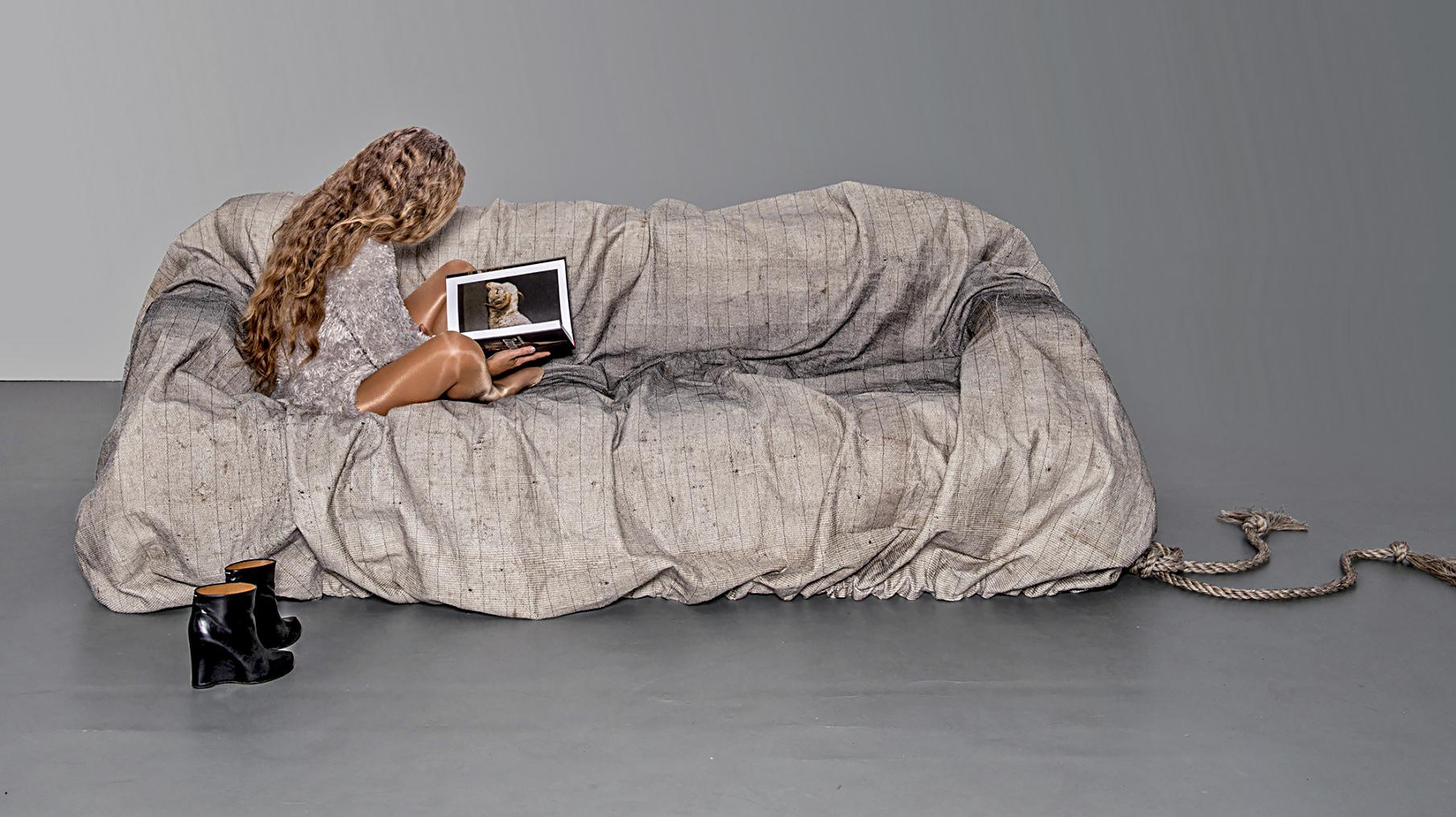
Wooden Couchcover, Buro Belén. Photography: Belén, Guus Schoth.
Wooden Couchcover, Buro Belén.
10.09.2026

Home-Maxxing shapes Heimtextil Trends 27/28

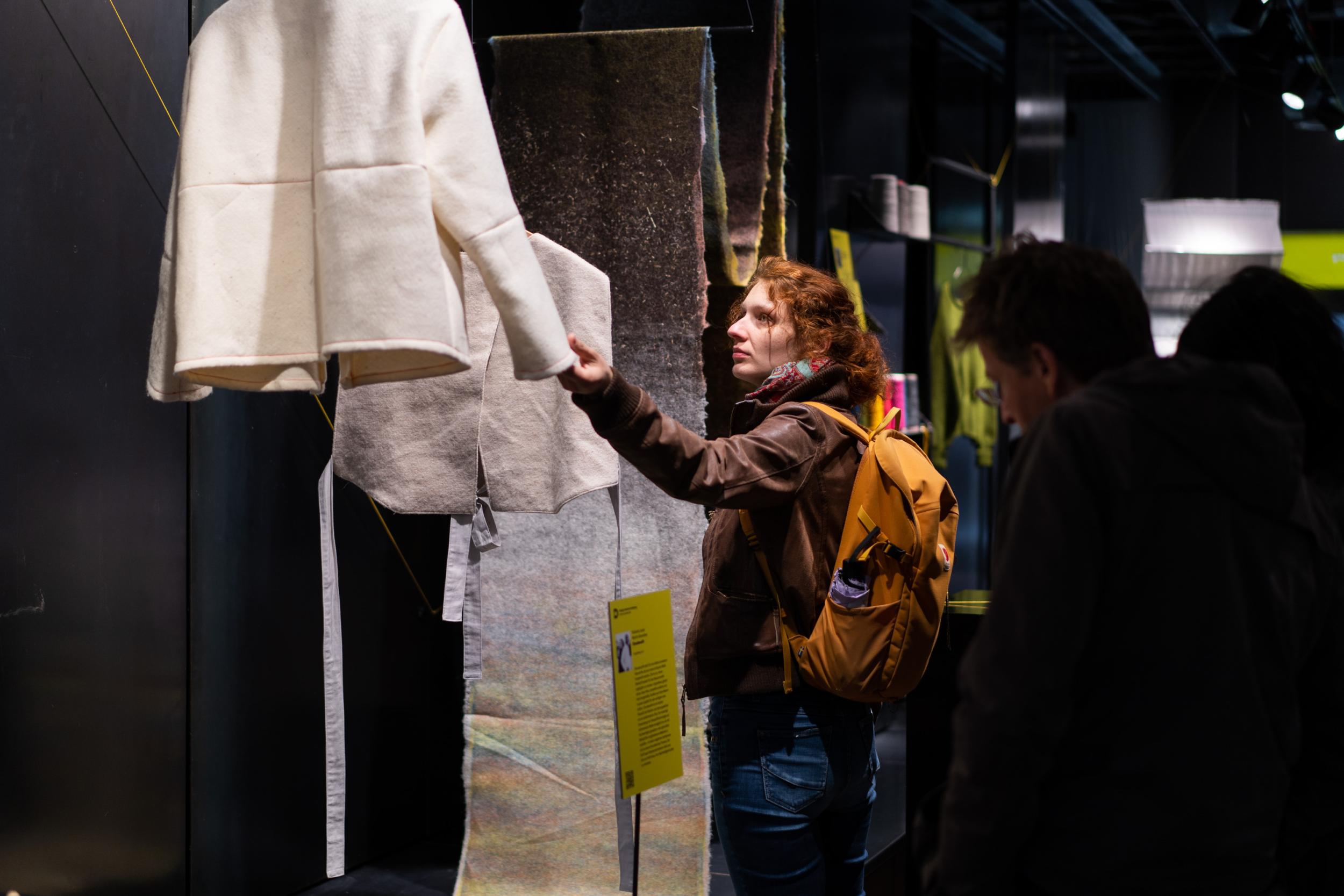
Heimtextil Trends 27/28 place the tension between optimization and respite at the center of the coming interior-textile season. Under the theme “Home-Maxxing – The Performance of Everyday Living,” Heimtextil and Milan design platform Alcova explore how technology, functionality and sensory material qualities are reshaping homes, hospitality, workplaces and healthcare environments.

Textiles are framed explicitly as functional components: they can regulate light, absorb sound or filter air. At the same time, tactility, durability and understandable construction are gaining importance. The three directions, Staged Competence, Inside, Out and Hyper Presence, range from visibly engineered performance and exposed connections to natural fibers and surfaces whose physical qualities take priority.

The trends will be presented in the Trend Space at Heimtextil from 12 to 15 January 2027. For home and contract-textile suppliers, the key message is that technical performance is no longer expected to disappear into the background; it increasingly becomes part of the visual and material language of a product.


Heimtextil Trends 27/28 place the tension between optimization and respite at the center of the coming interior-textile season. Under the theme “Home-Maxxing – The Performance of Everyday Living,” Heimtextil and Milan design platform Alcova explore how technology, functionality and sensory material qualities are reshaping homes, hospitality, workplaces and healthcare environments.

Textiles are framed explicitly as functional components: they can regulate light, absorb sound or filter air. At the same time, tactility, durability and understandable construction are gaining importance. The three directions, Staged Competence, Inside, Out and Hyper Presence, range from visibly engineered performance and exposed connections to natural fibers and surfaces whose physical qualities take priority.

The trends will be presented in the Trend Space at Heimtextil from 12 to 15 January 2027. For home and contract-textile suppliers, the key message is that technical performance is no longer expected to disappear into the background; it increasingly becomes part of the visual and material language of a product.


A matrix for recycled-fiber quality Graphic: (c) Uster Technologies AG
10.09.2026

A matrix for recycled-fiber quality

Uster Technologies has introduced a structured matrix for assessing mechanically recycled fibers. The approach is intended to help spinners deal with the wider variability of recycled feedstocks and relate measured fiber properties more directly to processing decisions and intended end uses.

Mechanically recycled cotton typically shows greater variation than virgin material because fiber length is reduced and input streams differ in origin and processing history. A consistent assessment framework can therefore support bale management, blending decisions and the adjustment of spinning parameters. Uster positions the Recycled Fiber Matrix as a practical bridge between increasing recycled-content targets and reliable quality control.

This matters for circularity at industrial scale. More recycling capacity alone does not guarantee usable yarn feedstock; recycled fibers also need to enter established production systems with predictable performance. Testing and data interpretation are becoming part of the infrastructure required to move textile-to-textile recycling from availability to repeatable production.

Uster Technologies has introduced a structured matrix for assessing mechanically recycled fibers. The approach is intended to help spinners deal with the wider variability of recycled feedstocks and relate measured fiber properties more directly to processing decisions and intended end uses.

Mechanically recycled cotton typically shows greater variation than virgin material because fiber length is reduced and input streams differ in origin and processing history. A consistent assessment framework can therefore support bale management, blending decisions and the adjustment of spinning parameters. Uster positions the Recycled Fiber Matrix as a practical bridge between increasing recycled-content targets and reliable quality control.

This matters for circularity at industrial scale. More recycling capacity alone does not guarantee usable yarn feedstock; recycled fibers also need to enter established production systems with predictable performance. Testing and data interpretation are becoming part of the infrastructure required to move textile-to-textile recycling from availability to repeatable production.

(c) De Montfort University (DMU)
08.09.2026

Smart textiles: flexible supercapacitors could power sensors directly in sportswear

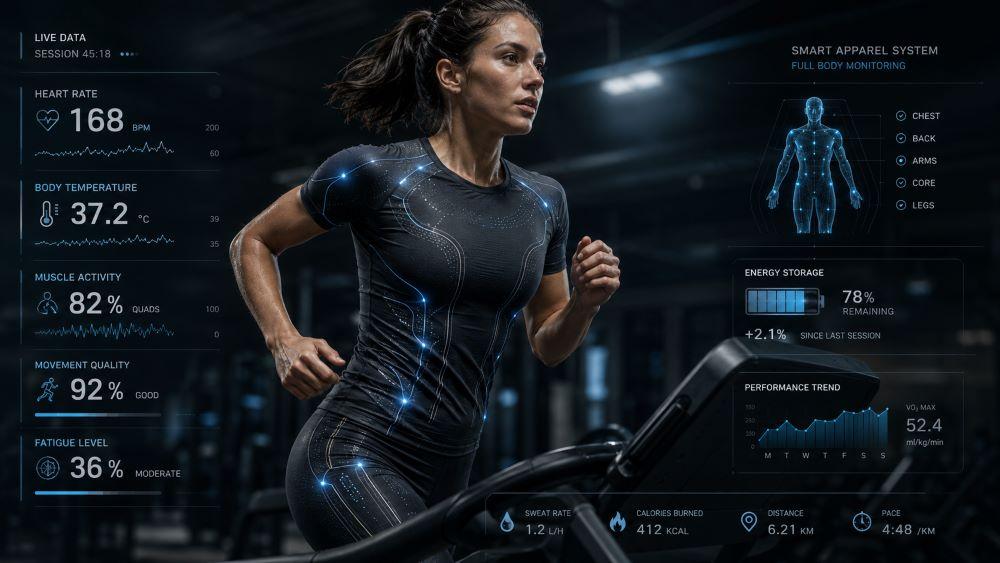
An international research team involving De Montfort University Leicester is examining how flexible supercapacitors could be integrated into sports clothing. The concept goes beyond adding another sensor to a garment. Instead, the textile would become part of the energy architecture: it could store electricity and supply distributed sensors embedded across the garment. Combined with technologies that harvest energy from body movement or heat, running tops, cycling kit or gym wear could eventually generate and store part of the power needed for continuous monitoring.

The researchers identify knitted structures and conductive yarns as particularly promising because they can combine electrical functionality with stretch, flexibility and breathability. Carbon-based electrode materials such as graphene and carbon nanotubes are also considered because of their energy-storage potential and mechanical flexibility. Compared with conventional batteries, supercapacitors can charge and discharge very rapidly, while potentially being made light and flexible enough for body-worn applications.

An international research team involving De Montfort University Leicester is examining how flexible supercapacitors could be integrated into sports clothing. The concept goes beyond adding another sensor to a garment. Instead, the textile would become part of the energy architecture: it could store electricity and supply distributed sensors embedded across the garment. Combined with technologies that harvest energy from body movement or heat, running tops, cycling kit or gym wear could eventually generate and store part of the power needed for continuous monitoring.

The researchers identify knitted structures and conductive yarns as particularly promising because they can combine electrical functionality with stretch, flexibility and breathability. Carbon-based electrode materials such as graphene and carbon nanotubes are also considered because of their energy-storage potential and mechanical flexibility. Compared with conventional batteries, supercapacitors can charge and discharge very rapidly, while potentially being made light and flexible enough for body-worn applications.

The potential use case extends beyond sport. A sensor-rich garment could monitor heart rate, body temperature, muscle activity, movement and fatigue at several points on the body rather than relying on a single wrist-mounted device. In healthcare, similar garments could support continuous monitoring and provide clinicians with information collected from different body regions. The textile would therefore shift from being a passive carrier to acting as a distributed sensing and energy platform.

Crucially, the DMU source does not present a finished smart garment. The underlying paper sets out a technological framework that brings together developments in electronics, materials science, manufacturing and flexible textiles. Considerable barriers remain. Electronic fabrics would have to tolerate sweat, repeated stretching and bending and regular laundering without losing performance. They must also remain comfortable and breathable, and eventually be manufactured at a cost and scale compatible with mainstream clothing.

Circularity is another design requirement. The study discusses recyclable or biodegradable materials, greener manufacturing and garment architectures that allow electronic components to be recovered at end of life rather than creating another stream of electronic waste. The next step is therefore practical development and funding, not commercial launch. That distinction is important: the work is a credible roadmap for e-textile integration, but its industrial maturity still has to be demonstrated.