

From the Sector

Reset
Without the ability to spin recycled fibres into yarn, it is impossible to weave or knit new fabrics. Photo TMAS / AWOL
Without the ability to spin recycled fibres into yarn, it is impossible to weave or knit new fabrics.
20.07.2026

TMAS welcomes ReSpin as Swedish textile recycling accelerates

As the latest company to join TMAS – the Swedish Textile Machinery Association – ReSpin has this year established what is just the latest in a succession of Swedish innovations shaping the country into one of Europe’s most sophisticated ecosystems for circular textiles. 

In May this year, Holma Spinning Mill, located in Forsa just outside Hudiksvall, was granted SEK 77.3 million in funding through the Swedish Environmental Protection Agency to establish Sweden’s first industrial spinning line for recycled textile fibres. Holma Spinning Mill is part of Holma Förvaltning, which is co-owned by ReSpin. Sister company Holma Helsingland brings more than a century of experience in spinning, twisting, dyeing and yarn production.

RespinJenny
ReSpin, headquartered in Undersåker, in northern Sweden’s Jämtland, has developed and patented a new mechanical recycling technology called RespinJenny which transforms textile waste into new fibres suitable for yarn production. 

As the latest company to join TMAS – the Swedish Textile Machinery Association – ReSpin has this year established what is just the latest in a succession of Swedish innovations shaping the country into one of Europe’s most sophisticated ecosystems for circular textiles. 

In May this year, Holma Spinning Mill, located in Forsa just outside Hudiksvall, was granted SEK 77.3 million in funding through the Swedish Environmental Protection Agency to establish Sweden’s first industrial spinning line for recycled textile fibres. Holma Spinning Mill is part of Holma Förvaltning, which is co-owned by ReSpin. Sister company Holma Helsingland brings more than a century of experience in spinning, twisting, dyeing and yarn production.

RespinJenny
ReSpin, headquartered in Undersåker, in northern Sweden’s Jämtland, has developed and patented a new mechanical recycling technology called RespinJenny which transforms textile waste into new fibres suitable for yarn production. 

ReSpin was founded in 2020 by Åsa Strandberg, who has more than 30 years of experience in the textile industry and for the past 15 years has been on a mission to make textiles circular. After 17 years at H&M, she chose to leave the company when growing concerns about the environmental impact of the fashion industry grew too big to  be ignored. In 2010 she launched Saiboo, a company which has a focus on the B2B production of garments, selling them and then taking them back for reuse. 

With full control over materials and design, the difficult sorting problem was solved for Saiboo from the start, and driven by the desire to push the industry further, Åsa began collaborating with Mid Sweden University in Östersund on how to design for recycling.
Soon, however, a more fundamental problem became clear – there were no viable recycling methods available on the market. Chemical initiatives were emerging and mechanical recycling existed, but only at very low level.

“While many believed chemistry was the solution, I saw untapped potential in mechanical methods and a remark from a machine researcher that anything which can be done by hand can be done mechanically became the spark that confirmed this direction,” she explains. “I then initiated several research projects together with industry and academia, including the Universities of Borås, Linköping and Luleå, to further explore this idea.”

“RespinJenny uses no water or chemicals, has low energy consumption and is based on preserving as much fibre quality as possible from waste textiles,” adds TMAS Secretary General Therese Premler-Andersson. “It is designed to enable local, small scale and resource efficient recycling closer to where textile waste is generated. The the Swedish Environmental Protection Agency’s funding is an important step in scaling fibre-to-fibre recycling industrially and demonstrating that circular textile materials can be produced on a larger scale with low climate impact.

“Mechanical recycling alone is not enough to achieve textile-to-textile recycling – without the ability to spin recycled fibres into yarn, it is impossible to weave or knit new fabrics, which is why Holma Spinning Mill represents a key part of building a complete circular textile value chain.” 

Rather than focusing on a single breakthrough technology, Swedish companies, including TMAS members, have developed expertise across the entire value chain – from collection and automated sorting through to fibre-to-fibre recycling, testing, product development and policy research.

Underpinning this, has been strong collaboration between Swedish industry and academia.

“The University of Borås – and particularly its Swedish School of Textiles –has become one of Europe’s leading centres for circular textile research and Borås is also home to a number of other TMAS members, such as the ACG Group and Eton Systems, who are driving innovation through advanced automation and involved in many cooperative projects between industry and academia in Sweden,” Therese Premler-Andersson observes.

In conclusion, Åsa Strandberg stresses the great value in now being part of a network where knowledge, innovation and collaboration are central.

“TMAS brings together many of Sweden’s leading companies and experts, all playing an important role in shaping the future of textile production technology,” she says. “As ReSpin moves towards industrialisation, we see great value in joining TMAS, because the transition to circular textile systems requires cooperation across the entire value chain, and the association provides an important platform for that dialogue.”
More information:
Respin Oy TMAS
Source:

TMAS / AWOL

STEELTOP® (c) Trützschler
STEELTOP®
15.07.2026

Trützschler: New benchmark in flat tops for spinning preparation

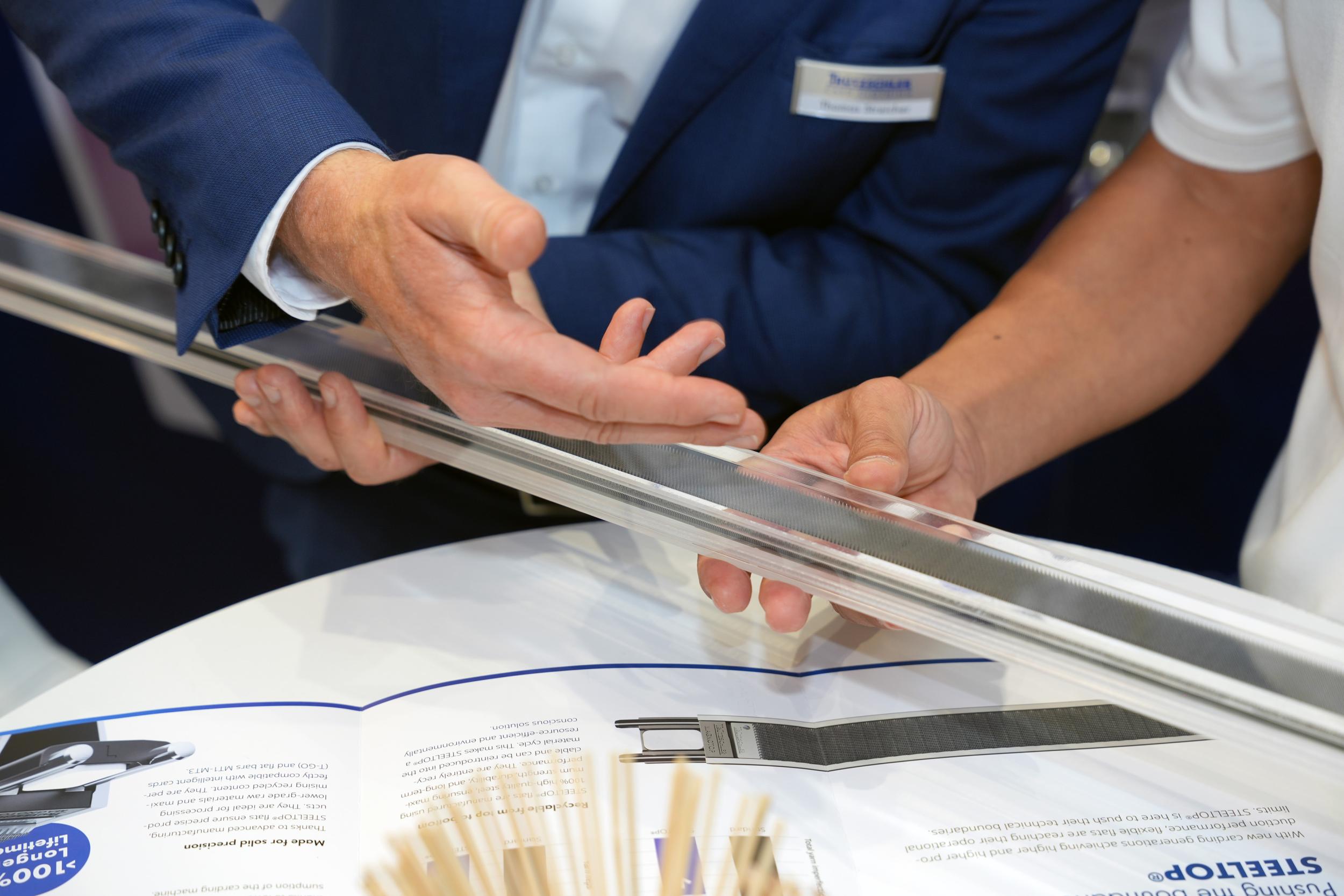
Modern carding generations achieve higher production performance, placing significantly greater stress on flat tops. Higher cylinder speeds and increased fiber density, combined with tighter carding gaps, create more demanding operating conditions. At the same time, poorer raw material quality and the increased use of recycled materials further intensify these challenges. With STEELTOP®, Trützschler introduces a new full steel flat top series developed for these demanding modern carding processes. 
 
A new benchmark in flat tops for spinning preparation 
STEELTOP® is manufactured entirely from high-quality steel and is designed to deliver consistent performance under demanding production conditions. It is ideal for processing lower-grade natural and man-made fibers and is perfectly compatible with intelligent cards, including Trützschler cards equipped with T-GO, due to its superior electrical conductivity. 
 
Built to last under extreme conditions 

Modern carding generations achieve higher production performance, placing significantly greater stress on flat tops. Higher cylinder speeds and increased fiber density, combined with tighter carding gaps, create more demanding operating conditions. At the same time, poorer raw material quality and the increased use of recycled materials further intensify these challenges. With STEELTOP®, Trützschler introduces a new full steel flat top series developed for these demanding modern carding processes. 
 
A new benchmark in flat tops for spinning preparation 
STEELTOP® is manufactured entirely from high-quality steel and is designed to deliver consistent performance under demanding production conditions. It is ideal for processing lower-grade natural and man-made fibers and is perfectly compatible with intelligent cards, including Trützschler cards equipped with T-GO, due to its superior electrical conductivity. 
 
Built to last under extreme conditions 
The new flat top achieves outstanding durability even under the most challenging carding conditions. Compared to conventional alternatives, the lifetime is more than doubled, ensuring long-term reliability. This extended lifetime reduces waste on carding machines, including fewer flat top strips and less fiber waste and leads to cost savings of more than 30% on flat top replacement. 
 
Driving yarn quality and production efficiency 
STEELTOP® contributes to elevated yarn quality and is particularly suitable for open-end (OE) and airjet (MVS) applications. It enables comparable or better sliver and yarn quality, with a reduction in total yarn imperfections (IPI) of up to 10%. In addition, it is exceptionally effective in the removal of neps, achieving reductions of up to 20%. 
Lower overall current consumption of the carding machine improves energy efficiency, while enhanced efficiency supports higher production rates. 
 
Sustainable from top to bottom 
Sustainability is a key feature of the new development. Made entirely of steel, the flat tops are fully recyclable and can be returned to the material cycle after use. At the same time, reduced waste and lower energy consumption contribute to a more sustainable carding process overall. 
 
Extending the limits of modern carding 
Combining durability, precision, recyclability, and efficiency, STEELTOP® sets a benchmark in performance and extends the limits of modern carding technology. 

Source:

Trützschler

08.07.2026

USColorworks: Digital Platform with Kornit Atlas MATRIX and Atlas MAX PLUS Solutions

Kornit Digital Ltd., a pioneer in sustainable, on-demand digital fashion and textile production, announced that USColorworks, a North Carolina-based apparel decoration and fulfillment company specializing in custom and on-demand printing for retail and promotional markets, has expanded its Kornit digital production platform with the addition of Atlas MATRIX and Atlas MAX PLUS systems to deliver high-quality, on-demand apparel across cotton, blended fabrics and polyester. 

Kornit Digital Ltd., a pioneer in sustainable, on-demand digital fashion and textile production, announced that USColorworks, a North Carolina-based apparel decoration and fulfillment company specializing in custom and on-demand printing for retail and promotional markets, has expanded its Kornit digital production platform with the addition of Atlas MATRIX and Atlas MAX PLUS systems to deliver high-quality, on-demand apparel across cotton, blended fabrics and polyester. 

Among the first companies to adopt Kornit's new Atlas MATRIX direct-to-garment (DTG) solution, USColorworks is leveraging its ability to deliver the highest quality output across all fabric types, including polyester, projecting a 30% increase in apparel and textile production for all on-demand orders. By reducing operational complexity and opening new revenue streams, Atlas MATRIX enables true on-demand manufacturing without compromising quality, durability, or efficiency. The scalable platform also allows USColorworks to bypass large inventory stocking in favor of fast, direct-to-customer shipping, producing high-definition, high-quality prints on demand across a boundless range of fabrics and colors. 

USColorworks is replacing its legacy production systems with Atlas MATRIX, unifying custom order production—whether for 1 piece or 1,000—to accelerate turnaround times, reduce labor costs, eliminate pre-treatment, and deliver a superior hand feel.  At the same time, USColorworks is reducing its reliance on the more labor-intensive direct-to-film (DTF) workflow, previously its method for short-run polyester print-on demand jobs, by transitioning those volumes to Kornit infrastructure. 

“Digital production has dramatically increased our competitiveness and revenue," said Rodney McDonald, President of USColorworks. "I don't believe you can win a national program now without having the ability to handle both bulk items and on-demand orders. Digital is the only way to do it all right—managing both large and small orders in the same process. As speed, accuracy, and consistency are critical, the Atlas MATRIX system is the right solution at the right time, and it has led to an immediate and significant increase in volume from retail customers. We see this new platform leading the way for print-on-demand across our entire business." 

“When we officially unveiled the Atlas MATRIX system at Kornit Konnections this past April, our intent was clear – enable brands and producers to embrace digital production for what has now become the on-demand era. Kornit is delivering on that promise with the new Atlas MATRIX system, which is already producing tangible results at some of our leading customers,” said Chris Carson, Vice President of Sales at Kornit North America. “We’re proud USColorworks has chosen to expand their digital production capabilities with Atlas MATRIX, thus removing production limitations and firmly embracing digital as the new standard for apparel production.” 

30.06.2026

Italian Textile Machinery Excellence Makes a Double Stop in Bangladesh

Technological upgrading and the transition toward higher value-added production are driving the new Italian industrial mission to Bangladesh. This year, the mission will split between the country’s two main manufacturing hubs, where Italian manufacturers will meet the leaders of the local textile supply chain in two strategic stages: July 7th in Dhaka and July 9th in Chittagong.

The double appointment shines a spotlight on a market that confirms itself as a true cornerstone for Italian exports in Asia—a geographical area that alone absorbs 40% of the sector’s foreign sales, reaching a value of 667 million euros. Bangladesh’s role has grown steadily, culminating in 2025 with a turnover of 71 million euros and posting a double-digit increase (+17% compared to the previous year).

Production flexibility and the ability to create customized technological niches are the hallmarks of the roughly 300 companies making up the Italian textile machinery industry—a highly internationalized sector that exports 86% of its production to 130 countries.

Technological upgrading and the transition toward higher value-added production are driving the new Italian industrial mission to Bangladesh. This year, the mission will split between the country’s two main manufacturing hubs, where Italian manufacturers will meet the leaders of the local textile supply chain in two strategic stages: July 7th in Dhaka and July 9th in Chittagong.

The double appointment shines a spotlight on a market that confirms itself as a true cornerstone for Italian exports in Asia—a geographical area that alone absorbs 40% of the sector’s foreign sales, reaching a value of 667 million euros. Bangladesh’s role has grown steadily, culminating in 2025 with a turnover of 71 million euros and posting a double-digit increase (+17% compared to the previous year).

Production flexibility and the ability to create customized technological niches are the hallmarks of the roughly 300 companies making up the Italian textile machinery industry—a highly internationalized sector that exports 86% of its production to 130 countries.

“The 2025 figures speak clearly: the 17% growth testifies that the Bangladeshi textile industry views Italian manufacturers as an irreplaceable partner to win the global challenge of quality and efficiency,” comments Marco Salvadè, President of ACIMIT. “The decision to visit both Dhaka and Chittagong with this workshop stems from our desire to closely support the country’s two industrial engines, offering tailored solutions capable of generating an immediate technological upgrade and guiding local players toward more sustainable models. This journey also represents an ideal springboard ahead of ITMA Hanover 2027, the global stage where we will showcase the next major evolutions of our technology.”

The workshop—promoted by the Italian Trade Agency (ICE) and ACIMIT and organized with the valuable support of the Embassy of Italy in Dhaka—will be structured to maximize networking opportunities through targeted B2B business meetings and in-depth technical seminars in both cities. It will feature the participation of the following Italian companies:

COLOR SERVICE, CORINO MACCHINE, DANTI, DURST, L.A.I.P., LAWER, MONTI – MAC, MS PRINTING SOLUTIONS, ROJ, PENTEK, PINTER CAIPO, REGGIANI MACCHINE, SALVADE’, TECNORAMA, UGOLINI.

Source:

Association of Italian Textile Machinery Manufacturers