From the Sector

Reset
(c) De Montfort University (DMU)
08.09.2026

Smart textiles: flexible supercapacitors could power sensors directly in sportswear

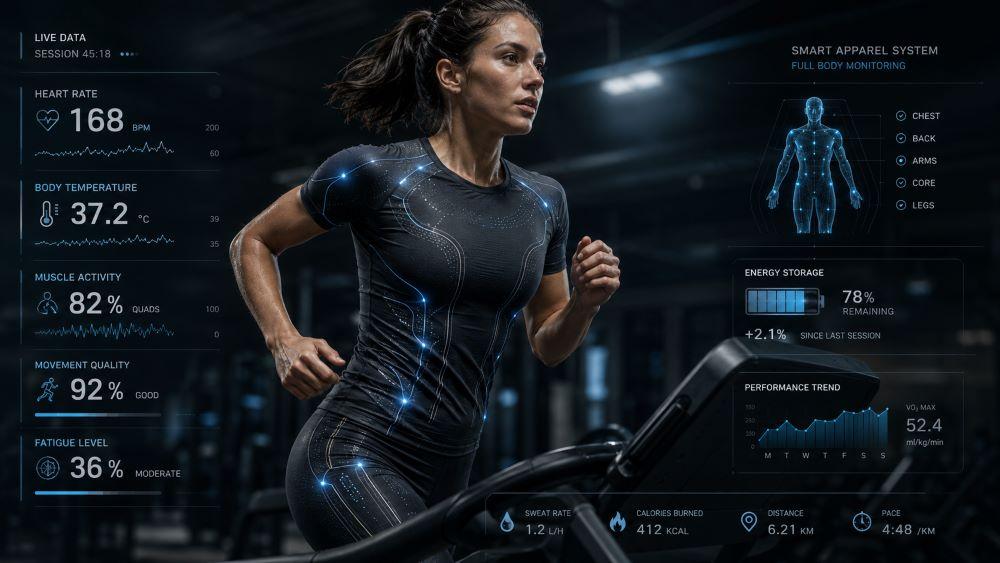
An international research team involving De Montfort University Leicester is examining how flexible supercapacitors could be integrated into sports clothing. The concept goes beyond adding another sensor to a garment. Instead, the textile would become part of the energy architecture: it could store electricity and supply distributed sensors embedded across the garment. Combined with technologies that harvest energy from body movement or heat, running tops, cycling kit or gym wear could eventually generate and store part of the power needed for continuous monitoring.

The researchers identify knitted structures and conductive yarns as particularly promising because they can combine electrical functionality with stretch, flexibility and breathability. Carbon-based electrode materials such as graphene and carbon nanotubes are also considered because of their energy-storage potential and mechanical flexibility. Compared with conventional batteries, supercapacitors can charge and discharge very rapidly, while potentially being made light and flexible enough for body-worn applications.

An international research team involving De Montfort University Leicester is examining how flexible supercapacitors could be integrated into sports clothing. The concept goes beyond adding another sensor to a garment. Instead, the textile would become part of the energy architecture: it could store electricity and supply distributed sensors embedded across the garment. Combined with technologies that harvest energy from body movement or heat, running tops, cycling kit or gym wear could eventually generate and store part of the power needed for continuous monitoring.

The researchers identify knitted structures and conductive yarns as particularly promising because they can combine electrical functionality with stretch, flexibility and breathability. Carbon-based electrode materials such as graphene and carbon nanotubes are also considered because of their energy-storage potential and mechanical flexibility. Compared with conventional batteries, supercapacitors can charge and discharge very rapidly, while potentially being made light and flexible enough for body-worn applications.

The potential use case extends beyond sport. A sensor-rich garment could monitor heart rate, body temperature, muscle activity, movement and fatigue at several points on the body rather than relying on a single wrist-mounted device. In healthcare, similar garments could support continuous monitoring and provide clinicians with information collected from different body regions. The textile would therefore shift from being a passive carrier to acting as a distributed sensing and energy platform.

Crucially, the DMU source does not present a finished smart garment. The underlying paper sets out a technological framework that brings together developments in electronics, materials science, manufacturing and flexible textiles. Considerable barriers remain. Electronic fabrics would have to tolerate sweat, repeated stretching and bending and regular laundering without losing performance. They must also remain comfortable and breathable, and eventually be manufactured at a cost and scale compatible with mainstream clothing.

Circularity is another design requirement. The study discusses recyclable or biodegradable materials, greener manufacturing and garment architectures that allow electronic components to be recovered at end of life rather than creating another stream of electronic waste. The next step is therefore practical development and funding, not commercial launch. That distinction is important: the work is a credible roadmap for e-textile integration, but its industrial maturity still has to be demonstrated.

08.09.2026

DSC launches MORPH materials platform

Dahsheng Company has introduced MORPH, a materials platform that combines foams, textiles, films and functional layers into application-specific engineered systems. Brands can select surface materials, foam cores, colours, density, thickness, perforation and additional functional layers. The platform can be supplied as moulded components, sheet materials or fully integrated material systems, with footwear and sports applications a clear focus.

At the core are DSC’s DREAMCELL open-cell and DURAPONTEX closed-cell foam technologies. The company says more than 100 fabric and colour options are available for the top layer. Depending on the construction, the system can combine comfort, low weight, durability, breathability and impact protection. The emphasis therefore shifts from a single foam or textile to a coordinated multilayer material architecture.

Dahsheng Company has introduced MORPH, a materials platform that combines foams, textiles, films and functional layers into application-specific engineered systems. Brands can select surface materials, foam cores, colours, density, thickness, perforation and additional functional layers. The platform can be supplied as moulded components, sheet materials or fully integrated material systems, with footwear and sports applications a clear focus.

At the core are DSC’s DREAMCELL open-cell and DURAPONTEX closed-cell foam technologies. The company says more than 100 fabric and colour options are available for the top layer. Depending on the construction, the system can combine comfort, low weight, durability, breathability and impact protection. The emphasis therefore shifts from a single foam or textile to a coordinated multilayer material architecture.

For textile developers, the interface between softgoods and foam engineering is the most relevant aspect. Face fabrics, synthetic surfaces, films, foam and backing layers can be engineered together for the end use. That can streamline material development for brands, but it also raises questions around adhesion, long-term durability, recyclability and the end-of-life handling of heterogeneous multilayer constructions.

DSC does not publish standardised performance values, comparative test data or recycling routes for MORPH in the announcement. Performance and environmental claims should therefore be treated as manufacturer statements at this stage. The editorial significance lies in the platform approach and the deeper integration of textile and polymer functional layers within one materials-development process.

Source:

Dahsheng Company / DSC

Image by Sallman Hayat, Pixabay
08.09.2026

IIT Delhi and Indian Air Force launch AI research for parachutes and safety equipment

The Indian Institute of Technology Delhi (IIT Delhi) and the Indian Air Force (IAF) are combining research expertise in technical textiles. According to IIT Delhi’s Department of Textile and Fibre Engineering, the cooperation will focus on AI-powered research for parachutes and other safety equipment.

The initiative brings together textile material and structural expertise with data-driven methods. In parachute systems, material ageing, fabric construction, seams and joining technologies, as well as behaviour under dynamic loads, are safety-critical. AI models can support faster evaluation of testing data, condition classification and data-based development or maintenance decisions.

For the technical-textile industry, the cooperation is particularly relevant because it demonstrates how established textile testing and engineering can be combined with digital models. Beyond military use, the approach may also be relevant to rescue systems, personal protective equipment and other highly loaded textile structures.

The Indian Institute of Technology Delhi (IIT Delhi) and the Indian Air Force (IAF) are combining research expertise in technical textiles. According to IIT Delhi’s Department of Textile and Fibre Engineering, the cooperation will focus on AI-powered research for parachutes and other safety equipment.

The initiative brings together textile material and structural expertise with data-driven methods. In parachute systems, material ageing, fabric construction, seams and joining technologies, as well as behaviour under dynamic loads, are safety-critical. AI models can support faster evaluation of testing data, condition classification and data-based development or maintenance decisions.

For the technical-textile industry, the cooperation is particularly relevant because it demonstrates how established textile testing and engineering can be combined with digital models. Beyond military use, the approach may also be relevant to rescue systems, personal protective equipment and other highly loaded textile structures.

Source:

Indian Institute of Technology Delhi (IIT Delhi), Department of Textile and Fibre Engineering

PITAKA's Brand Event in Berlin: 'Signals in the Wind' Photo (c) PITAKA
PITAKA's Brand Event in Berlin: 'Signals in the Wind'
07.09.2026

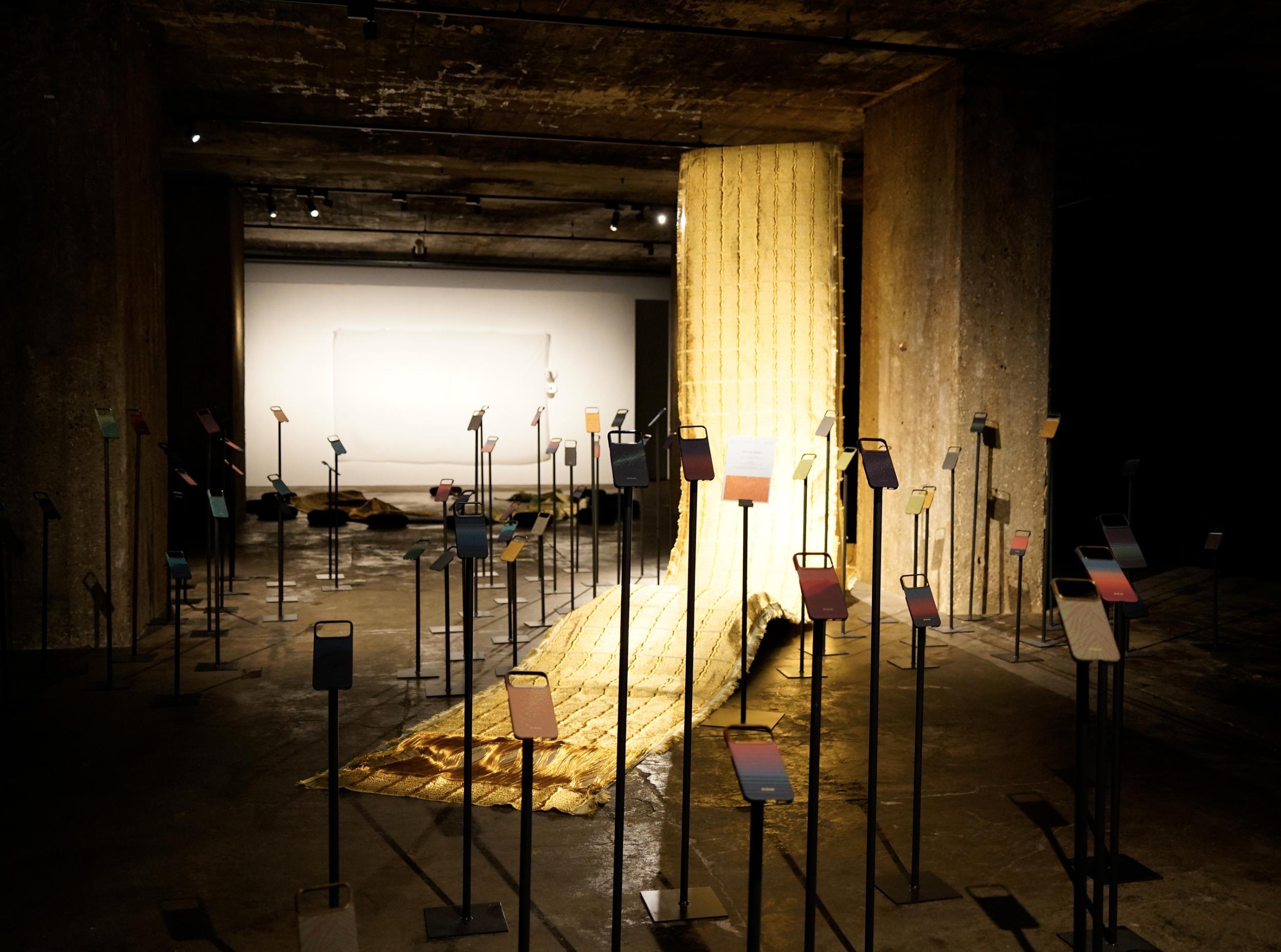
PITAKA turns aramid fibre into a deliberately irregular woven surface

PITAKA has introduced a new weaving technique for aramid fibre at a brand event in Berlin. The company is best known for thin smartphone cases and accessories made with aramid. Its new “Trace Form” technique is intended to avoid a completely uniform programmed surface: selected fibres are allowed to drift from their prescribed path so that texture emerges from controlled irregularity.

The first application is the “Wind Over Wheat Trace Form Edition”, with a surface intended to evoke wind moving across a wheat field and offered in three finishes. PITAKA presents the method as an interaction between industrial precision, material response and human judgement. For textile and material developers, the notable point is that a high-performance fibre normally valued for strength and low weight is being used as the visible aesthetic element of the product itself.

PITAKA has introduced a new weaving technique for aramid fibre at a brand event in Berlin. The company is best known for thin smartphone cases and accessories made with aramid. Its new “Trace Form” technique is intended to avoid a completely uniform programmed surface: selected fibres are allowed to drift from their prescribed path so that texture emerges from controlled irregularity.

The first application is the “Wind Over Wheat Trace Form Edition”, with a surface intended to evoke wind moving across a wheat field and offered in three finishes. PITAKA presents the method as an interaction between industrial precision, material response and human judgement. For textile and material developers, the notable point is that a high-performance fibre normally valued for strength and low weight is being used as the visible aesthetic element of the product itself.

The release leaves important technical questions unanswered. It provides no fibre fineness, weave parameters, mechanical data or quantified performance difference versus earlier aramid constructions. It would therefore be misleading to describe the launch as a new performance class. What can be stated is that PITAKA is translating a deliberately variable woven structure into a commercial aramid product and broadening the interface between technical fibres, composite structures and lifestyle design.

The limited Trace Form edition is scheduled to launch on 17 September. For textile-industry coverage, the relevant angle is not the consumer-electronics accessory itself but the material strategy: technical fibres can acquire additional value through construction, surface appearance and tactile expression beyond their conventional performance role.

More information:
PITAKA aramid
Source:

PITAKA  

Cinte Techtextil China Photo: Messe Frankfurt
28.08.2026

Cinte Techtextil China 2026 to open next week

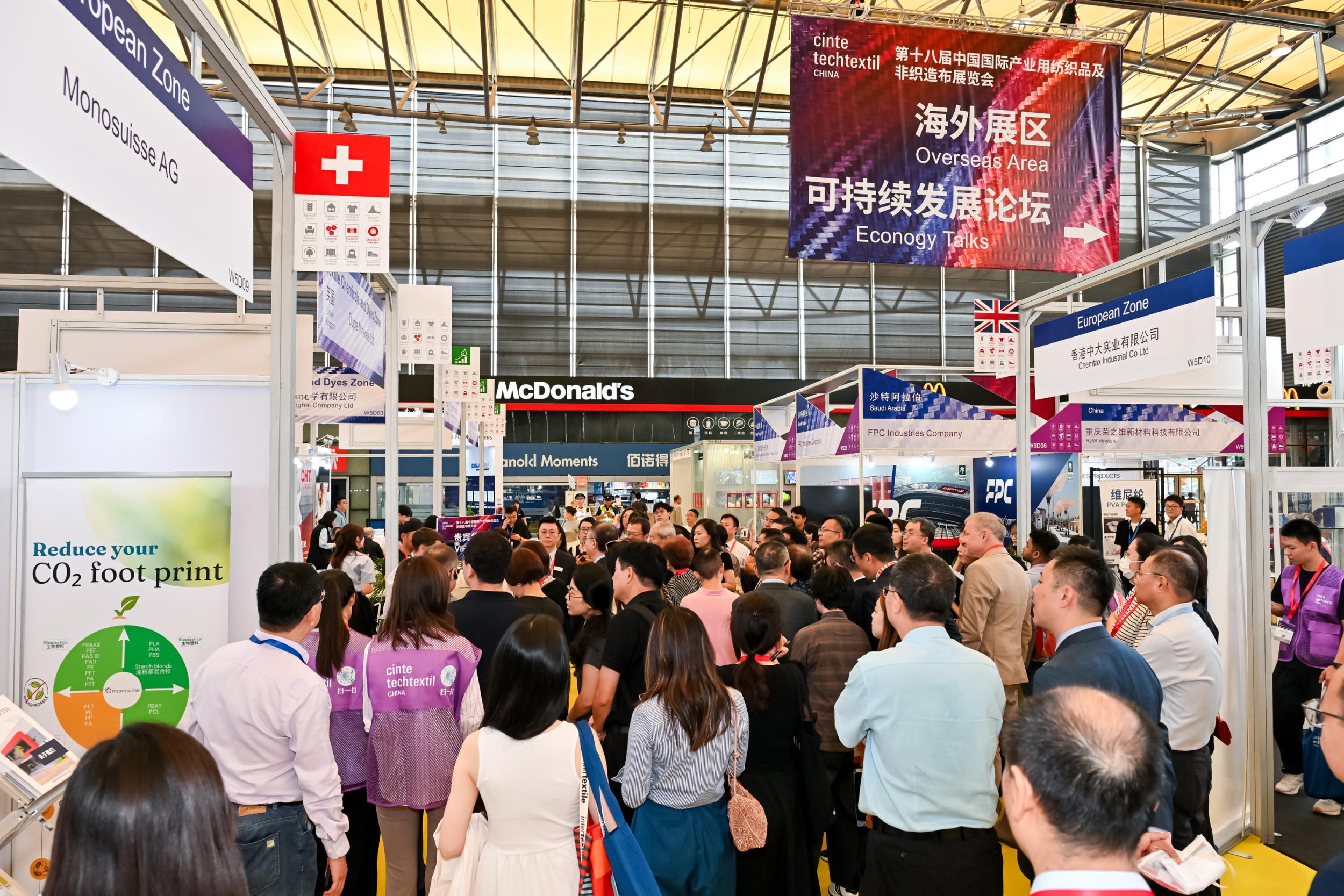
As Asia’s premier platform catering to the evolving needs in technical textiles and nonwovens, Cinte Techtextil China will open next week at the Shanghai New International Expo Centre, gathering over 300 exhibitors from 15 countries and regions. Across Halls W3 to W5, this edition will create chances for fast-growing sectors and emerging trends – such as Mobiltech, Medtech & Protech, Indutech and more. The curated zones, pavilions, and fringe programme are designed to better connect exhibitors with targeted buyers from across China, Asia-Pacific, and further afield. Meanwhile, the Association Village will gather international industry associations to foster even more global collaboration.

As a hub for global innovation, the fair will feature a strong contingent of international industry leaders in Hall W5’s Overseas Zone, including Andritz (China) Ltd, Groz-Beckert (Germany), A.Celli SPA (Italy), and Dilo (Germany), while others such as Picanol NV (Belgium) will showcase in Hall W4.

As Asia’s premier platform catering to the evolving needs in technical textiles and nonwovens, Cinte Techtextil China will open next week at the Shanghai New International Expo Centre, gathering over 300 exhibitors from 15 countries and regions. Across Halls W3 to W5, this edition will create chances for fast-growing sectors and emerging trends – such as Mobiltech, Medtech & Protech, Indutech and more. The curated zones, pavilions, and fringe programme are designed to better connect exhibitors with targeted buyers from across China, Asia-Pacific, and further afield. Meanwhile, the Association Village will gather international industry associations to foster even more global collaboration.

As a hub for global innovation, the fair will feature a strong contingent of international industry leaders in Hall W5’s Overseas Zone, including Andritz (China) Ltd, Groz-Beckert (Germany), A.Celli SPA (Italy), and Dilo (Germany), while others such as Picanol NV (Belgium) will showcase in Hall W4.

The sought-after European and German Zones will also be in Hall W5, featuring high-performance solutions from such markets. Key suppliers in the European Zone will include Monosuisse Group (Switzerland) and Comerio Ercole S.p.A (Italy), while the German Zone will include IBENA Textilwerke GmbH and Mahlo GmbH + Co KG. Nearby, the Textile Chemicals and Dyes Zone will return to offer advanced solutions for diverse technical applications.

A key highlight of Hall W5 is the Association Village, designed to showcase expertise, foster international trade networks and collaboration, as well as present the latest trends that shape the industry’s future. Key organisations anchoring this feature include the Asia International Hemp Federation (AIHF) (Thailand), UK Fashion and Textile Association (UKFT), Government of Tamil Nadu India, and Nonwoven Federation of India (NWFI).

Targeted solutions displayed across high-demand application areas
With the technical textiles and nonwovens markets evolving, exhibitors are presenting advances engineered for critical application areas across the show floor:

  • Mobiltech: highlighted suppliers include JR Ltd (Korea) and Eastex Industrial Science & Technology (China). Also on the domestic side, Tiandingfeng Holdings Co Ltd will showcase high-strength PET filament needle-punched nonwovens. The Mobiltech Zone, set to feature other key exhibitors, will also be in Hall W4.
  • Medtech: featuring first-time exhibitor NIPPON Paper Industries Co Ltd (Japan) with its Cu-TOP product – a functional material derived from wood pulp combined with copper technology. The Reifenhauser Group from Germany will also be in Hall W5, with Reifenhauser Reicofil presenting full nonwoven production lines, and Reifenhauser Enka Tecnica the service components that aid their longevity. Joining the lineup, Yixiang Health Technology Co Ltd and Zhejiang Kingsafe Hygiene Materials Technology Co Ltd will both showcase medical and hygiene nonwovens.
  • Protech: key Protech exhibitors include a new exhibitor Tepar Tekstil San Ve Tic A S (Turkiye), and Dawnsens New Materials (Xiamen) Co Ltd (China), both showcasing advanced safety materials.
  • Indutech: IMAE Industries Ltd (Japan) will make its debut at the fair. The company specialises in thermal insulation fibre products and supplies fine ceramics for heavy industry, automotive, iron and steel, chemical, power generation and more.

Other first-time international brands will include Care Holdings Pte Ltd (Singapore) and Texbond Nonwovens (India); while China’s innovation will be spotlighted with domestic pavilions in Hall W3 featuring medical and hygiene textiles and in Hall W4 featuring filtration and separation textiles. Exhibitors are set to be greeted by a wide range of industry visitors.

Before the fair, overseas visitor pre-registrations have risen notably compared to the same period last year. These include 139 VIP buyers from 27 countries and regions, such as Hyundai Motor Company and Sejong Healthcare (Korea), Meditec Japan Co Ltd (Japan), ALSICO (Belgium), Focus Industries Limited (Hong Kong), Freudenberg Performance Materials Service GmbH and MöllerWerke GmbH (Germany), seeking high-demand solutions across Mobiltech, Medtech and Protech, Indutech, and more. In addition, seven international buyer delegations, from industry hubs across Asia-Pacific and beyond, will add to the fair’s global business appeal.

Fringe events explore innovation, emerging markets, and automotive trends in Halls W4 and W5 

  • Panel Discussion (Day 1 morning) (W5 E20): the discussion topic, Industrial Hemp Fibre – Building the Future of Sustainable Materials, will take Thailand as a successful example to explore the use of advanced hemp fibre materials through cross-sector innovation and international investment. Complemented by the AIHF display area (W5 B20), featuring the evolution of raw hemp stalks into modern bioplastics, composites, mobility components, lifestyle products and other engineered applications.
  • 2026 Nonwovens Industry High-Quality Development Conference (Day 1 afternoon) (W4 D38): under the theme ‘Redefine the growth paradigm’, Ms Guimei Li, President of China Nonwovens & Industrial Textiles Association, will show China’s nonwovens development during the 15th Five-Year Plan. Guest speaker Mr Anshumali Jain, Vice President of the Nonwoven Federation of India, will discuss the situation and opportunities of India’s industrial ecosystem, while Mr Tony Fragnito, President of the Association of the Nonwoven Fabrics Industry, will explore the state of the US market.
  • Automotive textile panel (Day 2 afternoon) (W5 E20): titled “Defining the Future Cabin: Multi-functional Evolution of Nonwoven Materials in Automotive”, the panel will include automotive end users, Tier-1 automotive interior suppliers, and upstream nonwoven technology providers. The Mobiltech Display Area (W4 F25) will complement the panel, with exhibits from Groz-Beckert, AIHF, Care Holdings Pte Ltd, Swisstulle (Qingdao) Co Ltd, and more.

Other key events include a presentation on sustainability by UKFT and the Sustainability Tour by Mr Karl Borgschulze, Managing Director of Consulting Service Intl Ltd (both on Day 2 morning) (W5 E20); other guided tours led by industry experts (covering medical, protective, automotive, and tents & coverings); Technology Innovation and Product Development for Future Technical Textiles; Deeyeo Flushable Wipes Scientific Consensus Release and Industry High-Quality Development Dialogue; and a display zone dedicated to Industrial Textiles in the 15th Five-Year Plan.

The fair’s product categories cover 12 application areas, which comprehensively span a full range of potential uses in modern technical textiles and nonwovens. These categories also cover the entire industry, from upstream technology and raw materials providers to finished fabrics, chemicals and other solutions. This scope of product groups and application areas ensures that the fair is an effective business platform for the entire industry.

28.08.2026

NC State joins $160 million initiative for biobased fibre materials

NC State University is a core partner in the BRIDGES Engine initiative backed by the US National Science Foundation, with up to $160 million available over ten years. A central focus is the development of miscanthus and switchgrass as feedstocks for biobased products.

The plant fibres are intended for applications including automotive, construction and packaging. NC State will contribute techno-economic assessment, sustainability analysis and processing expertise to convert agricultural feedstocks into fibre materials suitable for industrial use.

For technical textiles, the initiative is particularly relevant because it goes beyond laboratory-scale material development and aims to build supply chains, processing capacity and regional markets in parallel.

NC State University is a core partner in the BRIDGES Engine initiative backed by the US National Science Foundation, with up to $160 million available over ten years. A central focus is the development of miscanthus and switchgrass as feedstocks for biobased products.

The plant fibres are intended for applications including automotive, construction and packaging. NC State will contribute techno-economic assessment, sustainability analysis and processing expertise to convert agricultural feedstocks into fibre materials suitable for industrial use.

For technical textiles, the initiative is particularly relevant because it goes beyond laboratory-scale material development and aims to build supply chains, processing capacity and regional markets in parallel.

Source:

NC State University

Dyneema SK80 fiber Photo (c) Avient Corporation
Dyneema SK80 fiber
28.08.2026

Dyneema SK80 targets significantly longer service life for mooring lines

Avient is introducing Dyneema SK80, a new HMPE fibre grade for mooring lines and offshore applications. According to the company, the fibre was engineered at polymer level to deliver at least twice the durability and fatigue resistance of Dyneema SK78 in demanding mooring applications.

The technological emphasis is therefore less on headline tensile strength than on service life under cyclic loading. In mooring systems, repeated load cycles, abrasion, bending stress and environmental exposure are major failure drivers. Improved fatigue resistance can therefore have a direct effect on maintenance intervals, operational safety and lifecycle costs.

The new fibre will be presented at SMM in Hamburg in early September. For Textination, the development is relevant because high-performance fibres are increasingly being positioned not only through weight and strength advantages, but through durability, reliability and the total cost of technical textile systems.

Avient is introducing Dyneema SK80, a new HMPE fibre grade for mooring lines and offshore applications. According to the company, the fibre was engineered at polymer level to deliver at least twice the durability and fatigue resistance of Dyneema SK78 in demanding mooring applications.

The technological emphasis is therefore less on headline tensile strength than on service life under cyclic loading. In mooring systems, repeated load cycles, abrasion, bending stress and environmental exposure are major failure drivers. Improved fatigue resistance can therefore have a direct effect on maintenance intervals, operational safety and lifecycle costs.

The new fibre will be presented at SMM in Hamburg in early September. For Textination, the development is relevant because high-performance fibres are increasingly being positioned not only through weight and strength advantages, but through durability, reliability and the total cost of technical textile systems.