From the Sector

Reset
09.11.2026

INDA: New Name for International Fiber Journal

The magazine will become Fibers&Nonwovens in January 2027, reflecting its established coverage of fiber innovation and the global nonwovens industry.

INDA, the Association of the Nonwoven Fabrics Industry, and its publishing arm INDA Media announced that International Fiber Journal (IFJ) will become Fibers&Nonwovens with Issue 1, 2027. The new name reflects the magazine’s longstanding focus on fiber innovation and its coverage of the materials, technologies and markets shaping the global nonwovens industry.

Under its new name, the magazine will continue to deliver the industry reporting, market insights and technical perspectives that IFJ readers rely on.

“Fibers, materials science, nonwovens and engineered materials have long been part of the same story for our readers,” said Rachael Davis, publisher and chief content officer, INDA Media. “An advance in fiber technology can change how a nonwoven is made, how it performs and where it can be used. Our job is to follow those connections and help readers understand what new developments mean for their work. The name Fibers&Nonwovens makes that editorial focus clear while carrying forward the technical reporting and industry perspectives readers have come to expect from International Fiber Journal.”

INDA acquired International Fiber Journal and International Filtration News in October 2018. At the time, IFJ covered man-made fibers, technical textiles and nonwovens, connecting producers of engineered materials and machinery with fiber and yarn users in more than 90 countries.

Current subscribers will continue to receive the new magazine without interruption. 

Source:

INDA Association of the Nonwoven Fabrics Industry
26.10.2026

INDA announces finalists for 2026 Hygienix Innovation Award™

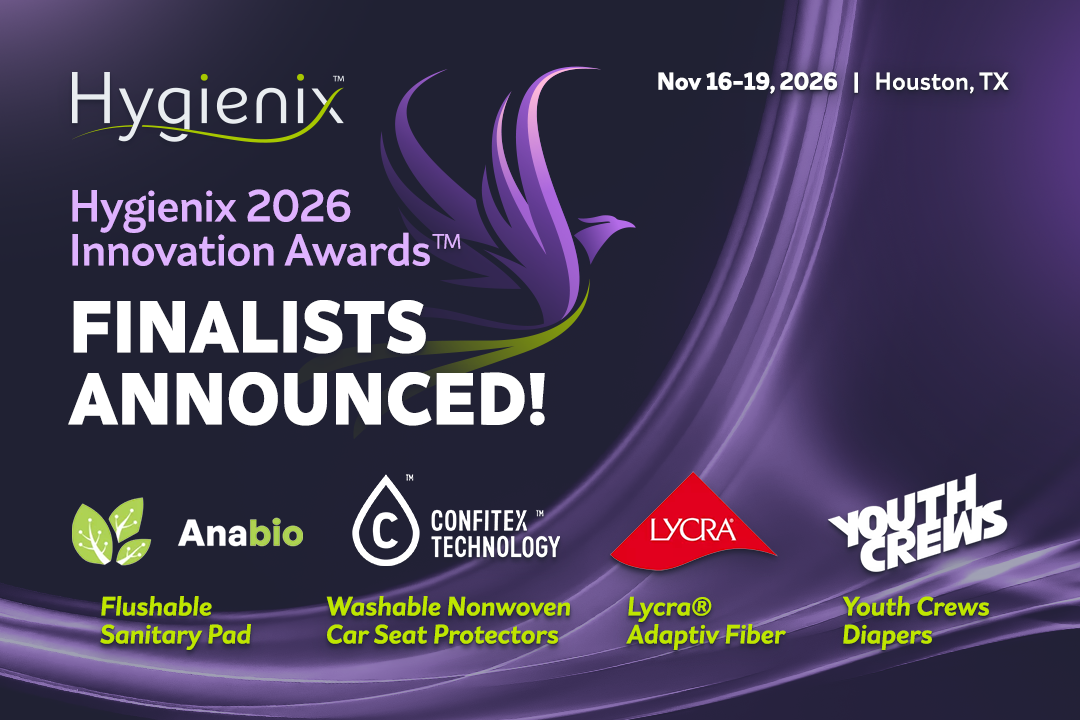
INDA, the Association of the Nonwoven Fabrics Industry, today announced the finalists for the 2026 Hygienix Innovation Award™: Anabio Technologies, Confitex Technology, The LYCRA Company and Youth Crews.

The finalists will present their innovations at Hygienix, an annual event for absorbent hygiene professionals, Nov. 16-19 at the Hyatt Regency Houston. The winner will be announced Thursday, Nov. 19, at 11:30 a.m.

Anabio Technologies: Flushable Sanitary Pad
Every sanitary pad used today can outlive us by an estimated 500 years. Anabio’s patented flushable pad changes that. Its multilayer architecture protects for 12 hours, then disperses when flushed. Independently tested to meet IWSFG flushability requirements, it is designed for flush toilets, septic systems and pit latrines and runs on standard converting lines, offering a practical route to scalable, sustainable, convenient and affordable menstrual care.

Confitex Technology: Washable Nonwoven Car Seat Protectors
Confitex Technology has cemented its reputation as the tech leader in reusable absorbent hygiene by extending the application of its transformative washable nonwoven AHPs into the automotive category. Its world-first washable nonwoven car seat protectors are independently verified to absorb and hold 24 fl oz (700 ml) inside a patented leak-resistant frame and keep performing after 30+ washes. Made from 100% nonwoven materials, they open up a new market segment for the nonwovens industry.

The LYCRA Company: Lycra® Adaptiv Fiber
LYCRA® ADAPTIV fiber reimagines stretch for absorbent hygiene products by leveraging technology originally developed for apparel to personal care. Designed to adapt dynamically to the wearer, this revolutionary spandex polymer with its unique chemistry delivers all-day comfort, inclusive sizing, easier on-and-off wear, and a second-skin fit, helping transform the wearing experience in personal care.

Youth Crews: Youth Crews Diapers
Youth Crews makes tab-style diapers for disabled kids ages 4 to 17 who outgrew baby diapers but don’t fit adult products. Sizes 9 through 12 are built for an older kid’s body: a pulp-free core, leg gathers cut for sitting, and a profile designed to fit under clothes. Founded by a dad who couldn’t find a diaper for his daughter. Free samples available at youthcrews.com.

2025 Award Winner
Confitex Technology Ltd. won the 2025 Innovation Award for its washable nonwoven sanitary pad, which the company says is the world’s first designed for sustainability and scalability without superabsorbent polymers.

“Hygienix Innovation Award finalists represent the future of absorbent hygiene,” said Matt O’Sickey, INDA’s director of education and technical affairs. “These companies are pushing boundaries with solutions that address consumer needs, sustainability goals and performance demands. Their work highlights the innovative spirit that drives our industry forward.”

Source:

INDA Association of the Nonwoven Fabrics Industry

23.10.2026

Italian Textile Machinery Orders in Q3 2026

Order intake for Italian textile machinery manufacturers increased by 7% in the third quarter of 2026, compared with the same period of 2025. Growth was driven by demand from international markets, where orders rose by 8%, while the domestic market remained weak, posting a 4% decline.

Compared with the previous quarter, overall order intake decreased by 4%, reflecting the uncertainty that continues to affect investment decisions across the global textile sector. The textile machinery orders index for the July-September period reached 44.6 points (base year 2021 = 100).

Italian manufacturers reported an average order backlog equivalent to 3.5 months of production, while capacity utilisation stood at 72.4%.

Sector-by-sector data show that order trends were generally stable or declining during the quarter, both in the domestic and export markets. Expectations for the final quarter of 2026 remain cautious, with most companies anticipating either stable or lower levels of order intake.

Marco Salvadè, President of ACIMIT, commented:
“Despite the widespread caution among manufacturers, fuelled by international uncertainty and rising energy costs, foreign markets continue to provide positive signals. This is particularly encouraging, as exports account for around 80% of the order intake of Italian textile machinery manufacturers.”

“The domestic market, however, remains subdued. The industry is looking for stronger investment momentum from Italian companies, supported by the incentives available under the Transition 5.0 scheme, which offers improved planning opportunities for industrial investments.”

More information:
order intake Italy quarter
Source:

ACIMIT

12.10.2026

Nike, Patagonia and other brands join new Microfiber Action Alliance

The Nature Conservancy has launched the Microfiber Action Alliance, bringing together Nike, Patagonia, Under Armour, lululemon, Cotopaxi, REI Co-op and other companies to accelerate practical measures against microfiber pollution.

The initiative is designed to complement existing scientific work by The Microfibre Consortium. Participating companies will apply and refine interventions within their own supply chains, generate evidence on what works and share implementation lessons with the wider industry. TNC emphasises prevention because both synthetic and treated natural fibers can contribute to microfiber pollution and released particles are difficult to remove from the environment.

Potential interventions include changes in material selection and textile construction, manufacturing-process improvements and filtration. The Alliance therefore shifts attention from measuring fiber fragmentation alone to integrating low-shedding design and manufacturing decisions into operational practice.