From the Sector

Reset
491 results
Summer School Aachen (c) ITA
24.10.2025

Aachen Summer School: Strengthening German-Korean cooperation in 4D and robotics

The Aachen Summer School has established itself as an important platform for promoting cooperation between RWTH Aachen University and Seoul National University. The focus is on practice-oriented research projects in the field of 4D and robotics technologies, which have been successfully implemented for years at the Institut für Textiltechnik of RWTH Aachen University.

This year, the theme of the Summer School was soft robotics and 4D materials. Participating students had the opportunity to develop innovative concepts for gripping systems by working with various actuators and stepper motors.

The programme structure comprised two intensive weeks. In the first week, various sample projects, including a three-finger gripper, were presented and replicated. In the second week, students were able to develop a modular system under supervision and implement their own project ideas.

The International Office at RWTH Aachen University encouraged German students to take part in this unique opportunity during their stay in Korea. Associate Professor Howon Lee specifically promoted the summer school to German mechanical engineering students.

The Aachen Summer School has established itself as an important platform for promoting cooperation between RWTH Aachen University and Seoul National University. The focus is on practice-oriented research projects in the field of 4D and robotics technologies, which have been successfully implemented for years at the Institut für Textiltechnik of RWTH Aachen University.

This year, the theme of the Summer School was soft robotics and 4D materials. Participating students had the opportunity to develop innovative concepts for gripping systems by working with various actuators and stepper motors.

The programme structure comprised two intensive weeks. In the first week, various sample projects, including a three-finger gripper, were presented and replicated. In the second week, students were able to develop a modular system under supervision and implement their own project ideas.

The International Office at RWTH Aachen University encouraged German students to take part in this unique opportunity during their stay in Korea. Associate Professor Howon Lee specifically promoted the summer school to German mechanical engineering students.

The participants consisted of mechanical engineers, electrical engineers, materials scientists and industrial engineers. Each group presented the results of their work in a final presentation.

Particularly noteworthy was the participation of Dr Hokyenong Rhee and Ms Jayoung Na from the German Academic Exchange Service (DAAD), who gave the students insights into possible funding programmes for studying abroad. This initiative underscores the motto of the summer school: ‘Let's shape the future together!’

This event impressively demonstrates how international cooperation in education can not only impart knowledge, but also build bridges between cultures – a decisive step towards an innovative future in the field of 4D and robotics.

23.10.2025

Canopy sustainability ranking confirms Lenzing's pioneering role

Lenzing AG has again taken first place in this year's Hot Button Report published by the Canadian non-profit organization Canopy. With 34.5 out of 40 points and no known risk of sourcing from ancient and endangered forests, Lenzing remains one of the most sustainable companies in regenerated cellulose fiber production. 

Lenzing's active projects to protect biodiversity in Austria, Albania, Burundi, Brazil, China, DR Congo, and Tanzania were particularly recognized. Progress in chemical management – above all the fulfillment of advanced standards in two of three viscose plants – also underscores Lenzing's holistic approach to sustainability. 

The Hot Button Report 2025 is further proof that Lenzing AG is well above the industry average. As part of the ranking, Canopy assesses the 34 largest producers of cellulose fibers worldwide in terms of their sustainable wood and pulp sourcing, their efforts to use alternative raw materials, and their achievements in protecting ancient and endangered forests.

Lenzing AG has again taken first place in this year's Hot Button Report published by the Canadian non-profit organization Canopy. With 34.5 out of 40 points and no known risk of sourcing from ancient and endangered forests, Lenzing remains one of the most sustainable companies in regenerated cellulose fiber production. 

Lenzing's active projects to protect biodiversity in Austria, Albania, Burundi, Brazil, China, DR Congo, and Tanzania were particularly recognized. Progress in chemical management – above all the fulfillment of advanced standards in two of three viscose plants – also underscores Lenzing's holistic approach to sustainability. 

The Hot Button Report 2025 is further proof that Lenzing AG is well above the industry average. As part of the ranking, Canopy assesses the 34 largest producers of cellulose fibers worldwide in terms of their sustainable wood and pulp sourcing, their efforts to use alternative raw materials, and their achievements in protecting ancient and endangered forests.

Source:

Lenzing AG

Deforestation Regulation EUDR Imgae: Edana
Deforestation Regulation EUDR
23.10.2025

EDANA calls for clarity and consistency on the EU Deforestation Regulation (EUDR)

EDANA, the international association representing the nonwovens and related industries, considers the European Commission’s recent U-turn on the EU Deforestation Regulation (EUDR) a missed opportunity to deliver a clear and effective framework to help effectively fight global deforestation. 

The recent announcement adds unnecessary complexity where simplification was needed. Instead of offering certainty, it introduces confusion amongst operators, disrupts already intricate supply chains, and risks undermining Europe’s competitiveness. 

„Our members are committed to supporting global efforts to prevent deforestation, however, the Regulation in its current format - supported by an IT system still unfit for purpose - presents fundamental challenges, including issues around polygon geolocation and excessive due diligence requirements that remain unresolved“, stated the association. 

EDANA, the international association representing the nonwovens and related industries, considers the European Commission’s recent U-turn on the EU Deforestation Regulation (EUDR) a missed opportunity to deliver a clear and effective framework to help effectively fight global deforestation. 

The recent announcement adds unnecessary complexity where simplification was needed. Instead of offering certainty, it introduces confusion amongst operators, disrupts already intricate supply chains, and risks undermining Europe’s competitiveness. 

„Our members are committed to supporting global efforts to prevent deforestation, however, the Regulation in its current format - supported by an IT system still unfit for purpose - presents fundamental challenges, including issues around polygon geolocation and excessive due diligence requirements that remain unresolved“, stated the association. 

EDANA emphasizes that the Regulation must not be pushed through prematurely: The European Commission should maintain its original proposal to the European Parliament and delay implementation by 12 months. Such a step would allow sufficient time to ensure the system is workable and fair for all operators. 

Frequent changes in direction erode business confidence and create uncertainty across global markets. The latest developments have already led to confusion on both sides of the Atlantic, with some countries calling for an accelerated timeline while others urge delay.

Source:

Edana

CHT: Fashion News Autumn/Winter 2026/27 Image (c) CHT, Gerhard Bildstein
CHT: Fashion News Autumn/Winter 2026/27
23.10.2025

CHT: Fashion News Autumn/Winter 2026/27

A year before the start of the season, CHT is publishing the latest trend colors for autumn and winter 2026/27 in its Fashion News brochure. Based on the international PANTONE® color system, CHT presents three inspiring color worlds that give designers, producers, and creative minds new ideas for the coming season. 

The color compositions set stylistic accents and offer seasonal inspiration, key colors, harmonious color combinations, and application ideas for different materials and product groups in women's or men's fashion, sportswear, and streetwear. 

In addition to the 18 selected trend colors, Fashion News also contains the matching recipes for exact implementation with high-quality CHT dyes. The recipes are available for a wide range of applications, from garment and polyamide dyeing to polyester, cellulose, and printing. The sustainable BEZAKTIV ONE product line is also part of the selection again. 

A year before the start of the season, CHT is publishing the latest trend colors for autumn and winter 2026/27 in its Fashion News brochure. Based on the international PANTONE® color system, CHT presents three inspiring color worlds that give designers, producers, and creative minds new ideas for the coming season. 

The color compositions set stylistic accents and offer seasonal inspiration, key colors, harmonious color combinations, and application ideas for different materials and product groups in women's or men's fashion, sportswear, and streetwear. 

In addition to the 18 selected trend colors, Fashion News also contains the matching recipes for exact implementation with high-quality CHT dyes. The recipes are available for a wide range of applications, from garment and polyamide dyeing to polyester, cellulose, and printing. The sustainable BEZAKTIV ONE product line is also part of the selection again. 

As in the previous year, the brochure is published in a slim format. The recipes are available exclusively in digital form via the interactive ePaper on the CHT ePaper Portal, the CHT homepage, or the CHT Textile Dyes app. This is a conscious effort to save paper and resources.

The cover photo of the current issue shows Anna Krepelka, Laboratory Technician and Assistant Textile Care at CHT Switzerland AG. Having been with the company for ten years, she inspires with a style that shows that fashion can be much more than convention. Through the creative combination of different elements, she repeatedly sets exciting accents. Her look makes it clear: individuality is the most beautiful statement. 

The photos were taken by Gerhard Bildstein, Technical Manager Pretreatment and Recycling, who has been with CHT Switzerland AG for over seventeen years. With his trained eye and keen sense for the right moment, he succeeds in capturing special images that are authentic and expressive.

Source:

CHT Gruppe

Graphic by nova-Institute
22.10.2025

nova-Institute starts digital discussion series format

The nova-Institute is launching a new format to address the most pressing issues and current topics in the cellulose fibres sector: nova talks – a digital discussion series designed to spotlight key topics in the cellulose fibres sector. In these open online sessions, leading experts will regularly explore and discuss the latest developments, technologies, and challenges. 

Online cellulose fibre nova talk: 13 November 2025, 13:00-14:30 CEST

Lyocell, a material made from cellulose, is gaining strong attention in the textile industry for its strength, softness, and sustainable production. As the textile industry increasingly prioritises circularity and sustainability, Lyocell 2.0 offers promising solutions through balanced high-quality performance combined with environmental responsibility, while also standing out for its recyclability and versatility.

The nova-Institute is launching a new format to address the most pressing issues and current topics in the cellulose fibres sector: nova talks – a digital discussion series designed to spotlight key topics in the cellulose fibres sector. In these open online sessions, leading experts will regularly explore and discuss the latest developments, technologies, and challenges. 

Online cellulose fibre nova talk: 13 November 2025, 13:00-14:30 CEST

Lyocell, a material made from cellulose, is gaining strong attention in the textile industry for its strength, softness, and sustainable production. As the textile industry increasingly prioritises circularity and sustainability, Lyocell 2.0 offers promising solutions through balanced high-quality performance combined with environmental responsibility, while also standing out for its recyclability and versatility.

On 13 November 2025, 13:00-14:30 CEST, nova-Institute will host the first ever nova talk — an interactive online-discussion format offering in-depth discussions on cellulose fibre innovation. This event will bring together internationally recognised experts Asta Partanen (nova-Institute), Philipp Köhler (Thuringian Institute for Textile and Plastics Research Rudolstadt e.V.  – TITK), and Manuel Steiner (LIST Technology AG) to explore next generation cellulose fibres from multiple perspectives.

As current EU directives for textiles are focussing on circularity and sustainability in textile fibres, the discussion will offer an overview of different fibre-to-fibre recycling methods as well as market figures and technology data. A special focus is set on one of the most growing textile fibres: Lyocell. Other key topics will include the emerging use of ionic liquids in Lyocell production, a comparison of chemical and mechanical fibre recycling, and how Lyocell compares with viscose in terms of recyclability and circularity. The panel will also cover technical advances in re-pulping cellulose to regenerate full Lyocell fibres, current trends, and international highlights.

This event is sponsored by LIST Technology AG. Based in Switzerland, LIST Technology AG is the leading technology provider for highly viscous and phase-changing industrial processes based on KneaderReactors, such as dissolution processes for spinning solutions, and inventor of the Lyocell 2.0 technology. LIST’s support highlights the importance of sustainable materials research in driving the textile industry’s future.

The TITK – Thuringian Institute for Textile and Plastics Research Rudolstadt e.V. is among the leading private institutes for polymer-based functional and engineering materials. With a modern technology park, it has recently advanced textile recycling, presenting at the World Expo in Japan the first polo shirt made from triple‑recycled cellulose fibre. The fibre, Lyohemp®, is TITK’s innovation and the first Lyocell made from hemp pulp.

Source:

nova-Institute

21.10.2025

adidas: Strong third quarter results and increased full-year outlook

adidas announced preliminary results for the third quarter of 2025. Currency-neutral revenues for the adidas brand increased 12%, driven by broad-based double-digit growth across markets, product divisions, categories, and channels. 

Having completed the sale of the remaining Yeezy inventory at the end of last year, the company’s results for the third quarter of 2025 do not include any Yeezy contribution. Including Yeezy sales in the prior-year quarter (2024: around € 200 million), currency-neutral revenues increased 8%. In euro terms, revenues reached € 6,630 million in the quarter (2024: € 6,438 million).

The company’s gross margin improved 0.5 percentage points to 51.8% in the quarter (2024: 51.3%), despite the negative impacts from unfavorable currency developments and higher tariffs. Operating profit improved strongly to € 736 million (2024: € 598 million). The third-quarter operating margin reached 11.1% (2024: 9.3%).

adidas announced preliminary results for the third quarter of 2025. Currency-neutral revenues for the adidas brand increased 12%, driven by broad-based double-digit growth across markets, product divisions, categories, and channels. 

Having completed the sale of the remaining Yeezy inventory at the end of last year, the company’s results for the third quarter of 2025 do not include any Yeezy contribution. Including Yeezy sales in the prior-year quarter (2024: around € 200 million), currency-neutral revenues increased 8%. In euro terms, revenues reached € 6,630 million in the quarter (2024: € 6,438 million).

The company’s gross margin improved 0.5 percentage points to 51.8% in the quarter (2024: 51.3%), despite the negative impacts from unfavorable currency developments and higher tariffs. Operating profit improved strongly to € 736 million (2024: € 598 million). The third-quarter operating margin reached 11.1% (2024: 9.3%).

adidas has increased its full-year guidance for 2025. For the full year, the company continues to expect double-digit currency-neutral revenue growth for the adidas brand. Including Yeezy sales in the prior-year period (2024: around € 650 million), currency-neutral revenues are now expected to increase by around 9% (previously: increase at a high-single-digit rate). The company’s operating profit is now expected to increase to a level of around € 2.0 billion (previously: to reach a level of between € 1.7 billion and € 1.8 billion). The improved profitability outlook reflects continued brand momentum, the better-than-expected business performance as well as the company’s successful efforts to partly mitigate the additional costs resulting from increased US tariffs.

adidas CEO Bjørn Gulden:
“I am extremely proud of what our teams achieved in the third quarter with actually record revenues. 12% growth for the adidas brand leading to total revenue of € 6.63 billion is the highest we have ever achieved as a company in a quarter.

The environment is volatile with the tariff increases in the US and a lot of uncertainty among both retailers and consumers around the world, but our teams work hard, and our brand and our products resonate well with consumers.

Given the positive development in Q3, we narrow our top-line guidance and raise our full-year EBIT outlook from between € 1.7 billion and € 1.8 billion to around € 2.0 billion. 2025 is a success for us already. I am especially happy to see that our performance business is growing strongly across categories and in all regions. The focus is now on transitioning well into 2026, which will be another exciting sports year with the Winter Olympics right at the beginning, the biggest Football World Cup ever, and many more great events to look forward to.

adidas is a sports company that connects sports and street culture. We sell performance, comfort, and lifestyle. We see global demand for all these segments continue to grow. That is why we look positive into the future!”

adidas will publish its final set of financial results for the third quarter and host its quarterly conference call on October 29, 2025.

Source:

adidas AG

The Dye-Max system at imogo’s new showroom in Sweden. Photo imogo
The Dye-Max system at imogo’s new showroom in Sweden.
20.10.2025

Dye-Max: Sweden’s imogo in Singapore

With a new strategic partner, its showroom now open in Sweden, and the successful commissioning of a Dye-Max spray dyeing system for a key H&M supplier in Bangladesh, imogo is looking to make a splash at next week’s ITMA Asia+CITME in Singapore.

Compared to conventional jet dyeing, impressive savings can be achieved with imogo’s Dye-Max, which is based on a series of spray cassettes with precision nozzles for accurate and consistent coverage combined with a patented pro-speed valve that controls the volume to be applied.

With a new strategic partner, its showroom now open in Sweden, and the successful commissioning of a Dye-Max spray dyeing system for a key H&M supplier in Bangladesh, imogo is looking to make a splash at next week’s ITMA Asia+CITME in Singapore.

Compared to conventional jet dyeing, impressive savings can be achieved with imogo’s Dye-Max, which is based on a series of spray cassettes with precision nozzles for accurate and consistent coverage combined with a patented pro-speed valve that controls the volume to be applied.

“The savings in treatment water the Dye-Max achieves are due to the extremely low liquor ratio of 0.5 litres per kilo of fabric,” explains imogo executive partner and board member Christian Moore. “At the same time, the low liquor ratio and the spray process require considerably less auxiliary chemistry to start with, and all of it is used in the process, which also greatly reduces the production of waste water, with only 20 litres being required for wash at changeovers. The low liquid content in the fabric meanwhile minimises the energy needed for fixation, while meeting industry quality standards and maintaining superior fabric performance.”  

The Dye-Max machine operates without the need for any changes to existing dyeing installations and employs traditional dyes suitable for application at room temperature. 

Blåkläder backing
In addition to ACG Kinna with whom it will share exhibition space in Singapore, imogo now has the support of Swedish workwear specialist Blåkläder.

With fully owned factories in Sri Lanka, Myanmar and Bangladesh, more than 8,000 employees and an annual turnover of SEK 2.7 billion, Blåkläder is one of the world’s leading manufacturers of quality workwear.

Blåkläder already uses dope dyeing, which reduces resource use in the dyeing of synthetic materials such as polyester, while imogo’s technology can also be used for natural fibres such as cotton, linen and viscose.

“Since most of the environmental impact from clothing occurs during manufacturing, it’s vital to develop methods that reduce resource consumption,” says Anders Carlsson, MD of Blåkläder. “Imogo’s groundbreaking technology addresses several of the industry’s toughest sustainability challenges and we naturally want to support that.

“Ninety percent of all the fabric we use comes from only ten carefully selected textile producers and by building long-term, trust-based relationships with them, we are well placed to influence sustainability efforts throughout the value chain.”

New showroom
Imogo’s new showroom and test centre is meanwhile now open and available for demonstrations and trials at the dyehouse of 7H Färgeri in Kinnahult, Sweden

“With this showroom, we are creating a platform for dialogue and collaboration with textile producers, brands and research partners,” says imogo CEO Joacim Wellander. “It enables visitors to see the technology in operation, understand the business impact and explore how innovation can drive transformation in their value chain.”

The facility will also serve as a knowledge hub, supporting technical training, application testing and joint development projects with partners. 

Chorka Textile
In Bangladesh, imogo has successfully installed a Dye-Max system at the plant of Chorka Textile, as part of retail giant H&M’s Green Fashion Initiative to support its key suppliers.

“The installation was handled by our own team and quality results were quickly achieved,” says Christian Moore. “This installation clearly proves that our technology is ready for the global market after years of development and fine-tuning, and working in Bangladesh taught us a lot. We look forward to discussing the opportunities that our technology can provide to mills around the world in Singapore.”

Source:

imogo

Photo (c) Outlast Technologies
20.10.2025

Outlast Technologies: Aersulate® Wadding thin, light and powerful

Outlast Technologies is showcasing Aersulate® Wadding - its NASA-inspired, fiber-based insulation - at PERFORMANCE DAYS Munich. Recognized among the Top Ten in the show’s Innovation Fo-rum, Aersulate® was selected from over 2,000 fabric submissions, standing out to the jury for its high thermal efficiency with low volume.

At the core of Aersulate® is aerogel - the world’s lightest solid, consisting of up to 99% air. Out-last embeds an impressive 50% by volume of aerogel directly into viscose fibers, creating an insu-lation that is exceptionally light yet extraordinarily effective.

Proven Performance
Independent lab data confirm a significant increase in thermal efficiency versus conventional solutions:

Outlast Technologies is showcasing Aersulate® Wadding - its NASA-inspired, fiber-based insulation - at PERFORMANCE DAYS Munich. Recognized among the Top Ten in the show’s Innovation Fo-rum, Aersulate® was selected from over 2,000 fabric submissions, standing out to the jury for its high thermal efficiency with low volume.

At the core of Aersulate® is aerogel - the world’s lightest solid, consisting of up to 99% air. Out-last embeds an impressive 50% by volume of aerogel directly into viscose fibers, creating an insu-lation that is exceptionally light yet extraordinarily effective.

Proven Performance
Independent lab data confirm a significant increase in thermal efficiency versus conventional solutions:

  • 35% higher RCT values in wadding
  • Up to +37% higher RCT in needlefelt applications
  • Same warmth at up to 35% less volume (no extra bulk)

Performs Under Pressure
Aersulate® Wadding delivers warmth precisely where traditional wadding loses effectiveness - under compression. Air is an excellent natural insulator, but in conventional fills it is squeezed out when pressure is applied (e.g., kneeling or sitting), causing thermal performance to drop. With an exceptionally high aerogel content - 50% by volume - Aersulate® stores air within a sta-ble, porous microstructure that keeps it from escaping. The result is consistently high insulation - even under compression and in humid conditions. From outerwear and ski apparel to technical workwear, Aersulate® reliably sustains thermal performance.

Sustainable by Design
Aersulate® Wadding unites aerogel made from quartz sand with renewable, wood-based viscose to offer a sustainable, animal-free alternative to down and conventional synthetic fills - with no compromise on performance.

“With our patent-pending fiber technology, Aersulate® redefines what textile insulation can be: thin, light, and powerful,” said Ari Pachur, Senior Business Development Manager Overseas of Outlast. “Being selected for the Top Ten out of more than 2,000 entries at PERFORMANCE DAYS is a fantastic recognition of what this technology enables.”

Source:

Outlast Technologies

20.10.2025

Turning post-consumer textile waste into new garments for Dutch Retailer Zeeman

A closed-loop recycling project has successfully transformed 24 tons of post-consumer textiles into nearly 50,000 garments for Dutch retailer Zeeman, with each product containing a high-rate of 70% recycled content. This achievement represents a major milestone in accelerating textile-to-textile recycling in Europe.  

A closed-loop recycling project has successfully transformed 24 tons of post-consumer textiles into nearly 50,000 garments for Dutch retailer Zeeman, with each product containing a high-rate of 70% recycled content. This achievement represents a major milestone in accelerating textile-to-textile recycling in Europe.  

The project was initiated by the Boer Group, with financing support from Refashion, both active partners of ReHubs. The entire value chain was established within Europe. Textiles were collected and sorted in France, before being prepared by mechanical recycling specialist Frankenhuis (part of the Boer Group) in the Netherlands, where colour sorting and defibration took place. Blue and white textiles were selected to naturally influence the colour of the final yarn. The feedstock was then transferred to Italy, where Spinaker spun the yarn and Stella Sky knitted the fabric. Zeeman, as the final customer, played a vital role by defining the type of product to be created and ensuring it aligned with consumer expectations. 
 
The project, which ran over eight months, was designed to test both the technical and financial feasibility of producing garments with high levels of recycled content in Europe. The project successfully showcases that post-consumer textiles can be transformed into high-quality yarns and garments, as well that a circular value chain with collaboration across collection, sorting, recycling, spinning, and manufacturing can be achieved within Europe. An accompanying environmental impact report confirmed the benefits of this approach by replacing conventional yarn with the yarn developed in this project, the environmental footprint of the product is significantly reduced, including lower GHG emissions, reduced water use, and decreased energy consumption. 

ReHubs’ recently updated strategy aims to break the supply-demand deadlock in which recyclers struggle to scale without brand commitments, and brands are lacking access to cost-competitive, reliable recycled fibers. This project shows how collaboration across the value chain from collection and sorting to recycling, spinning, and retail can deliver real products to the market.  

This project’s success highlights the power of collective action in transforming Europe’s textile waste into valuable new products. By uniting stakeholders with a shared vision, it has proven that closed-loop recycling is both technically possible and commercially viable. With a circular European value chain now demonstrated, this project sets a benchmark for future initiatives and strengthens momentum towards scaling textile-totextile recycling across Europe.  

Source:

ReHubs

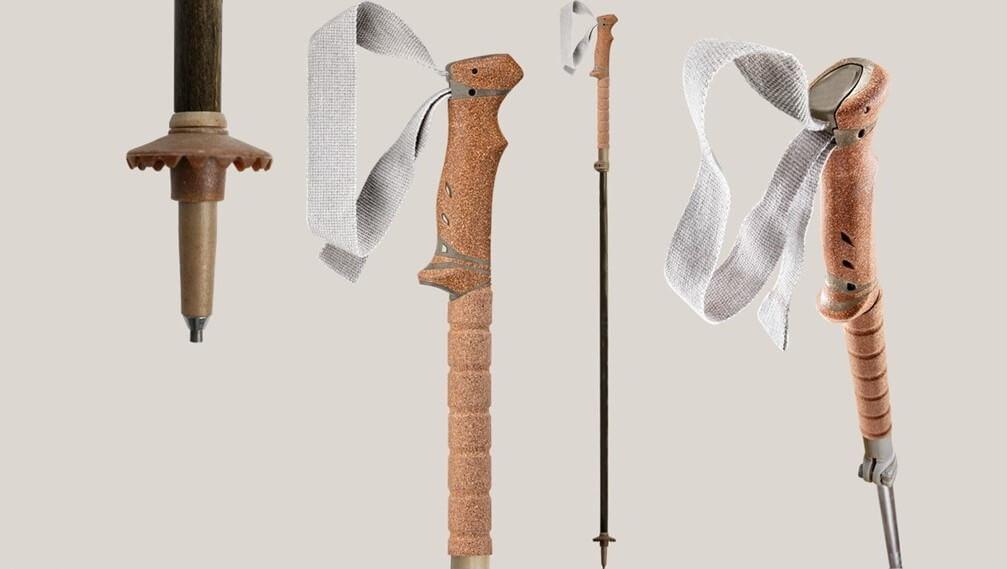
The grip loop is made of natural fiber fabric and the attachments are made of bio-based materials. Photo: LEKI Lenhart GmbH
The grip loop is made of natural fiber fabric and the attachments are made of bio-based materials.
20.10.2025

DITF: Hiking pole made from natural fibers and bio-based matrix

The German Institutes of Textile and Fiber Research Denkendorf (DITF) and LEKI Lenhart GmbH have collaborated on a project to develop a hiking pole made largely from renewable raw materials. The finished product demonstrates that sustainable materials can also offer high performance in the outdoor industry.

Consumers are increasingly asking for environmentally friendly alternatives to conventional materials. Aluminum and carbon fibers, for example, require a lot of energy to manufacture and are usually difficult to recycle. Therefore, the aim of the research project was to develop sustainable and durable sports poles made of hemp fibers and a bio-based matrix, which are manufactured using the pultrusion process.

The German Institutes of Textile and Fiber Research Denkendorf (DITF) and LEKI Lenhart GmbH have collaborated on a project to develop a hiking pole made largely from renewable raw materials. The finished product demonstrates that sustainable materials can also offer high performance in the outdoor industry.

Consumers are increasingly asking for environmentally friendly alternatives to conventional materials. Aluminum and carbon fibers, for example, require a lot of energy to manufacture and are usually difficult to recycle. Therefore, the aim of the research project was to develop sustainable and durable sports poles made of hemp fibers and a bio-based matrix, which are manufactured using the pultrusion process.

The shaft of the hiking pole is made of regionally harvested hemp fibers that have been processed to rovings using a Kemafil-process. This is a wrapping process that gives the fibers a stable, rope-like structure through a special interweaving technique. The matrix used was developed together with the project partner Bio-Composites and More GmbH and is based on epoxidized linseed oil, which can be cured in the same way as a synthetic epoxide resin. The matrix is up to 42 percent organic and is ideal for the energy- and material-efficient pultrusion process. At DITF, approximately 16 meters of tubular profiles were successfully pultruded on a laboratory scale. The manufactured parts have a smooth surface and the natural fibers used are visible.

The suitability of the process for series production was demonstrated by manufacturing under industrial conditions at the industrial partner CG TEC GmbH.

Other components besides of the shaft are also sustainable: the wrist strap is made of a natural fiber fabric and the attachments are made of a bio-based polymer. This means that over 64 percent of the entire hiking pole is made from renewable raw materials.

Initial market analyses indicate very good commercial viability and user satisfaction. While hemp fibers have previously been used mainly in applications with low mechanical requirements, the developed product proves that this natural fiber material is also suitable for resilient structures. The hiking poles manufactured achieve a bending strength comparable to that of aluminum poles and even offer improved damping properties. Thanks to its reduced carbon footprint, the product is sustainable and environmentally friendly.

Source:

Deutsche Institute für Textil- und Faserforschung Denkendorf (DITF)

The Three Finalists for the 2025 Hygienix Innovation Award™ (c) INDA
The Three Finalists for the 2025 Hygienix Innovation Award™
20.10.2025

The Three Finalists for the 2025 Hygienix Innovation Award™

INDA, the Association of the Nonwoven Fabrics Industry, announced the three finalists for the 2025 Hygienix Innovation Award™. These absorbent hygiene products will be presented at Hygienix™, the premier event for absorbent hygiene professionals, taking place November 17–20 at the Omni Orlando ChampionsGate, ChampionsGate, Florida. The 2025 Hygienix Innovation Award™ will be announced on Thursday, November 20th at 10:40 am.

The Award Finalists
Confitex Technology – Washable Nonwoven Sanitary Pads
Making single-use reusable:As regulators, retailers and consumers move toward a greener future, a new category of washable AHPs is creating opportunities for the nonwoven industry. Confitex Technology has created and patented world’s first washable nonwoven sanitary pads designed for sustainability and scalability without the need for SAPs. Confitex Technology is leading Innovator and Private Label supplier. Their purpose is to transform the lives of millions and reduce the Earth’s landfill by creating the ultimate reusable AHPs.

INDA, the Association of the Nonwoven Fabrics Industry, announced the three finalists for the 2025 Hygienix Innovation Award™. These absorbent hygiene products will be presented at Hygienix™, the premier event for absorbent hygiene professionals, taking place November 17–20 at the Omni Orlando ChampionsGate, ChampionsGate, Florida. The 2025 Hygienix Innovation Award™ will be announced on Thursday, November 20th at 10:40 am.

The Award Finalists
Confitex Technology – Washable Nonwoven Sanitary Pads
Making single-use reusable:As regulators, retailers and consumers move toward a greener future, a new category of washable AHPs is creating opportunities for the nonwoven industry. Confitex Technology has created and patented world’s first washable nonwoven sanitary pads designed for sustainability and scalability without the need for SAPs. Confitex Technology is leading Innovator and Private Label supplier. Their purpose is to transform the lives of millions and reduce the Earth’s landfill by creating the ultimate reusable AHPs.

Dukane – Curved Leg Elastic (CLE)
Dukane’s Curved Leg Elastic (CLE) technology redefines how elastic strands are attached in hygiene product manufacturing. By enabling ultrasonic bonding of curved elastics without any hotmelt adhesive, CLE eliminates material waste, simplifies construction, and enhances product performance. For the first time, manufacturers can seamlessly integrate curved and straight elastic strands within the same lamination using ultrasonic technology alone—a breakthrough previously thought possible only with adhesives or complex multilayer designs. CLE represents a new standard in sustainable, high-precision elastic attachment.

ZymoChem – BAYSE™
ZymoChem is a biotechnology leader revolutionizing sustainable chemical production. The company’s breakthrough product, BAYSE™, is the world’s first scalable, bio-based, microplastic-free, and biodegradable Super Absorbent Polymer.

Designed as a drop-in replacement for fossil-based SAPs, BAYSE offers a significantly lower carbon footprint while matching the performance of conventional materials and enabling seamless integration into existing manufacturing processes.  As featured earlier this year on CNBC’s “Clean Start,” this decarbonized solution is dramatically advancing the sustainability outlook for the hygiene industry.

Last year, HIRO Technologies, Inc. received the 2024 Award with its World’s First MycoDigestable Diapers—a breakthrough featuring plastic-eating mushrooms that combined excellent absorbency with sustainable, natural materials.

“Hygienix Innovation Award finalists represent the future of absorbent hygiene,” said Matt O’Sickey, PhD, INDA’s Director of Education & Technical Affairs. “These companies are pushing boundaries with solutions that address consumer needs, sustainability goals, and performance demands. Their work highlights the innovative spirit that drives our industry forward.”

Event Highlights at Hygienix™ 2025
Beyond the Innovation Award, Hygienix 2025 will deliver a powerful program of learning, networking, and collaboration, including:

  • Two Evenings of Exhibits & Receptions – Engage with leading suppliers and solution providers shaping the future of absorbent hygiene.
  • Workshops: Three workshops Monday afternoon covering absorbent hygiene systems, advances in menstrual care, and a deep dive into baby, infant, and toddler care.
  • Women in Nonwovens (WiN) Luncheon – Fostering mentorship, leadership, and collaboration across the industry.
  • Lightning Talks – Fast-paced 5-minute presentations spotlighting exhibitor innovations.
  • Lunch Around with Olivia Ahn, MD, Co-Founder of Planera – Hear her inspiring start-up journey firsthand.
  • Welcome Reception – Kick off the event with the ever-popular Welcome Reception in a relaxed, informal atmosphere Monday evening.

Featured Conference Sessions
Attendees will gain insights and strategies from sessions tackling the industry’s biggest opportunities and challenges:

  • The Illusion vs. Reality of Absorbent Hygiene Products Entrepreneurship – Overcoming Start-Up Hurdles (and Panel Discussion)
  • Economic Realities: Profit, Pressure, and Possibility
  • Panel Discussion: Servicing the Shift – Private Label as a Growth Engine
  • Finding Growth: Paws & Planet
  • Disruption Ahead: Misinformation, Regulation, and Testing in Absorbent Hygiene
  • Designed with the Consumer in Mind
  • Absorbent Hygiene Construction with Non-Traditional Inputs
  • Flushable by Design
  • Sustainable by Design
Source:

INDA