From the Sector

Reset
05.05.2026

Environmental Impact Measurement: Report - Denim moves towards sustainability

EIM (Environmental Impact Measurement), the global reference platform for measuring the environmental impact of garment finishing, presents the second edition of its annual report Denim Industry Progress & Insights 2025. The study analyses over 100,000 real denim finishing processes, providing an accurate and up-to-date view of the industry’s evolution towards more sustainable models.

The textile industry, as one of the sectors with the greatest environmental impact, plays a key role in the transition towards more sustainable production models. To move forward, measuring, understanding, and acting are essential. EIM acts as a compass for the industry, enabling the objective assessment of process impacts and supporting decision-making towards more eco-efficient production.

The report confirms that the denim industry continues to make progress in reducing its environmental impact. Currently, 66% of processes are already classified as low impact, reflecting a positive trend driven by process optimization and the adoption of more efficient technologies.

EIM (Environmental Impact Measurement), the global reference platform for measuring the environmental impact of garment finishing, presents the second edition of its annual report Denim Industry Progress & Insights 2025. The study analyses over 100,000 real denim finishing processes, providing an accurate and up-to-date view of the industry’s evolution towards more sustainable models.

The textile industry, as one of the sectors with the greatest environmental impact, plays a key role in the transition towards more sustainable production models. To move forward, measuring, understanding, and acting are essential. EIM acts as a compass for the industry, enabling the objective assessment of process impacts and supporting decision-making towards more eco-efficient production.

The report confirms that the denim industry continues to make progress in reducing its environmental impact. Currently, 66% of processes are already classified as low impact, reflecting a positive trend driven by process optimization and the adoption of more efficient technologies.

In terms of resource use, significant progress has been made in optimizing water and energy, although there is still room for improvement to reach more advanced standards. Water consumption remains stable at around 30 liters per garment, indicating a plateau after years of continuous improvement. Energy shows the strongest performance, with 85% of processes classified as low impact, driven by equipment modernization and automation.

However, the report highlights that chemical impact remains the industry’s main challenge, with 27% of processes still classified as high impact. Factors such as the use of generic chemicals, lack of transparency in formulations, and the persistence of legacy practices, such as pumice stones or potassium permanganate, continue to limit progress, despite the availability of more sustainable alternatives.

At the same time, worker health impact has improved significantly, with 68% of processes classified as low impact, driven by the increasing adoption of automated technologies replacing more harmful manual techniques.

“The industry has proven that it can improve when it measures its impact, but the next step requires accelerating the adoption of technologies and leaving behind practices that are no longer sustainable,” says Begoña García, creator of EIM and co-author of the report. “Today more than ever, we need reliable data to make informed decisions and move towards a real transformation of the industry.”

This second report further establishes EIM as a global reference standard to measure and track environmental impact in denim finishing. Its annual nature allows brands and manufacturers to benchmark performance, identify improvement areas, and move forward together towards more ambitious sustainability goals.

The full report is available for download and will be updated annually, reinforcing the industry’s commitment to transparency, continuous improvement and environmental impact reduction.

EIM, a global standard to measure and compare environmental impact
EIM, Environmental Impact Measurement, is a globally recognized tool for assessing the environmental performance of garment finishing processes.

It evaluates four key categories, water consumption, energy consumption, chemical impact and worker health impact. Each process is assessed and classified into three levels, low, medium or high impact, according to standardized benchmarks.

EIM includes specific benchmarks for denim finishing, garment washing and garment dyeing, ensuring that results are accurate, comparable and relevant for each type of process.

This methodology enables brands and manufacturers to measure their processes with precision, track improvements and communicate environmental performance in a transparent and verifiable way.

Source:

Environmental Impact Measurement

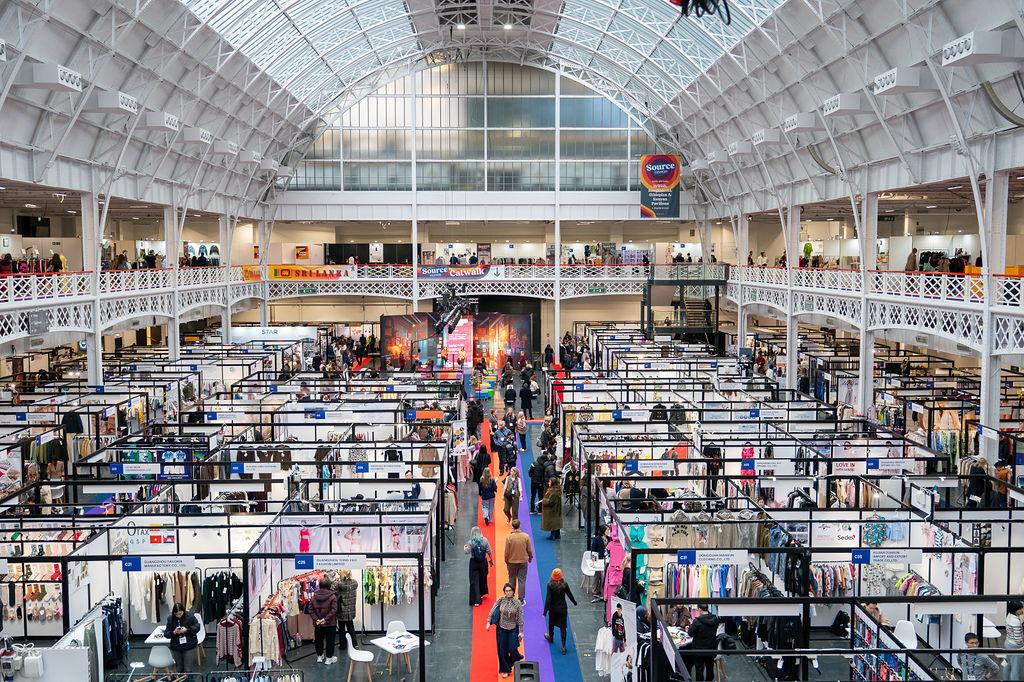
Source Fashion January 2026 Photo: (c) Source Fashion
Source Fashion January 2026
05.05.2026

Source Fashion: What Matters to Buyers in 2026?

As fashion brands and retailers navigate an increasingly complex landscape shaped by geopolitical disruption, ongoing supply chain challenges, evolving trade tensions and regulatory uncertainty, alongside shifting consumer demand, understanding what truly matters to buyers has never been more critical. For its July 2026 edition, Source Fashion is placing these challenges at the centre of its content agenda, using new industry insights and advisory board input to shape a programme designed to help buyers make more informed, commercially viable decisions in a market defined by constant change.

Insights from Source Fashion’s advisory board and from industry research point to a growing sense of complexity and fatigue across the industry. Buyers are being asked to navigate rising costs, increasing regulation and ongoing uncertainty, while making faster, higher-stakes sourcing decisions. Sustainability, once driven by advocacy, is now increasingly shaped by compliance and reporting requirements, leaving many teams questioning how to balance commercial reality with long-term responsibility.

As fashion brands and retailers navigate an increasingly complex landscape shaped by geopolitical disruption, ongoing supply chain challenges, evolving trade tensions and regulatory uncertainty, alongside shifting consumer demand, understanding what truly matters to buyers has never been more critical. For its July 2026 edition, Source Fashion is placing these challenges at the centre of its content agenda, using new industry insights and advisory board input to shape a programme designed to help buyers make more informed, commercially viable decisions in a market defined by constant change.

Insights from Source Fashion’s advisory board and from industry research point to a growing sense of complexity and fatigue across the industry. Buyers are being asked to navigate rising costs, increasing regulation and ongoing uncertainty, while making faster, higher-stakes sourcing decisions. Sustainability, once driven by advocacy, is now increasingly shaped by compliance and reporting requirements, leaving many teams questioning how to balance commercial reality with long-term responsibility.

Key themes shaping 2026
The research highlights six key shifts shaping buyer priorities in 2026:

  • Operating in permanent volatility - as geopolitical disruption, supply chain instability and unpredictable consumer demand force businesses to plan in a world that is constantly shifting. 
  • The commercial realities of sustainability – where doing the right thing does not always align with cost pressures, margins and supplier constraints. 
  • Making circularity commercially viable – with growing focus on resale, repair and lifecycle integration as part of a scalable business model. 
  • Rethinking the fashion value chain – as traditional sourcing strategies evolve and closer collaboration across the value chain becomes essential. 
  • Innovation with measurable impact – as brands look beyond hype to understand which technologies, including AI, can deliver real, scalable value. 
  • Regulation, data and compliance – as increasing reporting requirements and upcoming legislation reshape how businesses approach sustainability often shifting the focus from advocacy to obligation.

In response to these insights, Source Fashion’s July 2026 content programme has been designed to move beyond discussion and provide practical, commercially relevant guidance for buyers navigating an increasingly complex landscape. Through a series of new formats and returning features, the show will translate industry challenges into actionable insight, helping visitors better understand how to balance cost, risk and responsibility within their sourcing strategies. This approach is designed to support faster, more confident decision-making in a rapidly changing market.

Fashion Deconstructed will offer a hands-on, interactive space designed to help buyers better understand materials, processes and techniques, from upcycling and repair to innovative production methods. Alongside this, the Catwalk Stage will bring together industry leaders and practitioners to explore the future of fashion through panels, case studies and debates, while the return of the Debates Stage will create space for more open, peer-led discussion around the issues shaping the industry today. 

Speaker highlights include:

  • Marguerite, Global Insights Manager, Fashion, Euromonitor International  
  • Bill McRaith, Executive Advisor, Future-Proof Fashion  
  • Sonica Beckman, Founder and CEO, House of Kind  
  • Sarah Coleman, Head of Development, Design and Sustainability, Margarett Howell 
  • Nick Reed, Founder, Neem London 
  • Rosie Cripps, Head of Circularity, Vivo Barefoot
  • Joseph Mountain, Sustainability Manager, N Brown   

Suzanne Ellingham, Event Director of Source Fashion, said “What we’re hearing isn’t rocket science, what we know from listening is that the industry has become more complex, more pressured and, in many cases, overwhelming. There are no shortage of high expectations, new strategies, regulation or technology, but there is a real need for clarity on what actually works in practice, and what delivers real value at scale. As an industry we have to share insight now to help the boat go faster for everyone, in the right direction.

For us, this research is about listening to those challenges and shaping a content programme that responds directly to them. We want to move the conversation beyond theory and into practical, actionable insight that helps buyers navigate cost, risk and responsibility in a more confident and informed way. It’s about making sure the industry conversations we’re having translate into real business impact. Ultimately we want to talk about the things that matter.”


Source:

Source Fashion 

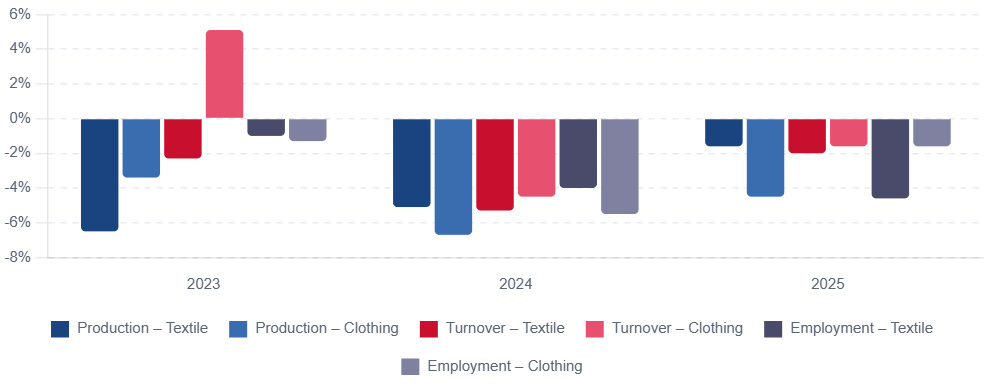
Annual change in key indicators (%) — 2023–2025 Source: EURATEX Economic Update 2026. Textile & Clothing sectors.
16.04.2026

Europe is losing its textile industry

Every week, textile factories close across Europe. Behind each closure: jobs lost, communities affected, strategic capabilities gone.

EURATEX has released its latest Economic Update on the performance of the European textile and apparel industry in 2025. For the third consecutive year, the sector recorded negative results across all key indicators — production, turnover and employment — confirming a continued erosion of competitiveness across Europe.

The causes are clear: structurally high energy costs, weak consumer demand, growing import pressure from Asia, unfair competition from online platforms, and an increasingly heavy regulatory burden on European producers.

Every week, textile factories close across Europe. Behind each closure: jobs lost, communities affected, strategic capabilities gone.

EURATEX has released its latest Economic Update on the performance of the European textile and apparel industry in 2025. For the third consecutive year, the sector recorded negative results across all key indicators — production, turnover and employment — confirming a continued erosion of competitiveness across Europe.

The causes are clear: structurally high energy costs, weak consumer demand, growing import pressure from Asia, unfair competition from online platforms, and an increasingly heavy regulatory burden on European producers.

The EU is preparing several policy responses — the Industrial Accelerator Act, reform of the Union Customs Code, the Energy Union. However, many companies cannot wait. Europe needs immediate action to reduce energy costs, simplify regulation, strengthen market surveillance and restore a genuine level playing field. 
Textiles is a strategic industrial ecosystem for Europe. Beyond fashion — clothing, footwear and home textiles that define European identity and craftsmanship — it supplies critical value chains: healthcare, defence, mobility, construction and agriculture, while supporting circularity through reuse and recycling. This is not a sector Europe can afford to lose. EURATEX calls on the European Commission and Member States to take concrete action before the end of 2026.

“If Europe is serious about maintaining its manufacturing base, it must act faster and more decisively. Every week, textile companies are closing. Production moves elsewhere, dependency increases, and the carbon footprint grows. That is the opposite of what Europe wants to achieve.” Mario Jorge Machado — President, EURATEX

Source:

European Apparel and Textile Confederation EURATEX