


STFI: Adaptive tracking and tracing system for customised textile production
In the production of technical textiles, customised products in small batches with ever-shorter life cycles represent an ongoing trend. In order to contribute to the development and production of such future products, one must not only possess production expertise but also a reliable, stable, and transparent production chain. Small and medium-sized manufacturers also face similar requirements in terms of tracking and tracing. At STFI, research was conducted into how a tracking and tracing system should best be designed for adaptable processes with flexible, order-based staff and machine allocation, for both modern and existing machinery, and how this can be adapted.
Based on this research, the researchers developed a tracking and tracing assistance system utilising technologies from the fields of the Industrial Internet of Things, mobile computing, wireless communication and graphical low-code programming. This was built upon existing, established open-source software technologies. The aim of the research project was to support the manufacture of textiles and semi-finished textile products through a flexible, adaptive tracking and tracing assistance system for order management.
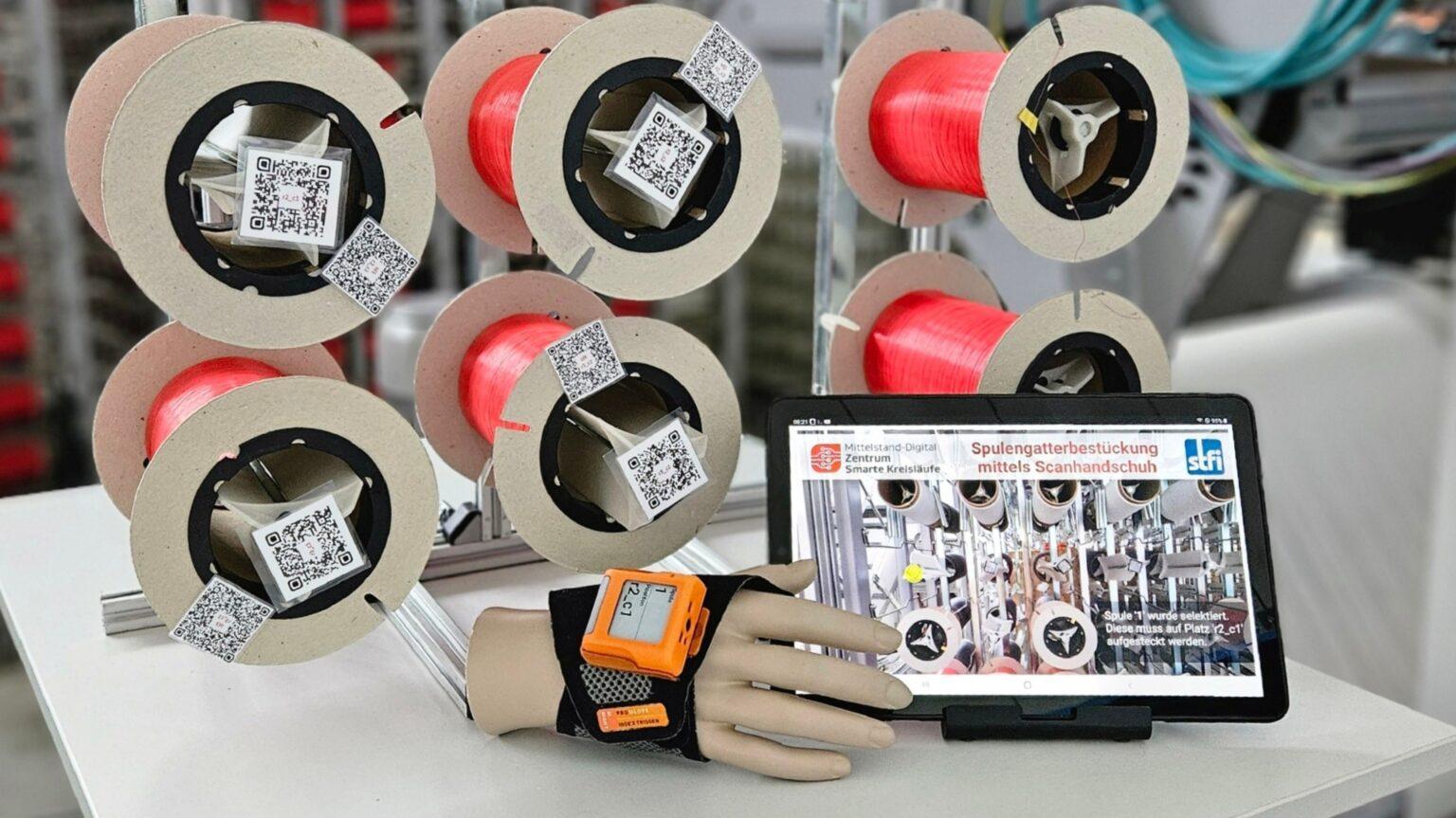
The assistance system enables automated production registration via radio-based personnel and optical machine registration. In addition to structured user guidance during familiarisation with new process steps, order picking can be precisely tracked using a scanning glove and location technology. Material detection at the manufacturing workstation is also camera-based, combined with sensor-based and smartphone-supported process monitoring. Furthermore, the underlying model-based low-code technology ensures flexible adaptability of the entire system.
Together with other development highlights from the STFI, the research project “Adaptive Tracking and Tracing System” was selected as a successful collaboration – Implemented with the company update texware GmbH, Kulmbach – and will be presented at the BMWE’s Innovationstag Mittelstand.
Sächsische Textilforschungsinstitut e.V.