
From the Sector

Reset
Knitted sports belt for postnatal strengthening of the deep abdominal and pelvic floor muscles Copyright: STFI/Weißensee KHB
Knitted sports belt for postnatal strengthening of the deep abdominal and pelvic floor muscles
26.02.2026

Techtextil 2026: STFI presents concepts for the textile circular economy

Sächsisches Textilforschungsinstitut e.V. (STFI) has been supporting companies in developing marketable innovations for over 30 years. With a clear focus on sustainability, the environment, health and protection, the STFI offers future-oriented research, textile testing for tailor-made solutions and certification of personal protective equipment. At Techtextil 2026, the institute will present ideas for the textile circular economy and showcase solutions for healthy and safe living.  

Sächsisches Textilforschungsinstitut e.V. (STFI) has been supporting companies in developing marketable innovations for over 30 years. With a clear focus on sustainability, the environment, health and protection, the STFI offers future-oriented research, textile testing for tailor-made solutions and certification of personal protective equipment. At Techtextil 2026, the institute will present ideas for the textile circular economy and showcase solutions for healthy and safe living.  

Highlights at Techtextil 2026: 
Sound booth – an oasis of calm amid the hustle and bustle of the trade fair 

Chemical recycling of mixed textile fractions produces textile residues that are currently not used as raw materials but are thermally recycled or disposed of. To enable further recycling, STFI is working with Refresh Global to investigate efficient treatment and processing methods for reusing these textile residues. These can be used in sound-absorbing design products, such as acoustic walls or furniture. Nonwoven forming processes are particularly suitable for processing these textile residues. At STFI, the recyclates are mechanically processed on pilot plants on a laboratory or semi-industrial scale before being laid into a non-woven fabric and consolidated. Through appropriate finishing, a visually matching top layer can also be integrated directly onto the nonwoven fabric. The finished nonwoven fabrics are processed into sound-absorbing design products by the project's industrial partner. 
 
Sports belt based on modulated medium frequencies for mobile applications for postnatal muscle building of the deep abdominal and pelvic floor muscles 
A team of companies and research institutions has developed a novel smart textile for stimulating and strengthening the deep abdominal and pelvic floor muscles using modulated medium frequencies (EMA), specifically for mobile use during and after childbirth. To this end, a textile belt was designed using knitting technology that covers the abdomen, thighs and buttocks and integrates electrodes at the relevant muscle zones. The electrodes are washable and fixed in the belt system, and the belt adapts to the user's decreasing body circumference thanks to its textile construction. The miniaturised, battery-powered control unit is attached to the belt and can be operated via a removable remote control. The system is easy to put on, comfortable, intuitive to use and does not restrict freedom of movement. This makes it particularly suitable for home use and everyday postnatal recovery.  
 
Protective trousers protect against stab and cut injuries and attacks by wild boar. 
In forestry and hunting in particular, workers are exposed to high risks of impact injuries resulting from attacks by wild boar. Conventional protective clothing often only offers protection against stab or cut injuries. The STFI has therefore developed a textile concept that adds impact protection to the existing level of protection, thus increasing the overall protection of users in practical working environments. In  tests, the impact of a blow was reduced by up to 20 per cent. We present an example of trousers in which the special impact protection fabric has been incorporated. Depending on requirements, the impact protection elements can also be designed to be recyclable. Specially woven hinges also increase the comfort of the work trousers.  

MC4 – Optimising recycling cycles for carbon and glass fibre composites 
High-performance fibre materials made of carbon and glass have a significant ecological footprint, and not just because of their energy-intensive production. High waste volumes in the manufacturing process and the reuse of raw materials at the end of the product life cycle offer enormous recycling potential for the future. MC4 (Multi-level Circular Process Chain for Carbon and Glass Fibre Composites) is a European project to promote circular approaches for carbon and glass fibre composites. These materials are indispensable in many technical applications due to their light weight and high mechanical properties. The project consortium is working until March 2025 to make the European value chains for carbon and glass fibres more ecologically and economically efficient and will present the development work carried out at the STFI stand as well as at its own stand and show what is technically feasible using selected demonstrators. 

(c) Institut für Textiltechnik (ITA) der RWTH Aachen University
26.02.2026

ITA: Pellet press enables thermomechanical textile recycling

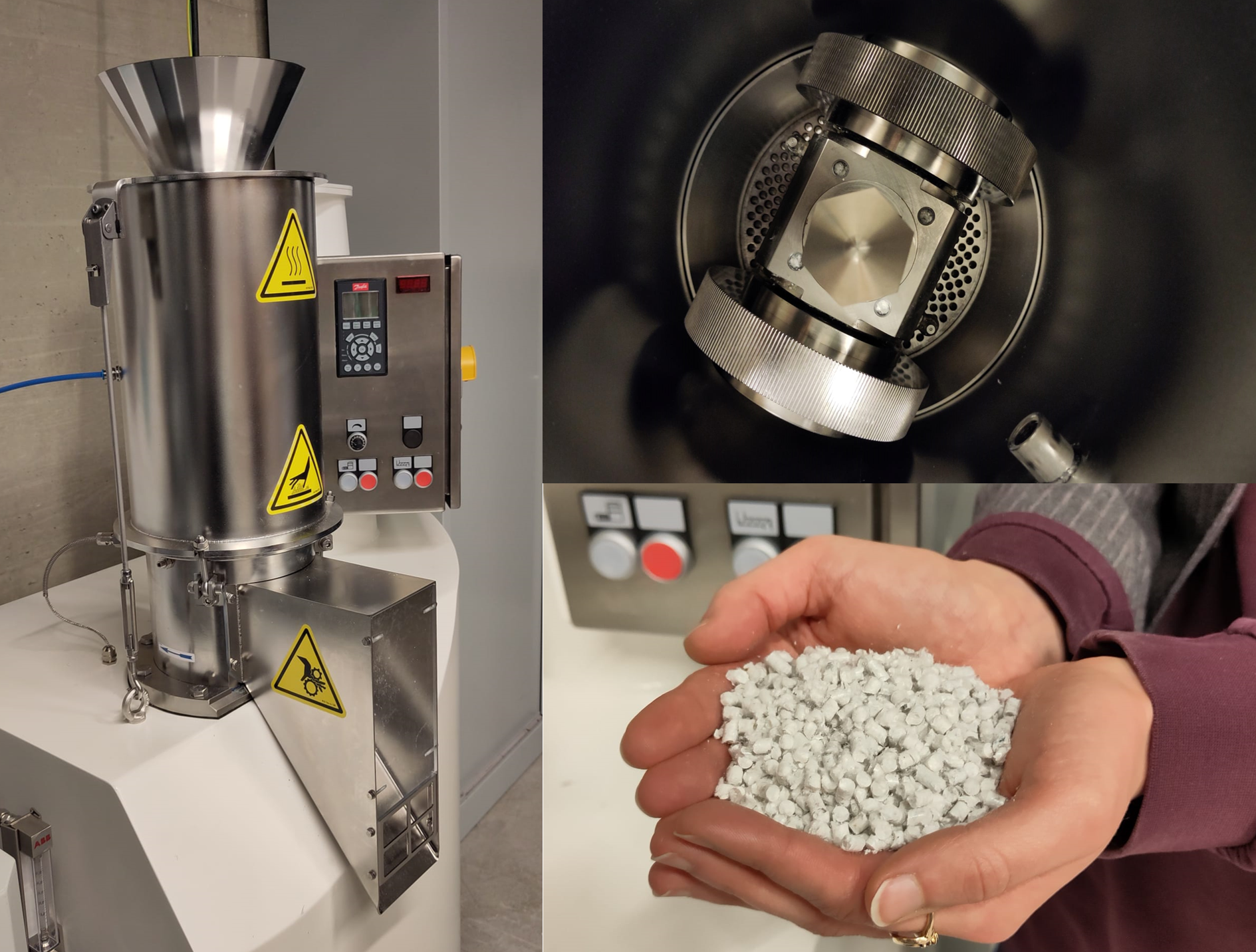
Since the end of 2025, the technical centre of the Institut für Textiltechnik (ITA) of RWTH Aachen University has been equipped with a pellet press from the manufacturer Amandus Kahl GmbH & Co. KG, Reinbek, Germany. This press can efficiently compact shredded synthetic textiles at a throughput of up to 25 kg/h and process them into pellets with a diameter of 4 mm.

The produced pellets are characterised by a homogeneous geometry, defined bulk density and suitable flowability. This enables reliable dosing and continuous feeding into an extruder. In this way, the process-related prerequisite for thermomechanical textile recycling on a pilot scale at the ITA is established.

Current research at the institute includes the thermomechanical recycling of cleaning textiles made from polylactide (PLA). The pellet press was procured as part of the RePLAy research project. The Federal Ministry of Research, Technology and Space is funding the project as part of the BIOTEXFUTURE innovation space. 

Since the end of 2025, the technical centre of the Institut für Textiltechnik (ITA) of RWTH Aachen University has been equipped with a pellet press from the manufacturer Amandus Kahl GmbH & Co. KG, Reinbek, Germany. This press can efficiently compact shredded synthetic textiles at a throughput of up to 25 kg/h and process them into pellets with a diameter of 4 mm.

The produced pellets are characterised by a homogeneous geometry, defined bulk density and suitable flowability. This enables reliable dosing and continuous feeding into an extruder. In this way, the process-related prerequisite for thermomechanical textile recycling on a pilot scale at the ITA is established.

Current research at the institute includes the thermomechanical recycling of cleaning textiles made from polylactide (PLA). The pellet press was procured as part of the RePLAy research project. The Federal Ministry of Research, Technology and Space is funding the project as part of the BIOTEXFUTURE innovation space. 

Stratasys Earns EcoVadis Gold Medal for Sustainability Graphic via Stratasys
26.02.2026

Stratasys Earns EcoVadis Gold Medal for Sustainability

Stratasys Ltd. has earned a Gold Medal from EcoVadis for sustainability, placing the company in the top 5% of 150,000 organizations evaluated globally, improving its status from last year’s Silver rating. Being at the highest level of ESG performance helps strengthen our value proposition to customers and their sustainable goals.

EcoVadis is a leading provider of business sustainability ratings, evaluating companies across four key areas: environment, labor and human rights, ethics, and sustainable procurement.

“Through our Mindful Manufacturing™ commitment, we’re building the evidence-based, data-driven responsible business practices that our customers and strategic stakeholders increasingly expect from a future-ready manufacturing partner,” said Rosa Coblens, Vice President, Sustainability and Communications, Stratasys. “Earning the EcoVadis Gold Medal and ranking in the top 5% globally is an important recognition of the hard and dedicated work our global teams have done to strengthen sustainability infrastructures across the company.”

Stratasys Ltd. has earned a Gold Medal from EcoVadis for sustainability, placing the company in the top 5% of 150,000 organizations evaluated globally, improving its status from last year’s Silver rating. Being at the highest level of ESG performance helps strengthen our value proposition to customers and their sustainable goals.

EcoVadis is a leading provider of business sustainability ratings, evaluating companies across four key areas: environment, labor and human rights, ethics, and sustainable procurement.

“Through our Mindful Manufacturing™ commitment, we’re building the evidence-based, data-driven responsible business practices that our customers and strategic stakeholders increasingly expect from a future-ready manufacturing partner,” said Rosa Coblens, Vice President, Sustainability and Communications, Stratasys. “Earning the EcoVadis Gold Medal and ranking in the top 5% globally is an important recognition of the hard and dedicated work our global teams have done to strengthen sustainability infrastructures across the company.”

Stratasys’ improved rating reflects sustainability excellence, maturity of management systems, and continued progress across enterprise sustainability practices, including reporting emissions across the value chain (Scope 3), increased supplier engagement on ESG, ongoing research on product environmental impacts through Life Cycle Analyses (LCAs), and third party limited assurance processes for carbon reporting.
As a leading 3D printing business partner for future-ready manufacturing enterprises, Stratasys helps customers scale production of parts while supporting more efficient, optimized, and responsible manufacturing.

More information:
Stratasys EcoVadis gold medal
Source:

Stratasys 

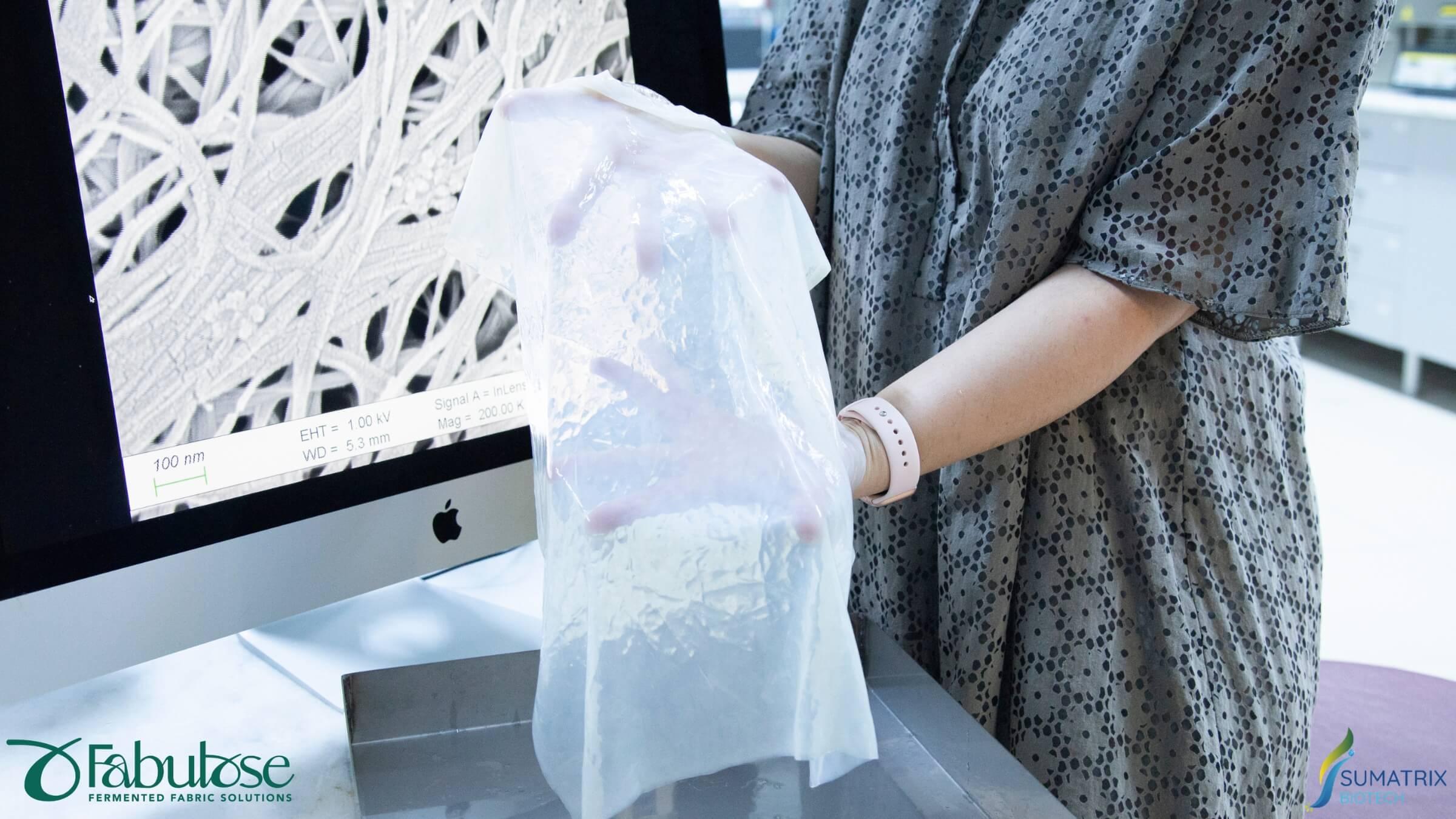
Bacterial cellulose film produced by Sumatrix. Photo: Source: Sumatrix Biotech (CC BY-NC 4.0)
Bacterial cellulose film produced by Sumatrix.
24.02.2026

Fabricating vegan and circular leather alternatives from bio-tech derived cellulose

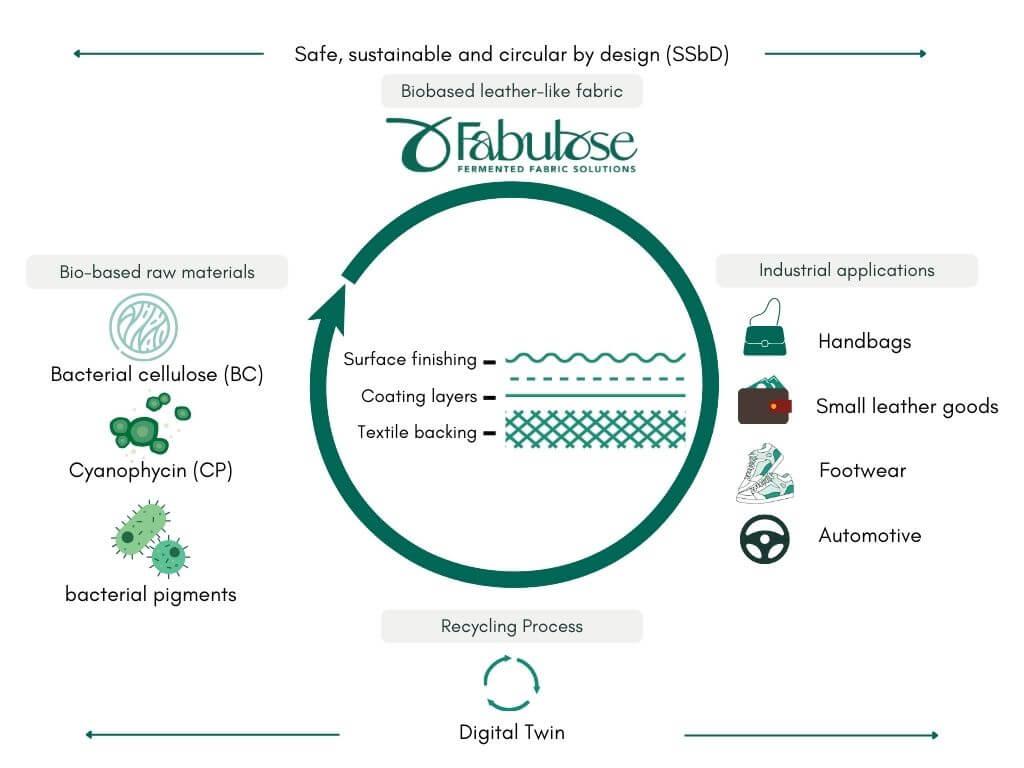
Fabulose is an EU funded project coordinated by the German Institutes of Textile and Fiber Research (DITF). Its consortium consists of leading research institutes, biotech innovators, and industry stakeholders who aim to create high-performance, biobased and recyclable leather-like fabrics, using efficient biotech production routes for bacterial cellulose, cyanophycin and bacterial pigments

Current leather alternatives are either made from petrol-based plastics and non-recyclable, or they are (partly) biobased, but difficult to scale up and recycle. The project, supported by the Circular Bio-based Europe Joint Undertaking (CBE JU), is investigating how animal-based materials can be replaced by environmentally friendly alternatives in industries such as automotive, fashion, and upholstered furniture.

Fabulose is an EU funded project coordinated by the German Institutes of Textile and Fiber Research (DITF). Its consortium consists of leading research institutes, biotech innovators, and industry stakeholders who aim to create high-performance, biobased and recyclable leather-like fabrics, using efficient biotech production routes for bacterial cellulose, cyanophycin and bacterial pigments

Current leather alternatives are either made from petrol-based plastics and non-recyclable, or they are (partly) biobased, but difficult to scale up and recycle. The project, supported by the Circular Bio-based Europe Joint Undertaking (CBE JU), is investigating how animal-based materials can be replaced by environmentally friendly alternatives in industries such as automotive, fashion, and upholstered furniture.

Fabulose uses advanced fermentation techniques, utilizes waste streams as feedstocks, and optimizes processes with the assistace of AI. This enables the environmentally-friendly and efficient production of bacterial cellulose, cyanophycin and pigments. These bio-based materials are combined in a coating formulation that replicates the durability and aesthetics of traditional leather. DITF’s HighPerCell® technology allows for re-spinning of bacterial cellulose to filaments to create recycled textile backings that offer high tensile strength without toxic agents. Instead of processing individual batches, the technology also allows to implement a roll-to-roll production process, thereby simplifying future scale-up to cost-effective mass production.

In addition, market requirements have been collected to select optimal material characteristics, while eco-design and Safe-by-design principles help to assess potential risks and ensure alignment with the safety and sustainability objectives. A digital twin framework will include key process parameters for optimisation and monitoring of material performances.

Summary of the key project innovations:

  • Using fermentation products to enable fast and cost-effective production of raw materials
  • Grow micro-organisms on waste feedstocks and CO2 to reduce production costs and environmental impact
  • Re-spinning bacterial cellulose to filaments to create recyclable, consistent and high-quality fabrics
  • Enabling production of cyanophycin to create durable coatings and finishing
  • Implementing roll-to-roll production process to simplify future scale-up

Project partners
The Fabulose project has a duration of 3,5 years and a budget of ca. 3,5 M euro.

The consortium includes 10 partners from 6 European countries, spanning the entire value chain, from research to real-world applications:

German Institutes of Textile and Fiber Research Denkendorf (DITF) (Germany), Next Technology Tecnotessile Societa Nazionale (Italy), University of Maribor (Slovenia), Sumatrix Biotech (Turkey), VTL GmbH (Austria), Novis GmbH (Germany), Melina Bucher (Germany), Benecke-Kaliko GmbH (Germany), Konrad Hornschuch GmbH (Germany), University of Aveiro (Portugal), and Steinbeis 2i GmbH (Germany).

Reju announces French site for regeneration hub Photo Reju
19.02.2026

Reju announces French site for regeneration hub

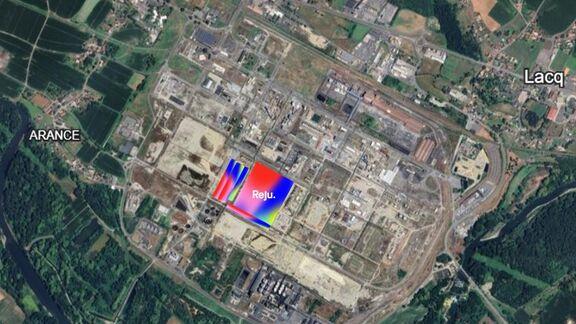
Reju, the textile-to-textile regeneration company based in France, announces the site selection for an industrial sized Regeneration Hub, in Lacq, in the Pyrénées-Atlantiques, on the Induslacq platform. Reju, a Technip Energies owned company, is deepening its roots in France through the development of this new Regeneration Hub. 

Every year, 121 million tonnes of textiles are discarded, yet only 1% are recycled into new garments. The vast majority end up in landfills or are incinerated, creating a severe environmental challenge for the world. Reju is tackling this global issue by developing solutions to regenerate textile waste into new materials. 

Reju, the textile-to-textile regeneration company based in France, announces the site selection for an industrial sized Regeneration Hub, in Lacq, in the Pyrénées-Atlantiques, on the Induslacq platform. Reju, a Technip Energies owned company, is deepening its roots in France through the development of this new Regeneration Hub. 

Every year, 121 million tonnes of textiles are discarded, yet only 1% are recycled into new garments. The vast majority end up in landfills or are incinerated, creating a severe environmental challenge for the world. Reju is tackling this global issue by developing solutions to regenerate textile waste into new materials. 

This Regeneration Hub will strengthen France’s leadership in circular, low carbon industrial innovation. Backed by Technip Energies’ global engineering expertise, Reju will bring cutting edge textile to textile regeneration technology to French industry. The plant will utilize Reju’s proprietary depolymerization technology to take post-consumer textiles from national waste streams as feedstock and to transform them into rBHET, a regenerated raw material for making new polyester from textile waste, that will then be repolymerized into Reju PET. 

The project is subject to final investment decision by the board of Technip Energies, the parent company of Reju. 

This project will help structure a new local industry, contributing to decarbonization. It would generate 80 direct jobs and more than 300 indirect jobs. “This French Regeneration Hub builds on our strategy to industrialize a circular post-consumer textile-to-textile model,” said Patrik Frisk, CEO of Reju. “By leveraging France’s ambitious circular-economy agenda and advancing our technology to new markets, we are reinforcing our mission to transform textile waste into valuable, circular resources.” 

Through its French Hub, Reju aims to build a scalable circular infrastructure in France and Europe, enabling textile-to-textile traceability and closing the loop on fiber use. The project aligns with Reju’s established operations, including Regeneration Hub Zero in Frankfurt, the announced site selection in Chemelot, Sittard-Geleen the Netherlands and the recently announced United States Hub to be located in Eastman Business Park, in Rochester, New York. 

The Regeneration Hub will be located on the Induslacq platform, owned by TotalEnergies. 

Owned by Technip Energies, Reju utilizes proprietary technology developed in conjunction with IBM Research to recover, regenerate and recirculate textile waste, starting with polyester. 
Reju actively participates in the work of several bodies and organizations such as ReHubs, Petcore and Evolen. This will create a circular ecosystem, developing a textile-to-textile sector in France in line with European requirements and based on traceability.

More information:
Reju regeneration hub France
Source:

Reju 

Jeanologia urges industry to accelerate PP Spray phase-out Graphic Jeanologia
17.02.2026

Jeanologia urges industry to accelerate PP Spray phase-out

Since 2015, Jeanologia has set the standard with laser, Light Bright and G2 Ozone technologies, achieving authentic vintage effects in denim without chemical spraying.

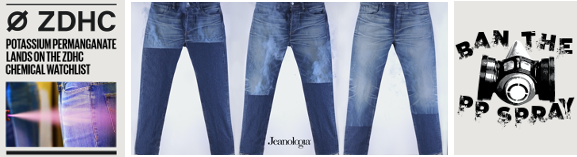
Potassium permanganate has officially entered the Chemical Watchlist of the ZDHC Foundation, signaling increased scrutiny and potential phase-out of one of the most hazardous chemicals still used in denim finishing. The inclusion confirms an industry shift that Jeanologia anticipated more than a decade ago.

For years, Jeanologia has called for the elimination of PP spray, warning about its impact on worker health, operational safety and the environment. Now, the industry is formally acknowledging what has been evident on factory floors worldwide.

PP spray is commonly used to create localized vintage effects in denim, but it exposes operators to chemical micro-particles and presents serious occupational risks. Despite growing awareness and available alternatives, this practice continues to be used in parts of the industry. According to Jeanologia, millions of workers globally are still affected by this process.

Since 2015, Jeanologia has set the standard with laser, Light Bright and G2 Ozone technologies, achieving authentic vintage effects in denim without chemical spraying.

Potassium permanganate has officially entered the Chemical Watchlist of the ZDHC Foundation, signaling increased scrutiny and potential phase-out of one of the most hazardous chemicals still used in denim finishing. The inclusion confirms an industry shift that Jeanologia anticipated more than a decade ago.

For years, Jeanologia has called for the elimination of PP spray, warning about its impact on worker health, operational safety and the environment. Now, the industry is formally acknowledging what has been evident on factory floors worldwide.

PP spray is commonly used to create localized vintage effects in denim, but it exposes operators to chemical micro-particles and presents serious occupational risks. Despite growing awareness and available alternatives, this practice continues to be used in parts of the industry. According to Jeanologia, millions of workers globally are still affected by this process.

Jeanologia eliminated the need for PP spray in 2015, becoming the first technology provider to offer a scalable industrial alternative through laser-based finishing. Today, the company replaces PP spray through its laser technology with Light Bright tool and combined with G2 Ozone technology, delivering authentic vintage effects without chemical spraying. The solution offers full digital control, safer working conditions and reliable industrial performance.

This approach is reinforced by Jeanologia’s Environmental Impact Measuring (EIM) platform. In its Innovations and Challenges in Denim Finishing 2024 Report, EIM identifies potassium permanganate as one of the remaining high-risk processes in garment finishing and highlights the urgent need for safer technologies, reinforcing laser-based solutions as a low-impact alternative.

Over the past decade, Jeanologia has progressively replaced the most hazardous denim finishing processes with eco-efficient technologies, becoming the first company to eliminate sandblasting and to advance alternatives to stone washing, manual scraping and PP spray. Today, its laser and G2 Ozone technologies are implemented worldwide, enabling denim brands to achieve the same aesthetic results while improving worker safety, reducing chemical use and lowering water consumption, with measurable impact across global production.

As transparency requirements, ESG reporting frameworks and chemical management standards continue to evolve, early adoption of safer technologies is increasingly becoming a competitive advantage. Jeanologia calls on brands, laundries and manufacturers to accelerate the transition toward chemical-free finishing. The technology exists.

Stretching Circularity is a collaborative project initiated by Fashion for Good dedicated to accelerating the adoption of lower-impact elastane alternatives that are compatible with circular textile systems. By validating bio-based and recycled elastane solutions through pilot-scale testing and demonstrator garments, the initiative aims to remove one of the most significant technical barriers to a circular textile economy. Source: Canva
Stretching Circularity is a collaborative project initiated by Fashion for Good dedicated to accelerating the adoption of lower-impact elastane alternatives that are compatible with circular textile systems. By validating bio-based and recycled elastane solutions through pilot-scale testing and demonstrator garments, the initiative aims to remove one of the most significant technical barriers to a circular textile economy.
12.02.2026

The Future Of Stretch: New Project To Validate Bio-based And Recycled Elastane

Stretching Circularity is a collaborative project initiated by Fashion for Good dedicated to accelerating the adoption of lower-impact elastane alternatives that are compatible with circular textile systems. By validating bio-based and recycled elastane solutions through pilot-scale testing and demonstrator garments, the initiative aims to remove one of the most significant technical barriers to a circular textile economy.

Present in approximately 80% of all clothing, elastane is a material added in varying concentrations (typically from 1–5% by weight in cotton or wool garments to up to 20% in polyester or polyamide garments) to provide stretch and comfort. This fossil-based material creates two critical sustainability challenges:

Stretching Circularity is a collaborative project initiated by Fashion for Good dedicated to accelerating the adoption of lower-impact elastane alternatives that are compatible with circular textile systems. By validating bio-based and recycled elastane solutions through pilot-scale testing and demonstrator garments, the initiative aims to remove one of the most significant technical barriers to a circular textile economy.

Present in approximately 80% of all clothing, elastane is a material added in varying concentrations (typically from 1–5% by weight in cotton or wool garments to up to 20% in polyester or polyamide garments) to provide stretch and comfort. This fossil-based material creates two critical sustainability challenges:

  • First, it contributes to carbon emissions and non-renewable resource consumption across the industry. 
  • Second (and more critically for circularity), even minimal concentrations of elastane act as a “contaminant” in textile recycling feedstocks, compromising fibre-to-fibre recycling of high-volume fibres like polyester and cotton. This effectively blocks circularity for the vast majority of clothing, leaving the industry with limited options beyond downcycling or landfill.

Stretching Circularity is a project initiated by Fashion for Good which tackles this challenge through two key workstreams. One workstream focuses on testing next-generation elastane materials made from alternative inputs, including bio-based materials and other feedstocks. This phase includes the creation of “demonstrator” garments, specifically a technical t-shirt (with 10% elastane) and a non-technical t-shirt (with 2% elastane). The other focuses on testing regenerated elastane made through emerging recycling innovations. Both workstreams follow a pilot-scale validation approach to generate comparable data on performance, impact, economical feasibility and scalability.

Driving this work is a powerful coalition of industry stakeholders representing the entire value chain. The consortium includes Fashion for Good partners Levi Strauss & Co (Beyond Yoga), On, Paradise Textiles, Positive Materials, and Reformation, with Ralph Lauren Corporation as an Advisor. Supported by ecosystem experts like Materiom and the Ellen MacArthur Foundation, the group will support knowledge sharing across the consortium to identify gaps and generate comparative data to de-risk the adoption of these circular solutions for the wider industry. Stretching Circularity operates under a structured due diligence and validation framework to assess if alternative materials are not just conceptually sound but also meet the performance standards of conventional elastane. 

“Lower-impact elastane solutions exist, but they lack the pilot-scale validation brands need to scale them confidently,” Katrin Ley, Fashion for Good Managing Director. “This initiative seeks to provide that missing data, turning a well-known recycling “contaminant” into a functional component of a circular supply chain.”

“Elastane is one of the most overlooked blockers to true circularity in fashion: it’s everywhere and yet there is a significant challenge to recovering it at scale. Stretching Circularity is about tackling that problem at the root and proving that lower-impact stretch materials and new recycling pathways can meet real performance and design standards.” Carrie Freiman Parry, Senior Director of Sustainability at Reformation

Source:

Fashion for Good

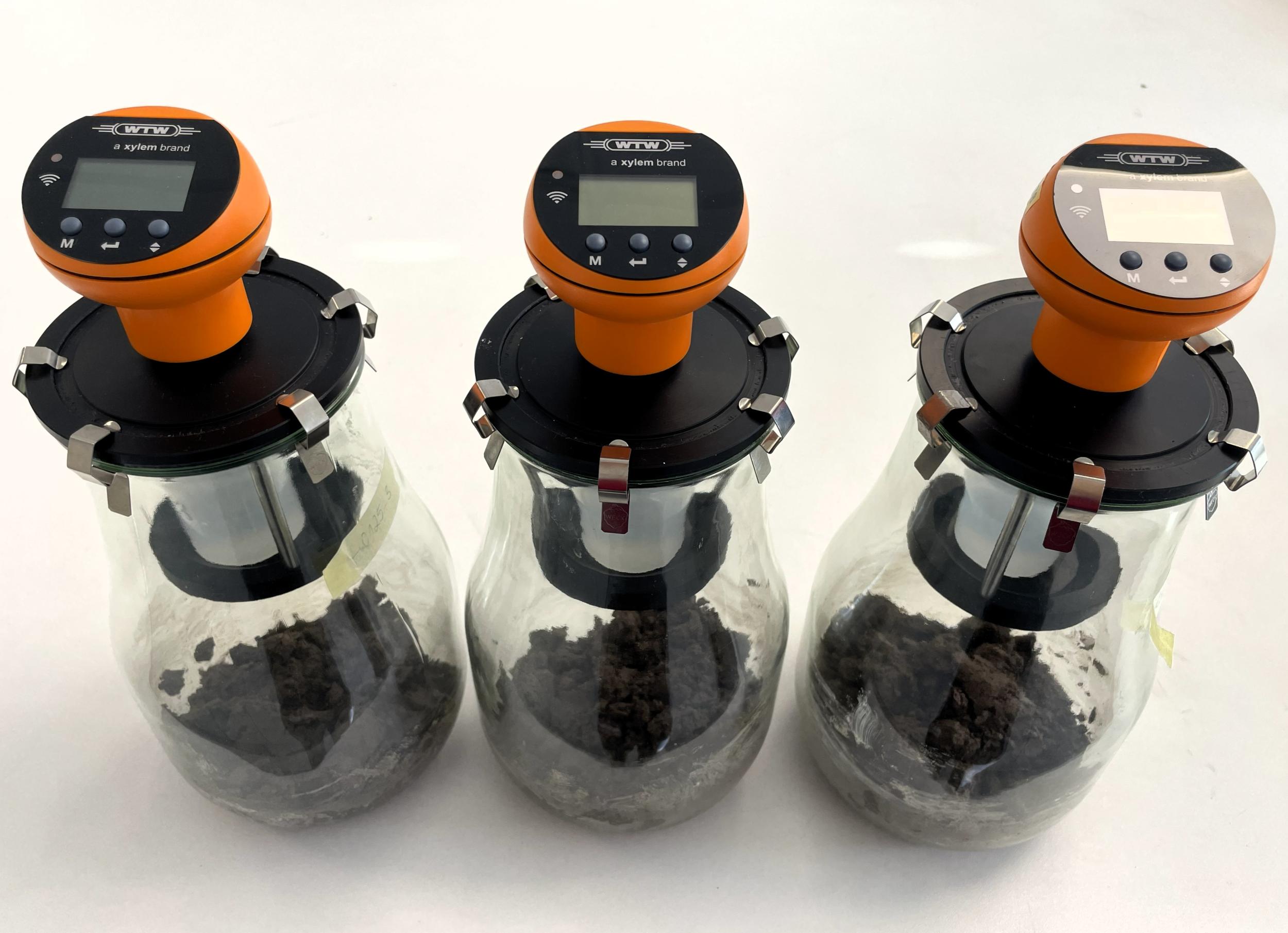
The respirometer system measures how much oxygen soil microorganisms consume during material degradation, allowing the rate and extent of biological breakdown to be determined. Foto (c) Hohenstein
The respirometer system measures how much oxygen soil microorganisms consume during material degradation, allowing the rate and extent of biological breakdown to be determined.
11.02.2026

New DIN SPEC assesses environmental impact of textile fragments in soil

Textile products made from synthetic fibres, finished fabrics or dyed materials release fibre fragments into the environment at every stage of their life cycle. With the new DIN SPEC 19296, Hohenstein has developed a standardised testing method to analyse how these fragments behave in soil under natural conditions. Until now, little was known about their environmental behaviour or potential ecological effects once released.

Holistic testing approach
DIN SPEC 19296 focuses on textile products and the fragments released through use, abrasion or disposal. Tests are conducted in standardised soil under defined climatic conditions over a period of up to 180 days.

Textile products made from synthetic fibres, finished fabrics or dyed materials release fibre fragments into the environment at every stage of their life cycle. With the new DIN SPEC 19296, Hohenstein has developed a standardised testing method to analyse how these fragments behave in soil under natural conditions. Until now, little was known about their environmental behaviour or potential ecological effects once released.

Holistic testing approach
DIN SPEC 19296 focuses on textile products and the fragments released through use, abrasion or disposal. Tests are conducted in standardised soil under defined climatic conditions over a period of up to 180 days.

The method combines several parameters: a respirometer system measures the oxygen consumption of microorganisms during degradation, enabling the biodegradability of textile fragments to be quantified. Plant growth tests using cress seeds assess potential effects on vegetation after degradation. In addition, earthworms are used as sensitive bioindicators to evaluate possible toxic effects. Survival rates and changes in body mass indicate whether degraded fragments or residues have a negative impact on soil organisms.
This integrated approach not only determines whether materials are biodegradable, but also whether their fragments could harm plants or soil organisms. 

Practical relevance and added value
“Textile fibres and fragments are released into the environment not only during washing, but also during everyday wear,” says Juliane Alberts, Project Manager at Hohenstein. “DIN SPEC 19296 allows us, for the first time, to assess under realistic conditions how different textile fragments behave in soil. It makes an invisible issue visible and supports the development of more sustainable textile products.”
The new DIN SPEC enables companies to compare textile products in terms of their potential environmental impact resulting from fibre release. It also provides a scientific basis for evaluating environmental claims such as “compostable”.

Jointly developed – publicly available
DIN SPEC 19296 was developed by Hohenstein in cooperation with industry partners and is publicly available. The results can help to better assess the actual environmental impacts of textile fiber loss, derive appropriate mitigation measures, and develop materials with lower environmentally harmful fiber shedding for the textile industry.

Source:

Hohenstein 

11.02.2026

One in five hazardous mixtures not reported to poison centres

ECHA Forum’s pilot enforcement project found that 19 % of the checked hazardous mixtures were not notified to poison centres.

Inspectors in 18 EU/EEA countries checked nearly 1 597 mixtures to verify whether industry complies with the obligation to notify hazardous mixtures to national poison centres. This is regulated under the EU’s Classification, Labelling and Packaging (CLP) Regulation. These notifications are crucial for poison centres to provide an adequate medical response in case of exposure to hazardous mixtures. Of all checked mixtures, 19 % were not notified to the authorities. 

Chris Van den hole, the Working Group Chair of this pilot project said: 
“Missing notifications of the necessary information to the poison centres undermine the effectiveness of emergency response. Therefore, inspectors take these findings very seriously and initiated numerous enforcement actions to bring companies to compliance.
“To improve the situation, we have listed recommendations for market actors, authorities and consumers in our report.”

ECHA Forum’s pilot enforcement project found that 19 % of the checked hazardous mixtures were not notified to poison centres.

Inspectors in 18 EU/EEA countries checked nearly 1 597 mixtures to verify whether industry complies with the obligation to notify hazardous mixtures to national poison centres. This is regulated under the EU’s Classification, Labelling and Packaging (CLP) Regulation. These notifications are crucial for poison centres to provide an adequate medical response in case of exposure to hazardous mixtures. Of all checked mixtures, 19 % were not notified to the authorities. 

Chris Van den hole, the Working Group Chair of this pilot project said: 
“Missing notifications of the necessary information to the poison centres undermine the effectiveness of emergency response. Therefore, inspectors take these findings very seriously and initiated numerous enforcement actions to bring companies to compliance.
“To improve the situation, we have listed recommendations for market actors, authorities and consumers in our report.”

The pilot project also aimed to raise the duty holders’ awareness of their legal obligations, for example, to place the Unique Formula Identifier (UFI) on the label of their products. The 16-digit, alphanumerical UFI code is a vital tool used by the poison centres to rapidly identify a mixture following an accidental poisoning. In 15 % of inspected mixtures, the required UFI was missing from the product label. 

Enforcement actions
Where non-compliance was detected, written advice was the most common enforcement measure applied by inspectors, followed by verbal advice, administrative orders, fines, and even criminal complaints. A number of cases were still under follow-up phase at time of reporting.

Background
According to the CLP Regulation, companies placing hazardous mixtures on the market are obliged to provide information about the composition of those mixtures to the appointed bodies. These bodies make this information available to poison centres so that they can give advice to the citizens or medical personnel in the event of an emergency. The duty to notify applies to mixtures that are classified for human health or physical hazards. For example, mixtures that are corrosive to skin, can cause eye damage or those that are explosive.

The names of companies that placed the controlled mixtures on the market and the products’ brand names were not reported for this project. The main purpose of the project was to harmonise and strengthen the national enforcement at the EU level.

Source:

European Chemicals Agency