
From the Sector

Reset
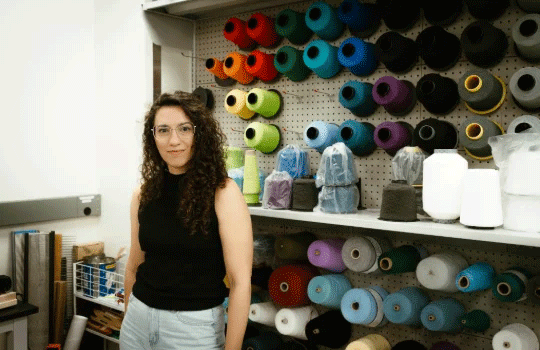
Vanessa Sanchez in ihrem Labor Foto (c) Rice University
18.09.2026

When the knit becomes the robot

Rice University mechanical engineer Vanessa Sanchez is developing knitted structures in which sensing, movement and mechanical behaviour are programmed into the textile rather than attached as separate components. Her project, “Programmable 3D-Knitted Soft Robotic Textiles for Human-Centered Mobility,” has received a Toyota Programmable System Innovation Fellowship.

Rice points to applications including vehicle seats that reshape around occupants, garments that assist walking and soft safety systems capable of responding to impending impacts.

The work uses knitting as a manufacturing architecture. By varying yarns, stitch geometry and local structural behaviour, the textile can be designed to produce functions that conventional soft-robotic systems may achieve with separate sensors, actuators or rigid elements.

Three-dimensional knitting is particularly important because form can be created during manufacture rather than assembled from multiple flat components. That approach could reduce seams and interfaces while retaining the softness and conformity expected from textiles.

Rice University mechanical engineer Vanessa Sanchez is developing knitted structures in which sensing, movement and mechanical behaviour are programmed into the textile rather than attached as separate components. Her project, “Programmable 3D-Knitted Soft Robotic Textiles for Human-Centered Mobility,” has received a Toyota Programmable System Innovation Fellowship.

Rice points to applications including vehicle seats that reshape around occupants, garments that assist walking and soft safety systems capable of responding to impending impacts.

The work uses knitting as a manufacturing architecture. By varying yarns, stitch geometry and local structural behaviour, the textile can be designed to produce functions that conventional soft-robotic systems may achieve with separate sensors, actuators or rigid elements.

Three-dimensional knitting is particularly important because form can be created during manufacture rather than assembled from multiple flat components. That approach could reduce seams and interfaces while retaining the softness and conformity expected from textiles.

Sanchez will use the fellowship to develop the programmable structures further and explore mobility-oriented applications.

Ravel - shredded polyester/elastane material ready for processing (c) Ravel
18.09.2026

Ravel raises $8.2m to scale blended-textile recycling

Ravel has closed an oversubscribed $8.2 million seed round led by One Small Planet, with participation from AP Ventures, Overlay Capital, Lichen Ventures and existing investors. The funding is intended to move the Seattle-based recycling company from pilot operation towards commercial readiness.

Its Purification Recycling process is aimed at one of apparel recycling's persistent problems: stretch blends. Elastane is widely used in activewear, denim, underwear and other garments, yet even relatively small percentages can interfere with established recycling routes.

Rather than treating the whole textile as a single feedstock, Ravel is developing a separation and purification route for polyester/elastane blends. The company says recovered material can be converted into recycled plastic pellets for renewed use as a raw material.

The next phase will test more than chemistry. Commercial viability depends on throughput, feedstock variability, separation efficiency, energy and chemical inputs, and the quality of the recovered fractions. Ravel plans to validate the process at production scale with textile partners.

Ravel has closed an oversubscribed $8.2 million seed round led by One Small Planet, with participation from AP Ventures, Overlay Capital, Lichen Ventures and existing investors. The funding is intended to move the Seattle-based recycling company from pilot operation towards commercial readiness.

Its Purification Recycling process is aimed at one of apparel recycling's persistent problems: stretch blends. Elastane is widely used in activewear, denim, underwear and other garments, yet even relatively small percentages can interfere with established recycling routes.

Rather than treating the whole textile as a single feedstock, Ravel is developing a separation and purification route for polyester/elastane blends. The company says recovered material can be converted into recycled plastic pellets for renewed use as a raw material.

The next phase will test more than chemistry. Commercial viability depends on throughput, feedstock variability, separation efficiency, energy and chemical inputs, and the quality of the recovered fractions. Ravel plans to validate the process at production scale with textile partners.

The financing adds capacity at a point where recyclers are increasingly trying to tackle blends that mechanical systems cannot readily return to fibre.