From the Sector

Reset
Photo Pallas Textiles
12.10.2026

Pallas brings high-performance, lower-impact textiles into healthcare interiors

Pallas Textiles will present its Giverny collection and broader healthcare portfolio at the Healthcare Design Conference + Expo in New Orleans. The collection translates nature-inspired colour and pattern into upholstery, panel and privacy-curtain applications intended for patient, waiting and care environments.

The company highlights performance and material choices alongside design. The Toile pattern is specified for very high abrasion exposure, while Nymphea incorporates SEAQUAL YARN and post-consumer recycled polyester and is designed for bleach cleanability. Pallas also points to material platforms including biodegradable vinyl and bio-attributed or biobased options across its portfolio.

The relevance for contract interiors lies in the combined specification challenge: healthcare fabrics have to support visual and tactile comfort while meeting demanding durability, cleaning and disclosure requirements. Pallas will show the collection from 17 to 20 October.

Pallas Textiles will present its Giverny collection and broader healthcare portfolio at the Healthcare Design Conference + Expo in New Orleans. The collection translates nature-inspired colour and pattern into upholstery, panel and privacy-curtain applications intended for patient, waiting and care environments.

The company highlights performance and material choices alongside design. The Toile pattern is specified for very high abrasion exposure, while Nymphea incorporates SEAQUAL YARN and post-consumer recycled polyester and is designed for bleach cleanability. Pallas also points to material platforms including biodegradable vinyl and bio-attributed or biobased options across its portfolio.

The relevance for contract interiors lies in the combined specification challenge: healthcare fabrics have to support visual and tactile comfort while meeting demanding durability, cleaning and disclosure requirements. Pallas will show the collection from 17 to 20 October.

UNIFI, Inc.
09.10.2026

UNIFI combines spun-yarn hand with filament performance and adds fluorine-free water resistance

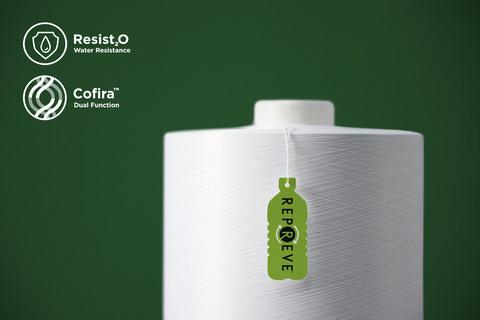
UNIFI has introduced Cofira™, a yarn platform designed to combine the visual and tactile character of spun yarns with filament-yarn functionality. The construction can incorporate other UNIFI technologies and is offered in virgin and REPREVE polyester, including REPREVE Takeback. 

Recycled options can be traced through FiberPrint and are linked to U-TRUST, GRS and SCS certification claims. The company is also expanding its water-resistant portfolio with Resist2O™ Pro. Rather than relying on a conventional topical durable-water-repellent finish, the technology is engineered for different forms of fabric construction and is described as fluorine-free and PFOA-free below 5 ppb.

UNIFI positions the two developments for apparel, furnishings, gear, accessories and industrial applications. Both will be presented in October at Performance Days in Munich and Functional Fabric Fair in Portland, giving the technologies immediate exposure to performance-material developers.


UNIFI has introduced Cofira™, a yarn platform designed to combine the visual and tactile character of spun yarns with filament-yarn functionality. The construction can incorporate other UNIFI technologies and is offered in virgin and REPREVE polyester, including REPREVE Takeback. 

Recycled options can be traced through FiberPrint and are linked to U-TRUST, GRS and SCS certification claims. The company is also expanding its water-resistant portfolio with Resist2O™ Pro. Rather than relying on a conventional topical durable-water-repellent finish, the technology is engineered for different forms of fabric construction and is described as fluorine-free and PFOA-free below 5 ppb.

UNIFI positions the two developments for apparel, furnishings, gear, accessories and industrial applications. Both will be presented in October at Performance Days in Munich and Functional Fabric Fair in Portland, giving the technologies immediate exposure to performance-material developers.


09.10.2026

Textile Exchange puts numbers on textile-to-textile recycling capacity for the first time

Editorial relevance: Very high – establishes a global baseline for available spinnable textile-to-textile recycled fiber and quantifies the gap between waste availability and usable output.

Textile Exchange has published a first global methodology for estimating textile-to-textile recycled fiber availability for apparel and home textiles. Developed with Fashion for Good, Reverse Resources and TEXroad, the framework combines available waste volumes with collection, sorting, processing and technology constraints to estimate how much material can actually become spinnable fiber.

The analysis projects recyclable textile feedstocks to increase from roughly 10 million tonnes in 2025 to around 15 million tonnes by 2030. Yet the quantity of recycled spinnable fiber is estimated at only 1–1.5 million tonnes in 2025, rising to approximately 3–5 million tonnes by 2030.

Editorial relevance: Very high – establishes a global baseline for available spinnable textile-to-textile recycled fiber and quantifies the gap between waste availability and usable output.

Textile Exchange has published a first global methodology for estimating textile-to-textile recycled fiber availability for apparel and home textiles. Developed with Fashion for Good, Reverse Resources and TEXroad, the framework combines available waste volumes with collection, sorting, processing and technology constraints to estimate how much material can actually become spinnable fiber.

The analysis projects recyclable textile feedstocks to increase from roughly 10 million tonnes in 2025 to around 15 million tonnes by 2030. Yet the quantity of recycled spinnable fiber is estimated at only 1–1.5 million tonnes in 2025, rising to approximately 3–5 million tonnes by 2030.

The scope covers post-industrial and post-consumer textiles and both mechanical and chemical recycling of cotton, polyester, nylon, manmade cellulosics, wool and and blends.
Textile Exchange stresses that the figures are directional: data quality remains uneven, and future editions are intended to incorporate more primary data from recyclers and suppliers.


(c) Archroma / Lameirinho
16.09.2026

Dye, fix and soften in one step

Archroma and Portuguese home-textile manufacturer Lameirinho have moved the InOneGO continuous dyeing process into commercial production. Lameirinho's first bed-linen collection made with the technology is now available worldwide.

InOneGO combines coloration, fixation and softening in a single pad-dry application. It was developed for woven cellulosic textiles including denim, fashion fabrics and home textiles, and works with Archroma sulfur-dye systems including DIRESUL RDT, EarthColors and FiberColors.

Archroma's ONE WAY Impact Calculator indicates reductions of up to 81% in process time, 97% in water consumption, 65% in energy use and 75% in CO2 emissions when a defined InOneGO/DIRESUL RDT scenario is compared with conventional cold pad-batch reactive dyeing plus pigment top-dye finishing. These are supplier calculations for a specified benchmark, not universal mill values.

The process runs on stenter and Thermosol lines. That makes the industrial proposition particularly relevant: mills may be able to remove several wet and dry processing stages without replacing the core line architecture.


Archroma and Portuguese home-textile manufacturer Lameirinho have moved the InOneGO continuous dyeing process into commercial production. Lameirinho's first bed-linen collection made with the technology is now available worldwide.

InOneGO combines coloration, fixation and softening in a single pad-dry application. It was developed for woven cellulosic textiles including denim, fashion fabrics and home textiles, and works with Archroma sulfur-dye systems including DIRESUL RDT, EarthColors and FiberColors.

Archroma's ONE WAY Impact Calculator indicates reductions of up to 81% in process time, 97% in water consumption, 65% in energy use and 75% in CO2 emissions when a defined InOneGO/DIRESUL RDT scenario is compared with conventional cold pad-batch reactive dyeing plus pigment top-dye finishing. These are supplier calculations for a specified benchmark, not universal mill values.

The process runs on stenter and Thermosol lines. That makes the industrial proposition particularly relevant: mills may be able to remove several wet and dry processing stages without replacing the core line architecture.


Source:

Archroma / Lameirinho