
From the Sector

Reset
Digital printing on acrylic opens up new creative possibilities for high-end interior decoration, reproducing the intricate veining and visual depth of natural marble. (c) Mimaki
Digital printing on acrylic opens up new creative possibilities for high-end interior decoration, reproducing the intricate veining and visual depth of natural marble.
26.11.2026

Recycled acrylic and digital printing for high-end design applications

The combination of recycled cast acrylic and digital printing is opening up new possibilities in interior decoration, retail design and high-end visual communication. Bompan, Mimaki’s exclusive importer for Italy, and Madreperla S.p.A., an Italian manufacturer of cast acrylic sheets, are exploring applications ranging from decorative panels and luxury displays to personalised products and industrial design.

In these markets, material selection and print quality are closely interrelated. Alongside precise colour reproduction and surface aesthetics, ink adhesion and resistance to external influences are important criteria. Applications in cosmetics, perfumery, hospitality and marine interiors, for example, may be exposed to frequent handling, cleaning agents, humidity or alcohol.

Recycled PMMA as a design material
Madreperla specialises in the production of cast polymethyl methacrylate (PMMA) sheets for visual communication, retail displays, lighting and interior design.

Under its Green Cast® brand, the company offers cast acrylic sheets made from 100% recycled raw material. According to Madreperla, these retain the optical, aesthetic and technical properties of cast PMMA manufactured from virgin raw material.

Through chemical recycling, pre- and post-consumer PMMA can be converted back into raw material for the manufacture of new acrylic sheets. Variations in colour, surface finish and transparency, combined with different processing techniques, allow the material to be adapted to a wide range of design and functional requirements.

Combining material expertise with digital printing
The collaboration brings together Madreperla’s expertise in cast acrylic and colour customisation, Bompan’s application development and technical support, and Mimaki’s digital printing technology.

The focus is on the interaction between substrate properties, ink performance, printing parameters and finishing processes. Particularly in high-end applications, these factors determine not only the visual appearance but also the functionality and durability of the finished product.

Potential applications include decorative wall panels, retail displays, signage, branded objects and customised design components. Digital printing also enables the reproduction of complex surface patterns, such as the characteristic veining and visual depth of natural marble.

Among the technologies available for these applications is Mimaki’s UJ330H-160 hybrid UV LED printer, designed to accommodate both rigid and flexible substrates.

Speech by Shigang Li, GM of Barmag Beijing and Richard Wang, GM of Barmag Suzhou Photo Barmag
Speech by Shigang Li, GM of Barmag Beijing and Richard Wang, GM of Barmag Suzhou
26.11.2026

Barmag opens Application Center China to strengthen local R&D

Barmag officially inaugurated its Application Center China (BACC) on 19 November 2026, during ITMA ASIA + CITME 2026, where the company presented its technology portfolio covering the value chain from polymer melt to filaments, fibres and nonwovens.

The new centre provides a development and testing environment linking fundamental research, experimental validation and industrial applications. Its activities include early-stage concept validation, customer trials, process optimisation and the development of new product variants.

Customers can conduct product trials and validate processes under conditions closely aligned with their industrial requirements. The aim is to shorten development cycles, minimise disruption to existing production lines and facilitate the transition from proof of concept to industrial-scale production.

Linking research in Germany with industrial applications in China
BACC is designed to connect Barmag's fundamental research activities in Germany with the application requirements of the Chinese market. Its proximity to customers and suppliers allows production challenges, new materials and emerging process concepts to be incorporated into development and validation projects at an early stage.

The resulting knowledge feeds back into Barmag's global R&D network, positioning China not only as a market for established technologies but also as a source of application-driven innovation.

The centre's infrastructure has been designed to accommodate different materials, technologies and process configurations, allowing development activities to adapt to changing industrial requirements.

Integrating spinning and texturing
A particular technological feature of BACC is the integration of spinning and texturing, including draw textured yarn (DTY) development, within a single platform.

Beyond the shared use of laboratories, personnel and infrastructure, this approach enables R&D teams to investigate the interdependencies between polymer properties, spinning parameters and subsequent texturing conditions more systematically.

For manufacturers, the integrated development environment provides opportunities to evaluate material and process combinations across several production stages and undertake joint, application-specific validation projects.

The centre's future activities will focus on the processing of new polymers, the development of yarns with specific product properties, the investigation of production-related challenges and the validation of new process concepts. By bringing experimental development closer to industrial production, BACC aims to accelerate the introduction of new materials, products and manufacturing processes.

26.11.2026

Zünd Technology Days 2026: Digital cutting and automated production

More than 200 international attendees visited Zünd Technology Days 2026 at the company's Swiss headquarters on 18 and 19 November. The event focused on the automation of industrial manufacturing processes, material efficiency and the scalability of digital production solutions. Applications ranged from leather and textile processing to gasket and footwear manufacturing, acoustic solutions and aerospace composites.

How can hides be automatically inspected for defects within seconds and subsequently cut to maximise material utilisation? How can manufacturers of acoustic solutions increase production capacity without compromising speed or quality? What opportunities do digitalisation and automation offer in the processing of composites, textiles and foams?

Zünd users and technology partners presented challenges and solutions from various industrial sectors. Martin Steffensen, CEO of Steffca S/A, outlined the requirements of gasket manufacturing, while Dion Bettjeman of Mindhive Global focused on the digital characterisation and defect detection of hides. Other presentations addressed offline production in the footwear industry and the scaling of industrial manufacturing processes.

Andy Vawter of US-based MPS Acoustics reported on how the company increased its production capacity while maintaining speed and quality. Alun Reece, CEO of Loop Technology, presented the 'Composites at Speed and Scale' (COMPASS) project. Miguel Rodriguez, board member of Portuguese textile company Pedrosa & Rodrigues, highlighted the potential of advanced pattern recognition and alignment technologies in garment manufacturing.

From material scanning to automated cutting
In the newly redesigned demonstration rooms, live production processes illustrated how data capture, software, material handling, cutting and automation interact. Among the applications presented was the Dectura workflow, which combines automated defect detection on hides with subsequent digital cutting.

Further live demonstrations covered the production of acoustic elements, carpet cutting, robot-assisted manufacturing processes and foam processing. Various machine configurations were also presented for cutting gasket materials and medical equipment.

The combination of technical presentations, live demonstrations and discussions with technology specialists enabled attendees to assess the solutions presented against their own production requirements.

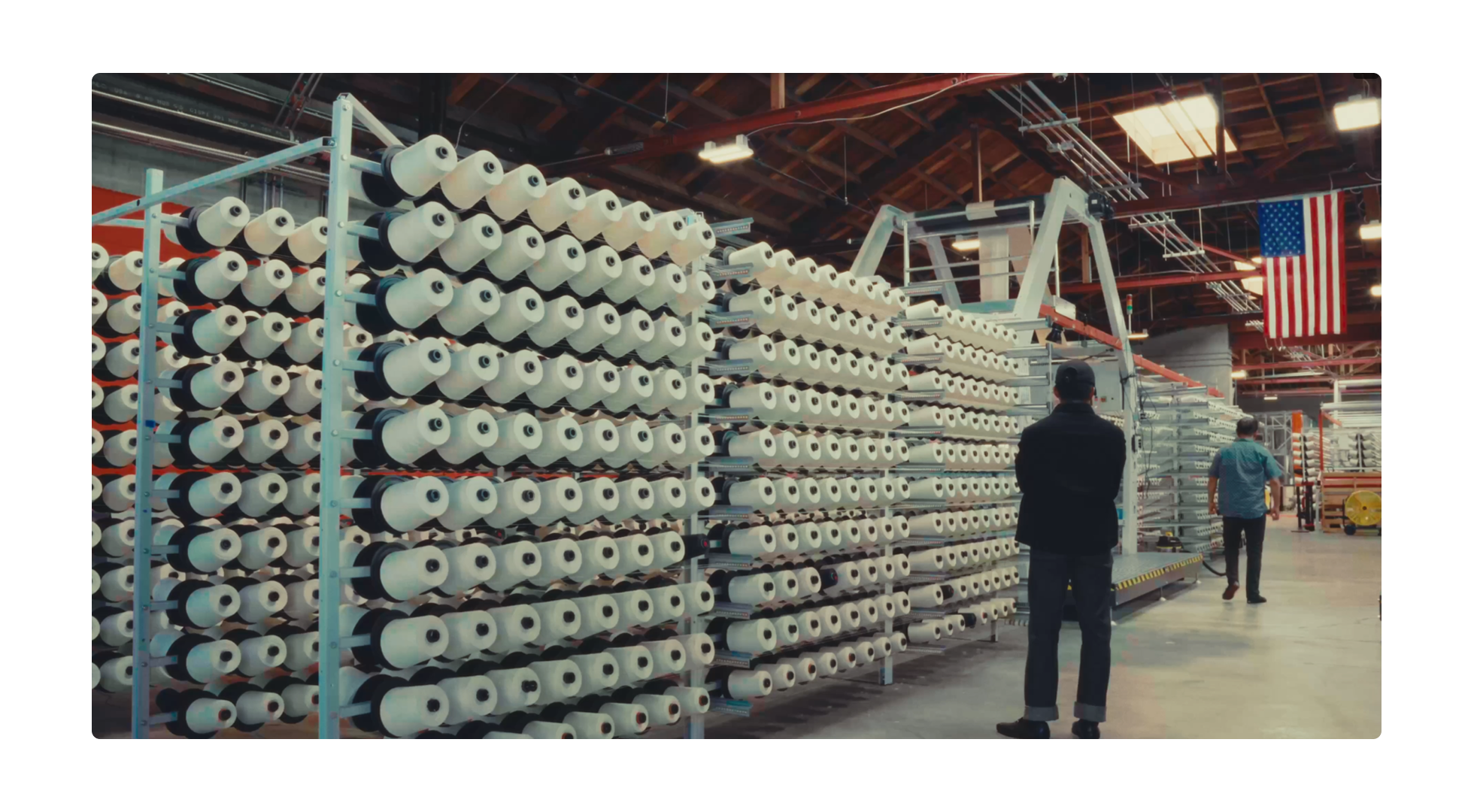
OneWeave machines at unspun’s headquarters in Emeryville, California Photo: (c) unspun
OneWeave machines at unspun’s headquarters in Emeryville, California
18.11.2026

unspun and Arvind take 3D weaving into industrial apparel production

unspun and Arvind Limited are bringing OneWeave 3D weaving into Arvind’s apparel manufacturing operations in Ahmedabad, India. Two machines are expected to be operating by December 2026. The agreement provides a route to more than 30 additional machines in India and/or North America during 2027 and 2028, with expansion linked to demand from apparel brands.

Arvind is purchasing the equipment and will contract directly with brands for garment production. unspun will handle installation, commissioning, training, software and continuing technical support. For the US technology company, the deployment takes its weaving platform beyond its own microfactory and into a large textile manufacturer’s production environment.

OneWeave produces three-dimensional garment forms directly from yarn. This removes the conventional step of first weaving flat fabric and reduces the subsequent cutting and sewing required. According to unspun, a trouser leg can be woven in around ten minutes.

The partners intend to use the technology for shorter production cycles and more flexible replenishment. Rather than committing an entire season’s requirements well in advance, brands could place smaller orders and respond to sales during the season. The companies also see opportunities to reduce fabric offcuts and the financial exposure associated with excess stock.

The rollout will begin with limited capacity on the first two machines. unspun says several global apparel brands are preparing programmes, with initial production slots to be allocated on a first-come, first-served basis.