
From the Sector

Reset
26.11.2026

Zünd Technology Days 2026: Digital cutting and automated production

More than 200 international attendees visited Zünd Technology Days 2026 at the company's Swiss headquarters on 18 and 19 November. The event focused on the automation of industrial manufacturing processes, material efficiency and the scalability of digital production solutions. Applications ranged from leather and textile processing to gasket and footwear manufacturing, acoustic solutions and aerospace composites.

How can hides be automatically inspected for defects within seconds and subsequently cut to maximise material utilisation? How can manufacturers of acoustic solutions increase production capacity without compromising speed or quality? What opportunities do digitalisation and automation offer in the processing of composites, textiles and foams?

Zünd users and technology partners presented challenges and solutions from various industrial sectors. Martin Steffensen, CEO of Steffca S/A, outlined the requirements of gasket manufacturing, while Dion Bettjeman of Mindhive Global focused on the digital characterisation and defect detection of hides. Other presentations addressed offline production in the footwear industry and the scaling of industrial manufacturing processes.

Andy Vawter of US-based MPS Acoustics reported on how the company increased its production capacity while maintaining speed and quality. Alun Reece, CEO of Loop Technology, presented the 'Composites at Speed and Scale' (COMPASS) project. Miguel Rodriguez, board member of Portuguese textile company Pedrosa & Rodrigues, highlighted the potential of advanced pattern recognition and alignment technologies in garment manufacturing.

From material scanning to automated cutting
In the newly redesigned demonstration rooms, live production processes illustrated how data capture, software, material handling, cutting and automation interact. Among the applications presented was the Dectura workflow, which combines automated defect detection on hides with subsequent digital cutting.

Further live demonstrations covered the production of acoustic elements, carpet cutting, robot-assisted manufacturing processes and foam processing. Various machine configurations were also presented for cutting gasket materials and medical equipment.

The combination of technical presentations, live demonstrations and discussions with technology specialists enabled attendees to assess the solutions presented against their own production requirements.

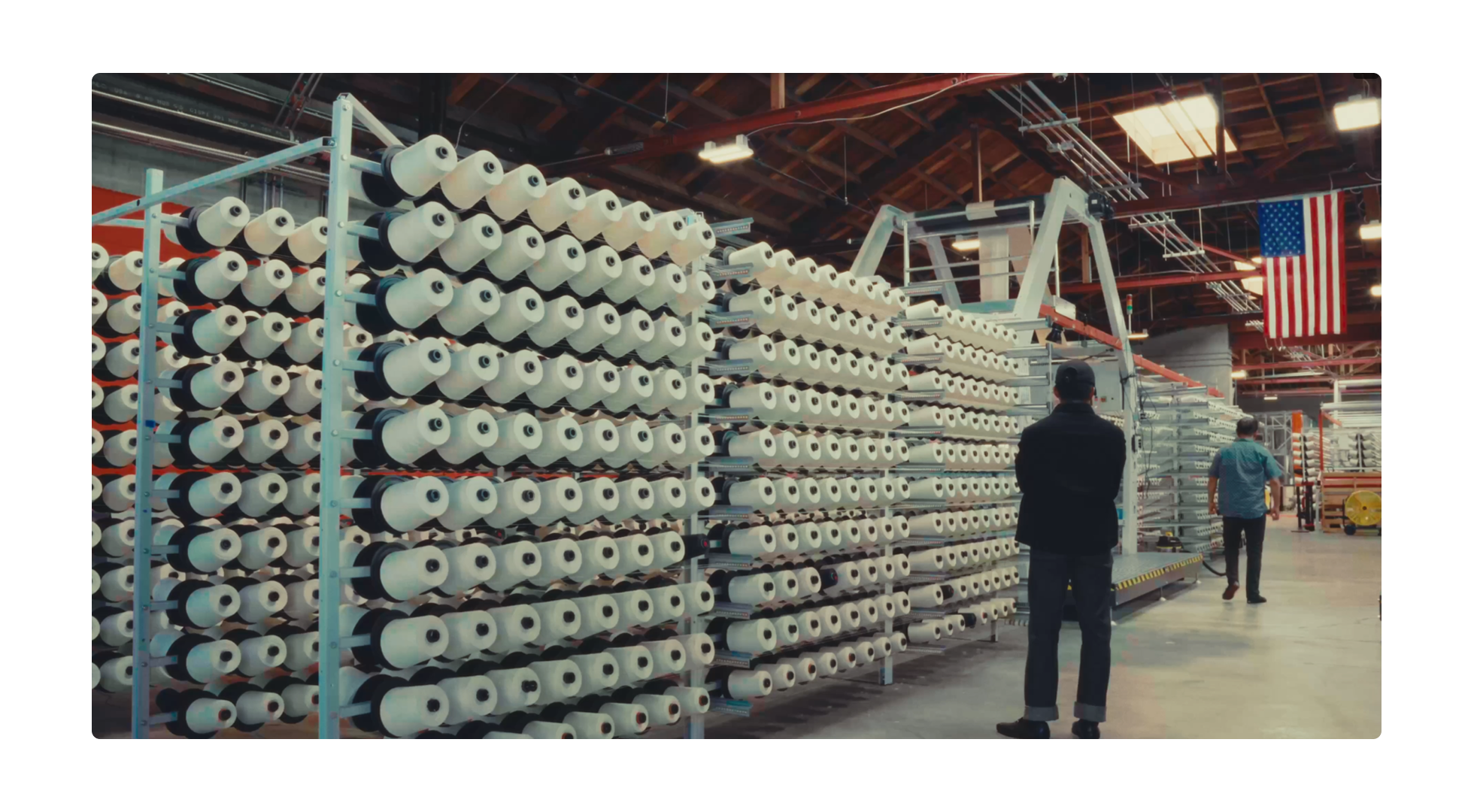
OneWeave machines at unspun’s headquarters in Emeryville, California Photo: (c) unspun
OneWeave machines at unspun’s headquarters in Emeryville, California
18.11.2026

unspun and Arvind take 3D weaving into industrial apparel production

unspun and Arvind Limited are bringing OneWeave 3D weaving into Arvind’s apparel manufacturing operations in Ahmedabad, India. Two machines are expected to be operating by December 2026. The agreement provides a route to more than 30 additional machines in India and/or North America during 2027 and 2028, with expansion linked to demand from apparel brands.

Arvind is purchasing the equipment and will contract directly with brands for garment production. unspun will handle installation, commissioning, training, software and continuing technical support. For the US technology company, the deployment takes its weaving platform beyond its own microfactory and into a large textile manufacturer’s production environment.

OneWeave produces three-dimensional garment forms directly from yarn. This removes the conventional step of first weaving flat fabric and reduces the subsequent cutting and sewing required. According to unspun, a trouser leg can be woven in around ten minutes.

The partners intend to use the technology for shorter production cycles and more flexible replenishment. Rather than committing an entire season’s requirements well in advance, brands could place smaller orders and respond to sales during the season. The companies also see opportunities to reduce fabric offcuts and the financial exposure associated with excess stock.

The rollout will begin with limited capacity on the first two machines. unspun says several global apparel brands are preparing programmes, with initial production slots to be allocated on a first-come, first-served basis.

17.11.2026

EURATEX and 3 Egyptian textile associations sign Memorandum of Understanding

The European Apparel and Textile Confederation (EURATEX) has signed a Memorandum of Understanding (MoU) with three leading Egyptian industry organisations: the Apparel Export Council of Egypt (AEC), the Textile Export Council of Egypt (TEC) and the Egyptian Exporters Association (EXPOLINK). 

The agreement was signed in Cairo during Destination Africa 2026, one of the region's major textile and apparel trade events, in the presence of EURATEX President Mario Jorge Machado and representatives of the Egyptian textile industry. 

The MoU marks an important step towards strengthening cooperation between the European and Egyptian textile and clothing sectors, with a shared objective of improving competitiveness, facilitating investment and developing more resilient and sustainable value chains. 

Under the agreement, the four organisations will work together on several priorities, including: 

  • Sustainability and regulatory cooperation: supporting Egyptian manufacturers in understanding and complying with European legislation, including requirements on circularity, waste management and Digital Product Passports. 
  • Industrial transformation: promoting sustainable production practices and advocating for an Industrial Greening Fund to support the sector's green transition. 
  • Trade and investment: facilitating business-to-business contacts, encouraging partnerships between European and Egyptian manufacturers and addressing customs-related challenges. 
  • Innovation and skills: exchanging industrial expertise, developing training initiatives and exploring joint participation in European projects. 

To ensure concrete follow-up, the agreement establishes a Joint Committee on Textiles and Clothing, which will meet at least twice a year to identify common priorities, develop projects and monitor cooperation. 

The partnership also reflects a broader ambition to reinforce economic relations across the Euro-Mediterranean region. With increasingly interconnected supply chains and growing demand for sustainable production, closer industrial cooperation can help European and Mediterranean manufacturers respond to common challenges while creating new business opportunities. 

Mario Jorge Machado, President of EURATEX, commented: 
"Egypt is an increasingly important partner for the European textile and clothing industry. At a time when our companies face increased global competition and pressure to transform their production models, strengthening cooperation with our Mediterranean neighbours is a strategic priority. This agreement is about creating concrete opportunities for businesses on both sides, supporting investment and building a more competitive and sustainable Euro-Mediterranean textile value chain."