From the Sector

from to
Reset
860 results
Carrington Textiles expands military range with ProTact by Haartz® Photo Carrington Textiles Ltd.
25.08.2025

Carrington Textiles expands military range with ProTact by Haartz®

As a global military fabrics manufacturer, Carrington Textiles has partnered with Haartz® GmbH to bring the ProTact by Haartz® range of laminated fabrics to Europe, the Middle East, Africa, Australia and New Zealand.

This partnership expands the specialist portfolio of defence fabrics with high performance technical laminates designed for military and tactical equipment. Manufactured in Germany by Haartz® GmbH, the ProTact range is engineered to meet the demanding requirements of modern military applications, including rucksacks, load carrying systems, vests and pouches.

The range offers several technical benefits for tactical equipment manufacturers, including:

As a global military fabrics manufacturer, Carrington Textiles has partnered with Haartz® GmbH to bring the ProTact by Haartz® range of laminated fabrics to Europe, the Middle East, Africa, Australia and New Zealand.

This partnership expands the specialist portfolio of defence fabrics with high performance technical laminates designed for military and tactical equipment. Manufactured in Germany by Haartz® GmbH, the ProTact range is engineered to meet the demanding requirements of modern military applications, including rucksacks, load carrying systems, vests and pouches.

The range offers several technical benefits for tactical equipment manufacturers, including:

  • Laser-cut ready – clean edges, no residue
  • Reduced fraying – precision layer bonding
  • Superior flexibility – softer feel, more comfortable wear
  • CORDURA® Truelock technology – consistent colour, UV fade resistance
  • No delamination – even in extreme conditions
  • Proven field performance – engineered for reliability under pressure

The initial range includes ProTact G510.1, a 500D/1000D fabric offered in black, coyote brown and the MultiCam® camouflage pattern, and ProTact G55.1, a 500D/500D option available in black, coyote brown and ranger green.

ProTact by Haartz® has already proven itself in the field with advanced durability and protection. The addition of this range complements our existing military fabric offering and further strengthens our position as a trusted supplier to defence forces and tactical equipment manufacturers.

Gartex Texprocess India 2025 (c) Messe Frankfurt Trade Fairs India
Gartex Texprocess India 2025
21.08.2025

Gartex Texprocess India 2025 opened: 35% new exhibitors

The 13th edition of Gartex Texprocess India opened on a high note at the Bharat Mandapam, Pragati Maidan - New Delhi. The landmark event is being held between the 21st -23rd August 2025. Organized by Messe Frankfurt Trade Fairs India Pvt Ltd and MEX Exhibitions Pvt Ltd, the exhibition is bound to set a new benchmark in the garment, textile manufacturing and denim industry. This 13th edition of the Gartex Texprocess India features two new additions - the LeatherX Pavilion and the Textile Care Forum which makes the event more holistic and all-encompassing.

The Gartex Texprocess India 2025 has a record participation from over 200 exhibitors (35% first-time exhibitors) and 600+ brands from India and with international brands like Durst, Morimota Singapore (Kansai), Epson, Morgan, Jinjen, Groz Beckert, Brothers International, Jack Franc, Veolia, Amazon and more recording international participation from China, Japan, Italy, Germany and Singapore. The first day of the exhibition saw a high-level of engagement and was marked with vigorous activities across all stalls.  

The 13th edition of Gartex Texprocess India opened on a high note at the Bharat Mandapam, Pragati Maidan - New Delhi. The landmark event is being held between the 21st -23rd August 2025. Organized by Messe Frankfurt Trade Fairs India Pvt Ltd and MEX Exhibitions Pvt Ltd, the exhibition is bound to set a new benchmark in the garment, textile manufacturing and denim industry. This 13th edition of the Gartex Texprocess India features two new additions - the LeatherX Pavilion and the Textile Care Forum which makes the event more holistic and all-encompassing.

The Gartex Texprocess India 2025 has a record participation from over 200 exhibitors (35% first-time exhibitors) and 600+ brands from India and with international brands like Durst, Morimota Singapore (Kansai), Epson, Morgan, Jinjen, Groz Beckert, Brothers International, Jack Franc, Veolia, Amazon and more recording international participation from China, Japan, Italy, Germany and Singapore. The first day of the exhibition saw a high-level of engagement and was marked with vigorous activities across all stalls.  

Inaugurating the show, Chief Guest, Shri Manohar Lal Khattar expressed: “The textile industry is one of the largest sources of employment generation in the country with over 45 million people employed directly, including a large number of women and rural population. The government has taken a number of measures/ incentives to boost the textile sector and generate employment in the country. I give due credit to the two joint organisers for doing a great job of amalgamating the complete value chain from yarn to finished products here in Delhi.” 

Speaking on energy, Shri Khattar added: “Coming to power, we have extended several schemes, including subsidies up to 75%. Today, we are looking at the transition from fossil fuels to renewable energy. I urge you all to kindly upgrade your plants to renewable energy, as India is moving towards its Mission 2047 to reduce emissions. India had set a target to replace 50% of the energy by 2030 with renewable and clean sources but has managed to achieve the same this year.”

He was followed by the address from the Guest of Honour: Shri Rakesh Sachan, Hon’ble Minister, Department of MSME, Khadi, Village Industries, Sericulture and Textile, Government of Uttar Pradesh. He expressed: “The Indian textile industry is yet to produce indigenous machinery. It relies mostly on imports. The Government of Uttar Pradesh is taking efforts to allow industries to excel with special dedicated land parcels in the state. We had requested about 200 acres of land for the development of industries. Of these, we have received approval of about 100 acres. In another development, the Yamuna Expressway Industrial Development Authority (YEIDA) is developing a 150-acre apparel cluster in Noida, which will be Uttar Pradesh's first textile park. The project aims to attract investment, generate employment, and boost exports in the apparel sector.”
Speaking on the US tariffs, Shri Sachan said: “The surge in US tariffs has hit hard, but this is the time to upgrade and create capacity, improve on indigenous technology.”

The expo was inaugurated by Chief Guest Shri Manohar Lal Khattar, Hon’ble Minister of Housing & Urban Affairs, India, Minister of Power, Government of India. 

The opening day saw amazing enthusiasm among both exhibitors and visitors. It was witness to many impactful discussions among stakeholders, putting India in the global textile eco-space. The highlights of The Gartex Texprocess India 2025 are ‘The Denim Show’ in association with the Denim Manufacturers Association and the featured zones of the Fabrics and Trims Show, Screen Print India (Textile) and the latest addition of LeatherX Pavilion and launch of the Textile Care Forum in association with the Drycleaners and Launderers Association of India enhance the platform by connecting the industry. The new developments add value to the already composite nature of Gartex Texprocess India. With a focus on technology and modernisation, the exhibition is a step forward towards setting global standards in textile manufacturing, denim, leather goods, laundry management and the overall fashion industry. 

Source:

Messe Frankfurt Trade Fairs India

20.08.2025

ECHA publishes updated PFAS restriction proposal

The European Chemicals Agency (ECHA) has published the updated proposal to restrict per- and polyfluoroalkyl substances (PFAS) under the EU’s chemicals regulation, REACH. The update has been prepared by the authorities from Denmark, Germany, the Netherlands, Norway and Sweden, who submitted the initial proposal in January 2023.

The five authorities, acting as the Dossier Submitter, have completed their evaluation of the more than 5 600 scientific and technical comments received from third parties during the 2023 consultation. Based on the evidence gathered, they have updated their initial restriction proposal. This updated report, called the Background Document, forms the basis for ECHA’s committees’ opinions. This document may still be updated further, based on the evaluation of the committees.

The five authorities have, among other things, identified and carried out assessments for eight sectors that were not specifically named in the initial proposal. These sectors are:

The European Chemicals Agency (ECHA) has published the updated proposal to restrict per- and polyfluoroalkyl substances (PFAS) under the EU’s chemicals regulation, REACH. The update has been prepared by the authorities from Denmark, Germany, the Netherlands, Norway and Sweden, who submitted the initial proposal in January 2023.

The five authorities, acting as the Dossier Submitter, have completed their evaluation of the more than 5 600 scientific and technical comments received from third parties during the 2023 consultation. Based on the evidence gathered, they have updated their initial restriction proposal. This updated report, called the Background Document, forms the basis for ECHA’s committees’ opinions. This document may still be updated further, based on the evaluation of the committees.

The five authorities have, among other things, identified and carried out assessments for eight sectors that were not specifically named in the initial proposal. These sectors are:

  • printing applications;
  • sealing applications;
  • machinery applications;
  • other medical applications, such as immediate packaging and excipients for pharmaceuticals;
  • military applications;
  • explosives;
  • technical textiles; and
  • broader industrial uses, such as solvents and catalysts.

In addition, they have considered alternative restriction options, beyond a full ban or a ban with time-limited derogations for certain applications. These options involve conditions allowing the continued manufacture, placing on the market or use of PFAS where the risks can be controlled. These alternative options have been assessed by the Dossier Submitter for:

  • PFAS manufacturing;
  • transport;
  • electronics and semiconductors;
  • energy;
  • sealing applications;
  • machinery applications; and
  • technical textiles.

ECHA’s scientific committees for Risk Assessment (RAC) and for Socio-Economic Analysis (SEAC) continue to evaluate the proposed restriction. The Agency aims to provide the European Commission with a transparent, independent, and high-quality RAC and SEAC opinion as soon as possible.
The European Commission will ultimately decide on the restriction in consultation with the EU Member States.

Background
The proposal to restrict PFAS in the EU/EEA was prepared by authorities in Denmark, Germany, the Netherlands, Norway and Sweden. It was submitted to ECHA on 13 January 2023. It aims to reduce PFAS emissions into the environment and make products and processes safer for people. The six-month consultation ran from 22 March to 25 September 2023.
Currently, ECHA’s scientific committees, comprised of independent experts from EU Member States, are evaluating the proposal.

Source:

European Chemicals Agency

Tapes for high-performance applications made from recycled carbon fibers Photo DITF
Tapes for high-performance applications made from recycled carbon fibers
19.08.2025

4.2 million euros for research into textile recycling

Around the world, used textiles are still rarely recycled and pile up into huge mountains of waste. A recent study by the Boston Consulting Group (BCG) drew attention to this problem. However, the low recycling rate is also due to the fact that only a small percentage of used textiles are actually suitable for recycling into high-quality materials and for demanding applications. The German Institutes of Textile and Fiber Research Denkendorf (DITF) are addressing this problem with their research. Europe's largest textile research center has launched two research projects with a total project volume of over 4.2 million euros.

Around the world, used textiles are still rarely recycled and pile up into huge mountains of waste. A recent study by the Boston Consulting Group (BCG) drew attention to this problem. However, the low recycling rate is also due to the fact that only a small percentage of used textiles are actually suitable for recycling into high-quality materials and for demanding applications. The German Institutes of Textile and Fiber Research Denkendorf (DITF) are addressing this problem with their research. Europe's largest textile research center has launched two research projects with a total project volume of over 4.2 million euros.

To promote the recycling of high-performance fibers such as carbon and glass fibers, the DITF will establish a center for the development of high-performance fiber composite structures based on recycled high-performance fibers (HiPerReF) over the next two years. There, scientists are developing a complete process chain for the industrial-scale production of highly oriented semi-finished products from recycled carbon and glass fibers. In order to achieve maximum performance in the component, the interaction of all machines and equipment is being optimized to produce commercially available semi-finished products such as prepreg and non-porous composite plastics with a fiber volume fraction of over 45 percent.

The CYCLOTEXUM project focuses on recycling classic textile waste into high-quality yarns. The aim is to intelligently combine existing mechanical, physical, and chemical process steps so that fine, uniform yarns can be produced from secondary raw materials. The Material Flow and Cost Accounting (MFCA) developed at the DITF makes it possible to review all technological developments for economic efficiency and sustainability.

The research work of the two centers provides the national and global textile industry with effective tools and solutions for an effective textile circular economy.

Source:

Deutsche Institute für Textil- und Faserforschung Denkendorf

The Shelton Vision stand-alone AI Classifier and review station Photo Stelton
The Shelton Vision stand-alone AI Classifier and review station
12.08.2025

Shelton to bring Deep Learning AI to ITMA Asia + CITME 2025

Machine learning and AI are now entering the field of textile technology and at this year’s ITMA Asia + CITME exhibition from October 28-31 in Singapore, UK-based Shelton Vision will demonstrate how these advanced new disciplines are informing its latest machine vision technology.

The company is one of a 20-strong delegation of members of the British Textile Machinery Association (BTMA) who will be present at the Singapore exhibition, showcasing advances in technologies for new high performance fibres and fabrics, as well as testing, instrumentation and control in processing.

The ability to detect and classify even the tiniest faults in both plain or fully patterned fabrics which are moving at industrial speeds is significant breakthrough. In Singapore, Shelton Vision will demonstrate its latest machine vision inspection technology which incorporates machine learning to provide a defect detection level of above 98%, and Deep Learning AI to provide up to 100% defect classification and grading accuracy.

Machine learning and AI are now entering the field of textile technology and at this year’s ITMA Asia + CITME exhibition from October 28-31 in Singapore, UK-based Shelton Vision will demonstrate how these advanced new disciplines are informing its latest machine vision technology.

The company is one of a 20-strong delegation of members of the British Textile Machinery Association (BTMA) who will be present at the Singapore exhibition, showcasing advances in technologies for new high performance fibres and fabrics, as well as testing, instrumentation and control in processing.

The ability to detect and classify even the tiniest faults in both plain or fully patterned fabrics which are moving at industrial speeds is significant breakthrough. In Singapore, Shelton Vision will demonstrate its latest machine vision inspection technology which incorporates machine learning to provide a defect detection level of above 98%, and Deep Learning AI to provide up to 100% defect classification and grading accuracy.

Third party adoption
Shelton will also demonstrate a stand-alone AI Classifier in multiple applications used within the Shelton suite of vision system components. This is can be adapted for use with existing third party inspection systems that do not have defect classification (naming) or grading functionality – eliminating subjective manual decisions in day to day operation and vastly increasing the efficiency and throughput of the album review process

Additionally Shelton will optimised cut plan capability for the Shelton AI Review station or use in the fabric production plants, based on the automated classifier and grading system output which forms a key component in the ROI of the entire system.

“At the show, we will focus on the output data from our vision systems and how this can generate benefit for the whole value chain, including brand, by providing to everyone a reliable source of fabric quality data immediately the fabric is inspected,” explains CEO Mark Shelton. “This results in reduced lead times, reduced fabric waste and increased productivity and efficiency and our patterned fabric inspection system is now already entering new markets such as outdoor upholstery and one piece woven (OPW) airbags, even as the original market of camouflage printing continues to grow.”

More information:
AI BTMA ITMA Asia + CITME
Source:

AWOL Media / BTMA

Toyota Accelerates Production Innovation with Stratasys’ 3D printing technology Photo: Toyota / Stratasys
11.08.2025

Toyota Accelerates Production Innovation with Stratasys’ 3D printing technology

Longstanding partnership with Stratasys increases worker safety, and fuels on-demand factory tooling 
Stratasys Ltd. announced that Toyota’s production engineering group is accelerating innovation on the factory floor through its strategic collaboration with Stratasys. The automaker is empowering automotive workers to seamlessly integrate advanced 3D printing technology in their manufacturing process, taking tools, fixtures and jigs from initial concept to working prototype in just one day. 

Through the more than 10-year partnership with Stratasys, Toyota engineers have access to industrial-grade 3D printers and advanced materials designed to withstand tough factory conditions. These Stratasys high-performance polymers reduce reliance on external suppliers and long lead times, giving frontline engineering teams the ability to iterate rapidly and adapt to shifting production needs in real time. 

Toyota is currently using the Stratasys F3300, F900, Origin One, F770, Neo800, H350, F370, J850, and Fortus 450mc printers to produce robust factory tooling, end-use parts, and functional prototypes throughout its North American facilities. 

Longstanding partnership with Stratasys increases worker safety, and fuels on-demand factory tooling 
Stratasys Ltd. announced that Toyota’s production engineering group is accelerating innovation on the factory floor through its strategic collaboration with Stratasys. The automaker is empowering automotive workers to seamlessly integrate advanced 3D printing technology in their manufacturing process, taking tools, fixtures and jigs from initial concept to working prototype in just one day. 

Through the more than 10-year partnership with Stratasys, Toyota engineers have access to industrial-grade 3D printers and advanced materials designed to withstand tough factory conditions. These Stratasys high-performance polymers reduce reliance on external suppliers and long lead times, giving frontline engineering teams the ability to iterate rapidly and adapt to shifting production needs in real time. 

Toyota is currently using the Stratasys F3300, F900, Origin One, F770, Neo800, H350, F370, J850, and Fortus 450mc printers to produce robust factory tooling, end-use parts, and functional prototypes throughout its North American facilities. 

By integrating Stratasys industrial 3D printing solutions across its North American operations, Toyota can transform ideas into durable, customized tools that support workflows, enhance worker safety, and withstand wear and tear. Much of this work is powered by the Toyota Add Lab, the company’s in-house additive manufacturing center that was opened in January 2023 and dedicated to accelerating R&D and factory innovation. 

“Sometimes we start with nothing more than a sketch on paper or an idea in our heads,” said Dallas Martin, Additive Manufacturing Engineer at Toyota North America. “We can model it digitally and hold a working part in our hands the very next day. That speed lets us move quickly, implement safer solutions, and continuously iterate to improve our processes.” 

The collaboration reflects Stratasys’ broader commitment to helping automotive leaders transform their manufacturing workflows with scalable, cost-effective additive solutions that drive innovation. From jigs and fixtures to ergonomic aids and complex assembly tools, additive manufacturing is helping Toyota team members solve production challenges with unprecedented speed and flexibility. 

“Additive manufacturing has transformed how our teams collaborate and innovate,” said Lisa Bednar, Group Manager, Production Engineering at Toyota North America. “Instead of sending an idea out and waiting weeks for a part, we’re building it ourselves, refining it the same day, and getting it into production faster. It’s not just about speed — it’s about giving our people the tools to think differently and act immediately.” 

Thanks in part to the Add Lab’s innovations, Toyota engineers have used 3D printing to redesign a door assembly fixture, creating a lighter, more ergonomic tool on-site in just a few days. In another case, they developed a custom window alignment jig that turned a multi-person job into a one-person task, boosting both safety and efficiency. 

“Toyota is a standout example of how leading manufacturers are leveraging additive manufacturing to deliver meaningful operational impact,” said Rich Garrity, Chief Industrial Business Officer at Stratasys. “Their teams are using our technology to move faster, adapt on the fly, and build safer, more efficient production environments. We’re proud to support a partner that’s turning bold ideas into real-world, measurable improvements on the factory floor.” 

Source:

Stratasys Ltd.

11.08.2025

Cinte Techtextil China 2025: Refreshed fringe programme

Industries around the world are transforming to meet modern demands – with technology advancing, markets changing, and sustainability as vital as ever – and the technical textiles and nonwovens sector is no exception. At this year’s Cinte Techtextil China, fringe events will be organised into four key segments to help industry players adapt: Sustainability, Artificial Intelligence, Innovation, and Industry Insight. With an impactful lineup of events, speakers, and product showcases, the organisers expect the array to draw significant interest at the show, taking place 3 – 5 September at the Shanghai New International Expo Centre.

Key themes highlight insights and business exchange in modern economic climate

Sustainability

Industries around the world are transforming to meet modern demands – with technology advancing, markets changing, and sustainability as vital as ever – and the technical textiles and nonwovens sector is no exception. At this year’s Cinte Techtextil China, fringe events will be organised into four key segments to help industry players adapt: Sustainability, Artificial Intelligence, Innovation, and Industry Insight. With an impactful lineup of events, speakers, and product showcases, the organisers expect the array to draw significant interest at the show, taking place 3 – 5 September at the Shanghai New International Expo Centre.

Key themes highlight insights and business exchange in modern economic climate

Sustainability

  • Sustainability Forum: taking place in the Econogy Talks seminar area, the forum will address the dual challenges of environmental protection and technological innovation, and outline how manufacturers need to adapt production methods to suit transformation requirements for the sector. Speakers will use insights and practical case studies to show how the integration of technology and design, and innovative business models, can drive the sector towards a greener future.

    Moderated by Dr Guoxiang Yuan, Graduate Supervisor of Donghua University and Research Fellow of The Hong Kong Polytechnic University, guest speakers include Mr Dominique Simard, Founder & CEO of Rethink Fashion; Ms Jackie Liu, Business Leader from 3M China Limited; and Mr Kinor Jiang, Professor of School of Fashion and Textiles of the Hong Kong Polytechnic University.
  • Econogy Tour: an insightful tour of independently verified sustainable exhibitors, led by Mr Karl Borgschulze, Managing Director of Consulting Service International. The tour will shine a spotlight on the global companies making positive environmental impacts through innovative product design, production processes, or supply chain management. Combining ‘ecology’ and ‘economy’, Messe Frankfurt’s innovative ‘Texpertise Econogy’ initiative promotes a greener, business-friendly future for the textile industry.  

Artificial Intelligence

  • AI Panel Discussion: focusing on the challenges and opportunities associated with using AI for automated textile material inspection, the panel will offer insights into AI’s enhanced accuracy, reduced labour costs, and real-time inspection capability in high-speed manufacturing environments. Participants include Prof Calvin Wong, CEO & Centre Director of Laboratory for Artificial Intelligence in Design (AiDLab) and Cheng Yik Hung Professor in Fashion of The Hong Kong Polytechnic University; Mr Eric Sham, Senior Consultant at AiDLab; and Ms Dorothy Yeung, Assistant Manager of Business Development at AiDLab (moderator).

Industry Insight

  • China International Nonwovens Conference (CINC): held for 12 consecutive years, the influential conference is organised by the China National Industries Textile Association (CNITA), and has become an important platform for attendees to understand the global nonwovens market, relating to policies, technological developments, and applications. Featuring a range of high-profile speakers, each session focuses on various companies’ nonwoven or related product advancements and development status, with a strong focus on sustainability and innovation. This year’s conference theme is ‘Breaking the Deadlock and Reconstruction.’

Innovation

  • Innovation Space: an exhibition area focused on spotlighting the technical textile and nonwoven sector’s cutting-edge advancements. The space serves as a guide to drive industry upgrades, providing visitors with a high-quality showcase of new materials, new products, and new technologies.
  • Innovation Product Awards and Presentation: the event provides a valuable opportunity for innovators to promote their products to key industry players and potential collaborators, encouraging technological innovation, green development, and high-end applications, and accelerating the adoption of new technology. Outstanding products will be awarded the ‘2025 Innovation Product Award.’

During the three-day fair, other events include various livestreamed tours, focusing on textile application areas such as medical; protective; filtration & separation; automotive; and tent & composite materials. Meanwhile, the ‘Kingsafe Dangs’ National University Students’ Nonwovens Development and Applications Showcase aims to promote and recognise innovation from the next generation. This is set to boost the show’s design and entrepreneurial exchange, with the corresponding awards ceremony giving added visibility to some of the industry’s most promising talents.

Cinte Techtextil China will be held from 3 – 5 September 2025.

The fair is organised by Messe Frankfurt (HK) Ltd; the Sub-Council of Textile Industry, CCPIT; and the China Nonwovens & Industrial Textiles Association (CNITA).

Mumbai Photo: Simon, Pixabay
11.08.2025

ReCycle Zone at Techtextil India

In a major push to advance circularity and environmental accountability in the technical textiles sector, Techtextil India 2025 will launch the dedicated ‘ReCycle Zone’ in collaboration with the Society of Plastics Engineers India (SPE India). Reclaim, Reuse and Reimagine are among the key features of the zone at the upcoming edition of Techtextil India scheduled from 19th – 21st November 2025 at the Bombay Exhibition Centre, Mumbai.
 
As industries across the globe adopt circular economy models and sustainable production practices, the ReCycle Zone will serve as a vital platform for stakeholders working to transform textile and plastic waste into value-added materials. The initiative reflects Technical India’s ongoing commitment to driving responsible innovation by converging recyclers, solution providers, machinery manufacturers startups and policy enablers under one roof. This new industry focused zone will spotlight sustainable innovation and next-gen recycling technologies.
 
Spotlighting on Textile Waste Management and circularity, this ReCycle Zone will host companies specialising in: 

In a major push to advance circularity and environmental accountability in the technical textiles sector, Techtextil India 2025 will launch the dedicated ‘ReCycle Zone’ in collaboration with the Society of Plastics Engineers India (SPE India). Reclaim, Reuse and Reimagine are among the key features of the zone at the upcoming edition of Techtextil India scheduled from 19th – 21st November 2025 at the Bombay Exhibition Centre, Mumbai.
 
As industries across the globe adopt circular economy models and sustainable production practices, the ReCycle Zone will serve as a vital platform for stakeholders working to transform textile and plastic waste into value-added materials. The initiative reflects Technical India’s ongoing commitment to driving responsible innovation by converging recyclers, solution providers, machinery manufacturers startups and policy enablers under one roof. This new industry focused zone will spotlight sustainable innovation and next-gen recycling technologies.
 
Spotlighting on Textile Waste Management and circularity, this ReCycle Zone will host companies specialising in: 

  • Garment, agro-textiles and medical textiles waste recycling
  • Plastic and PET waste recycling for textile applications
  • Fibre to fibre and yarn regeneration 
  • Sorting, shredding and advanced recycling machinery 
  • EPR compliance, traceability and green certifications 
  • AI and automation in waste management systems 

This initiative aims to bridge the gap between innovation and implementation by connecting buyers, suppliers, R&D specialists and sustainability officers.
 
To deepen the technical engagement, SPE India will curate a series of focused knowledge sessions and panel discussions within the ReCycle Zone. Experts from academia, policy think tanks and leading corporates will weigh in on topics such as circular product design, industry compliance and mandates, advances in waste recovery, and investment outlook in green tech.
 
The launch of ReCycle Zone aligns with India’s national efforts towards sustainable manufacturing, driven by programs like LiFE (Lifestyle for Environment) and PM MITRA Parks (Pradhan Mantri Mega Integrated Textile Regions and Apparel). As technical textiles play an increasingly important role across sectors such as defence, healthcare, automotive and agriculture, integrating recycling and circular design into their production processes has become essential.
 
The zone further reinforces Messe Frankfurt India’s role in nurturing a sustainable business ecosystem through its leading industry platforms. Techtextil India will mark the 10th edition of India’s most comprehensive exhibition for technical textiles, nonwovens, and composites. Organised by Messe Frankfurt Trade Fairs India, the show will cover 12 diverse application areas from protective wear and functional fabrics to smart textiles, filtration and mobility solutions.
 
Scheduled from 19th – 21st November 2025 at Bombay Exhibition Centre, Mumbai, the show will bring together global and domestic exhibitors, solutions providers, institutional buyers, research organisations and key industry bodies for three days of business, innovation and networking.
 
Adding momentum to the industry dialogue the India edition of the Dornbirn Global Fibre Conference one of the most prestigious global conferences for fibre and material innovations, will take place on 18th November 2025 also at NESCO, Mumbai – one day prior to Techtextil India show.

Source:

Messe Frankfurt Trade Fairs India

This piece of fabric is coated with a new non-stick material made via a technique called nanoscale fletching, developed by researchers in the department of mechanical and industrial engineering in U of T's Faculty of Applied Science & Engineering Photo by Samuel Au, University of Toronto
This piece of fabric is coated with a new non-stick material made via a technique called nanoscale fletching, developed by researchers in the department of mechanical and industrial engineering in U of T's Faculty of Applied Science & Engineering
05.08.2025

University of Toronto: Safer alternative to conventional PFAS

A new material developed by University of Toronto researchers could offer a safer alternative to the non-stick chemicals commonly used in cookware and other applications. 

The substance is capable of repelling water and grease about as well as standard non-stick coatings; it also contains far lower amounts of per- and polyfluoroalkyl substances (PFAS), a family of chemicals – that includes Teflon – that have raised environmental and health concerns.

It was developed in the Durable Repellent Engineered Advanced Materials (DREAM) laboratory at U of T’s Faculty of Applied Science & Engineering using a novel chemistry technique described in Nature Communications.

“The research community has been trying to develop safer alternatives to PFAS for a long time,” says Kevin Golovin, an associate professor in the department of mechanical and industrial engineering who heads the DREAM lab. “The challenge is that while it’s easy to create a substance that will repel water, it’s hard to make one that will also repel oil and grease to the same degree. Scientists had hit an upper limit to the performance of these alternative materials.” 

A new material developed by University of Toronto researchers could offer a safer alternative to the non-stick chemicals commonly used in cookware and other applications. 

The substance is capable of repelling water and grease about as well as standard non-stick coatings; it also contains far lower amounts of per- and polyfluoroalkyl substances (PFAS), a family of chemicals – that includes Teflon – that have raised environmental and health concerns.

It was developed in the Durable Repellent Engineered Advanced Materials (DREAM) laboratory at U of T’s Faculty of Applied Science & Engineering using a novel chemistry technique described in Nature Communications.

“The research community has been trying to develop safer alternatives to PFAS for a long time,” says Kevin Golovin, an associate professor in the department of mechanical and industrial engineering who heads the DREAM lab. “The challenge is that while it’s easy to create a substance that will repel water, it’s hard to make one that will also repel oil and grease to the same degree. Scientists had hit an upper limit to the performance of these alternative materials.” 

Since its invention in the late 1930s, Teflon – also known as polytetrafluoroethylene or PTFE – has been prized for its ability to repel water, oil and grease alike.

Its non-stick properties are the result of the inertness of carbon-fluorine bonds, with PFAS molecules consisting of chains of carbon atoms, each bonded to several fluorine atoms.

However, this chemical inertness also causes PFAS to resist the normal processes that would break down other organic molecules over time. For this reason, they are sometimes called ‘forever chemicals.’ 

In addition to their persistence, PFAS are known to accumulate in biological tissues, and their concentrations can become amplified as they travel up the food chain. 

Various studies have linked exposure to high levels of PFAS to certain types of cancer, birth defects and other health problems, with longer-chain PFAS generally considered more harmful than the shorter-chain variety.

Despite the risks, the lack of alternatives means that PFAS remain ubiquitous in consumer products: in addition to cookware, they are used in rain-resistant fabrics, food packaging and cosmetics.

The material Golovin’s team have been working with is an alternative to PFAS called polydimethylsiloxane (PDMS).

“PDMS is often sold under the name silicone, and depending on how it’s formulated, it can be very biocompatible – in fact it’s often used in devices that are meant to be implanted into the body,” says Golovin. “But until now, we couldn’t get PDMS to perform quite as well as PFAS.” 

To overcome this problem, PhD student Samuel Au developed a new technique called nanoscale fletching which involves bonding short chains of PDMS to a base material – which Au likens to bristles on a brush.

“To improve their ability to repel oil, we have now added in the shortest possible PFAS molecule, consisting of a single carbon with three fluorines on it. We were able to bond about seven of those to the end of each PDMS bristle,” says Au.

“If you were able to shrink down to the nanometre scale, it would look a bit like the feathers that you see around the back end of an arrow, where it notches to the bow. That’s called fletching, so this is nanoscale fletching.” 

The team coated the new material on a piece of fabric, before placing drops of various oils on it to test its repellency.

The coating achieved a grade of 6 on an American Association of Textile Chemists and Colorists scale – placing it on par with many standard PFAS-based coatings.

“While we did use a PFAS molecule in this process, it is the shortest possible one and therefore does not bioaccumulate,” says Golovin. 

“What we’ve seen in the literature, and even in the regulations, is that it’s the longest-chain PFAS that are getting banned first, with the shorter ones considered much less harmful. Our hybrid material provides the same performance as what had been achieved with long-chain PFAS, but with greatly reduced risk.” 

Golovin says the team is open to collaborating with manufacturers of non-stick coatings who might wish to scale up and commercialize the process. In the meantime, they will continue working on even more alternatives. 

“The holy grail of this field would be a substance that outperforms Teflon, but with no PFAS at all,” says Golovin. “We’re not quite there yet, but this is an important step in the right direction.” 

Source:

Tyler Irving, University of Toronto

The Knit One Chair. (c) Isomi
The Knit One Chair.
01.08.2025

Knit One Chair: Furniture Design with 3D Knitting

At Isomi, the company has defined their approach by an ambition to work with materials in their purest, most purposeful form. With the Knit One Chair, they are taking this commitment further exploring how 3D knitting technology can unlock a more resourceful, intelligent way to make furniture. 

3D knitting is, at its essence, a digital manufacturing process that transforms a spool of yarn into a fully formed, three dimensional textile shape created directly on the knitting machine, without the need for cutting, stitching or excess trimming. This precise method has already reshaped industries like sportswear and footwear, celebrated for its ability to produce complex forms with minimal waste and remarkable structural integrity. In furniture, however, the possibilities of 3D knitting are only just beginning to be realised. Traditionally, upholstery involves layering foams, fabrics and fillers, glued and stapled into place, a process that generates off cuts, requires multiple materials, and makes recycling complicated at best. Knit One rethinks this entirely.

At Isomi, the company has defined their approach by an ambition to work with materials in their purest, most purposeful form. With the Knit One Chair, they are taking this commitment further exploring how 3D knitting technology can unlock a more resourceful, intelligent way to make furniture. 

3D knitting is, at its essence, a digital manufacturing process that transforms a spool of yarn into a fully formed, three dimensional textile shape created directly on the knitting machine, without the need for cutting, stitching or excess trimming. This precise method has already reshaped industries like sportswear and footwear, celebrated for its ability to produce complex forms with minimal waste and remarkable structural integrity. In furniture, however, the possibilities of 3D knitting are only just beginning to be realised. Traditionally, upholstery involves layering foams, fabrics and fillers, glued and stapled into place, a process that generates off cuts, requires multiple materials, and makes recycling complicated at best. Knit One rethinks this entirely.

01.08.2025

CARBIOS enters r-PET market for tire textile filaments

CARBIOS has signed a multi-year commercial agreement with Indorama Ventures, a global leader in PET production. This agreement covers the supply of biorecycled monomers from its Longlaville plant, which will be transformed into r-PET filaments by Indorama Ventures and then integrated by Michelin into the manufacturing of its tires.
 
A strategic commitment to turn complex PET waste into high-performance materials. 
Thanks to its enzymatic PET recycling technology, CARBIOS will produce monomers from complex PET waste at its future industrial site in Longlaville. Indorama Ventures will handle the repolymerization and production of technical filaments. Michelin will use these innovative materials in its tire reinforcements. 
 
A new milestone in the pre-commercialization of the Longlaville plant. 
This commercial agreement is part of the pre-commercialization momentum of CARBIOS’ future industrial site, just weeks after signing the first sales contracts for biorecycled PET with two global cosmetics leaders.
 

CARBIOS has signed a multi-year commercial agreement with Indorama Ventures, a global leader in PET production. This agreement covers the supply of biorecycled monomers from its Longlaville plant, which will be transformed into r-PET filaments by Indorama Ventures and then integrated by Michelin into the manufacturing of its tires.
 
A strategic commitment to turn complex PET waste into high-performance materials. 
Thanks to its enzymatic PET recycling technology, CARBIOS will produce monomers from complex PET waste at its future industrial site in Longlaville. Indorama Ventures will handle the repolymerization and production of technical filaments. Michelin will use these innovative materials in its tire reinforcements. 
 
A new milestone in the pre-commercialization of the Longlaville plant. 
This commercial agreement is part of the pre-commercialization momentum of CARBIOS’ future industrial site, just weeks after signing the first sales contracts for biorecycled PET with two global cosmetics leaders.
 
Vincent Kamel, CEO of CARBIOS: “This commercial agreement with Indorama Ventures marks a new step in the realization of our industrial project. It confirms the trust of Indorama Ventures and Michelin in our PET biorecycling technology. Alongside the commercial successes already achieved in cosmetic packaging applications, this agreement illustrates our ability to deliver innovative solutions to the most demanding industries, particularly industrial filaments for tire applications and, more broadly, textile.”

Source:

Carbios

air lock system of low pressure oven Photo (c) DITF
air lock system of low pressure oven
01.08.2025

Carbowave: Energy Efficiency in Carbon Fiber Production

A new technology uses microwaves and plasma heating to produce carbon fibers in an energy-efficient manner. This means high-strength composite materials can be produced more cheaply and efficiently. The German Institutes of Textile and Fiber Research (DITF) are part of the Carbowave research consortium, which aims to improve and commercialize microwave and plasma-induced carbonization.

The combination of high strength and low weight makes carbon fibers almost indispensable in manufacturing modern lightweight products. Major industries, such as automotive, aerospace, and renewable energy, are increasingly relying on high-strength carbon fiber composites.

Despite their advantages, these materials are complex and energy-intensive to produce. Stabilization and carbonization of the fibers, which are often made from petroleum-based polyacrylonitrile (PAN), requires slow process control in high-temperature furnaces. Despite the considerable energy input, a low material yield is achieved due to the long dwell time in the ovens.

A new technology uses microwaves and plasma heating to produce carbon fibers in an energy-efficient manner. This means high-strength composite materials can be produced more cheaply and efficiently. The German Institutes of Textile and Fiber Research (DITF) are part of the Carbowave research consortium, which aims to improve and commercialize microwave and plasma-induced carbonization.

The combination of high strength and low weight makes carbon fibers almost indispensable in manufacturing modern lightweight products. Major industries, such as automotive, aerospace, and renewable energy, are increasingly relying on high-strength carbon fiber composites.

Despite their advantages, these materials are complex and energy-intensive to produce. Stabilization and carbonization of the fibers, which are often made from petroleum-based polyacrylonitrile (PAN), requires slow process control in high-temperature furnaces. Despite the considerable energy input, a low material yield is achieved due to the long dwell time in the ovens.

A new process uses microwave and plasma heating to replace the traditional stabilization and carbonization process with energy-saving technology. With this technology, energy is only induced into the fibers locally, thereby minimizing energy loss. This process shortens the production time of carbon fibers, enabling higher production volumes with lower energy consumption.

A European research consortium has joined forces under the name "Carbowave" to optimize and market the process. Their specific research objectives are to develop an optimal coating for PAN fibers that improves microwave adsorption, to develop a plasma heating system for the oxidative stabilization of PAN fibers, and to advance microwave and plasma technology for continuous processes.

The DITF are responsible for implementing these processes in continuous production and on pilot lines in a pilot plant. In the joint project, the central task of the DITF is the stabilization of the precursor fibers with plasma technology. This involves combining plasma and low-pressure technology to reduce energy consumption in the stabilization process.

In terms of the circular economy, the Carbowave project includes recycling of carbon fibers. The new process technologies will allow for the microwave-assisted decomposition of carbon fiber composites (CFRP).

Thus, the Carbowave research consortium provides a holistic approach that includes the production and recycling of modern lightweight materials.

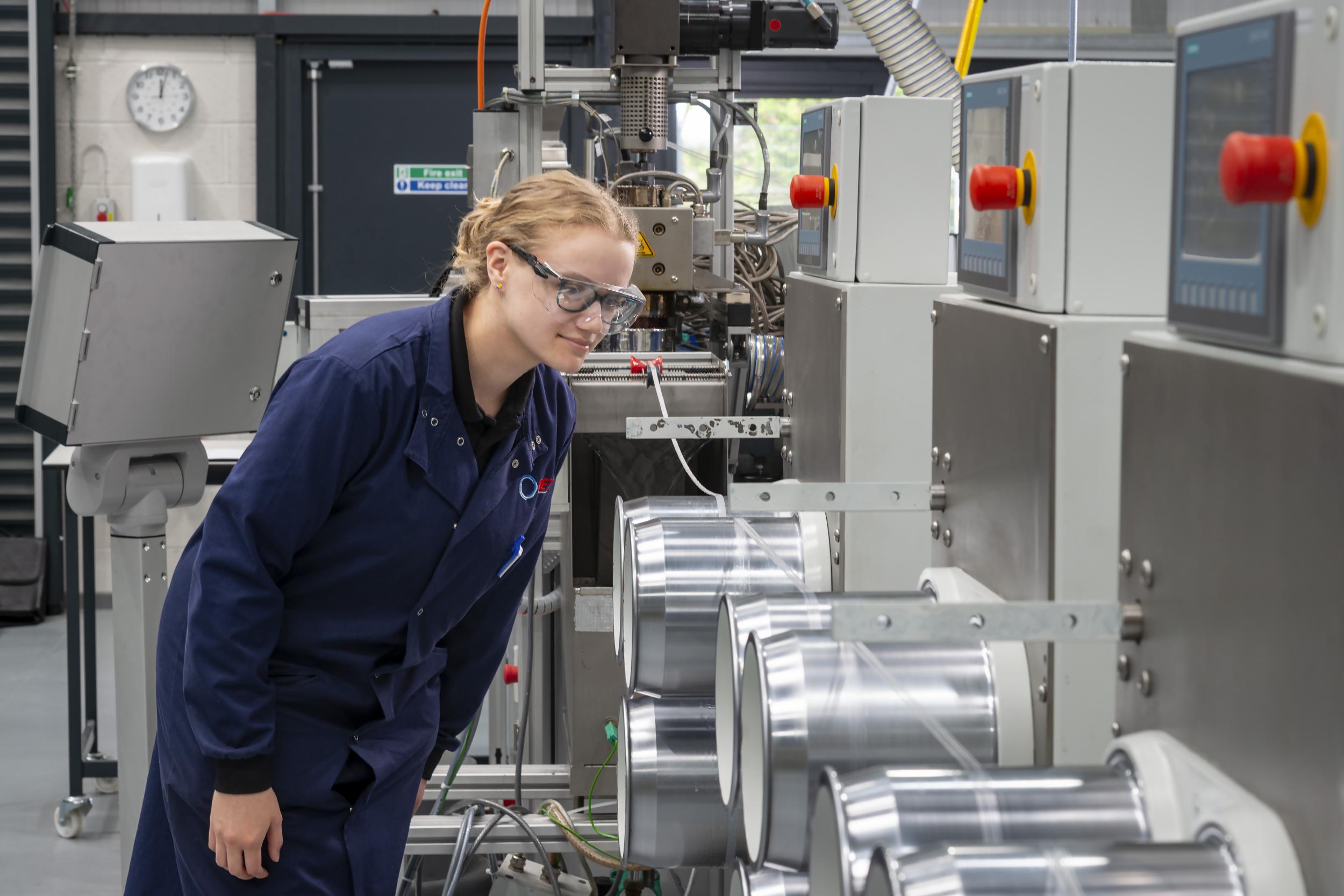
Fibre Extrusion Technology Photo Fibre Extrusion Technology
30.07.2025

Fibre Extrusion Technology at three major trade shows in 2025

Fibre Extrusion Technology Ltd (FET) of Leeds, UK will be exhibiting at three major trade shows in Asia and Europe over the next 3 months.

This sequence begins in early September at Cinte Techtextil China, the leading trade fair for technical textile and nonwoven products in Asia. FET will be taking a 30sq. metre stand in conjunction with its agent and partner, Chemtax in Hall W5.

This will be followed by ITMA ASIA in Singapore, aimed at the textile and garment industry in South and Southeast Asia and the Middle East. This exhibition takes place at the end of October and FET can be found at Hall H4.

This trio of events is rounded off at COMPAMED 2025 between 17-20 November in Dusseldorf, Germany. This exhibition is widely recognised as a major international trade fair for the medical technology supplier sector. FET’s will be exhibiting in Hall 08B.

Fibre Extrusion Technology Ltd (FET) of Leeds, UK will be exhibiting at three major trade shows in Asia and Europe over the next 3 months.

This sequence begins in early September at Cinte Techtextil China, the leading trade fair for technical textile and nonwoven products in Asia. FET will be taking a 30sq. metre stand in conjunction with its agent and partner, Chemtax in Hall W5.

This will be followed by ITMA ASIA in Singapore, aimed at the textile and garment industry in South and Southeast Asia and the Middle East. This exhibition takes place at the end of October and FET can be found at Hall H4.

This trio of events is rounded off at COMPAMED 2025 between 17-20 November in Dusseldorf, Germany. This exhibition is widely recognised as a major international trade fair for the medical technology supplier sector. FET’s will be exhibiting in Hall 08B.

“This is a very hectic period for FET,” commented FET’s Managing Director Richard Slack. “However, these exhibitions provide a great opportunity for smaller specialist companies like FET to raise our profile on the international stage and reflects our growing influence in the fields of technical textiles, medical device innovation and many other sectors.”

FET designs, develops and manufactures extrusion equipment for a wide range of high value textile material applications worldwide and the diversity of these three exhibitions illustrates FET’s scope in the industry.

Under GLP, Hohenstein Medical primarily offers tests on the biocompatibility of medical devices, such as chemical screenings and biological in-vitro tests, as well as tests on microbial load and microbial barrier. (c) Hohenstein
Under GLP, Hohenstein Medical primarily offers tests on the biocompatibility of medical devices, such as chemical screenings and biological in-vitro tests, as well as tests on microbial load and microbial barrier.
23.07.2025

Hohenstein: GLP Certification for Medical Device Testing

Since the middle of July, the testing service provider Hohenstein has been certified to conduct medical device testing in accordance with the internationally recognised Good Laboratory Practice (GLP) standard. This certification comprehensively covers chemical, physical and biological safety testing of medical devices. The standard focuses on the organisational procedures and documentation of non-clinical health and environmental safety studies and their framework conditions. GLP ensures that all necessary requirements regarding quality assurance, documentation and safety are met. This applies to the organisation and personnel as well as facilities, test and reference items, study reports and archiving.

Under GLP, Hohenstein Medical primarily conducts biocompatibility testing for medical devices. This includes chemical screenings and biological in-vitro tests, as well as microbiological tests such as bioburden and barrier effectiveness. 

Since the middle of July, the testing service provider Hohenstein has been certified to conduct medical device testing in accordance with the internationally recognised Good Laboratory Practice (GLP) standard. This certification comprehensively covers chemical, physical and biological safety testing of medical devices. The standard focuses on the organisational procedures and documentation of non-clinical health and environmental safety studies and their framework conditions. GLP ensures that all necessary requirements regarding quality assurance, documentation and safety are met. This applies to the organisation and personnel as well as facilities, test and reference items, study reports and archiving.

Under GLP, Hohenstein Medical primarily conducts biocompatibility testing for medical devices. This includes chemical screenings and biological in-vitro tests, as well as microbiological tests such as bioburden and barrier effectiveness. 

A Key Milestone
"We are pleased that in addition to our existing ISO 17025 accreditation, we now meet all the criteria for GLP certification. This international standard is a key milestone for our medical device testing portfolio," says Dr Timo Hammer, CEO of Hohenstein. "It enables global comparability and acceptance of our test results for our customers. In some countries – for example, the United States – GLP testing is even a regulatory requirement."

At Hohenstein, GLP-relevant data is primarily stored digitally. In addition, a state-of-the-art, climate-controlled paper archive has been constructed at the company headquarters in Boennigheim.

Sound-absorbing walls and ceiling in the acoustics lab at the DITF. Photo: (c) Deutsche Institute für Textil- und Faserforschung Denkendorf
Sound-absorbing walls and ceiling in the acoustics lab at the DITF.
23.07.2025

New measurement methods for soundproofing textiles

Noise pollution can cause stress and damage our health. Whether in restaurants, open-plan offices, or schools, we are confronted with loud background noise in our everyday lives. Sound-absorbing materials are used to reduce noise. The German Institutes of Textile and Fiber Research Denkendorf (DITF) are developing a comprehensive system for measuring and predicting the acoustic properties of a wide variety of textiles. This research enables the development of a wide range of sound-absorbing or acoustically effective materials.

Currently, in addition to foams, nonwovens are mostly used as sound absorbers. However, these are relatively thick and not very stretchy. Textile fabrics such as woven or knitted materials are more elastic and flexible and are able to reduce noise more specifically in certain frequency ranges. This allows them to be individually adapted to existing or expected noise problems. However, these textile fabrics have rarely been used in acoustics to date.

Noise pollution can cause stress and damage our health. Whether in restaurants, open-plan offices, or schools, we are confronted with loud background noise in our everyday lives. Sound-absorbing materials are used to reduce noise. The German Institutes of Textile and Fiber Research Denkendorf (DITF) are developing a comprehensive system for measuring and predicting the acoustic properties of a wide variety of textiles. This research enables the development of a wide range of sound-absorbing or acoustically effective materials.

Currently, in addition to foams, nonwovens are mostly used as sound absorbers. However, these are relatively thick and not very stretchy. Textile fabrics such as woven or knitted materials are more elastic and flexible and are able to reduce noise more specifically in certain frequency ranges. This allows them to be individually adapted to existing or expected noise problems. However, these textile fabrics have rarely been used in acoustics to date.

In order to exploit this potential, research and development are encountering a problem: the measurement methods and simulation models used for nonwovens are not readily applicable to other types of textiles. Nonwovens consist of loosely arranged, interconnected fibers; they have what is known as a random fiber arrangement. In woven and knitted fabrics, on the other hand, the fiber arrangement has a recurring, non-random pattern. The different fiber arrangements result in significant differences in material properties. Due to a lack of alternatives, manufacturers of acoustic textiles still have to use these limited methods for their product development.

This is where the MetAkusTex research project comes in. Dr. Elena Shabalina, Head of the Technology Center E-Textiles & Acoustics at the DITF, explains: "In acoustics research, there is limited knowledge about the potential and diversity of textiles. As a textile research institute, we want to ensure that a wide range of textile structures, including 3D textiles, find their way into the world of acoustics. We are laying the necessary foundations for this." The DITF are developing new acoustic measurement and prediction methods that can be used to evaluate how different textiles interact with sound, whether they absorb, reflect, or scatter it. With the help of mathematical models, textile materials can be tested, adapted, and optimized for their acoustic effect as early as the design phase.

The project results will help companies make their product development processes more efficient and to design materials in a more targeted manner, for example, to make them sustainable. This will shorten time to market.

In addition to the development of new measurement methods, the acoustics laboratory at the DITF is being expanded. The measuring room with sound-absorbing walls and a sound-reflecting floor (semi-anechoic chamber) will be equipped with a modern data acquisition system. In addition to software, this includes various measuring microphones, loudspeakers, and a turntable to measure the sound quality of loudspeakers from different directions. The new acoustics laboratory will be used for research at the institute and will also be made available to industry for testing.
 
The MetAkusTex research project was funded by the Baden-Württemberg Ministry of Economic Affairs, Labor, and Tourism as part of the Invest BW - Praxissprints program.

Source:

Deutsche Institute für Textil- und Faserforschung Denkendorf 

Liste Stanford University © www.TopResearchersList.com
22.07.2025

Stanford University: Roshan Paul included in the list of the world's top 2 percent of scientists

Dr Roshan Paul, Platform Leader of the Smart Finishing Group at Institut für Textiltechnik (ITA) of RWTH Aachen University, is one of the world's top 2 percent of scientists. Stanford University has therefore included him in its rankings for 2021, 2022 and 2024. 

"The Smart Finishing Group is driving the sustainable biotransformation of the textile processing industry, and the development of technical textiles through multifunctional finishing based on green chemistry. The Group has already established itself as a reliable partner for the industry. Our technologies can enhance the competitiveness of SMEs and the start-ups focusing on niche markets," says Roshan Paul.

Professor Dr Gries states: "The ranking recognizes Dr Paul's global influence on the progress of science and technology. He is doing a great job at ITA. We are proud to have him in our ranks and congratulate him on his outstanding achievements!"

Dr Roshan Paul, Platform Leader of the Smart Finishing Group at Institut für Textiltechnik (ITA) of RWTH Aachen University, is one of the world's top 2 percent of scientists. Stanford University has therefore included him in its rankings for 2021, 2022 and 2024. 

"The Smart Finishing Group is driving the sustainable biotransformation of the textile processing industry, and the development of technical textiles through multifunctional finishing based on green chemistry. The Group has already established itself as a reliable partner for the industry. Our technologies can enhance the competitiveness of SMEs and the start-ups focusing on niche markets," says Roshan Paul.

Professor Dr Gries states: "The ranking recognizes Dr Paul's global influence on the progress of science and technology. He is doing a great job at ITA. We are proud to have him in our ranks and congratulate him on his outstanding achievements!"

Source:

ITA – Institut für Textiltechnik of RWTH Aachen University

18.07.2025

Global exhibitors across sub-sectors confirmed for Cinte Techtextil China 2025

With 12 exhibiting countries and regions so far confirmed, Cinte Techtextil China is poised to present a dynamic industry platform, bridging the gap between Asian and Western markets. From 3 to 5 September in Shanghai, the fair will feature a full spectrum of technical textiles and nonwovens for 12 application areas, with a key highlight being 2025’s debut product category and zone – the Textile Chemicals and Dyes Zone. Meanwhile, domestic and international exhibitors with automotive applications can be found across the fairground, with the segment drawing strong interest globally. Also featuring a range of innovators in the reputable European and German Zones, the fair’s International Hall (W5) will offer valuable expertise and opportunities to trade visitors from China, Asia and beyond.

With 12 exhibiting countries and regions so far confirmed, Cinte Techtextil China is poised to present a dynamic industry platform, bridging the gap between Asian and Western markets. From 3 to 5 September in Shanghai, the fair will feature a full spectrum of technical textiles and nonwovens for 12 application areas, with a key highlight being 2025’s debut product category and zone – the Textile Chemicals and Dyes Zone. Meanwhile, domestic and international exhibitors with automotive applications can be found across the fairground, with the segment drawing strong interest globally. Also featuring a range of innovators in the reputable European and German Zones, the fair’s International Hall (W5) will offer valuable expertise and opportunities to trade visitors from China, Asia and beyond.

A strong combination of global exhibitors has already confirmed their participation this year, coming from Belgium, China, Germany, Hong Kong, India, Italy, Malaysia, Saudi Arabia, Switzerland, the UK, the US, and Vietnam. With the additional textile chemicals and dyes product category launched at the fair, new business avenues have been opened for renowned companies such as CHT Germany GmbH (Germany), Michelman Inc (USA), and more, who will convene at the debut Textile Chemicals and Dyes Zone. The new category is suitable for a range of textile applications, such as for sports & leisure, safety & protection, industrial protection, construction and more.

European and German Zones to showcase continent’s industry excellence
With Europe’s production of technical textiles and nonwovens largely returning to pre-pandemic levels, the vast Asian market represented at Cinte Techtextil China has attracted leading companies to showcase their quality, high-tech products in the European and German Zones.

In addition to well-known returning brands, such as EMS-GRILTECH, Graf + Cie, Monosuisse, and Swisstulle from Switzerland, and Fibre Extrusion Technology from the UK, several new exhibitors are set to make their mark in the European Zone. 

Across the hall, the German Zone will also welcome a strong array of members, including Autefa Solutions, Mahlo, Reifenhauser Heinsberg, and many more, such as Brueckner Textile Technologies, Lindauer DORNIER or Wetekam Group (new).

Highlighted exhibitors featuring automotive textile solutions
Harnessing market demand, Cinte Techtextil China will feature a raft of global Mobiltech exhibitors, including Eastex Industrial Science And Technology and Oriental Industries from China, Picanol from Belgium, Rowa Group from Germany, and more.

The fair’s product categories cover 12 application areas, which comprehensively span a full range of potential uses in modern technical textiles and nonwovens. These categories also cover the entire industry, from upstream technology and raw materials providers to finished fabrics, chemicals and other solutions. This scope of product groups and application areas ensures that the fair is an effective business platform for the entire industry.

Cinte Techtextil China will be held from 3 – 5 September 2025.
The fair is organised by Messe Frankfurt (HK) Ltd; the Sub-Council of Textile Industry, CCPIT; and the China Nonwovens & Industrial Textiles Association (CNITA).

Source:

Messe Frankfurt (HK) Ltd

Evolon® sustainable protective packaging © Freudenberg Performance Materials
Evolon® sustainable protective packaging
17.07.2025

Freudenberg: Protective packaging solutions for automotive OEMs at Fachpack 2025

Freudenberg Performance Materials (Freudenberg) will showcase packaging materials combining high performance protection, CO2 emission reduction and waste prevention at Fachpack 2025 in Nuremberg, Germany, from September 23-25. Evolon® packaging solutions offered by Freudenberg are particularly suited for packaging automotive components with sensitive surfaces. 

Evolon® packaging materials provide superior surface protection for a wide range of automotive parts, including molded plastics and painted elements. The high-end textiles make an important contribution to the quality goals of OEMs and tier suppliers by preventing damage to transported parts and lowering rejection rates.

Freudenberg Performance Materials (Freudenberg) will showcase packaging materials combining high performance protection, CO2 emission reduction and waste prevention at Fachpack 2025 in Nuremberg, Germany, from September 23-25. Evolon® packaging solutions offered by Freudenberg are particularly suited for packaging automotive components with sensitive surfaces. 

Evolon® packaging materials provide superior surface protection for a wide range of automotive parts, including molded plastics and painted elements. The high-end textiles make an important contribution to the quality goals of OEMs and tier suppliers by preventing damage to transported parts and lowering rejection rates.

Recycled content and low CO2 footprint
Evolon® textiles have a small carbon footprint because their manufacturing process uses low-CO2 energy, and the fabrics are lightweight and reusable. Furthermore, Evolon® packaging materials are made of up to 85% recycled content. “By replacing virgin raw materials with recycled content, we’ve been able to cut the carbon footprint of our fabric production by 35%. We are actively exploring the possibility of manufacturing Evolon® using 100% recycled content to drive CO₂ emissions down even further,” explains Jean-François Kerhault, Director Global Sales & Marketing General Industry at Freudenberg Performance Materials. 

Although Evolon® fabrics are lightweight – from 80gsm to 300gsm – they nevertheless still provide the high mechanical strength properties required for automotive packaging applications. This conserves raw materials and reduces the weight of transported loads. In particular, the new Evolon® Ultra Force is approximately 50% lighter than PVC-based materials with similar high mechanical strength, while containing a minimum 50% recycled content and no PVC.

Waste prevention
Evolon® materials play an important role in decreasing waste when it comes to transporting automotive parts. Above all, the high-end materials provide superior surface performance which directly reduces scrap of transported parts. 
In addition, packaging waste is also prevented because Evolon® technical packaging textiles are designed for reusable packaging containers. Single-use packaging is avoided. Moreover, Evolon® packaging material lasts for the entire production cycle of a car model.

Source:

Freudenberg Performance Materials

16.07.2025

Closing Military Procurement Loophole in Boost for U.S. Textile Industry

The National Council of Textile Organizations (NCTO), spanning the entire spectrum of U.S. textiles from fiber to finished sewn products, issued a statement today commending the House Armed Services Committee (HASC) for passing the Fiscal Year 2026 National Defense Authorization Act (NDAA), which contains a provision that could boost domestic textile industry sales to the U.S. military. 

The House NDAA bill, which authorizes funding levels and provides authorities for the U.S. military, includes a provision that would eliminate a statutory exemption under the Berry Amendment that acts as a loophole allowing the U.S. military to buy textiles abroad instead of from American textile manufacturers as long as the purchase is at or below a small purchase threshold of $150,000.

The National Council of Textile Organizations (NCTO), spanning the entire spectrum of U.S. textiles from fiber to finished sewn products, issued a statement today commending the House Armed Services Committee (HASC) for passing the Fiscal Year 2026 National Defense Authorization Act (NDAA), which contains a provision that could boost domestic textile industry sales to the U.S. military. 

The House NDAA bill, which authorizes funding levels and provides authorities for the U.S. military, includes a provision that would eliminate a statutory exemption under the Berry Amendment that acts as a loophole allowing the U.S. military to buy textiles abroad instead of from American textile manufacturers as long as the purchase is at or below a small purchase threshold of $150,000.

The NDAA also includes language from the Better Outfitting Our Troops (BOOTS) Act, a bill that NCTO has pushed for as part of a broader coalition. The provision requires the Secretary of Defense to issue regulations within two years that prohibit any member of the Armed Forces from wearing optional combat boots as part of a required uniform unless those boots are made in the United States with American-made components, with a few exceptions.

“We applaud the HASC for passing the FY 2026 NDAA and including provisions that would help boost domestic manufacturing, strengthen American economic competitiveness, and meet the mission-critical needs of our Armed Forces,” said NCTO President and CEO Kim Glas.

“We are sincerely appreciative of the leadership of Congressman Don Davis (D-NC) and Congressman Pat Harrigan (R-NC), who led efforts to close the Berry Amendment loophole and co-sponsored the amendment to the NDAA.

“The Berry Amendment requires the Department of Defense (DOD) to purchase 100% U.S.-made textiles and clothing. But the small-purchase exemption in the statute has led to U.S. military purchases of foreign-made textile articles largely at the expense of American textile manufacturers who have potentially lost several million dollars per year in U.S. government sales.

“Eliminating this exemption will lead to the military procurement of more American-made military textile products as well as oversight of Berry Amendment compliance.  

“Lastly, we also applaud the inclusion of the BOOTS Act in the NDAA, which will support domestic military footwear production. 

“This is a win for the American textile and apparel industry, a key strategic contributor to our national defense that supplies over 8,000 products a year to our men and women in uniform. The industry provides high-tech, functional components for the U.S. government, including more than $1.8 billion worth of vital uniforms and equipment for our armed forces annually.

“It is vital to America’s national security that the U.S. military maintain the ability to source high-quality, innovative textile materials, apparel, and personal equipment from a vibrant American textile industrial base. After passage of the FY 2026 NDAA by the full House, we look forward to working with the Senate and House to ensure this provision is included in the final NDAA conference report.”

Source:

National Council of Textile Organizations

eVent Fabrics: New Website Photo eVent Fabrics
16.07.2025

eVent Fabrics: New Website

With increasing demand for sustainably-minded performance laminates for apparel and footwear, eVent®️ Fabrics, a global leader in breathable waterproof, weatherproof, and windproof fabric technologies, introduces the new www.eventfabrics.com. 

The new website delivers several upgrades over the previous one, including simplified navigation, cohesive brand storytelling, and improved messaging around eVent’s increasing focus on more sustainable, circular, high-performance laminates.  

“As we continue to position ourselves as leaders in PFAS-free performance laminates and our brand messaging evolves to support our overall brand mission, this new website will better represent our brand to our core audiences,” said Chad Kelly, President of eVent Fabrics. “As demand grows, this new site will help brands, product developers, and customers better understand who we are as a brand and what we offer in PFAS-free laminates, allowing everyone along the value chain to make more informed buying decisions.”

With increasing demand for sustainably-minded performance laminates for apparel and footwear, eVent®️ Fabrics, a global leader in breathable waterproof, weatherproof, and windproof fabric technologies, introduces the new www.eventfabrics.com. 

The new website delivers several upgrades over the previous one, including simplified navigation, cohesive brand storytelling, and improved messaging around eVent’s increasing focus on more sustainable, circular, high-performance laminates.  

“As we continue to position ourselves as leaders in PFAS-free performance laminates and our brand messaging evolves to support our overall brand mission, this new website will better represent our brand to our core audiences,” said Chad Kelly, President of eVent Fabrics. “As demand grows, this new site will help brands, product developers, and customers better understand who we are as a brand and what we offer in PFAS-free laminates, allowing everyone along the value chain to make more informed buying decisions.”

Faced with more stringent sustainability regulations and growing consumer demand, eVent’s increasing focus on delivering PFAS-free and circular performance laminates to a global market is driving awareness, interest, and sales. The new website is designed to better highlight the eVent’s evolving brand story and support discovery of sustainably-minded performance technology.

As eVent’s PFAS-free laminate offering continues to gain traction, the new site better supports brand direction, growth, and messaging. Improved navigation helps site visitors more easily identify and learn about the breathable waterproof, weatherproof, and windproof laminates that address their performance and sustainability goals. In addition, the new site will serve as the hub for the overall eVent brand evolution, helping to better tell the brand’s unique story. 

Source:

eVent Fabrics