Home
Highlights
Jobs
Companies and Headhunters are looking for ...
N E U: Sales Manager / Account Manager (m/w/d) - Technische Textilien
N E U: Geschäftsführer / General Manager (w/m/d) - Technische Textilien
Leitung Entwicklung Flachstrick (m / w / d)
Leitung Gewebeentwicklung (m/w/d) - Technische Textilien
Bekleidungstechniker (m/w/d) Nähtechnik / Konfektionstechnik
Nähmaschinen - Techniker (m/w/d)
Qualitätsmanager (m/w/d) - Belgien
Director of Innovation & Processes (m/f/d) - Belgium
Cross-functional Quality Manager (m/f/d) - Belgium
Leiter Innovation und Prozessmanagement (m/w/d) - Belgien

News
Companies and Markets
Kappahl backs a longer-lasting wardrobe
Kappahl is launching its Autumn 2026 campaign across all markets on 16 September. Built around the existing “We Are Family” platform, the campaign presents a wardrobe of pieces intended to be easy to combine and relevant beyond short trend cycles.
The assortment spans womenswear, XLNT and menswear, with knitwear, denim, tailoring, lace and outerwear. The coat has a specific heritage role, linking the current collection to the company’s origins in Gothenburg in 1953, when founder Per-Olof Ahl opened a store focused on coats.
This is not, by itself, a technical sustainability claim. The editorial signal is how a large fashion retailer is using longevity and versatility as part of brand and assortment positioning. The campaign will run across digital channels, marketing activities and stores.
s.Oliver brings the 90s back
Editorial relevance: Medium – a current brand-positioning and retail story supported by a product capsule.
s.Oliver has launched a new hero campaign, “Casual Since Forever,” featuring Heidi Klum meeting a younger version of herself from the 1990s. The concept uses the time shift to reinforce the brand’s positioning around enduring casual style.
The campaign is accompanied by a limited-edition vintage capsule that reinterprets 1990s references through casual basics and vintage-inspired designs. The pieces are being sold online and in selected s.Oliver stores, turning the campaign narrative into an immediate product and retail activation.
The editorial relevance lies in the combination of heritage storytelling and merchandising. Established fashion brands increasingly use archive aesthetics and cultural nostalgia not only for communication but as a direct product-development and traffic-driving mechanism.
ELIE SAAB joins H&M
H&M has named ELIE SAAB as its next designer collaborator. The collection will bring the Beirut-founded couture house’s codes into a mass-market collaboration covering womenswear, menswear, accessories and footwear.
The range is set to include embellished gowns, shimmering separates and tailored pieces, with details such as lace, gradient sequins and monograms. The project extends H&M’s long-running collaboration model, in which luxury and designer brands are translated into limited retail collections with broad consumer reach.
The collection launches in selected stores and online on 22 October 2026. For the fashion and retail market, the partnership is a further example of how high-fashion brand equity, scarcity and cross-price-segment collaboration are used to create traffic and global media visibility.
Airborne microfibres enter soil and water
Researchers from Empa, Eawag and Agroscope have produced the first systematic estimate of how much microplastic is deposited from the atmosphere across Switzerland. For areas below 2,000 metres, the study estimates annual deposition of about 219 tonnes, including roughly 78 tonnes on agricultural land and around ten tonnes directly into water bodies.
The official release identifies loose fibres from functional clothing among the sources that can enter the environment, alongside PET bottles and other plastic products. Sampling was conducted for a full year at five locations, with particles between 20 and 215 micrometres analysed using imaging infrared microspectroscopy. PET, polyethylene and polypropylene were the most frequently detected polymers.
For textiles, the findings matter because they add atmospheric transport to the better-known discussion around fibre release through washing. The work provides a new evidence base for assessing material emissions and mitigation priorities, while the researchers stress that long-term environmental and health effects remain under investigation.
Wool turns sunlight into clean water
Editorial relevance: Very high – a measurable functional-textile application combining natural fibre and surface engineering.
Cornell University researchers have demonstrated that polydopamine-dyed wool can serve as a low-cost, renewable material for solar-driven water purification. The approach uses interfacial solar vapor generation, concentrating solar heat at the water surface while a textile structure transports water and converts it into vapor.
The strongest configuration used ultrablack wool positioned vertically and illuminated from both sides. It produced 2.43 kilograms of water per square metre of fabric per hour, while polydopamine-only wool achieved 2.21 kilograms. Both rates were nearly twice those reported for conventional horizontal two-dimensional evaporation systems. The material also operated continuously for ten hours without salt accumulation.
Hamburg Textile Week puts future fabrics on show
Hamburg Textile Week will present 14 projects from Germany, the Netherlands and Sweden from 1 to 11 October 2026 under the theme “Stoffe mit Zukunft” – Fabrics with a Future. The program focuses on new materials, processes and technologies, including textile energy systems, bio-based materials and interactive fabrics.
Projects range from SkySails kites that generate electricity from high-altitude wind and revoltech’s hemp-residue-based LOVR material to “Talking Textiles,” which translates touch into sound in real time. A Stühmer|Scholz exoskeleton uses textile components as the interface between body and technology. Other exhibits include a curtain woven with thin-film solar cells and work on bio-based dyeing.
Design Zentrum Hamburg is joined by the FABRIC – Future Fashion Lab for talks and workshops, with HAW Hamburg, AMD Akademie Mode & Design, Made auf Veddel and Greenpeace also participating. The format brings research, design, production and circular-design questions into one city-wide textile program.
Textile Exchange raises the bar on materials
Textile Exchange has published new guidance setting out the next requirements for brands and retailers in its Action Cohort. From 2027, participating companies will be required to report material sourcing volumes through the Materials Benchmark and set measurable targets for the share of materials sourced through standards, certification or other programs that verify preferred production practices.
The targets should cover relevant key materials accounting for at least 80% of a company’s material portfolio. Textile Exchange identifies common intervention areas including pesticide and fertilizer reduction, deforestation and conversion, animal welfare, recycled feedstocks with a focus on textile inputs, and human-rights due diligence.
Aggregate cohort results will be made public, while more detailed results will be shared with participating brands. The framework therefore tightens the connection between voluntary membership, quantitative materials data and verifiable sourcing objectives, increasing the need for brands and suppliers to document material strategies with comparable evidence.
Home-Maxxing shapes Heimtextil Trends 27/28
Heimtextil Trends 27/28 place the tension between optimization and respite at the center of the coming interior-textile season. Under the theme “Home-Maxxing – The Performance of Everyday Living,” Heimtextil and Milan design platform Alcova explore how technology, functionality and sensory material qualities are reshaping homes, hospitality, workplaces and healthcare environments.
Textiles are framed explicitly as functional components: they can regulate light, absorb sound or filter air. At the same time, tactility, durability and understandable construction are gaining importance. The three directions, Staged Competence, Inside, Out and Hyper Presence, range from visibly engineered performance and exposed connections to natural fibers and surfaces whose physical qualities take priority.
The trends will be presented in the Trend Space at Heimtextil from 12 to 15 January 2027. For home and contract-textile suppliers, the key message is that technical performance is no longer expected to disappear into the background; it increasingly becomes part of the visual and material language of a product.
A matrix for recycled-fiber quality
Uster Technologies has introduced a structured matrix for assessing mechanically recycled fibers. The approach is intended to help spinners deal with the wider variability of recycled feedstocks and relate measured fiber properties more directly to processing decisions and intended end uses.
Mechanically recycled cotton typically shows greater variation than virgin material because fiber length is reduced and input streams differ in origin and processing history. A consistent assessment framework can therefore support bale management, blending decisions and the adjustment of spinning parameters. Uster positions the Recycled Fiber Matrix as a practical bridge between increasing recycled-content targets and reliable quality control.
This matters for circularity at industrial scale. More recycling capacity alone does not guarantee usable yarn feedstock; recycled fibers also need to enter established production systems with predictable performance. Testing and data interpretation are becoming part of the infrastructure required to move textile-to-textile recycling from availability to repeatable production.
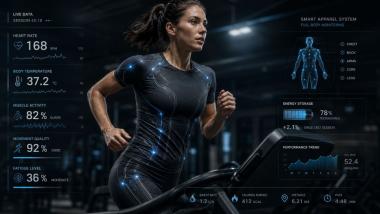
Smart textiles: flexible supercapacitors could power sensors directly in sportswear
An international research team involving De Montfort University Leicester is examining how flexible supercapacitors could be integrated into sports clothing. The concept goes beyond adding another sensor to a garment. Instead, the textile would become part of the energy architecture: it could store electricity and supply distributed sensors embedded across the garment. Combined with technologies that harvest energy from body movement or heat, running tops, cycling kit or gym wear could eventually generate and store part of the power needed for continuous monitoring.
The researchers identify knitted structures and conductive yarns as particularly promising because they can combine electrical functionality with stretch, flexibility and breathability. Carbon-based electrode materials such as graphene and carbon nanotubes are also considered because of their energy-storage potential and mechanical flexibility. Compared with conventional batteries, supercapacitors can charge and discharge very rapidly, while potentially being made light and flexible enough for body-worn applications.
Business
Study - Asia
Technical University Darmstadt conducts study
"India and China as procurement markets". A comparative study for the German textile industry
Textination members can request the results of the study under the keyword China-India by mail: news@textination.de.
Study - Austria
Bank Austria presents study on textile and clothing industry
In May 2017 the bank presented its industry report on the Austrian textile and clothing industry.
You can find the download link for the study in our newsline from 18 July 2017.
Good
to Know
TexCampus
TexCampus – the
knowledge database for
research publications
R & D is a decisive competitive factor.
Find out as early as possible what the research landscape is working on.
Find information quickly and specifically in our online database.
Benefit from the time advantage: final reports, scientific-technical documentations and editorial contributions on research projects available 24/7.
Stay informed about innovations in your sector.
Feel free to contact us by email, if you are interested in becoming a part of TexCampus.
Downcheck
Welcome to DownCheck
Bundled knowledge around the topic "feathers & down".
Regardless of whether you need tips on purchase or care of bedding or have questions about materials and origin or brands and licenses, you can find here answers to your questions.
And should you ever have further inquiries, we look forward to your mail to daunencheck@textination.de.
Tenders
Get your weekly update of European tenders
You are welcome to subscribe to our tender service:
- Textiles
- Clothing
- Textile service
Apply to our mailing service and order your test mail free of charge.

Sustainability