
Forschungspublikationen

2 Ergebnisse
04.12.2025

PFAS-free POF and vibration-enhancing structures for social presence through immersive, emotional and vivid experiences of closeness at a distance

Rohstoffe Fasern Nachhaltigkeit Smart Textiles

Zusammenfassung

The three-year project ‘SPIELEND – Social Presence through Immersive, Emotional and Lively Experiences of Closeness at a Distance’, funded by the BMFTR, addresses the question of how technology-assisted games should be designed to convey a feeling of social closeness to participants even across distances. This explicitly includes the representation of the other person or fellow players. In order to measure the resulting closeness, the corresponding evaluation options are derived from psychological and cognitive science research within the framework of the project. As part of the project, various digital augmented reality games are being designed, implemented and tested. In order to enable an immersive and emotional experience and to create a heightened sense of social presence, the augmented reality games are being developed with the inclusion of smart, functional textiles.

Bericht

1.         Abstract

See „abstract for TEXCAMPUS“


2.         Introduction

Our society is undergoing change: education, study and work, but also the shortage of housing in urban centres, are placing increasing demands on citizens' mobility [1]. At the same time, travel is proving to be an unsustainable solution in terms of its ecological and economic consequences [2]. Social distancing during the COVID-19 pandemic exacerbated the separation of families, friends, club members and church communities. According to [3], 69% of respondents did not have any private meetings during the coronavirus measures in 2020. At the same time, the pandemic accelerated the digitalisation of social interaction. One in two people aged 16-29 used video calls to communicate with family and friends [4]. While these developments appear welcome in terms of resource efficiency, there are also negative effects of digital communication that lack social proximity: video conferences cannot replace real meetings; there is a lack of spontaneity, non-verbal communication, playfulness and emotionality. So-called ‘Zoom fatigue’ is becoming widespread [5]; people are rarely willing to hold private video conferences with family and friends.

The aim of the three-year BMFTR project SPIELEND is to develop a system that enables physical and emotional immersion in the context of playful interaction at a distance in order to intensify a feeling of closeness. Well-known game concepts are used, further developed and expanded to include sensory qualities, in particular through polymer optical fibres (POF) and 4D textiles. This makes it possible to support loved ones who suffer from the social side effects of physical separation. Smart textiles are being used in particular to enhance sensory qualities. The study focuses on the factors influencing social presence, such as the representation of fellow players, multimodal stimulation and game elements, including joint activities.

3.         Materials and methods

Two types of smart textiles are used for physical distance interaction: textile emitters in the form of polymer optical fibres (POF) and 4D textiles.

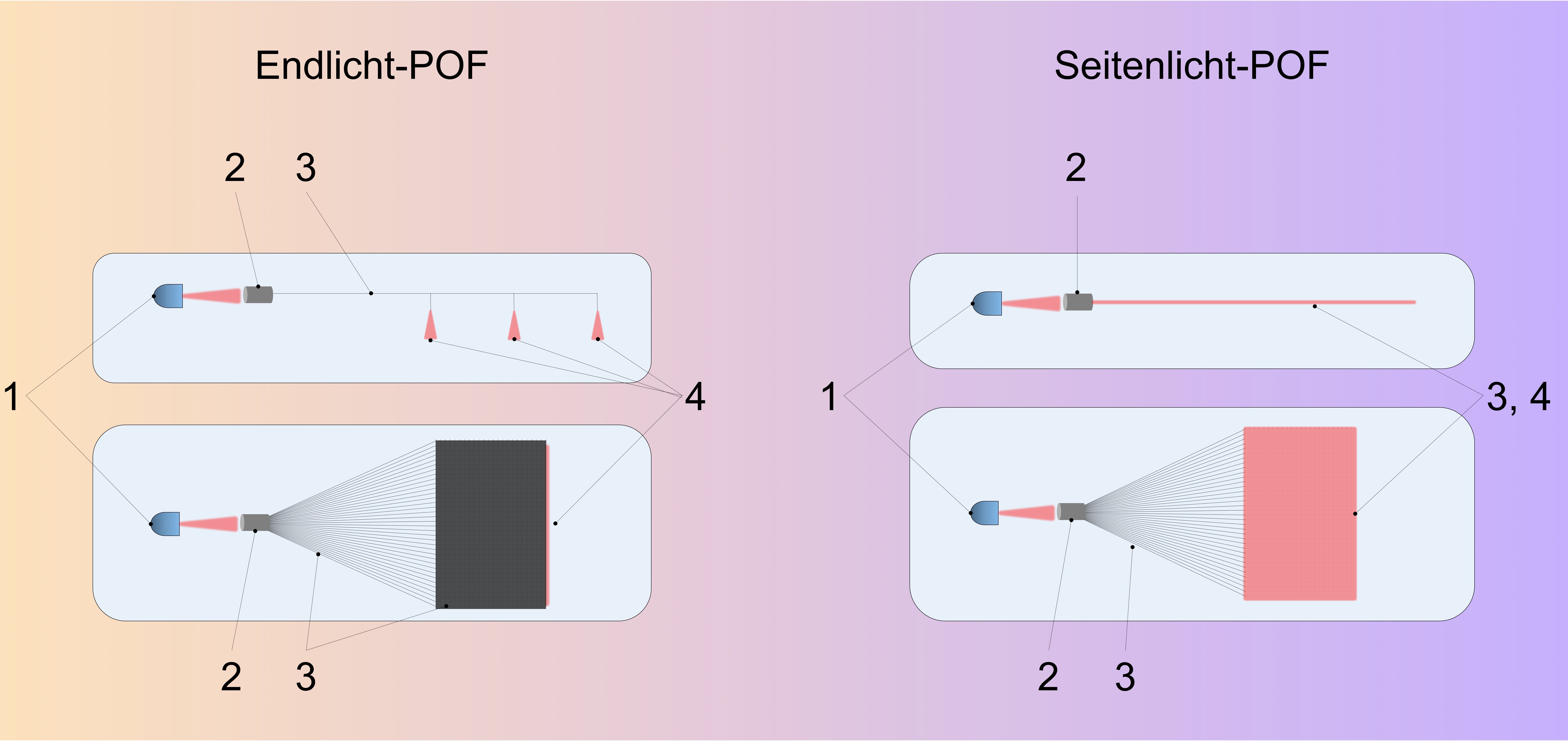
POFs are designed either as end-light fibres or side-light fibres. End-light fibres conduct the coupled light from the end of the fibre closest to the light source to the end furthest from the light source. Side-light fibres, on the other hand, also emit light across the entire surface of the POF. End-lighting POF can therefore be used for spot lighting and, when integrated into a textile structure, for line lighting. Side-lighting POF can be used for line lighting and, when integrated into a textile structure, for area lighting (see Fig. 1). All commercial plastic light-conducting fibres consist of two polymer materials. One is polymethyl methacrylate (PMMA) in the fibre core. The other is a fluoropolymer in the fibre cladding. Commercial POF is therefore contaminated with PFAS. As part of the project, possible alternative cladding materials are being investigated and PFAS-free POF is being produced using the bicomponent melt spinning process.

see Fig. 1 Illustration of various application options for end-lighting POF and side-lighting POF

Common materials for textile actuators are PLA (polylactide) and TPU (thermoplastic polyurethane). Critical factors for textile actuators are the adhesion properties and ensuring the flexibility of the textile. For the vibration propagation structure, the polymers TPU and PLA were considered, as well as the two textiles Eurojersey and Buttinette.


4.         Results

Through theoretical material screening based on optical, thermal and economic evaluation criteria, the following polymers were identified as possible alternatives to the fluorinated material currently in use: polymethyl pentene (PMP) and polylactic acid (PLA) – with the former appearing more promising in preliminary practical tests. Through material screening based on optical, rheological and thermal evaluation criteria, three types of polymethylpentene (PMP grades) were selected for testing: TPX MX002, TPX DX820 and TPX RT18 – all from Mitsui Chemicals, Inc., Tokyo (Japan) (see Fig. 2). Through multiple iterative experimental analyses using bicomponent melt spinning tests and subsequent geometric, mechanical and optical evaluation methods, insights and improvements in the production of PFAS-free materials were achieved. PFAS-free POF with a roundness of over 99% was produced using the three PMP grades and PMMA 7N from Röhm GmbH, Darmstadt (Germany). The fineness-related strengths achieved are comparable to commercial POF. Using DX820 as the sheath material, a maximum sheath extruder temperature of 255 °C and a nozzle hole capillary diameter of 3.5 mm, PFAS-free POF (diameter 500 µm) with the lowest attenuation was produced.

see Fig. 2 Used Granulates

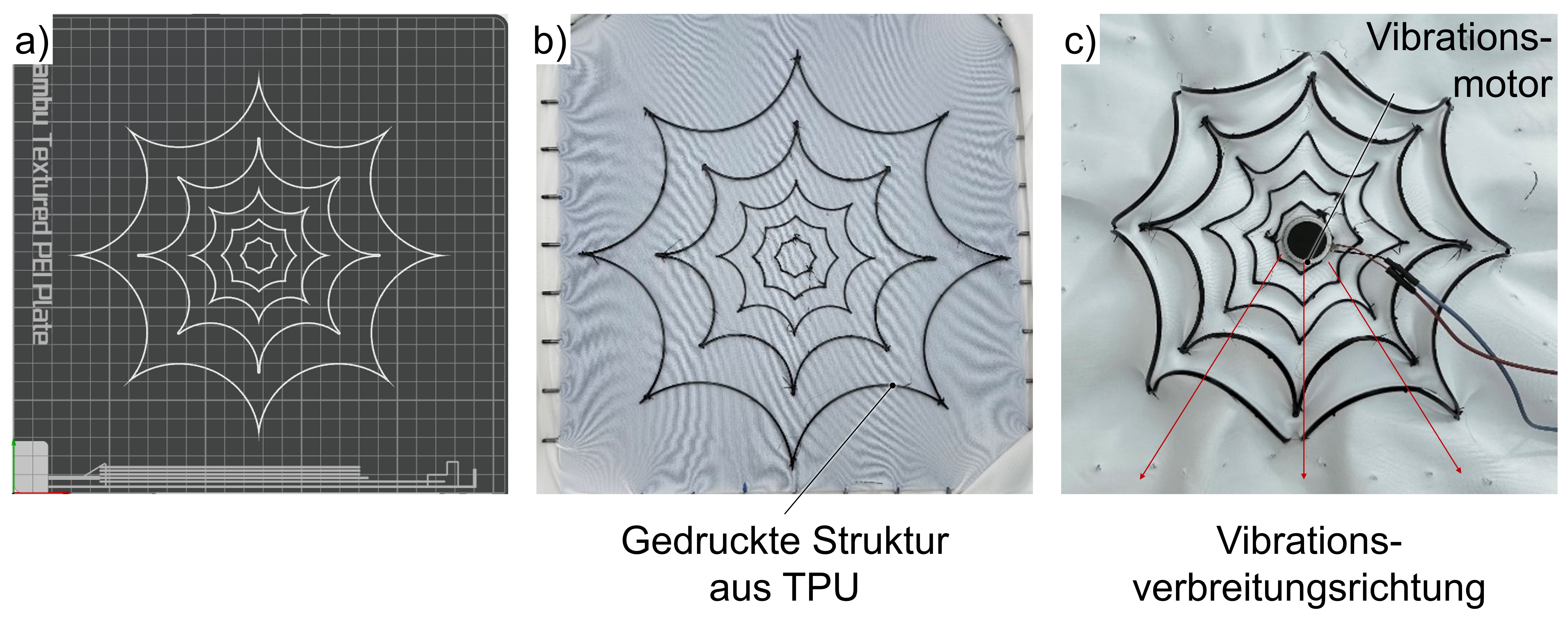
For the application of textile actuators on textiles, it was found that the common materials PLA and TPU can be printed using fused deposition modelling (FDM). TPU showed superior adhesion compared to PLA and was selected as a suitable material for smart textiles due to its better adhesion properties and flexibility. To identify suitable material combinations for the vibration propagation structure, the adhesion at the interface between the polymers and the textiles was systematically analysed. The results show that PLA has the best adhesion properties on Buttinette textiles, while TPU shows improved adhesion on Eurojersey textiles. These material combinations were determined to be optimal for the further development of the vibration propagation structure. As part of the investigation of textile actuators, TPU and Eurojersey were identified as a suitable material combination. The selection was based on the soft texture of TPU and its improved adhesion to Eurojersey. These properties enable optimal interaction with the textile structure and are particularly advantageous for the implementation of tactile feedback (see Fig. 3).

see Fig. 3: Vibration propagation structure

5.         Summary

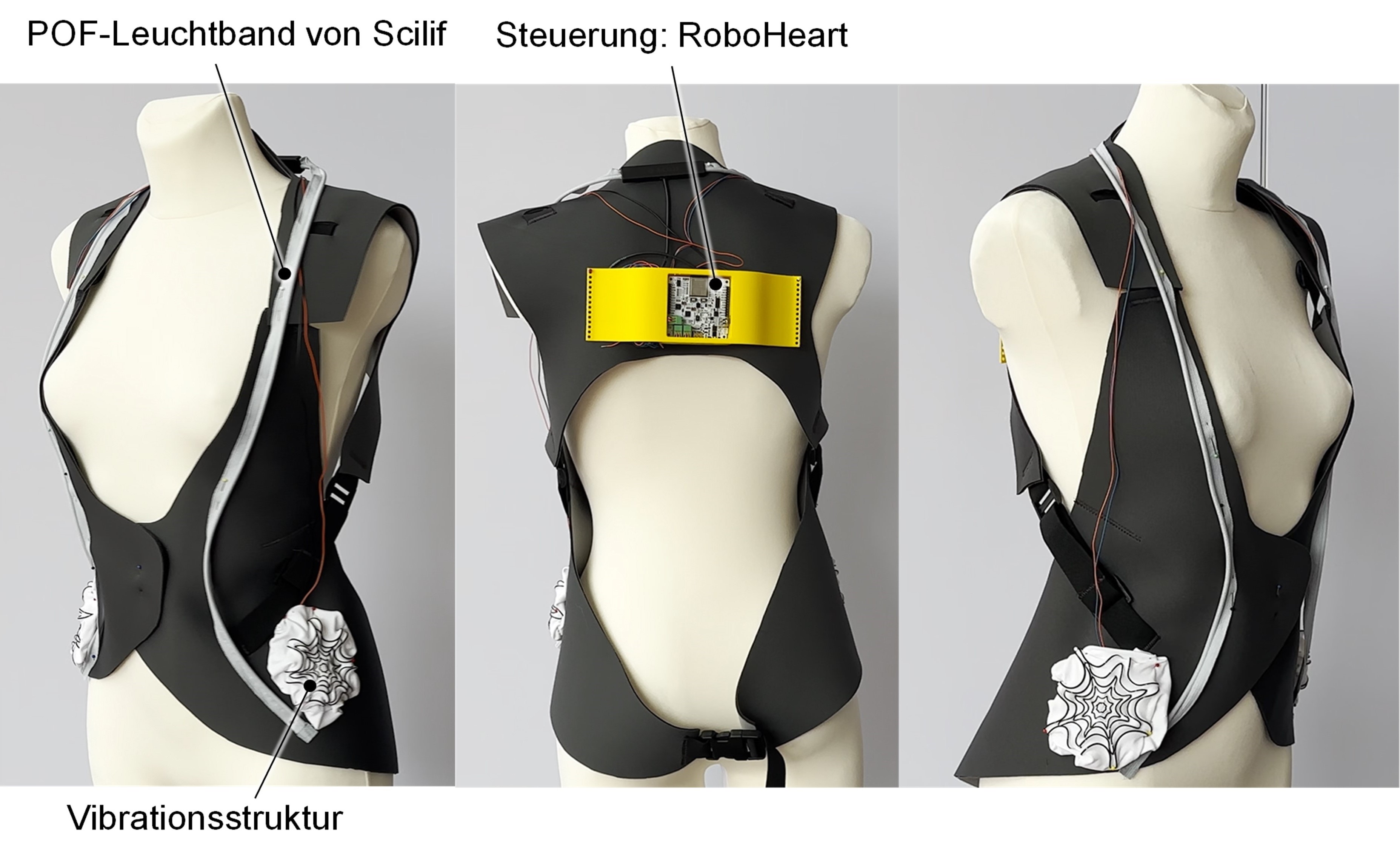
The SPIELEND project represents an innovative approach on two levels to expand the experience of digital games for remote interaction and thus make them more accessible (see Fig. 4). Vibration propagation structures on textiles are being explored to make the gaming experience physically tangible. This allows feedback to be passed on directly to the player. Thermoplastic polyurethane on a Eurojersey textile was found to be the best material combination. On the other hand, the use of light-conducting fibres made of plastic (polymer optical fibre, POF) makes it possible to enhance the gaming experience with realistic visual stimuli. For this purpose, PFAS-free POF was designed theoretically and manufactured practically using the bicomponent melt spinning process, which means that it is not contaminated with fluorinated substances.

see Fig. 4: Smart vest with POF light strip, vibration amplification structure and control via RoboHeart from project partner Augmented Robotics

6.         Acknowledgement

We would like to thank the Federal Ministry of Research, Technology and Space (BMFTR) for funding the SPIELEND research project (FKZ: 16SV9098). We would also like to thank everyone involved in this project for their contributions and commitment.


7.         Bibliography

[1]        Deutschland Bundeszentrale für Politische Bildung, Datenreport 2021 ein Sozialbericht für die Bundesrepublik Deutschland. 2021.

[2]        Europäische Kommission und Generaldirektion Mobilität und Verkehr, „EU transport in figures: statistical pocketbook 2021“. Publications Office, 2021. Accessed: 11. February 2022. [Online]. Available at: https://data.europa.eu/doi/10.2832/733836

[3]        „Statista: Häufigkeit von privaten Treffen pro Woche vor und während der Corona-Maßnahmen 2020“, 2020. https://bit.ly/3BlCgOj. Accessed: 11. February 2022.

[4]        „Statista: Umfrage zu erhöhter Nutzung von Videoanrufen während der Corona-Krise nach Alter 2020“. https://bit.ly/3HOOG3n. Accessed: 11. February 2022.

[5]        J. N. Bailenson, „Nonverbal Overload: A Theoretical Argument for the Causes of Zoom Fatigue“, Technol. Mind Behav., Bd. 2, Nr. 1, Feb. 2021, doi: 10.1037/tmb0000030.


AutorInnen: Pätzel, M. Danchen, Z. Rekik, S. Gries, T.

ITA - Institut für Textiltechnik of RWTH Aachen University, Otto-Blumenthal-Straße 1, 52074 Aachen, Germany

Clothtech POF PFAS-frei TPU 3D-Druck

More entries from ITA Institut für Textiltechnik der RWTH Aachen University

12.09.2025

PFAS-freie POF und Vibrationsverbreiterungsstrukturen für soziale Präsenz durch immersive, emotionale und lebendige Erfahrungen von Nähe auf Distanz

Rohstoffe Fasern Nachhaltigkeit Smart Textiles

Zusammenfassung

Das durch das BMBF geförderte dreijährige Projekt „SPIELEND - Soziale Präsenz durch immersive, emotionale und lebendige Erfahrungen von Nähe auf Distanz“ beschäftigt sich mit der Frage, wie technikunterstützte Spiele gestaltet sein sollten, um Teilnehmenden auch über Entfernungen hinweg das Gefühl der sozialen Nähe zu vermitteln. Explizit zählt hierzu die Repräsentation des Gegenübers bzw. der Mitspielenden. Um die entstandene Nähe messen zu können werden die entsprechenden Evaluationsmöglichkeiten im Rahmen des Projektes aus der psychologischen und kognitionswissenschaftlichen Forschung abgeleitet. Im Rahmen des Projektes werden unterschiedliche, digitale Augmented Reality Spiele designt, umgesetzt und getestet. Um eine immersive und emotionale Erfahrung zu ermöglichen und ein verstärktes Gefühl der sozialen Präsenz zu erzeugen, werden die Augmented Reality Spiele unter Einbezug von smarten, funktionalen Textilien entwickelt.

Bericht

1.       Einleitung

Unsere Gesellschaft befindet sich im Wandel: Ausbildung, Studium und Beruf, aber auch die Knappheit von Wohnraum in Ballungszentren stellen zunehmend steigende Ansprüche an die Mobilität der Bürgerinnen und Bürger [1]. Gleichzeitig erweist sich das Reisen hinsichtlich seiner ökologischen und ökonomischen Konsequenzen als nicht dauerhaft tragfähige Lösung [2]. Das Social Distancing in der COVID-19-Pandemie verschärfte die Separierung von Familien, Freunden, Vereinsmitgliedern und Kirchengemeinden. Nach [3] hatten 69 % der Befragten keine privaten Treffen während der Corona-Maßnahmen 2020. Gleichzeitig beschleunigte sich pandemiebedingt die Digitalisierung des sozialen Austauschs. Jede 2. Person im Alter 16-29 Jahre nutzte Videoanrufe, um sich mit Familie und Freunden auszutauschen [4]. Während diese Entwicklungen vor dem Hintergrund der Ressourceneffizienz begrüßenswert erscheinen, zeichnen sich gleichzeitig auch negative Auswirkungen der digitalen Kommunikation ab, die soziale Nähe fehlt: Videokonferenzen können reale Treffen nicht ersetzen; es fehlt an Spontanität, nonverbalem Austausch, Spiel und Emotionalität. Die sogenannte “Zoom-Fatigue” macht sich breit [5]; selten sind Personen gewillt, privat noch eine Videokonferenz mit Familie und Freunden abzuhalten.

Das Ziel des dreijährigen BMBF-Projektes SPIELEND ist die Entwicklung eines Systems, das körperlich-emotionale Immersion im Kontext einer spielerischen Interaktion auf Distanz zur Intensivierung eines Nähegefühls ermöglicht. Dabei werden bekannte Spielkonzepte genutzt, weiterentwickelt und um sensorische Qualitäten insbesondere durch polymeroptische Fasern (POF) und 4D-Textilien erweitert. So lässt sich erreichen nahestehende Menschen, die unter den sozialen Nebenwirkungen räumlicher Trennung leiden, zu unterstützen. Für die Erweiterung der sensorischen Qualitäten wird insbesondere auf smarte Textilien gesetzt. Im Fokus der Untersuchung stehen dabei die Einflussfaktoren der Repräsentation des Mitspielers, der multimodalen Stimulation, sowie der Spielelemente inklusive gemeinsamer Aktivitäten auf die soziale Präsenz.

2.         Material und Methoden

Zur physische Distanzinteraktion werden zwei Arten von smarten Textilien eingesetzt: Zum einen textile Emitter in Form von polymeroptischen Fasern (POF), zum anderen 4D-Textilien.

POF werden entweder als Endlichtfasern oder als Seitenlichtfasern konzipiert. Endlichtfasern leiten das eingekoppelte Licht von der lichtquellennahen Stirnseite der Faser zur lichtquellenabgewandten Stirnseite. Seitenlichtfaser hingegen emittieren zusätzlich Licht über die gesamte Mantelfläche der POF. Endlicht-POF können somit für den Einsatz einer Punktbeleuchtung und integriert in eine textile Struktur für den Einsatz einer Linienbeleuchtung eingesetzt werden. Seitenlicht-POF können als Linienbeleuchtung und integriert in eine textile Struktur als Flächenbeleuchtung eingesetzt werden (s. Abb. 1). Alle kommerziellen lichtleitenden Fasern aus Kunststoff bestehen aus zwei Polymerwerkstoffen. Zum einen Polymethylmethacrylat (PMMA) im Faserkern. Zum anderen einem Fluorpolymer im Fasermantel. Die kommerzielle POF ist daher durch PFAS belastet. Im Rahmens des Projektes werden mögliche alternative Mantelmaterialen eruiert und PFAS-freie POF mittels des Bikomponentenschmelzspinnverfahren hergestellt.

s. Abb. 1 Darstellung verschiedener Verwendungsoptionen von Endlicht-POF und Seitenlicht-POF, jeweils nicht in eine textile Struktur eingebettet (oben) und in eine textile Struktur (unten) eingebettet mit den folgenden Komponenten – 1: Lichtquelle, 2: Bündelung mittels Ferrule, 3: POF, 4: Bereich der Lichtemission

Gängige Materialien für textiler Aktuatoren sind PLA (Polylactid) und TPU (Thermoplastisches Polyurethan). Kritsch sind bzgl. textiler Aktuatoren die Adhäsionseigenschaften und Gewährleistung der Flexibilität des Textils. Für die Vibrationsverbreitungsstruktur wurden die Polymere TPU und PLA, sowie die zwei Textilien, Eurojersey und Buttinette betrachtet.

3.         Ergebnisse

Durch ein theoretisches Material-Screening anhand von optischen, thermischen und wirtschaftlichen Bewertungskriterien konnten die folgenden Polymere als mögliche Alternativen zum derzeitig verwendeten Fluormaterial gefunden werden: Polymethylpenten (PMP) und Polymilchsäure (PLA) – wobei ersteres in praktischen Vorversuchen vielversprechender scheint. Durch ein Material-Screening anhand von optischen, rheologischen und thermischen Bewertungskriterien konnten drei Arten von Polymethylpenten (PMP-Grades) zur Erprobung ausgewählt werden: TPX MX002, TPX DX820 und TPX RT18 – alle von Mitsui Chemicals, Inc., Tokio (Japan) (s. Abb. 2). Durch mehrfach iterative, experimentelle Analysen mittels des Bikomponentenschmelzspinnversuchen sowie anschließenden geometrischen, mechanischen und optischen Bewertungsmethoden konnten Erkenntnisse und Verbesserungen in der Herstellung PFAS-freier erzielt werden. So konnten PFAS-freie POF mit einer Rundheit von über 99 % mit den drei PMP-Grades und jeweils PMMA 7N von der Röhm GmbH, Darmstadt (Deutschland) produziert werden. Die erzielten feinheitsbezogenen Festigkeiten sind vergleichbar mit kommerziellen POF. Mit DX820 als Mantelmaterial, einer maximalen Temperatur des Mantelextruders von 255 °C und einem Durchmesser der Düsenlochkapillare von 3,5 mm wurden PFAS-freie POF (Durchmesser 500 µm) mit der niedrigsten Dämpfung produziert.

s. Abb. 2 Darstellung der verwendeten Granulate a) PMMA 7N als Kernpolymer, b) PMP TPX MX002 als Mantelpolymer und c) PMP TPX DX820 als Mantelpolymer

Für die Anwendung textiler Aktuatoren auf Textilien zeigte sich, dass die gängigen Materialien PLA und TPU mittels Fused Deposition Modeling (FDM) gedruckt werden können. TPU zeigte eine überlegene Haftung im Vergleich zu PLA und wurde aufgrund seiner besseren Adhäsionseigenschaften sowie seiner Flexibilität als geeignetes Material für smarte Textilien ausgewählt. Zur Identifikation geeigneter Materialkombinationen der Vibrationsverbreitungsstruktur wurden die Adhäsion an der Grenzfläche zwischen den Polymeren und den Textilien systematisch analysiert. Die Ergebnisse zeigen, dass PLA die besten Haftungseigenschaften auf Buttinette-Textilien aufweist, während TPU eine verbesserte Adhäsion auf Eurojersey-Textilien zeigt. Diese Materialkombinationen wurden als optimal für die weitere Entwicklung der Vibrationsverbreitungsstruktur bestimmt. Im Rahmen der Untersuchung textiler Aktuatoren wurden TPU und Eurojersey als geeignete Materialkombination identifiziert. Die Auswahl erfolgte basierend auf der weichen Beschaffenheit von TPU sowie dessen verbesserter Adhäsion auf Eurojersey. Diese Eigenschaften ermöglichen eine optimale Interaktion mit der textilen Struktur und sind besonders vorteilhaft für die Umsetzung eines taktilen Feedbacks (s. Abb. 3).

Abb. 3 Darstellung Vibrationsverbreitungsstruktur a) 3D-Modell der Struktur, b) 3D gedruckte Struktur auf vorgespanntes Textil, c) Struktur nach Lösen der Vorspannung im entspannten, gekrümmten Zustand

4.         Zusammenfassung

Das Projekt SPIELEND stellt auf zwei Ebenen einen innovativen Ansatz dar das Erlebnis von digitalen Spielen zur Distanzinteraktion zu erweitern und somit nahbarer zu machen (s. Abb. 4). So werden Vibrationsverbreitungsstrukturen auf Textilen exploriert, welche das Spielerlebnis physisch erlebbar zu machen. Somit kann ein Feedback direkt an den Spieler weitergegeben werden. Als beste Materialkombination wurde thermoplastisches Polyurethan auf einem Eurojersey-Textil eruiert. Zum anderen ermöglicht der Einsatz von lichtleitenden Fasern aus Kunststoff (polymeroptische Faser, POF) das Spielerlebnis durch realerlebbare visuelle Reize zu erweitern. Hierfür wurden PFAS-frei POF theoretisch konzipiert und praktisch mittels des Bikomponentenschmelzspinnverfahrens hergestellt, welche somit nicht durch fluorhaltige Stoffe kontaminiert sind.

s. Abb. 4 Smarte Weste mit POF Leuchtband, der Vibrationsverbreiterungsstruktur und der Ansteuerung durch das RoboHeart vom Projektpartner Augmented Robotics

5.         Danksagung

Wir danken dem Bundesministerium für Forschung, Technologie und Raumfahrt (BMFTR) für die Förderung des Forschungsprojekts SPIELEND (FKZ: 16SV9098). Zudem möchten wir allen Beteiligten in diesem Projekt für ihre Beiträge und ihr Engagement danken.


6.         Literaturverzeichnis

[1]        Deutschland Bundeszentrale für Politische Bildung, Datenreport 2021 ein Sozialbericht für die Bundesrepublik Deutschland. 2021.

[2]        Europäische Kommission und Generaldirektion Mobilität und Verkehr, „EU transport in figures : statistical pocketbook 2021“. Publications Office, 2021. Zugegriffen: 11. Februar 2022. [Online]. Verfügbar unter: https://data.europa.eu/doi/10.2832/733836

[3]        „Statista: Häufigkeit von privaten Treffen pro Woche vor und während der Corona-Maßnahmen 2020“, 2020. https://bit.ly/3BlCgOj (zugegriffen 11. Februar 2022).

[4]        „Statista: Umfrage zu erhöhter Nutzung von Videoanrufen während der Corona-Krise nach Alter 2020“.

https://bit.ly/3HOOG3n (zugegriffen 11. Februar 2022).

[5]        J. N. Bailenson, „Nonverbal Overload: A Theoretical Argument for the Causes of Zoom Fatigue“, Technol. Mind Behav., Bd. 2, Nr. 1, Feb. 2021, doi: 10.1037/tmb0000030.


AutorInnen: Mark Pätzel Z. Danchen S. Rekik T. Gries

ITA - Institut für Textiltechnik der RWTH Aachen University, Otto-Blumenthal-Straße 1, 52074 Aachen

Clothtech POF PFAS-frei TPU 3D-Druck

More entries from ITA Institut für Textiltechnik der RWTH Aachen University