
Forschungspublikationen

6 Ergebnisse
02.03.2026

Development of a Weaving Technology for the integral manufacturing oft thick-walled nodal structures for media transport

Gewebe Composites

Zusammenfassung

In the IGF project 01IF22946N, a novel weaving technology was developed for the integral manufacturing of thick-walled, fiber-reinforced composite pipe joints (T- and Y-geometries) for media transportation.

The objective was to realize load-path-optimized pipe joints featuring a homogeneous wall structure and a continuous inner cavity. The core innovation is a modular, retrofittable auxiliary system for processing reversing warp yarns on shuttle weaving machines. This system enables, for the first time, the controlled redirection of defined warp yarn groups and thereby ensures the integral production of woven, pipe joints with flow capability.

Based on macro- and mesoscopic finite element simulations, load-path-oriented fiber orientations in the high-stress branch region were identified and translated into complex multilayer weave patterns. The developed process chain comprises CAD-based geometric design, 2D flattening and weave pattern development, fabrication of a 2.5D woven preform, its transformation into the three-dimensional geometry, and subsequent consolidation using the RTM process. Validation was carried out through several prototypes and a demonstrator. The results demonstrate that the integral weaving-based approach enables a constant wall thickness while eliminating the material overdimensioning in the branching region that is typically required in filament-wound solutions. Consequently, the technology provides a material-efficient, reproducible, and economically scalable route for manufacturing load resistant FRP pipe joints for media transport with significant application potential in industrial piping systems.

Bericht

Within the IGF project 01IF22946N (“Durchströmbare Rohrknoten”), the ITM conducted the complex structural and weave pattern development of a woven thick-walled T- and Y-shaped pipe joint for media transport based on the application of reversing warp yarns.

Introduction

Pipeline systems constitute essential functional components in numerous industrial applications, particularly in chemical plant engineering, mechanical and automotive engineering, as well as in energy and environmental technologies. In addition to straight pipe sections, branches in the form of T- and Y-shaped pipe joints represent safety-critical components whose structural integrity decisively determines the operational reliability of the overall system. Especially in pressure-loaded media lines, complex three-dimensional stress states arise in the transition zone between the main pipe and the branch, imposing stringent requirements on both material and structural design. While established manufacturing processes such as filament winding and centrifugal casting are available for straight fiber-reinforced composite (FRC) pipes, no integral and industrially scalable solutions currently exist for highly load-bearing, fiber-reinforced polymer (FRP) pipe joints for media transport. Fiber-reinforced polymers (FRP) offer significant potential for pipeline systems due to their low weight, high specific strength, and corrosion resistance.

Metallic pipe joints are typically manufactured by welding and are associated with high mass, susceptibility to corrosion, and mandatory inspections of weld seams. Although filament-wound composite solutions enable a higher pressure resistance, the fiber orientation in the branching region is not aligned with the principal load paths, resulting in structural overdimensioning and increased material consumption. Consequently, textile-based approaches with load-path-oriented structural design are particularly promising. In particular, the weaving technology developed at ITM enables the realization of structurally complex pipe joints through sophisticated weave architectures. However, the previously developed woven 3D node elements are, due to weave and technological constraints, internally separated and therefore unsuitable for media-conveying pipeline systems [1, 2]. This results in a fundamental conflict between integral textile manufacturing and the required flow capability of the components. Against this background, there was a substantial need for research aimed at developing a novel weaving technology incorporating a dedicated warp yarn reversal module, enabling for the first time the integral production of flow-through FRP pipe joints with load-path-optimized fiber architecture.

Objectives

The objective of the project was the development of a simulation-based process chain for the integral manufacturing of woven pipe joints for media transport up to the consolidated composite component for internally pressurized FRP pipeline systems. First, a structural-mechanical design was carried out based on macro- and mesoscopic finite element models. The aim was to determine the principal stress directions in the joint region and to derive a load-path-oriented fiber architecture, particularly within the branching zone. Based on the simulated, load-adapted fiber orientations, the complete and highly complex weave architectures of the three-dimensional pipe joints were developed.

A key technological innovation was the development and implementation of a modular add-on system for warp yarn reversal on Jacquard weaving machines. This system enables, for the first time, the controlled deflection of selected warp yarns at the fabric edge and thereby establishes the prerequisite for forming an open, flow-through branching region while simultaneously realizing a load-path-optimized reinforcement structure. Only through the implementation of the warp yarn reversal module, fiber trajectories can be aligned with the principal stress directions without structurally separating the internal cavity between the main pipe and the branch. Material overdimensioning in the branching region, that is typical of filament-wound pipe joints, was completely eliminated using this approach. Validation was carried out using three functional prototypes and a three-dimensional FRP demonstrator in the form of T- and Y-shaped pipe joints. The developed FRP pipe joints were successfully manufactured and demonstrated.

Results

Process chain for the manufacturing of woven FRP pipe joints

Integrally woven three-dimensional FRP pipe joints are based on tubular multilayer fabrics produced on a shuttle weaving machine equipped with at least four shuttles. A prerequisite for forming a tubular structure is a circumferential weft yarn insertion, i.e., a closed fabric edge, enabling a seamless pipe wall configuration. This structural feature can only be realized using shuttle weaving technology. The primary challenge in manufacturing pipe joints lies in combining a tubular structure with a branching geometry that features a continuous wall structure while maintaining an open internal cavity.

The pipe joint is initially produced in a two-dimensional state as a 2.5D woven structure. The transformation into the three-dimensional geometry is subsequently achieved by the targeted and automated removal of excess lengths of floating warp yarn within the fabric, causing the textile structure to deploy into the intended three-dimensional shape.

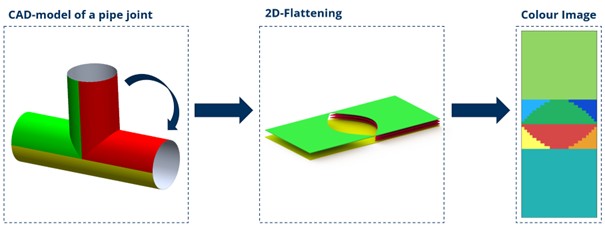
The complete manufacturing process (Figure 1) of an integrally woven pipe joint begins with the definition of the target geometry, including diameter, wall thickness, pipe lengths, and branching angle. Based on these parameters, a CAD model of the final geometry is created. The surfaces defined in the model are then flattened into the plane, taking into account the required layer architecture, in order to generate a colour-coded image from the developed surfaces.

Subsequently, an individual weave pattern is developed for each coloured area within this colour image. These partial weave patterns are combined into an overall weave pattern using weave design software (EAT DesignScope Victor). The corresponding machine control data are generated and transferred to the weaving machine. In the subsequent weaving process, the 2.5D preform is manufactured integrally according to the developed weave architecture. After completion of the weaving process, the textile preform is automatically shaped into the previously defined three-dimensional pipe joint geometry.

The final FRP component is produced by consolidating the preform using a resin transfer molding (RTM) process with a tool adapted to the outer diameter of the pipe joint. After demolding, the manufacturing process is completed by final trimming of the component.

Simulation-based design of pipe joints for media transport

The development of pipe joints for media transport requires a load-path-oriented design of the warp yarn systems. A boundary condition of the simulation was the arrangement of warp and weft yarn systems in such a way that no structural separation of the internal cavity between the main pipe and the branch occurs, thereby ensuring the flow capability of the pipe joint.

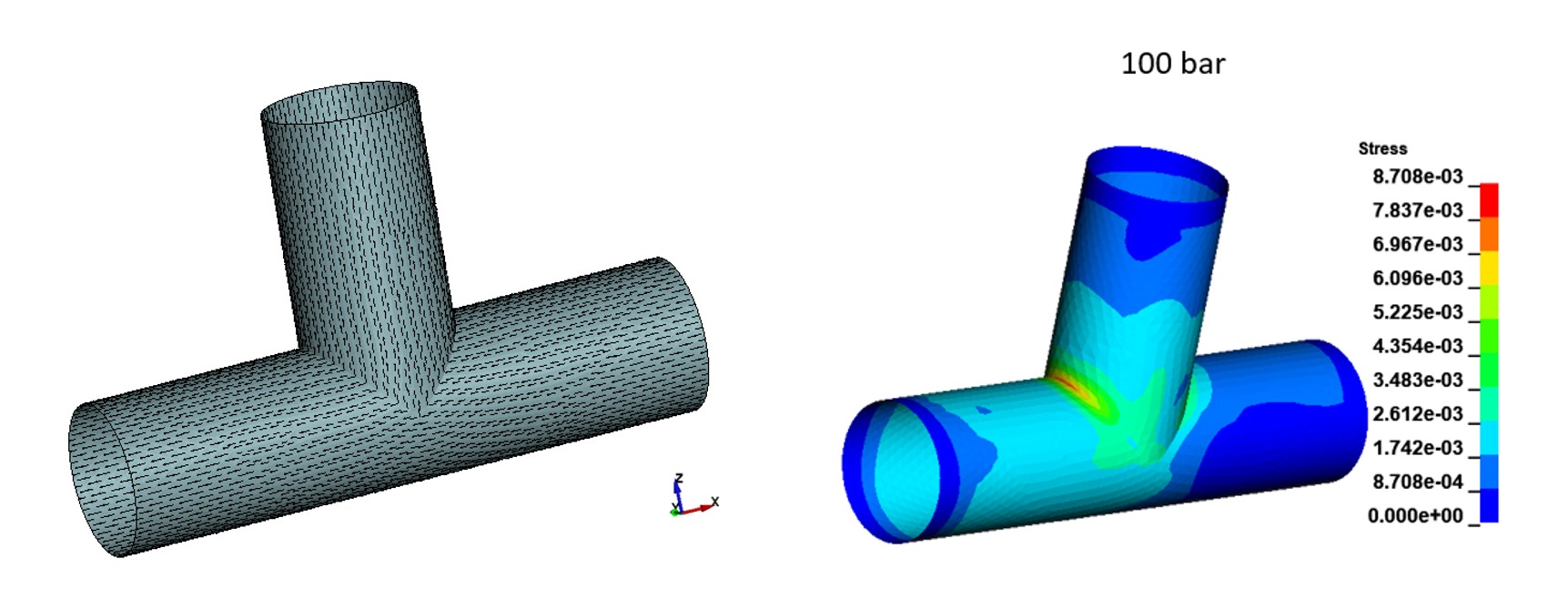
To this end, the stress distribution within the pipe joint geometry under internal pressure loading was first determined numerically. The highest stresses occur in the transition zone between the main pipe and the branch (Figure 2). This region therefore represents the governing design zone for the fiber architecture.

Based on the calculated stress distribution, a load-path-oriented architecture of the warp yarns was defined in order to fully exploit the tensile properties of the warp yarn material. This optimized warp yarn architecture forms the basis for the subsequent weave development of the pipe joints for media transport.

Development of Prototypes

The development of the weave architecture for an integrally woven pipe joint begins with a three-dimensional CAD model of the joint geometry. The simulated warp yarn systems and their trajectories are color-coded in Figure 3 (left).

Subsequently, the surfaces of the model are flattened into the plane and merged into a color-coded image. Each colored area represents a structurally induced modification within the woven architecture.

For each color-coded area, individual weave patterns are developed and subsequently combined into a unified weave pattern of an integrally woven pipe joint for media transport using the software EAT DesignScope Victor. This integration is achieved through the coordinated control of the shuttles, the fabric take-up system, and the assignment of heddles.

Development of a Warp Yarn Reversal Module

The developed weave patterns were transferred to the shuttle weaving machine “Mageba SL RTEC1200/1” and manufactured using four shuttles. In order to realize the load-path-oriented warp yarn trajectories, an additional module for processing reversing warp yarns is required. This module was designed as a CAD model, taking into account the available installation space in the take-up area of the weaving machine, and subsequently integrated into the machine. The module can be implemented cost-effectively and is adaptable and retrofittable to other weaving machines.

The functional principle for processing reversing warp yarns is based on joining two predefined warp yarns prior to the start of fabric production, thereby forming a loop. The connection point is displaced from the weaving zone toward the creel to make sure it does not become part of the woven pipe joint to be produced. This procedure is repeated until all warp yarns designated for reversal in the two fabric layers are present as loops.

To apply a warp yarn tension comparable to that of the continuously running warp yarns, the loops are integrated into the fabric take-up system by means of the module. The warp yarn tensions of both yarn types were recorded and analyzed using a warp tension measuring device. Both the controlled fixation of the warp yarn loops and their integration into the fabric take-up system represent central functions of the developed warp yarn reversal module.

Application of the module and manufacturing of the prototypes

After the formation of the warp yarn loops, the textile preform is manufactured. In the first section of the pipe joint, the loop-forming warp yarns initially remain fully floating. Following the production of the oval branching region, these warp yarns are integrated into the structure in a regular manner.

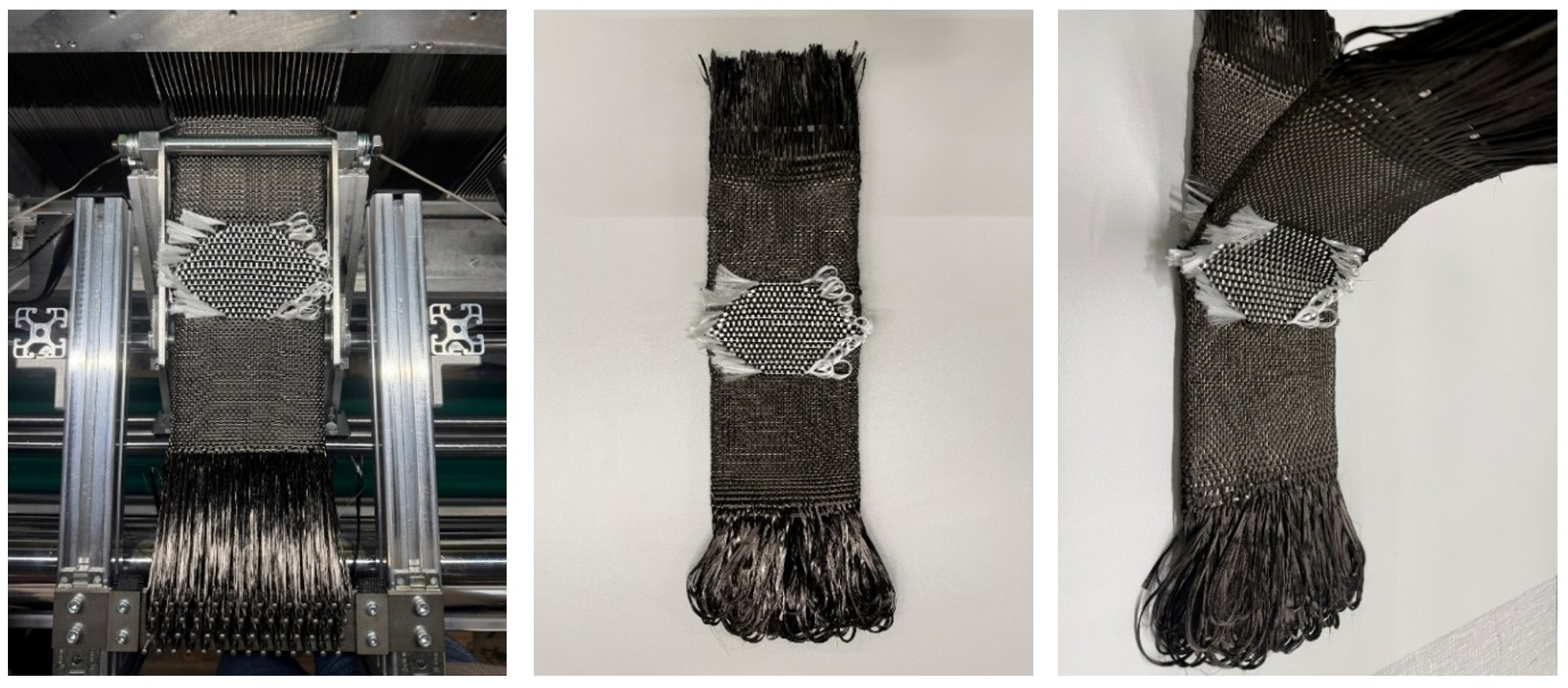
From the oval region onward, the use of four shuttles becomes necessary in order to realize the superimposed tubular fabric layers in the second section of the pipe joint. Within the oval region, one shuttle inserts a separate weft yarn that supports the formation of the oval fabric edge. The manufactured textile preform is shown in Figure 4.

For the reproducible production of this highly complex weave architecture, uniform weft insertion is essential. In particular, during the fabrication of the oval region, the weft yarns must reverse within the fabric structure rather than being inserted across the full fabric width, as is typical in conventional weft insertion. The precision of this process step significantly influences both the quality of the three-dimensional pipe joint geometry and the quality of matrix infiltration during consolidation. The textile preforms were successfully manufactured (Figure 4).

3D-shaping and consolidation of the woven prototypes

To transform the 2.5D preform into the three-dimensional structure, a dedicated 3D-shaping process developed specifically for pipe joints with flow capability is applied. A shape-defining internal core is inserted into the tubular structure, defining the target contour during the shaping process. The 3D-shaping is achieved by the targeted elimination of the excess warp yarn lengths introduced during the geometric flattening process. These excess lengths are withdrawn from the structure at the cut edge of the woven structure. A process-specific sequence to eliminate the floating warp yarns must be strictly followed in order to prevent material damage and to reproducibly achieve a precise warp yarn alignment after the shaping process. An automation concept for this shaping technology was developed.

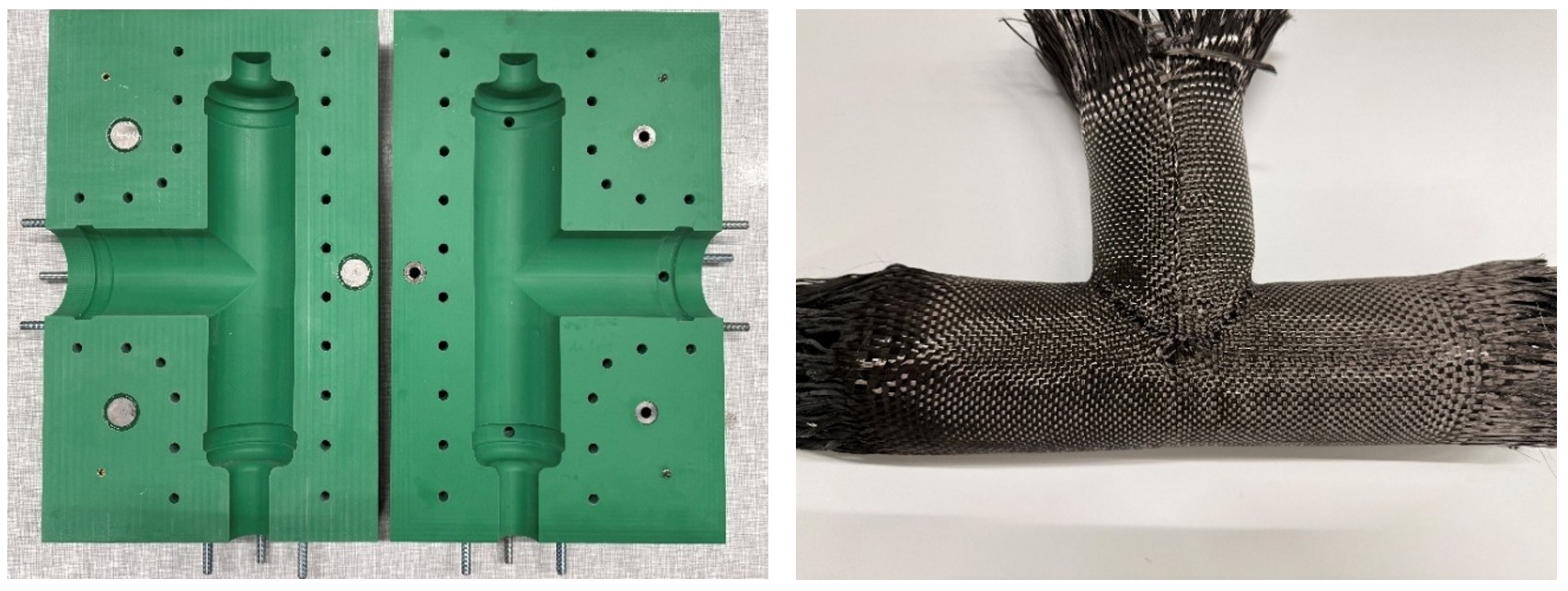
Since the warp yarn loops in the first section of the fabric remain floating up to the edge of the oval region, the corresponding warp yarn excess lengths can be withdrawn. As a result, this warp yarn system is integrated into only one half of the woven structure within the pipe joint. After the preform has been shaped into its three-dimensional configuration, consolidation is carried out. An RTM tool specifically adapted to the contour of the flow-through pipe joint was designed and manufactured (Figure 5). The result after consolidation is a fully consolidated T-joint for media transport with high surface quality and reproducible geometric accuracy.

The material overdimensioning in the branching region typical of filament-wound FRP pipe junctions was completely eliminated through the integral, fabric-based manufacturing approach employing reversing warp yarns.

Summary and Outlook

FRP pipe joints can, for the first time, be manufactured both integrally woven and flow-capable by means of an add-on module for existing shuttle weaving machines. The textile preform is produced in a single-stage weaving process. Following a 3D-shaping procedure specifically developed for the novel yarn architectures, the 2.5D preform can be consolidated into a load-bearing lightweight FRP pipe branch using established RTM processes.

The weave patterns developed, along with the underlying design methodology, can be made available to SMEs for industrial implementation. The geometry of the pipe joint (diameter, wall thickness, pipe lengths, and branching angle) can be individually adapted with minimal modification effort. In addition to T-joints, Y-shaped pipe joints can also be manufactured using the newly developed methodology and weave system, enabling application-specific realization of different topologies.

The results achieved within this project form the foundation for a scalable and load-path-optimized manufacturing technology for FRP pipe joints for media transport.


Acknowledgement

 The IGF project 01IF22946N of the research association Forschungskuratorium Textil e.V., Wallstraße 58/59, 10179 Berlin, was funded by the German Federal Ministry for Economic Affairs and Energy via the German Aerospace Center (DLR) as part of the program for the promotion of Industrial Collective Research (IGF) based on a resolution of the German Bundestag.

The authors would like to thank the aforementioned institutions for providing the financial resources. The research report and further information are available from the Institute of Textile Machinery and High Performance Material Technology at TU Dresden.


References


[1]      Matthias Hübner; Monireh Fazeli; Thomas Gereke; Chokri Cherif: Geometrical design and forming analysis of three-dimensional woven node structures. Textile Research Journal 88(2018)2, S. 213-224

[2]      Schegner, P.; Fazeli, M.; Sennewald, C.; Hoffmann, G.; Cherif, C.: Technology Development for Direct Weaving of Complex 3D Nodal Structures. Applied Composite Materials 26(2019)1, S. 423-432


AutorInnen: Anna Happel Thị Anh Mỹ Huỳnh Cornelia Sennewald Chokri Cherif

https://tu-dresden.de/ing/maschinenwesen/itm

Technische Universität Dresden

Fakultät Maschinenwesen

Institut für Textilmaschinen und Textile Hochleistungswerkstofftechnik (ITM)

01062 Dresden

More entries from TU Dresden, Institut für Textilmaschinen und Textile Hochleistungswerkstofftechnik ITM

24.10.2025

Datengetriebenes Green Shopfloor Management für nachhaltige Produktionssysteme

Vliesstoffe Nachhaltigkeit Kreislaufwirtschaft

Zusammenfassung

Die zunehmenden Anforderungen an nachhaltige Produktionssysteme erfordern eine systematische Integration ökologischer und sozialer Zielgrößen in bestehende Lean-Management-Strukturen. In diesem Beitrag wird ein datenbasiertes Konzept für ein Green Shopfloor Management im Rahmen eines Nachhaltigkeitsdatenmanagementsystems (NDMS) vorgestellt. Das Konzept erweitert das klassische Shopfloor Management um Nachhaltigkeitsziele, -kennzahlen und -entscheidungsprozesse und basiert auf vier Komponenten: einem an der Unternehmensstrategie ausgerichteten Zielsystem, einem darauf aufbauenden Kennzahlensystem auf Basis der Overall Sustainability Equipment Effectiveness (OSEE), standardisierten Shopfloor-Runden zur funktionsübergreifenden Entscheidungsfindung sowie einem digitalen Shopfloorboard zur Visualisierung von Kennzahlen und Maßnahmen. Durch die Verknüpfung von Lean-Prinzipien und Nachhaltigkeitsmanagement wird ein kontinuierlicher Verbesserungsprozess ermöglicht, der ökonomische, ökologische und soziale Dimensionen gleichermaßen berücksichtigt und datenbasiert steuert.

Bericht

Inhaltsverzeichnis

1       Einleitung und Kontext...................................................................... 3

2       Konzept des Green Shopfloor Management................................. 4

3       Datenmodell der OSEE.................................................................... 11

4       Ausblick und Weiterentwicklung................................................... 16

5       Literaturverzeichnis......................................................................... 18


Impressum

Institut für Textiltechnik (ITA) der RWTH Aachen University

52074 Aachen

Otto-Blumenthalstraße 1

Autoren: Florian Pohlmeyer, Thomas Gries

14.10.2025

DOI: 10.18154/RWTH-2025-08596


  1. Einleitung und Kontext

Die textile Wertschöpfungskette gehört zu den ressourcenintensivsten Industriesektoren weltweit. Sie ist verantwortlich für bis zu 10 % der globalen CO₂-Emissionen, einen Wasserverbrauch von rund 93 Milliarden m³ pro Jahr und erhebliche Mengen textiler Reststoffe. Innerhalb dieses Sektors nimmt die Vliesstoffindustrie eine besondere Rolle ein: Sie ist technologisch hoch entwickelt, vielseitig anwendbar und sowohl in kurzlebigen Konsumgütern als auch in langlebigen technischen Anwendungen vertreten. Gleichzeitig steht sie unter erheblichem Transformationsdruck – geprägt durch volatile Rohstoffmärkte, niedrige Margen, hohe Qualitätsanforderungen und steigende regulatorische Verpflichtungen im Bereich Nachhaltigkeit. Europäische und nationale Strategien wie der Green Deal, der Aktionsplan für die Kreislaufwirtschaft, die EU-Textilstrategie und die Corporate Sustainability Reporting Directive (CSRD) fordern eine tiefgreifende Neuausrichtung industrieller Produktionssysteme. Unternehmen müssen ökologische, ökonomische und soziale Zielgrößen in ihre Entscheidungsprozesse integrieren, Nachhaltigkeitskennzahlen systematisch erfassen und über den gesamten Produktlebenszyklus hinweg kommunizieren. Für viele kleine und mittlere Unternehmen stellt dies eine erhebliche Herausforderung dar: Es fehlen häufig die personellen, finanziellen und digitalen Ressourcen, um Nachhaltigkeitsziele messbar zu machen und operativ zu steuern.

Ein wesentlicher Hebel zur Bewältigung dieser Herausforderungen ist die Verfügbarkeit und Nutzung produktionsnaher Daten. Digitale Technologien ermöglichen es, Informationen zu Energie- und Ressourceneffizienz, Qualität und Prozessleistung in Echtzeit zu erfassen und als Entscheidungsgrundlage bereitzustellen. Entscheidend ist dabei, dass Nachhaltigkeit nicht als zusätzliches Berichtsthema, sondern als integraler Bestandteil des täglichen Shopfloor-Managements verstanden wird. Hier setzt das Konzept des Green Shopfloor Management an: Es verbindet die Prinzipien des Lean Managements – also die Vermeidung von Verschwendung und die kontinuierliche Verbesserung – mit den Zielen nachhaltiger Entwicklung. Im Green Shopfloor Management werden operative Prozesse durch ein datengetriebenes Kennzahlensystem transparent gemacht, das ökologische und soziale Dimensionen in bestehende Leistungskennzahlen integriert. Auf dieser Grundlage lassen sich Abweichungen erkennen, Maßnahmen im Sinne des PDCA-Zyklus ableiten und die Zielerreichung messbar verfolgen. Das Konzept zielt darauf ab, Nachhaltigkeit dort zu verankern, wo sie entsteht – am Ort der Wertschöpfung. [Bar24]

Die Verknüpfung von Nachhaltigkeitsmanagement, Lean-Prinzipien und Datenverfügbarkeit eröffnet neue Potenziale für die industrielle Transformation: Prozesse können energie- und ressourceneffizienter gestaltet, Zielkonflikte zwischen Wirtschaftlichkeit und Umweltverträglichkeit besser adressiert und Verbesserungsmaßnahmen datenbasiert priorisiert werden. Gleichzeitig fördert die Integration von Nachhaltigkeitskennzahlen in das Shopfloor Management eine stärkere Beteiligung der Mitarbeitenden und schafft Transparenz über die ökologischen und sozialen Auswirkungen des eigenen Handelns. Vor diesem Hintergrund verfolgt das Green Shopfloor Management das Ziel, Nachhaltigkeit in den operativen Alltag produzierender Unternehmen zu integrieren und durch datenbasierte Entscheidungsunterstützung einen kontinuierlichen Verbesserungsprozess zu etablieren. Es bildet damit einen zentralen Baustein auf dem Weg zu einer datengetriebenen, ressourceneffizienten und sozial verantwortlichen Produktion – und leistet einen konkreten Beitrag zur Umsetzung der europäischen Nachhaltigkeitsziele in der Industrie.

  1. Konzept des Green Shopfloor Management

Das Lean Management steht für das Streben nach verschwendungsfreien und ressourceneffizienten Prozessen in der Produktion und der perfekten Organisation [KR22]. Die Mitarbeitenden eines Produktionssystems werden bei der Entscheidungsfindung durch aufbereitete Informationen und Kennzahlen (engl.: Key Performance Indicator (KPI)) unterstützt. [KR22] Die Kommunikation und die Visualisierung von Kennzahlen sind zentrale Elemente des Shopfloor Management im Lean Management, um die KPIs an den Ort der Wertschöpfung zu bringen und den Wertschöpfungsprozess in den Mittelpunkt zu stellen. Nachhaltigkeit und Lean Management sind eng verknüpft, da bei beiden Themen die Vermeidung von Verschwendung im Fokus steht. [Ber20; Bar24]

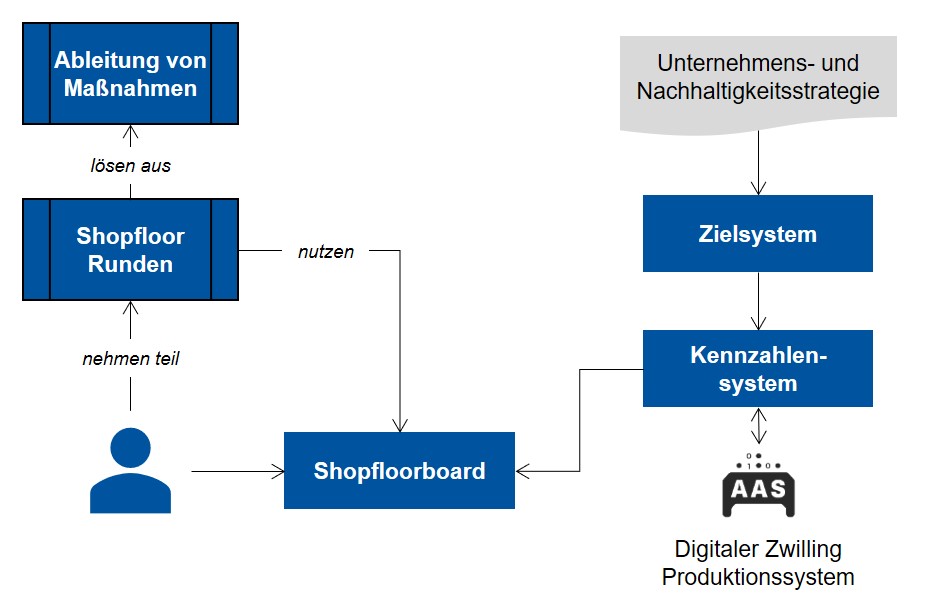
Die elementaren Bestandteile des hier betrachteten Green Shopfloor Management sind das Zielsystem, das Kennzahlensystem, die Shopfloor-Runden und die Definition von Maßnahmen (siehe Abb. 2.1).


Abb. 2.1: Aufbau des Green Shopfloor Management

Zielsystem

Das Zielsystem eines Produktionssystems wird an der langfristigen Vision des Unternehmens und der Unternehmens- und Nachhaltigkeitsstrategie ausgerichtet. Das Zielsystem bildet die Grundlage für das Kennzahlensystem und stellt sicher, dass die entscheidungsbestimmenden Kennzahlen im Produktionssystem auf die Unternehmensziele ausgerichtet sind.

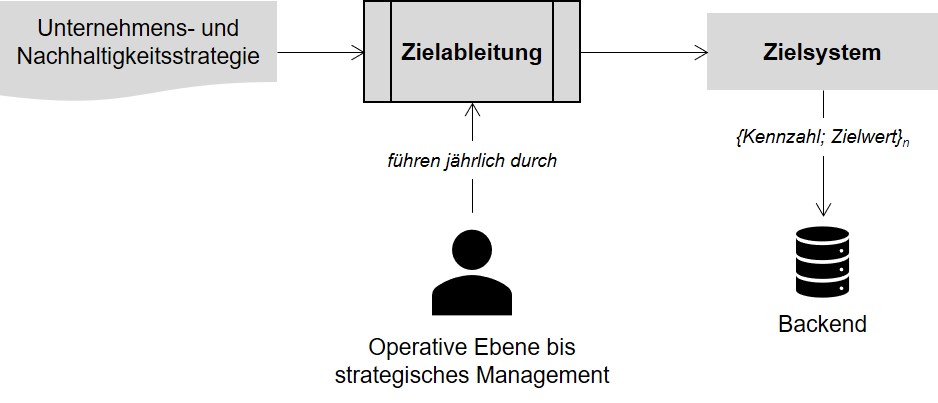
Das Zielsystem ist das Ergebnis eines Zielableitungsprozesses, der einen kaskadierenden Prozess von der Unternehmensvision bis zu den Zielen der operativen Ebene beschreibt (siehe Abb. 2.2) [Ber20]. Der Grad der Zielerreichung kann durch das Kennzahlensystem bestimmt werden. Der Fokus liegt auf den quantifizierbaren Zielen. Beim Aufbau des Zielsystems sind die Grundsätze der VDI-Richtlinien 2870 (Blätter 1-2), 2871 (Blätter 1-2), 2872 (Blätter 1-2) zu beachten [VDI12; VDI13; VDI21; VDI17; VDI19; VDI22].


Abb. 2.2: Ableitung des Zielsystems im NDMS

In dieser Arbeit werden die klassischen Zieldimensionen Qualität, Kosten und Zeit um die Dimension Nachhaltigkeit erweitert. Der Ausgangspunkt für die Integration der Dimension Nachhaltigkeit ist die Nachhaltigkeitsstrategie eines Unternehmens. Aus der Unternehmens- und Nachhaltigkeitsstrategie werden in einem manuellen Zielableitungsprozess messbare, spezifische Ziele abgeleitet. Die Ziele sind auf den Funktionsbereich Produktionssystem bezogen und können zur besseren Vergleichbarkeit auch produktspezifisch sein. Das Ergebnis des Zielableitungsprozesses sind n Jahresziele. Im Prozess ist zu beachten, dass die Anzahl der Ziele überschaubar ist und die Ziele realistisch sind [VDI13]. Die n Ziele werden in einer Datenbank als Tupel aus Kennzahl und Zielwert abgespeichert. Ein Beispiel für das Ziel zur Senkung des Energieverbrauches in einem Produktionssystem ist der Zielwert {Energieverbrauch [kWh/kg]; 1,1}. Der konkrete Aufbau des erforderlichen Datenmodells erfolgt weiter unten in Kapitel 3. Herausforderungen liegen in möglichen Zielkonflikten und einer mangelnden Fokussierung bei zu vielen Zielen [VDI13]. Diesen Herausforderungen wird in der Datenmodellierung begegnet (siehe unten).

Kennzahlensystem

Das Kennzahlensystem dient der Messung der Leistung und Zielerreichung und steht in einem direkten Zusammenhang zum Zielsystem. Die Kennzahlen entsprechen den quantifizierbaren Zielen. [Bar24; Ber20; VDI12] Mit den Leistungskennzahlen muss eine ganzheitliche Bewertung und Überwachung der drei Nachhaltigkeitsdimensionen auf Abruf möglich sein. Außerdem sollte das Kennzahlensystem möglichst in bestehende Prozesse und Systeme integriert werden und auf prozessnahen Daten beruhen. Die Kennzahlen müssen auf einheitlichen Kalkulationsverfahren beruhen und einen Bezug zur Unternehmensstrategie aufweisen.

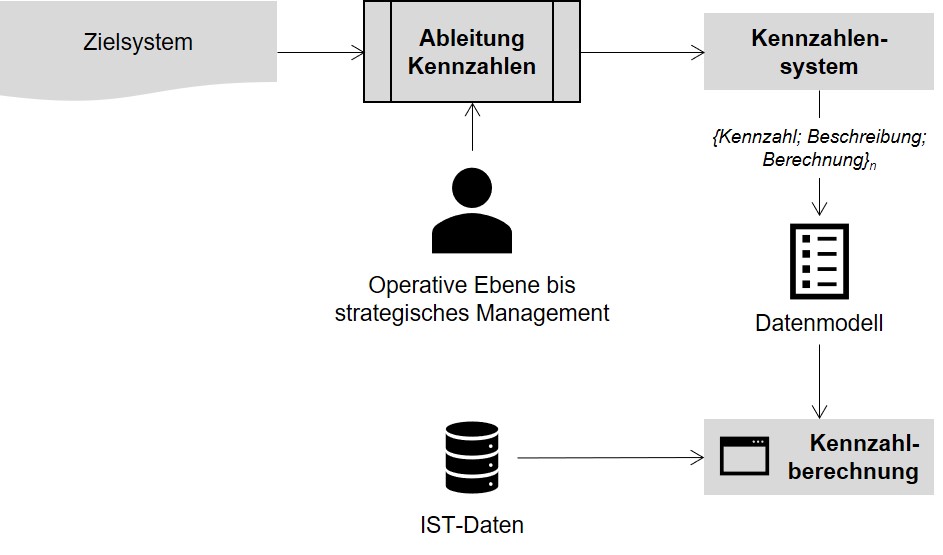
Das Kennzahlensystem wird aus dem Zielsystem abgeleitet und entspricht einem Datenmodell aus Kennzahlen, deren Beschreibung und deren Berechnungsvorschriften (siehe Abb. 2.3).


Abb. 2.3: Ableitung von Kennzahlen im NDMS

Die European Sustainability Reporting Standards (ESRS) sind das von der EU vorgegebene Rahmenwerk für die Nachhaltigkeitsberichterstattung von Unternehmen. Das Kennzahlensystem sollte sich an diesem Rechtsstandard orientieren, um Vergleichbarkeit zu ermöglichen. Auch beim Kennzahlensystem werden die Vorgaben der VDI-Richtlinien 2870-2872 beachtet. Auf dieser Grundlage sind die folgenden Anforderungen an die Kennzahlen zu beachten [Ber22; Hel21]:

AK.1:   Kennzahlen müssen SMART (Spezifisch, Messbar, Attraktiv, Realistisch, Terminiert) formuliert sein.

AK.2:   Die Anzahl der Kennzahlen sollte auf 3-5 pro Ebene begrenzt sein.

AK.3:   Die Kennzahlen sollten durch die Mitarbeitenden beeinflussbar sein.

AK.4:   Die Kennzahlen müssen repräsentativ, aussagekräftig, reversibel und zielorientiert sein.

AK.5:   Die Kennzahlen müssen wirtschaftlich ermittelbar sein.

Eine technische Lösung, die die Anforderungen erfüllt ist das Kennzahlensystem der Overall Sustainability Equipment Effectiveness (OSEE) [MA24]. Die Overall Equipment Effectiveness (OEE) ist ein weitverbreitetes Kennzahlensystem, in das die OSEE Nachhaltigkeitsdimensionen integriert. Die Stärke der Lösung liegt im operativen Fokus des Kennzahlensystems und Nachhaltigkeitsdimensionen auf taktischer oder strategischer Ebene werden bewusst ausgeklammert. Die Kennzahlen sind also durch die Mitarbeitenden des Produktionssystems beeinflussbar. Das Kennzahlensystem umfasst 3 Hauptkennzahlen (Ökonomische, Ökologische und Soziale Nachhaltigkeit), die eine beliebige Anzahl von Indikatoren aggregieren.

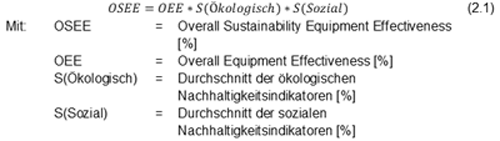
Die Berechnung der OSEE erfolgt gemäß Gleichung 2.1 als Produkt aus der Ökonomischen Dimension (OEE), der Ökologischen Dimension und der Sozialen Dimension.

Gleichung 2.1

Gleichung 2.1

Die Berechnung der OEE erfolgt gemäß Gleichung 2.2 und ist das Produkt aus der Anlagenverfügbarkeit, dem Leistungsfaktor und der Qualitätsrate.

Gleichung 2.2

Gleichung 2.2


Neben dem Datenmodell des Kennzahlensystems ist ein Datenverarbeitungsdienst zur Berechnung der Kennzahlen bzw. zur Datenverarbeitung erforderlich. Der Dienst implementiert die Berechnungsvorschriften der Kennzahlen und greift auf verschiedene Datenquellen zu. Die Daten werden aus den Datenquellen importiert, harmonisiert und für die Kennzahlberechnung vorbereitet. Abschließend erfolgt die Berechnung der jeweiligen Kennzahlen. Die Kennzahlen werden wiederum in einer für Zeitreihen geeigneten Datenbank gespeichert. Die berechneten Kennzahlen liegen in Tupeln des Formates {Bezeichnung, Wert} vor. Das Konzept der OSEE sieht vor, dass die Kennzahlen einer Relation des IST-Zustandes im Vergleich zum Zielzustand in % entsprechen.

Die wesentliche Herausforderung im Bereich des Kennzahlensystems liegt in der Anzahl der Kennzahlen, die durch die Komplexität der Nachhaltigkeitsdimensionen zu hoch sein kann. Dieser Herausforderung wird hier durch die Aggregation der Kennzahlen durch die OSEE begegnet.

Shopfloor-Runden

Die Shopfloor-Runden sind der Kern des Shopfloor-Managements und dienen der Führung am Ort der Wertschöpfung und einem schnellen und zielgerichteten Informationsfluss. Unter den Shopfloor-Runden sind regelmäßige standardisierte und kurzzyklische Besprechungen mit funktionsübergreifenden Teilnehmern zu verstehen. [Ber20] Die Basis für die Besprechungen bildet das Kennzahlensystem. In den Besprechungen werden die Kennzahlen besprochen und bei Abweichungen Maßnahmen beschlossen. Die Leistungskennzahlen müssen in die Entscheidungsprozesse der jeweiligen Entscheidungsträger integriert werden und dabei abteilungsübergreifende Zielkonflikte berücksichtigen.

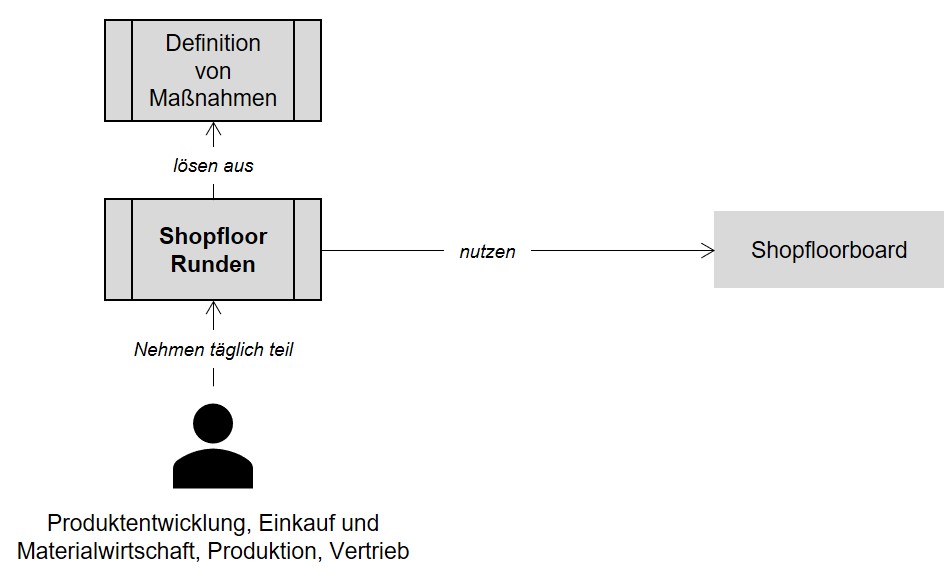
In den Shopfloor-Runden sollten in diesem Fall funktionsübergreifend mindestens die Produktentwicklung, der Einkauf und die Materialwirtschaft, die Produktion und der Vertrieb teilnehmen (siehe Abb. 2.4). In den Shopfloor-Runden finden zur Kennzahlvisualisierung Shopfloorboards Anwendung, die nachfolgend für den Anwendungsfall ausgelegt werden.


Abb. 2.4: Umfang der Shopfloor-Runden

Der Umfang und die Durchführung der Shopfloor-Runden weicht durch die Integration der Nachhaltigkeitskennzahlen nicht von den üblichen Standards ab. Das Vorgehen nach VDI-Richtlinie 2871-2 bedarf keiner weiteren Anpassung [VDI21]. Außerdem sind die Shopfloor-Runden ein Prozess, der keiner weiteren softwaretechnischen Auslegung bedarf.

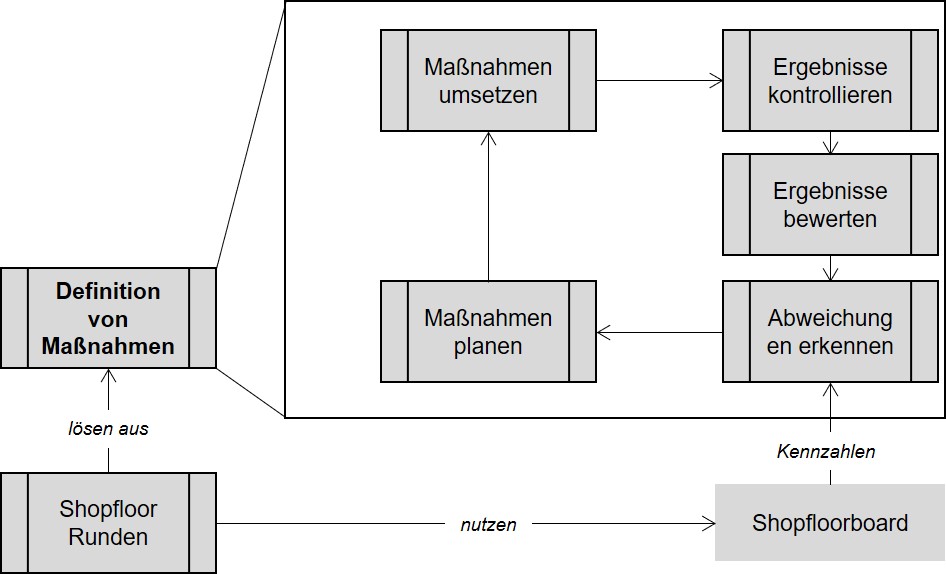
Definition von Maßnahmen

Ein Teil der Shopfloor-Runden ist die Definition von Maßnahmen bei Problemen oder Abweichungen. Die Definition, Umsetzung und Überwachung der Maßnahmen dienen der schnellen Problemlösung und Zielerreichung. Dieser Prozess dient der Umsetzung eines nachhaltigen und kontinuierlichen Verbesserungsprozesses unter Berücksichtigung der Nachhaltigkeitsdimensionen. Das System trägt zu einem dauerhaften Verbesserungsprogramm bei.

Die Definition von Maßnahmen setzt eine Abweichungserkennung voraus und orientiert sich am PDCA-Zyklus (siehe Abb. 2.5). Die Abweichungserkennung basiert auf den Kennzahlen und Zielwerten. Weichen die Kennzahlen von den jeweiligen Zielwerten ab, werden im PDCA-Zyklus Maßnahmen abgeleitet. Im Sinne des Nachhaltigkeitsmanagements ist keine weitere Anpassung des Prozesses erforderlich, weil die Nachhaltigkeitsdimensionen über das Kennzahlensystem Berücksichtigung finden. Die Umsetzung orientiert sich an den Methoden PDCA und Shopfloor-Management der VDI-Richtlinien VDI 2870 Blatt 2 und VDI-MT 2871 Blatt 2. [VDI13; VDI21]


Abb. 2.5: Definition, Umsetzung und Bewertung von Verbesserungsmaßnahmen

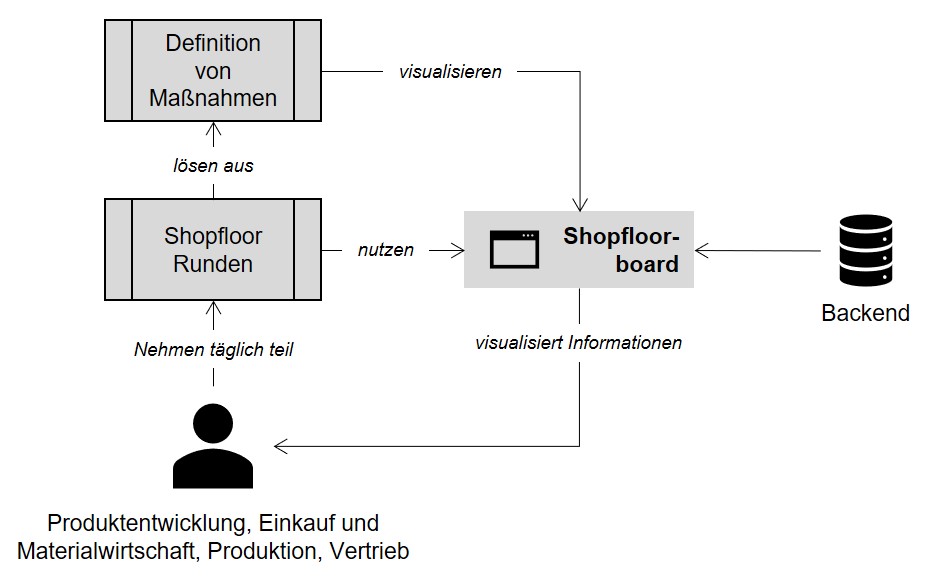
Shopfloorboard

Das Shopfloorboard dient der Visualisierung und Transparenz des aktuellen Prozessstatus am Ort der Wertschöpfung und ist das zentrale Kommunikationsinstrument in den Shopfloor-Runden. Mit dem Board soll es möglich sein, den Status eines Produktionssystems auf einen Blick zu erfassen. [VDI19; VDI22; VDI21; CEL19]

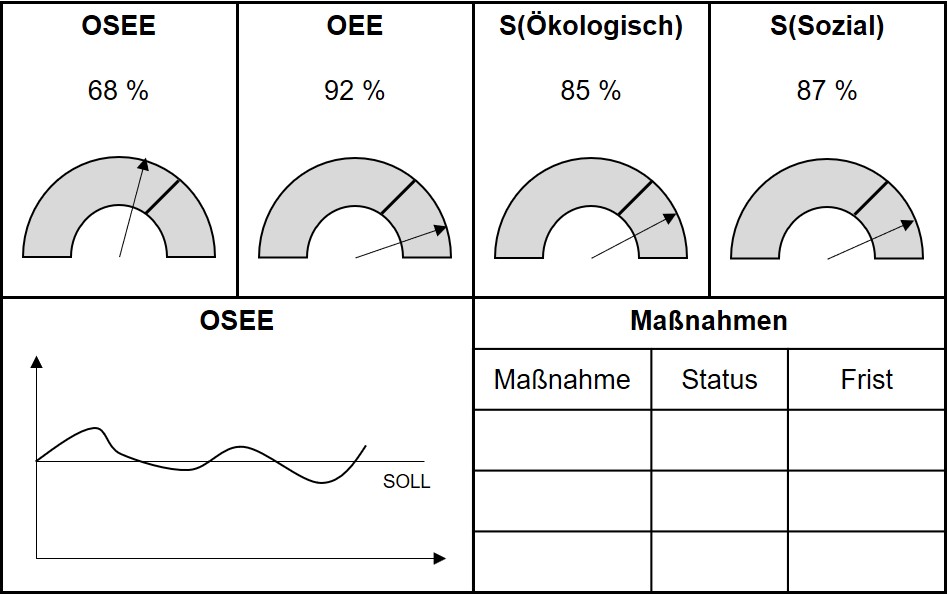
Das Shopfloorboard muss in dieser Arbeit auf eine Überwachung der drei Nachhaltigkeitsdimensionen im Produktionssystem angepasst werden und stützt sich dabei auf das Kennzahlensystem. Das Board ist das Kommunikationsmittel, um die Leistungskennzahlen in die Entscheidungsprozesse einfließen zu lassen. Das Shopfloorboard muss die Nachhaltigkeitsdaten verständlich, übersichtlich und eindeutig auslegbar als Entscheidungsgrundlage bereitstellen. Dazu kommen aussagekräftige Dashboards zum Einsatz, die eine gleichzeitige Überwachung mehrerer Zielgrößen ermöglichen. Die Visualisierung muss durch eine schnell interpretierbare Form die wahrgenommene Komplexität reduzieren.

Das Shopfloorboard visualisiert die Kennzahlen und die Maßnahmen. Das Board wird in den täglichen Shopfloor-Runden zur Visualisierung von Informationen genutzt. Die Übersicht ist in Abb. 2.6 dargestellt.


Abb. 2.6: Übersicht über das Shopfloorboard

In der VDI-Richtlinie VDI-MT 2871 Blatt 2 sind Vorgaben für die Gestaltung von Shopfloorboards enthalten [VDI21]. Die Boards müssen den aktuellen Status eines Produktionssystems zeigen und sollten nicht überentwickelt sein. Wichtig ist außerdem, dass die Boards unternehmensindividuell von den Nutzenden selbst entwickelt werden sollten. Die VDI-Richtlinie VDI 2870 Blatt 1 zeigt ein Beispiel [VDI12].

Für das Shopfloorboard ist ein Datenverarbeitungsdienst zur Visualisierung von Daten erforderlich. Der Dienst implementiert grafische Benutzeroberflächen und greift auf verschiedene Datenquellen zu. Die Daten werden aus den Datenquellen importiert und in verschiedenen Diagrammtypen dargestellt. Die spezifische Auslegung des Dienstes wird hier nicht weiter detailliert, weil unternehmensindividuelle Anforderungen berücksichtigt werden sollten. Allerdings ist in Abb. 2.7 ein beispielhafter Aufbau eines Shopfloorboardes dargestellt.


Abb. 2.7: Visualisierung von Kennzahlen und Maßnahmen im Shopfloorboard in Anlehnung an [VDI12]

  1. Datenmodell der OSEE

Das Datenmodell für das Kennzahlensystem dient der einheitlichen Interpretation der Daten und ermöglicht semantische Interoperabilität. Im Datenmodell für das Kennzahlensystem müssen die drei Nachhaltigkeitsdimensionen ganzheitlich abgebildet sein. Außerdem gelten die bereits im Kennzahlensystem festgelegten Spezifikationen. Die Grundlage des Datenmodells bilden das Kennzahlensystem OSEE und die in den Nachhaltigkeitsstrategien der Vliesstoffunternehmen verankerten Nachhaltigkeitsziele.

Das Datenmodell basiert auf der Grundstruktur der Overall Sustainable Equipment Effectiveness (OSEE), welche die Dimensionen Ökonomie, Ökologie und Soziales systematisch integriert. Zentrales Element ist die Kennzahl OSEE, die sich aus der OEE (Gesamtanlageneffektivität) sowie aggregierten ökologischen S(Ökologisch) und sozialen S(Sozial) Indikatoren zusammensetzt (siehe Abb. 3.1). Die inhaltliche Ausgestaltung dieser Indikatoren erfolgt auf Basis einer systematischen Analyse der Nachhaltigkeitsstrategien von Unternehmen der Vliesstoffindustrie. Zur Sicherstellung von Interoperabilität und Vergleichbarkeit werden im Datenmodell Daten und Metadaten modelliert.


Abb. 3.1: Datenmodell für das Kennzahlensystem

Für das Erstellen von Datenmodellen sollten existierende Standards genutzt werden. Das Konzept der OSEE ist in [MA24] definiert. Ein einheitliches Datenmodell der OSEE oder der OEE für die Vliesstoffindustrie ist bislang nicht bekannt. Allerdings sind verschiedene Standards für die Nachhaltigkeitsfaktoren und die OEE für das Vokabular und die Ontologie des Datenmodells zu berücksichtigen. Auf bestehende Normen und Standards für die Nachhaltigkeitsfaktoren wird im weiteren Verlauf bei der Definition einzelner Kennzahlen eingegangen. Für die OEE existieren bestehende Modelle, die in dieser Arbeit nicht weiterentwickelt werden. Die ISO 22400-Reihe bietet einen Rahmen, um KPIs im Manufacturing Operations Management (MOM) standardisiert zu definieren und zu bewerten. ISO 22400-1 beschreibt die grundlegenden KPI-Konzepte [ISO14], während ISO 22400-2 konkrete Kennzahlenformeln (z. B. OEE, Verfügbarkeit, Qualitätsraten) sowie deren zugehörige Zeit- und Datenmodelle definiert [ISO14]. Der Standard ist auch als XML-Implementierung verfügbar [Dol16]. Eine Ergänzung zur ISO 22400 stellt die VDI 3423 dar, die zentrale Zeitarten (z. B. Nutzungszeit, Ausfallzeiten) und Berechnungsgrundlagen für die technische Verfügbarkeit bereitstellt [VDI11]. Diese bilden die zeitlogische Basis für OEE-Kennzahlen und lassen sich konsistent mit den Strukturvorgaben der ISO 22400 kombinieren. Die Normenreihe IEC 62264 (ISA-95) bietet eine konsistente Grundlage für die Modellierung der OEE-Komponente innerhalb des OSEE-Datenmodells [DIN14; DIN14; DIN17]. Sie definiert hierfür eine einheitliche Systemhierarchie, standardisierte Objekt- und Attributstrukturen sowie zugehörige Aktivitätsmodelle für Planung, Ausführung und Analyse. Dadurch lassen sich OEE-relevante Daten verorten, strukturiert erfassen und interoperabel in bestehende Produktions- und IT-Systeme integrieren. Für die technische Implementierung bietet die Verwaltungsschale (AAS) nach IEC 63278 eine standardisierte Struktur zur semantischen Beschreibung von Assets (hier das Produktionssystem) und Kennzahlen [IEC23]. Die konkrete Nutzung der AAS zur Modellierung der OSEE-Kennzahlen wird im folgenden Abschnitt zu den Entwurfsentscheidungen erläutert.


Die technische Modellierung des Kennzahlensystems erfolgt in vier Schritten:

  1. Ableitung der Faktoren von S(Ökologisch) und S(Sozial) auf der Basis von Nachhaltigkeitsstrategien aus der Vliesstoffindustrie.
  2. Semantisch eindeutige Beschreibung der Faktoren durch eine Zuordnung zu existierenden Standards und Normen.
  3. Zusammenführung der Faktoren und der OEE im erweiterten OSEE-Modell.
  4. Modellierung des Kennzahlensystems in der Verwaltungsschale.

Die Grundlage für die Ableitung der einzelnen Faktoren bildet eine systematische Analyse von Nachhaltigkeitsberichten und -strategien von 23 Unternehmen, die Vliesstoffe produzieren, und die Nachhaltigkeitsstrategie der Edana. Die Grundgesamtheit sind die 73 Mitgliedsunternehmen der Edana in der Kategorie „Nonwoven“ (Stand: Januar 2025). Nicht alle dieser Unternehmen veröffentlichen Informationen über Nachhaltigkeitsstrategien und -ziele. Zur Erhöhung der Vergleichbarkeit werden jeweils spezifische Werte verwendet. Sämtliche Werte werden auf die produzierte Menge von Vliesstoff in m² bezogen. Die 20 Indikatoren für den Faktor S(Ökologisch) sind in Tab. 3.1 aufgelistet und jeweils Standards und Normen zur semantischen Beschreibung zugeordnet.

Tab. 3.1: Indikatoren für den Faktor S(Ökologisch)


Die 3 Faktoren für den Faktor S(Sozial) sind in Tab. 3.2 aufgelistet und jeweils Standards und Normen zur semantischen Beschreibung zugeordnet.

Tab. 3.2: Indikatoren für den Faktor S(Sozial)


Für eine Vergleichbarkeit der Faktoren müssen sie nachfolgend normiert werden. Im Kontext der OSEE werden die Faktoren auf einen Wertebereich von 0 bis 100 % normiert, wobei 100 % gleichbedeutend mit einer vollständigen Zielerreichung ist. Für sämtliche Indikatoren sind Zielwerte zu definieren (siehe Auslegung des Zielsystems). Für die Berechnung der normierten Faktoren gilt dann:

Berechnung 3.1

Die resultierenden normierten Faktoren werden in ein Datenmodell integriert, das auf der bestehenden OEE-Struktur basiert. Die OEE-Komponente (Verfügbarkeit, Leistung, Qualität) wird nicht neu entwickelt, sondern auf Basis etablierter Standards (z. B. ISO 22400, VDI 3423) übernommen. Die S(Ökologisch)- und S(Sozial)-Indikatoren werden ergänzend als gewichtete Teilkennzahlen eingebunden und in einem gemeinsamen semantischen Modell mit den OEE-Daten verknüpft.

Zur semantischen und strukturellen Abbildung der Kennzahlen wird die Verwaltungsschale (Asset Administration Shell, AAS) gemäß IEC 63278 genutzt. Die relevanten KPI-Daten werden in einem eigenen Teilmodell „OSEE“ modelliert, da ein entsprechendes Teilmodell noch nicht als Template veröffentlicht ist. Bei der Modellierung von Teilmodellen der Verwaltungsschale sind die Grundsätze aus der Spezifikation der Verwaltungsschale zu beachten [Ind24; BDE+21]. Der Grundsatz der Modularisierung besagt, dass komplexe Informationen nicht monolithisch, sondern in fachlich und funktional abgegrenzten Modulen strukturiert werden sollen. Dementsprechend wird das Datenmodell der OSEE in SubmodelElementCollections (SEC) strukturiert (siehe Abb. 3.2).


Abb. 3.2: Modularisierung im Teilmodell für das Kennzahlensystem OSEE

Die SECs der Faktoren enthalten jeweils 3 Properties:

  • actualValue: IST-Wert des Indikators
  • targetValue: Zielwert des Indikators
  • normalizedValue: Normierter Faktor

Die Beschreibungen der Faktoren sind über das Attribut description integriert, um Zweck und Inhalt der Faktoren für menschliche Nutzer zu erläutern. Die Zuordnung der Standards und Normen als semantische Beschreibungen der Faktoren erfolgt über das Attribut semanticId der Teilmodellelemente. Die semanticId ist ein Verweis auf den inhaltlichen Bedeutungsgehalt eines Elements [Ind24]. Die semanticIds sind vom Typ ExternalReference. Die GLOBAL_REFERENCEs verweisen über einen Link auf die zugrundeliegenden Normen oder Standards. Zusätzlich werden zwei fachliche Qualifier für die Teilmodellelemente eingesetzt, um die Kennzahlen zu spezifizieren. Die physikalische Einheit der Elemente wird durch Qualifier der Art VALUE_QUALIFIER und dem typeunit“ eindeutig zugeordnet. Die Optimierungsrichtung einer Kennzahl wird durch Qualifier der Art CONCEPT_QUALIFIER und dem typeoptimizationDirection“ eindeutig zugeordnet. Damit sind sowohl die Einheiten als auch die Optimierungsrichtung für Applikationen maschinenlesbar.


Abb. 3.3: Ansicht des OSEE-Teilmodells im AASX Package Explorer

  1. Ausblick und Weiterentwicklung

Die in dieser Arbeit vorgestellte Konzeption eines datengetriebenen Green Shopfloor Managements stellt einen ersten Ansatz dar, um Nachhaltigkeitsziele systematisch in die operative Produktionssteuerung zu integrieren. Durch die Verbindung der Lean-Prinzipien mit einem Nachhaltigkeitsdatenmanagementsystem (NDMS) konnte gezeigt werden, dass ökologische und soziale Leistungsdimensionen mess- und steuerbar in bestehende Prozesse eingebettet werden können. Dennoch ergeben sich aus der praktischen Umsetzung und den konzeptionellen Grenzen des Ansatzes mehrere Entwicklungsfelder.

(1) Erweiterung des Datenmodells und Integration weiterer Datenquellen.

Das entwickelte Datenmodell der Overall Sustainability Equipment Effectiveness (OSEE) bildet den gegenwärtigen Stand der Integration von ökonomischen, ökologischen und sozialen Indikatoren ab. Für eine ganzheitliche Betrachtung zukünftiger Produktionssysteme ist eine Erweiterung um zusätzliche Dimensionen, wie z. B. Lieferkettentransparenz, Materialkreisläufe und Produktlebenszyklen, erforderlich. Eine Verknüpfung mit externen Datenquellen – etwa über den Digitalen Produktpass (DPP) – ermöglicht eine Bewertung jenseits der Fabrikgrenzen und unterstützt die Systemtransparenz entlang der gesamten Wertschöpfungskette.

(2) Automatisierung und Echtzeitfähigkeit der Datenerfassung.

Aktuell beruhen viele Nachhaltigkeitskennzahlen noch auf periodischen Datenerhebungen. Zukünftige Entwicklungen sollten auf eine stärkere Automatisierung und Echtzeitintegration abzielen, um Abweichungen unmittelbar zu erkennen und dynamische Steuerungsmechanismen zu ermöglichen. Hierfür sind Schnittstellen zu Produktions- und Energiemanagementsystemen (z. B. MES, EMS) zu standardisieren und um semantische Datenmodelle zu erweitern.

(3) Integration von Entscheidungsunterstützung und KI-basierten Analysen.

Eine Weiterentwicklung des Green Shopfloor Management liegt in der Nutzung datenanalytischer Verfahren zur Entscheidungsunterstützung. Methoden der künstlichen Intelligenz können Muster in großen Datenmengen erkennen und Optimierungspotenziale in Bezug auf Energieeffizienz, Ressourcennutzung und soziale Faktoren automatisiert identifizieren. Die OSEE kann dabei als Zielgröße für lernende Systeme dienen.

(4) Sozio-technische Implementierung und Organisationsentwicklung.

Die technische Umsetzung muss durch ein angepasstes Change Management flankiert werden. Zukünftige Arbeiten sollten die sozialen Aspekte der Systemeinführung stärker berücksichtigen – insbesondere Schulung, Motivation und Akzeptanz der Mitarbeitenden. Nachhaltigkeit am Shopfloor kann nur gelingen, wenn technologische Innovationen mit einer partizipativen Organisationskultur verbunden werden.

(5) Validierung und Standardisierung.

Eine umfassende Validierung des Konzepts in weiteren industriellen Umgebungen, insbesondere außerhalb der Vliesstoffindustrie, ist erforderlich, um die Übertragbarkeit zu prüfen. Parallel dazu sollte die formale Standardisierung der OSEE und ihrer semantischen Beschreibung in der Verwaltungsschale (AAS) vorangetrieben werden, um eine breite industrielle Anwendung zu ermöglichen.

(6) Verknüpfung mit europäischen Datenräumen.

Langfristig bietet die Anbindung an entstehende industrielle Datenräume wie Catena-X oder Manufacturing-X die Möglichkeit, Nachhaltigkeitsdaten sicher und souverän zwischen Unternehmen auszutauschen. Damit kann das Green Shopfloor Management zu einem operativen Knotenpunkt für Nachhaltigkeitsdaten im Produktionsnetzwerk werden.


  1. Literaturverzeichnis

[Bar24] Bardy, S.:
Shopfloor Management für die ressourceneffiziente Produktion. Darmstadt: Technische Universität Darmstadt, Dissertation,

[Ber20] Bertagnolli, F.:
Lean Management. Wiesbaden: Springer Fachmedien Wiesbaden, 2020

[Ber22] Bertagnolli, F.:
Lean Management. Wiesbaden: Springer Fachmedien Wiesbaden, 2022

[CEL19] Conrad, R. W.; Eisele, O.; Lennings, F.:
Shopfloor-Management - Potenziale mit einfachen Mitteln erschließen. Berlin, Heidelberg: Springer Berlin Heidelberg, 2019

[Hel21] Helmold, M.:
Kaizen, Lean Management und Digitalisierung.
Wiesbaden, Heidelberg: Springer Gabler, 2021

[IEC23] IEC 63278-1:2023 2023Asset Administration Shell for industrial applications - Part 1: Asset Administration Shell structure.

[KR22] Kletti, J.; Rieger, J.:
Die perfekte Produktion. 3. AuflageAufl..- Wiesbaden, Heidelberg: Springer Vieweg, 2022

[MA24] Madreiter, T.; Ansari, F.:
From OEE to OSEE: How to reinforce Production and Maintenance Management Indicator Systems for Sustainability?
6th IFAC Workshop on Advanced Maintenance Engineering, Services and Technologies (2024)

[VDI12] Richtlinie VDI 2870 Blatt 1 00.07.2012Ganzheitliche Produktionssysteme - Grundlagen, Einführung und Bewertung.

[VDI13] Richtlinie VDI 2870 Blatt 2 00.02.2013Ganzheitliche Produktionssysteme - Methodenkatalog.

[VDI17] Richtlinie VDI 2871 Blatt 1 00.01.2017Ganzheitliche Produktionssysteme - Führung.

[VDI19] Richtlinie VDI 2872 Blatt 1 00.10.2019Ganzheitliche Produktionssysteme - Lean-Enterprise-System - Grundlagen und Einführung.

[VDI21] Richtlinie VDI-MT 2871 Blatt 2 00.06.2021Ganzheitliche Produktionssysteme - Führung - Methodenkatalog.

[VDI22] Richtlinie VDI 2872 Blatt 2 00.04.2022Ganzheitliche Produktionssysteme - Lean-Enterprise-System - Methodenkatalog.

AutorInnen: Florian Pohlmeyer Thomas Gries

Institut für Textiltechnik (ITA) der RWTH Aachen University
52074 Aachen
Otto-Blumenthalstraße 1

More entries from ITA Institut für Textiltechnik der RWTH Aachen University

31.07.2025

Development of Hybrid Yarn Structures from Carbon, Stainless Steel, and Elastomer Fibers for Composite Applications

Fasern Garne Composites Recycling Nachhaltigkeit

Zusammenfassung

As part of the IGF research project 01IF22916N, a complete, industry-ready process chain for producing three-component hybrid yarns from rCF, MF, and EF was successfully developed at the ITM of TU Dresden. The process chain comprises fiber preparation, carding, and drafting to form slivers, followed by modified flyer spinning to produce hybrid yarns.

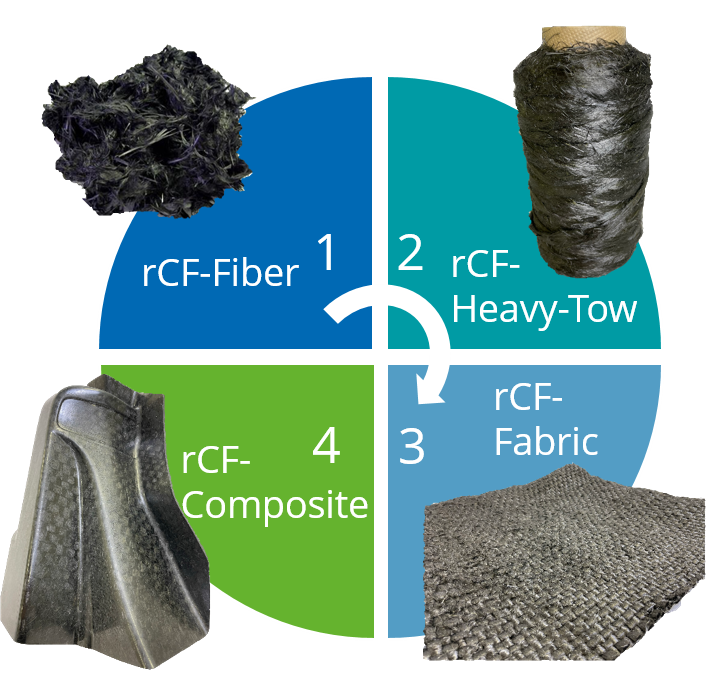
Proof of concept was provided through the production of hybrid yarns with defined fiber volume contents and a functional demonstrator. Fig. 3 illustrates the full process chain from fiber preparation to demonstrator production from rCF, MF and EF at ITM. The resulting yarns ranged from 1500 to 3500 tex and were successfully processed into textile preforms. The resulting composites demonstrated excellent mechanical performance: a maximum flexural strength of 806 ± 18 MPa, flexural modulus of 83 ± 4 GPa, and an impact strength of up to 117 ± 17 kJ/m².

The results show that yarn twist significantly influences composite mechanical properties: moderate twist enhances flexural behavior, while higher twist improves impact resistance. By adjusting the yarn twist level, the mechanical performance of hybrid composites can be effectively tailored.

These novel hybrid yarns are particularly suited for producing cost-efficient, high-performance thermoset composites with complex geometries. Their application-specific performance and process-integrated production offer high innovation and market potential, especially in the fields of materials engineering, lightweight design, sustainability, and resource efficiency. For small and medium-sized enterprises (SMEs) in the textile industry, this technology provides opportunities to develop advanced fiber-reinforced products and establish themselves as key suppliers in sectors such as automotive, mechanical engineering, wind energy, aerospace, medical technology, and sports equipment.

Bericht

Introduction

The size of the CF-CFRP (carbon fiber-reinforced plastics) market was estimated at USD 21.12 billion in 2023. It is projected to grow from USD 22.57 billion in 2024 to USD 38.4 billion by 2032, with a CAGR of approximately 6.86% during the forecast period (2024–2032) [1]. Due to their high specific stiffness and strength, CFRPs are widely used in the automotive, sports, leisure, and aerospace industries [2]. However, CFRP components are brittle under impact loading, which can result in catastrophic failure and severe splintering [3]. This brittleness raises concerns for the use of thermoset CFRP structures in safety-critical components such as wind turbine blades or automotive B-pillars.

Current hybridization concepts aim to combine materials with high stiffness, strength, and ductility [4]. Existing approaches integrate carbon fibers (CF) with stainless steel fibers (MF) or elastomer fibers (EF) using metal or elastomer films in fiber-metal laminates (FMLs), such as CARALL [5–8], or in elastomer-based laminates, such as KRAIBON [9–14]. Metal films offer higher energy absorption due to their plastic deformability and elongation at break of up to 20%, surpassing CFRP and carbon/aramid hybrid composites [15–17]. Elastomer films reduce hazardous splintering under dynamic loading due to their elastic deformation behavior [9]. While such multilayer systems improve impact and splinter resistance, they also carry a high risk of delamination [18]. Moreover, there is a lack of cost-effective and sustainable composites with enhanced impact and splinter properties that fully utilize the benefits of their individual components.

Objective

The goal of this research project was the simulation-based development of novel three-component hybrid yarns with micro-scale hybridization using three distinct material concepts. These yarns were then used to produce functional composite structures for sustainable lightweight applications. By strategically combining ductile metal fibers (MF), highly elastic elastomer fibers (EF), and high-stiffness, high-strength recycled carbon fibers (rCF), scalable composites with tailored mechanical properties were developed.

The developed hybrid yarns form the basis for application-specific composites with high energy absorption capacity and improved damage resistance.


Hybrid Yarn Structures and Related Composites: Development and Characterization

Development and Production of Hybrid Yarns Using Flyer Spinning Technology

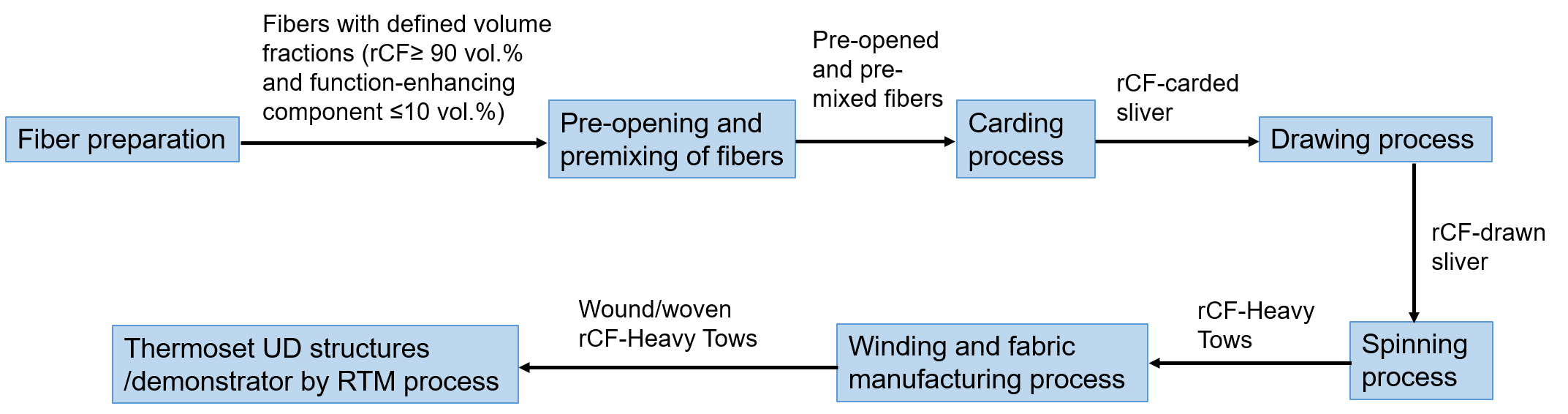
Starting from the selected and characterized rCF and EF fiber materials with an average fiber length of 80 mm and defined blend ratios, the fibers were prepared using mechanical pre-opening and blending units. The pre-opened and pre-mixed fibers were processed using a lab-scale carding machine to produce card slivers of rCF and EF. Characterization of these slivers revealed a CF damage level of 10–25%, while EF fibers showed no length reduction.

To avoid damaging the stainless steel fibres during carding, card slivers were firstly produced that were either 100% rCF or a blend of rCF and EF. These were combined with 100% MF slivers to develop sandwich-type structures (rCF/MF or rCF/EF/MF slivers), which served as feed material for the drafting process. The slivers were drafted multiple times to enhance fiber blending and homogeneity. These drafted slivers were then used to produce hybrid yarns.

The ITM’s specialized flyer spinning machine was modified to optimize drafting mechanics, sliver feed, and machine settings to avoid fiber misalignment. Based on experimental investigations, optimal settings were determined, and hybrid yarns with a yarn count of 1500 tex and twist levels ranging from 40 to 150 T/m were produced. These yarns were characterized in accordance with DIN EN ISO 13934-1, evaluating unevenness, yarn structure, and tensile behavior, and were subsequently used to produce composite.

Manufacturing of Recycled Carbon Fiber-Reinforced Composite

Using the developed hybrid yarns, unidirectional (UD) composites were produced via the resin transfer molding (RTM) process. The hybrid yarns were wound under constant tension onto a frame and consolidated under optimized parameters. The resin system consisted of Hexion RIMH 135 and hardener Hexion RIMH 137.

Composite characterization followed standardized test methods. Tensile specimens were prepared based on DIN EN ISO 527-5/A/2, with tensile testing conducted according to             DIN EN ISO 527-4. The flexural properties were evaluated in accordance with DIN EN ISO 14125 and impact resistance was assessed using DIN EN ISO 179-2 (Charpy method). The compression-after-impact (CAI) performance was measured following DIN ISO 18352. Additionally, a custom test rig was developed to analyze splintering behavior using a ZwickRoell HTM 5020 high-speed testing machine. Puncture resistance was evaluated according to DIN EN ISO 6603-2.

Selected Results and Discussion

Fig. 1 presents the relationship between flexural strength and modulus for various twist levels in hybrid yarn-based composites at a constant fiber volume content of 50 vol%. Both a CF-filament-based reference composite and three UD composites made from rCF/MF hybrid yarns (90 wt% rCF / 10 wt% MF) were investigated, differing only in yarn twist (40, 80 and 120 T/m). The reference composite achieved 725 ± 35 MPa flexural strength and a modulus of 74 ± 8 GPa. Notably, the T40 hybrid variant surpassed these values, reaching 806 ± 18 MPa and 83 ± 4 GPa, respectively.

However, increasing the yarn twist (80 and 120 T/m) led to a continuous decline in flexural properties. The intensified helical structure reduces fiber alignment in the load direction, which weakens load transfer and overall flexural performance.

Fig. 2 shows the impact strength of composites made from rCF/MF hybrid yarns at varying yarn twist levels. Results indicate a trend of increasing impact strength with higher twist (40 → 120 T/m), from 85 kJ/m² to 117 kJ/m². This improvement is attributed to a more compact yarn structure, enhanced fiber cohesion, and improved energy absorption during impact. Additionally, the tighter fiber arrangement enhances load transfer and structural integrity by reducing the number of loose fiber ends, resulting in greater resistance to sudden loads.

Summary

As part of the IGF research project 01IF22916N, a complete, industry-ready process chain for producing three-component hybrid yarns from rCF, MF, and EF was successfully developed at the ITM of TU Dresden. The process chain comprises fiber preparation, carding, and drafting to form slivers, followed by modified flyer spinning to produce hybrid yarns.

Proof of concept was provided through the production of hybrid yarns with defined fiber volume contents and a functional demonstrator. Fig. 3 illustrates the full process chain from fiber preparation to demonstrator production from rCF, MF and EF at ITM. The resulting yarns ranged from 1500 to 3500 tex and were successfully processed into textile preforms. The resulting composites demonstrated excellent mechanical performance: a maximum flexural strength of 806 ± 18 MPa, flexural modulus of 83 ± 4 GPa, and an impact strength of up to 117 ± 17 kJ/m².

The results show that yarn twist significantly influences composite mechanical properties: moderate twist enhances flexural behavior, while higher twist improves impact resistance. By adjusting the yarn twist level, the mechanical performance of hybrid composites can be effectively tailored.

These novel hybrid yarns are particularly suited for producing cost-efficient, high-performance thermoset composites with complex geometries. Their application-specific performance and process-integrated production offer high innovation and market potential, especially in the fields of materials engineering, lightweight design, sustainability, and resource efficiency. For small and medium-sized enterprises (SMEs) in the textile industry, this technology provides opportunities to develop advanced fiber-reinforced products and establish themselves as key suppliers in sectors such as automotive, mechanical engineering, wind energy, aerospace, medical technology, and sports equipment.

Acknowledgements

The IGF project 01IF22916N of the research association Forschungskuratorium Textil e.V. was funded via the DLR within the framework of the program for the promotion of industrial collaborative research and development (IGF) by the German Federal Ministry for Economic Affairs and Climate Action, based on a resolution of the German Bundestag. We thank the aforementioned institutions for their financial support.


References

  1. WiseGuyReports. (n.d.). CF & CFRP Market Report. Accessed on 29.07.2025, https://www.wiseguyreports.com/de/reports/cf-cfrp-market
  2. E. Witten; V. Mathes; M. Sauer; M. Kühnel: Composites-Marktbericht 2023 - Marktentwicklun-gen, Trends, Ausblicke und Herausforderungen. Deutsche Fachverband für Faserverbundkunststoffe/Composites - AVK, 2023
  3. J. Striewe; C. Reuter; K.-H. Sauerland; T. Tröster: Manufacturing and crashworthiness of fabric-reinforced thermoplastic composites. Thin-Walled Structures 123(2018), Pp. 501-508. https://doi.org/10.1016/j.tws.2017.11.011
  4. D. Nestler: Beitrag zum Thema Verbundwerkstoffe - Werkstoffverbunde: Status quo und For-schungsansätze. Chemnitz: Univ.-Verl., 2014. – ISBN 9783944640129
  5. ZHU, W.; XIAO, H.; WANG, J.; LI, X.: Effect of Different Coupling Agents on Interfacial Properties of Fibre-Reinforced Aluminum Laminates. Materials (Basel, Switzerland) 14(2021)4. https://doi.org/10.3390/ma14041019
  6. GUPTA, R. K.; MAHATO, A.; BHATTACHARYA, A.: Notch Shape Influence on Damage Evolution of Al/CFRP Laminates Under Tensile Loading: Experimental and Numerical Analysis. Appl Compos Mater (2022). https://doi.org/10.1007/s10443-022-10051-2
  7. TRZEPIECIŃSKI, T.; NAJM, S. M.; SBAYTI, M.; BELHADJSALAH, H.; SZPUNAR, M.; LEMU, H. G.: New Advances and Future Possibilities in Forming Technology of Hybrid Metal–Polymer Composites Used in Aerospace Applications. J. Compos. Sci. 5(2021)8, Pp. 217 f. https://doi.org/10.3390/jcs5080217
  8. PONNARENGAN, H.; KAMARAJ, L.; BALACHANDRAN, S. R.; KATHAR BASHA, S.: Evaluation of me-chanical properties of novel GLARE laminates filled with nanoclay. Polym. Compos. 42(2021)8, Pp. 4015-4028. https://doi.org/10.1002/pc.26113
  9. KRAIBON®: https://www.kraiburg-rubber-compounds.com/kraibon (31.07.2025)
  10. D. Düring; L. Weiß; D. Stefaniak; N. Jordan; C. Hühne: Low-velocity impact response of composi-te laminates with steel and elastomer protective layer. Composite Structures 134(2015), Pp. 18-26. https://doi.org/10.1016/j.compstruct.2015.08.001
  11. E. Stelldinger; A. Kühhorn; M. Kober: Experimental evaluation of the low-velocity impact dama-ge resistance of CFRP tubes with integrated rubber layer. Composite Structures 139(2016), Pp. 30-35. https://doi.org/10.1016/j.compstruct.2015.11.069
  12. E. Sarlin; M. Apostol; M. Lindroos; V.-T. Kuokkala; J. Vuorinen; T. Lepistö; M. Vippola: Impact properties of novel corrosion resistant hybrid structures. Composite Structures 108(2014), Pp. 886-893. https://doi.org/10.1016/j.compstruct.2013.10.023
  13. LI, Z.; ZHANG, J.; JACKSTADT, A.; KÄRGER, L.: Low-velocity impact behavior of hybrid CFRP-elastomer-metal laminates in comparison with conventional fiber-metal laminates. 02638223 287(2022), Pp. 115340 f. https://doi.org/10.1016/j.compstruct.2022.115340
  14. FLEISCHER, J. (HRSG.): Intrinsische Hybridverbunde für Leichtbautragstrukturen – Grundlagen der Fertigung, Charakterisierung und Auslegung. Berlin, Heidelberg: Springer Vieweg, 2021. – ISBN 978-3-662-62832-4
  15. Y. Swolfs; P. De Cuyper; M.G. Callens; I. Verpoest; L. Gorbatikh: Hybridisation of two ductile materials Steel fibre and self-reinforced polypropylene composites. Composites Part A: Applied Science and Manufacturing 100(2017), Pp. 48-54. https://doi.org/10.1016/j.compositesa.2017.05.001
  16. H.J. Koslowski: Chemiefaser-Lexikon. Deutscher Fachverlag, 2008. – ISBN 3871508764
  17. H. Schürmann: Konstruieren mit Faser-Kunststoff-Verbunden. Springer-Verlag GmbH, 2007. – ISBN 3540721894
  18. N. Montinaro; D. Cerniglia; G. Pitarresi: Evaluation of interlaminar delaminations in titanium-graphite fibre metal laminates by infrared NDT techniques. NDT & E International 98(2018), Pp. 134-146. https://doi.org/10.1016/j.ndteint.2018.05.004


AutorInnen: Mahmud Hossain Anwar Abdkader Tobias Lang Thomas Gereke Chokri Cherif

Technische Universität Dresden
Fakultät Maschinenwesen
Institut für Textilmaschinen und Textile Hochleistungswerkstofftechnik (ITM)
01062 Dresden
https://tu-dresden.de/mw/itm

More entries from TU Dresden, Institut für Textilmaschinen und Textile Hochleistungswerkstofftechnik ITM

08.09.2023

Mit einem Sustainability-Assessment zur nachhaltigen Unternehmensstrategie

Nachhaltigkeit Technische Textilien

Zusammenfassung

Die Textilindustrie gilt im Sinne der Nachhaltigkeit auf europäischer Ebene als Risikobranche. Warum das eine besondere Herausforderung ist und wie ein systematischer Ansatz zur nachhaltigen Transformation von Unternehmen aussehen kann, erfahren Sie in diesem Artikel.

Die Textilindustrie ist bekannt für ihre Innovationen und Ideen, die weit über die traditionellen Anwendungen von Bekleidung und einfachen Stoffen hinausgehen. Einige Beispiele sind der Einsatz von Glas- oder Carbonfasern zum Ersatz von Stahlbewehrungen in Betonbauteilen, künstliche Herzklappen aus Textilien oder Wasserstofftanks aus Carbonfasern. Allerdings steht die Textilindustrie vor großen Herausforderungen in Bezug auf Nachhaltigkeit. Sie ist weltweit eine der Branchen mit den höchsten Umweltbelastungen und hat auch erhebliche soziale Auswirkungen auf die Arbeitskräfte in der Lieferkette, die häufig auf Baumwollfeldern in Ländern wie China, Indien oder Pakistan beginnt. Hier ist ein systematischer Ansatz zur Nachhaltigkeitsbewertung erforderlich. Das Ergebnis der Nachhaltigkeitsbewertung bildet den Status Quo ab, kann als Benchmark im Vergleich mit anderen Unternehmen der Branche verwendet werden und bietet einen optimalen Ausgangspunkt für die Integration von Nachhaltigkeit in die Unternehmensstrategie.

Bericht

Einleitung

Aachen/München: Die Textilindustrie ist bekannt für ihre Innovationen und Ideen, die weit über die traditionellen Anwendungen von Bekleidung und einfachen Stoffen hinausgehen. Einige Beispiele sind der Einsatz von Glas- oder Carbonfasern zum Ersatz von Stahlbewehrungen in Betonbauteilen, künstliche Herzklappen aus Textilien oder Wasserstofftanks aus Carbonfasern.

Allerdings steht die Textilindustrie vor großen Herausforderungen in Bezug auf Nachhaltigkeit. Sie ist weltweit eine der Branchen mit den höchsten Umweltbelastungen und hat auch erhebliche soziale Auswirkungen auf die Arbeitskräfte in der Lieferkette, die häufig auf Baumwollfeldern in Ländern wie China, Indien oder Pakistan beginnt. Auch die weiterverarbeitenden Prozesse innerhalb der Wertschöpfungskette bergen die Gefahr unzureichender Umweltschutzmaßnahmen und der Missachtung international geltender Menschenrechte. Eine nachhaltige Textilindustrie hingegen setzt sich gezielt und insbesondere für den Einsatz von umweltfreundlichen Materialien, faire Arbeitsbedingungen und die Reduzierung des Energie- und Wasserverbrauchs ein. „Die EU verweist in ihrer neuen Sustainable Product Initiative nicht umsonst verstärkt auf ein hohes Maß an Umweltschutz und notwendige Verbesserungen der Umweltqualität. Wir müssen an den wichtigen gesellschaftlichen Herausforderungen forschen und neue Technologien schnell in die Umsetzung bringen“, so Prof. Thomas Gries vom Institut für Textiltechnik (ITA) der RWTH Aachen University.
 

Systematischer Ansatz zur Nachhaltigkeitsbewertung

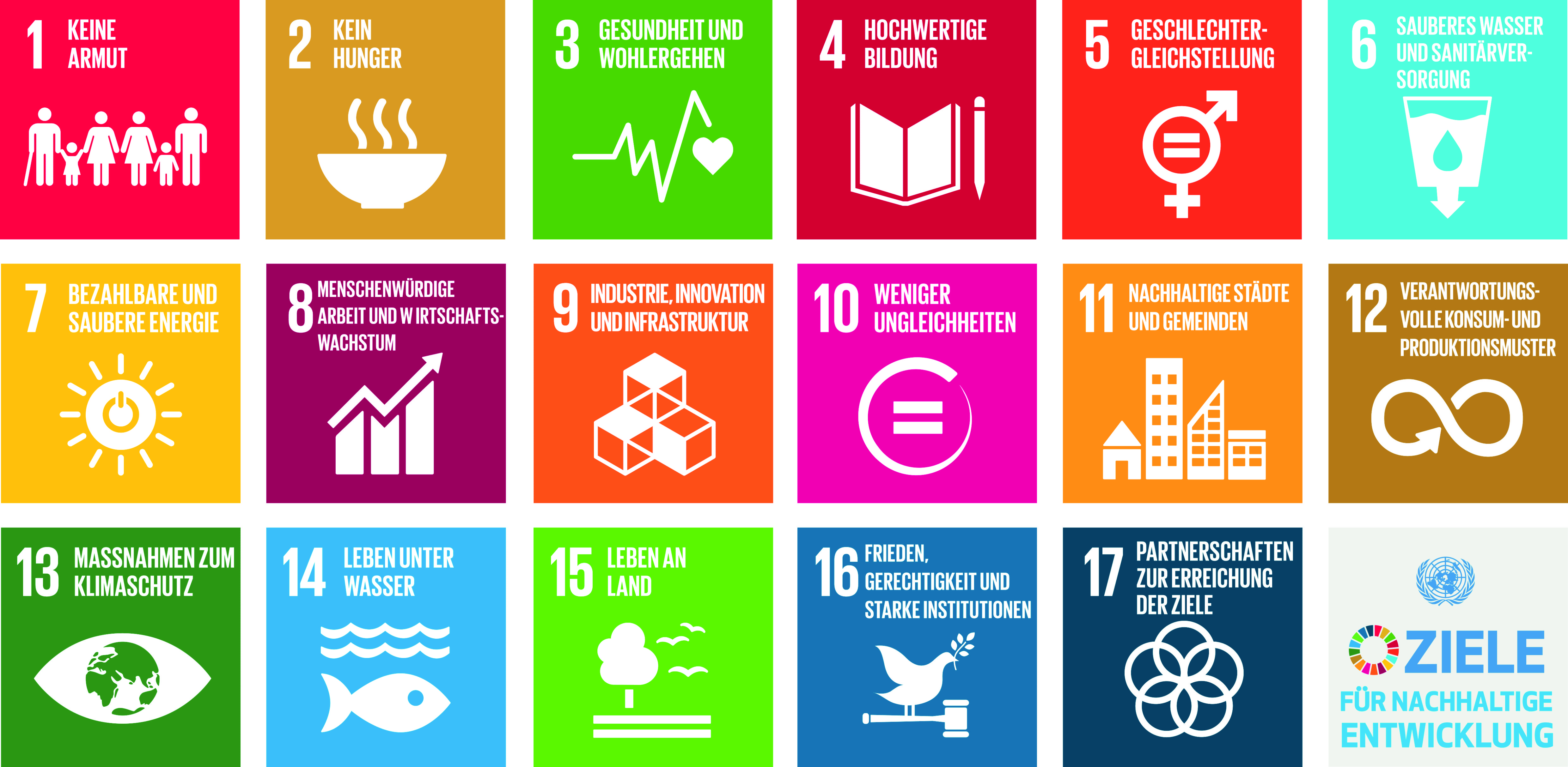
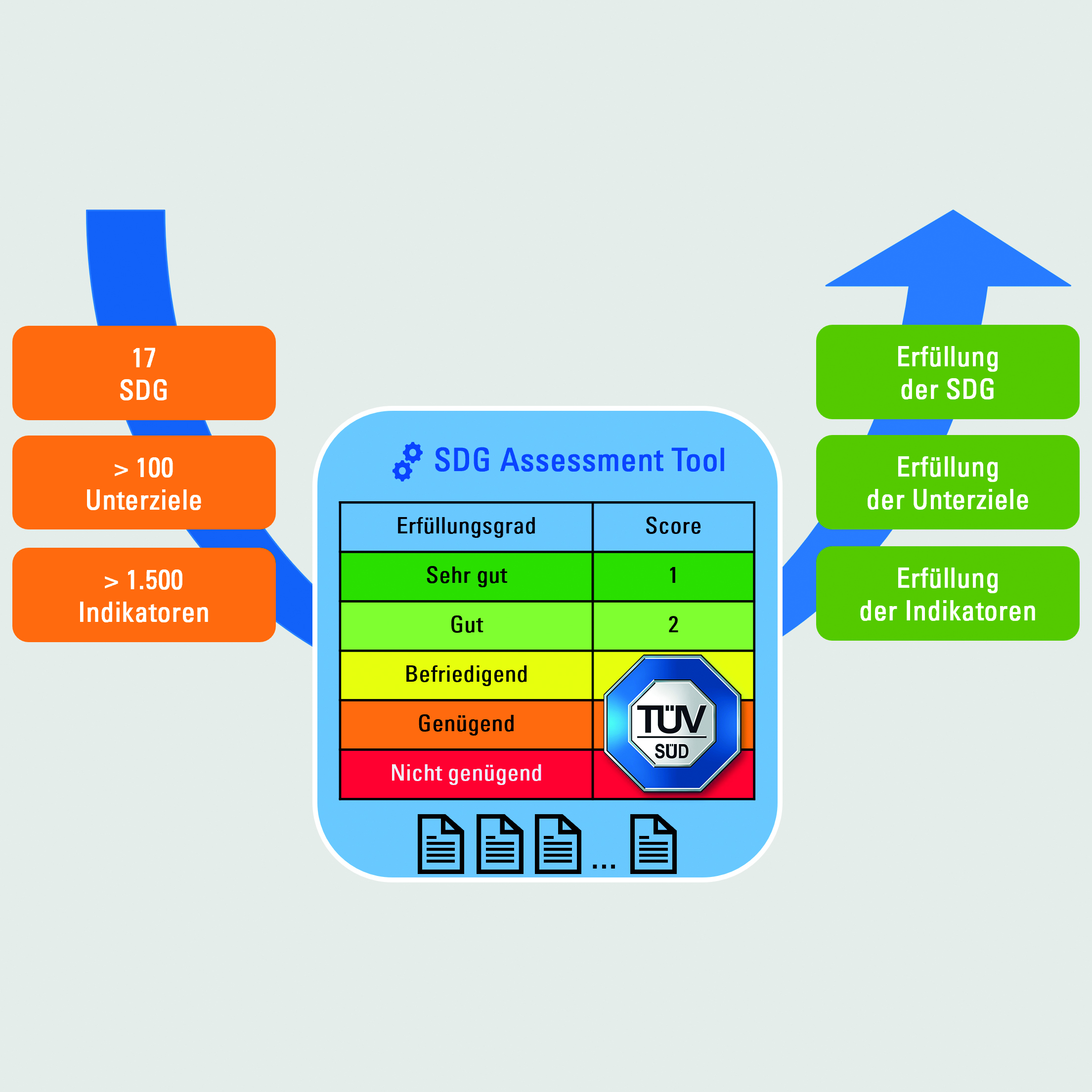
Auf Unternehmensebene fängt die Transformation mit der Erfassung der notwenigen Daten (Indikatoren) und der der daraus resultierenden Messbarkeit der eigenen Nachhaltigkeitsleistung an. Die TÜV SÜD Industrie Service GmbH hat dazu eine Methodik entwickelt, die in Zusammenarbeit mit dem ITA für die Textilindustrie adaptiert und optimiert wurde: die Nachhaltigkeitsbewertung orientiert sich an den 17 Sustainable Development Goals (SDG) der Vereinten Nationen. Auf der Grundlage verschiedener Indikatoren, die durch Branchen- und Ländervergleiche gewichtet werden, wird die Nachhaltigkeitsleistung des Unternehmens objektiv, unabhängig und transparent beurteilt. „Mit unserer Nachhaltigkeitsbewertung ermöglichen wir allen relevanten Akteuren der Wertschöpfungskette Klarheit über den Ist-Zustand der unternehmensspezifischen Nachhaltigkeit zu erlangen, die wesentlichen Nachhaltigkeitsrisiken zu identifizieren und mit den daraus abgeleiteten Verbesserungsmaßnahmen einen wesentlichen Schritt in Richtung eines Nachhaltigkeitsmanagementsystems zu gehen“, so Lucas Wagner von der TÜV SÜD Industrie Service GmbH. Dieser Ansatz umfasst die gesamte Unternehmensstrategie und ist auch für andere Branchen einsetzbar.
 

Integration von Nachhaltigkeit in die Unternehmensstrategie

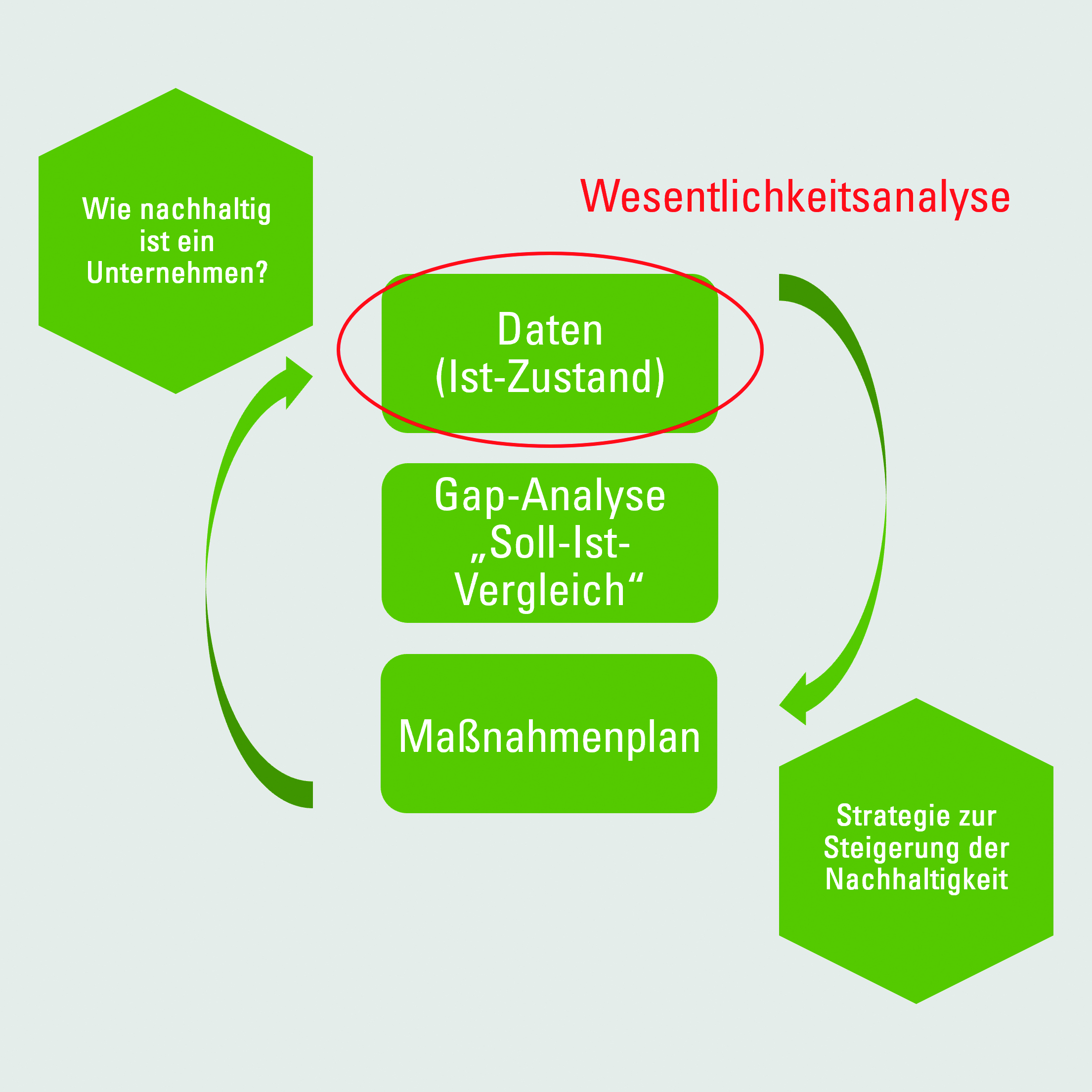
Das Ergebnis der Nachhaltigkeitsbewertung bildet den Status Quo ab, kann als Benchmark im Vergleich mit anderen Unternehmen der Branche verwendet werden und bietet einen optimalen Ausgangspunkt für die Integration von Nachhaltigkeit in die Unternehmensstrategie. Die objektive Bewertung bietet zunächst die Möglichkeit, notwendige Schwerpunkte für die Transformation hin zu einem nachhaltigen Unternehmen zu identifizieren. Zusammen mit externen Experten, z. B. aus der Forschung, werden Potentiale identifiziert und konkrete Umsetzungsmaßnahmen abgeleitet. „Das Vorgehen bietet einen holistischen Ansatz, um die nachhaltige Transformation zu einem Kern der Unternehmensstrategie zu machen. Die Wirtschaftlichkeit bildet dabei eine wichtige Säule“, so Prof. Gries. Darüber hinaus bietet die Nachhaltigkeitsbewertung durch die TÜV SÜD Industrie Service GmbH eine ausgezeichnete Ausgangslage, um die Anforderungen der CSRD, also der „Corporate Sustainability Reporting Directive“ zu erfüllen. So wird Nachhaltigkeit zu einem planbaren Erfolgsfaktor für Unternehmen.

Bildunterschriften:

Abbildung 1: 17 Ziele für nachhaltige Entwicklung (SDG) der Vereinten Nationen (Quelle: Vereinte Nationen)

Abbildung 2: Methodischer Ansatz für die Nachhaltigkeitsbewertung eines Unternehmens (Quelle: TÜV SÜD Industrie Service GmbH)

Abbildung 3: Wesentlichkeitsanalyse und Strategieentwicklung (Quelle: TÜV SÜD Industrie Service GmbH)

AutorInnen: Pohlmeyer, Florian1 Wagner, Lucas2 Möbitz, Christian1 Gries, Thomas1

1: Institut für Textiltechnik der RWTH Aachen University, Otto-Blumenthal-Str. 1, 52074 Aachen

2: TÜV SÜD Industrie Service GmbH, Westendstraße 199, 80686 München

More entries from ITA Institut für Textiltechnik der RWTH Aachen University

20.06.2023

Development of heavy tows from recycled carbon fibers for low-cost and high performance thermoset composites (rCF heavy tows)

Rohstoffe Fasern Garne Composites Textilmaschinenbau Recycling Nachhaltigkeit Kreislaufwirtschaft Technische Textilien

Zusammenfassung

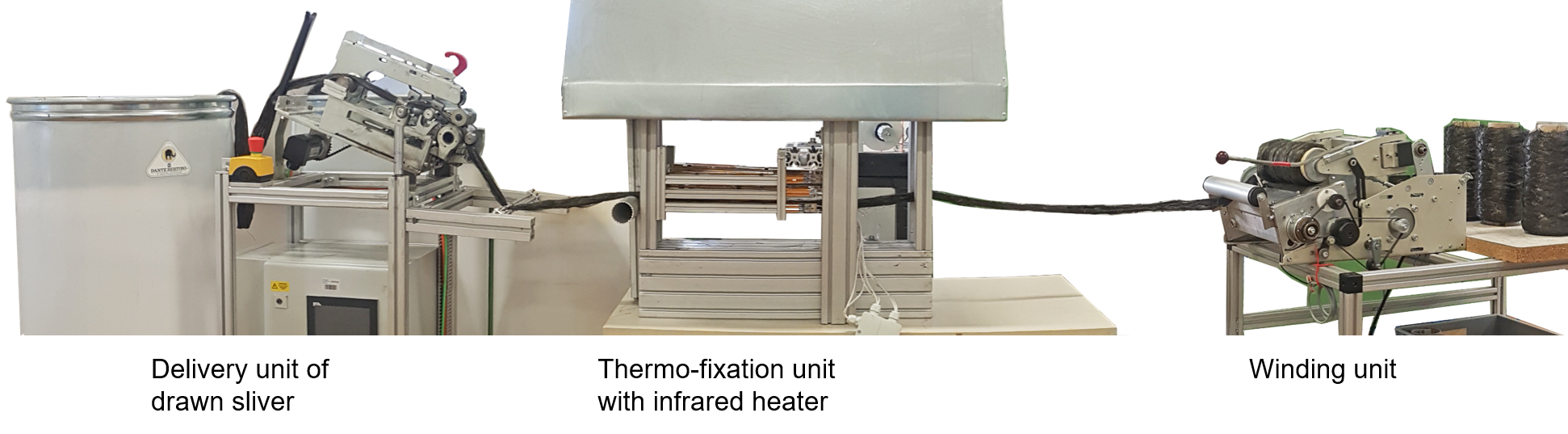
Within the framework of the IGF research project (21612 BR), the entire process chain for the industrial production of novel twist-free rCF heavy tows was developed at ITM. In particular, a novel technology for the production of rCF heavy tows based on recycled carbon (rCF ≥ 90 vol.%) and hot melt adhesive fibers (< 10 vol.%) was designed, constructed and successfully implemented. This includes fiber preparation, the carding process for card sliver formation, the stretching process for drawn sliver formation, and the final fabrication of the rCF heavy tows from rCF and hot melt adhesive fibers in a newly developed test set-up. The suitability of the developed technology is demonstrated by the implementation of rCF heavy tows with different rCF types, fiber lengths and fiber volume contents and a demonstrator. The developed rCF heavy tows with finenesses between 3000-7000 tex and their further processability into textile semi-finished products were successfully demonstrated. The developed rCF Heavy Tows and composites based on them exhibit a maximum composite tensile strength and a maximum Young’s modulus of 1158±72 MPa and 80±5.7 GPa, respectively. The rCF Heavy Tows are thus applicable for low-cost thermoset composites with high performance and complex geometry. Thus, the developed rCF Heavy Tows offer a very high innovation and market potential in the fields of materials and materials, lightweight construction, environmental and sustainability research, and resource efficiency. This opens up the opportunity for SMEs in the textile industry to develop new products and technologies for the fiber composite market and to establish themselves as suppliers for the automotive, mechanical engineering and aerospace, medical and sports equipment industries.

Bericht

Introduction, problem definition and aim of the project

Carbon fiber-reinforced plastics (CFRP) are increasingly used in lightweight applications due to their high stiffness and strength as well as low density, especially in aerospace, transportation, wind energy, sports equipment or construction. Global demand of CFRP is predicted to increase to 197,000 t/a by 2024, almost tripling compared to 2011. This shows an urgent need for solutions to recycle the high quality carbon fiber (rCF) in terms of the circular economy. This is necessary not only due to strict legal regulations, but also for ecological and economic reasons. In recent years, numerous research institutes and companies developed solutions for the reuse of rCF in the fields of nonwovens, injection molding or as hybrid yarns. However, the majority of these works involve the use of rCF in combination with thermoplastic fibers for thermoplastic composites. In the field of rCF-based thermoset CFRP, mainly rCF nonwovens made of 100% rCF have been so far developed. Since the fibers in the nonwovens mostly have a limited length and a low orientation and process-related additional high fiber damage occurs, with these materials only maximum 30% of the composite characteristic values of CFRP components made of carbon filament yarns can be so far achieved.

Currently, the matrix systems used in the field of high mechanical loaded CFRPs are predominantly thermoset. Such components exhibit high dimensional stability, high stiffness and strength as well as are suitable for the implementation of complex component geometries due to low-viscosity matrix systems. However, primary carbon filament yarns are particularly used for these components due to the insufficient properties of rCF. In addition to low sustainability, the utilization of these filament yarns result in at least 200 % higher cost. The production of primary carbon filament yarn requires a high-energy demand of about 230 MJ/kg with a CO2 emission equivalent to 20 kg CO2/kg CF. Here, a significant improvement of the CO2 balance is required to make a substantial contribution to the envisaged climate protection goals of the Federal Republic of Germany and the EU. For this reason, the focus of the project work is the development of novel, sustainable rCF heavy tows made of recycled carbon fibers (rCF) and associated manufacturing technologies for the implementation of cost-effective thermoset composites with high mechanical performance.

Acknowledgments

The IGF project 21612 BR of the Research Association Forschungskuratorium Textil e.V. was funded by the Federal Ministry of Economics and Climate Protection (BMWK) via the AiF within the framework of the program for the promotion of joint industrial research and development (IGF) on the basis of a resolution of the German Bundestag. We would like to thank the above-mentioned institutions for providing the financial resources.

AutorInnen: Mahmud Hossain, Anwar Abdkader und Chokri Cherif

Technische Universität Dresden
Fakultät Maschinenwesen
Institut für Textilmaschinen und Textile Hochleistungswerkstofftechnik (ITM)
01062 Dresden
https://tu-dresden.de/mw/itm

rCF fiber yarn Composite textile machine

More entries from TU Dresden, Institut für Textilmaschinen und Textile Hochleistungswerkstofftechnik ITM

16.01.2023

Increased performance and sustainability through the use of profiled textile reinforcements for concrete applications

Fasern Garne Gestricke & Gewirke Textilmaschinenbau Nachhaltigkeit Technische Textilien

Zusammenfassung

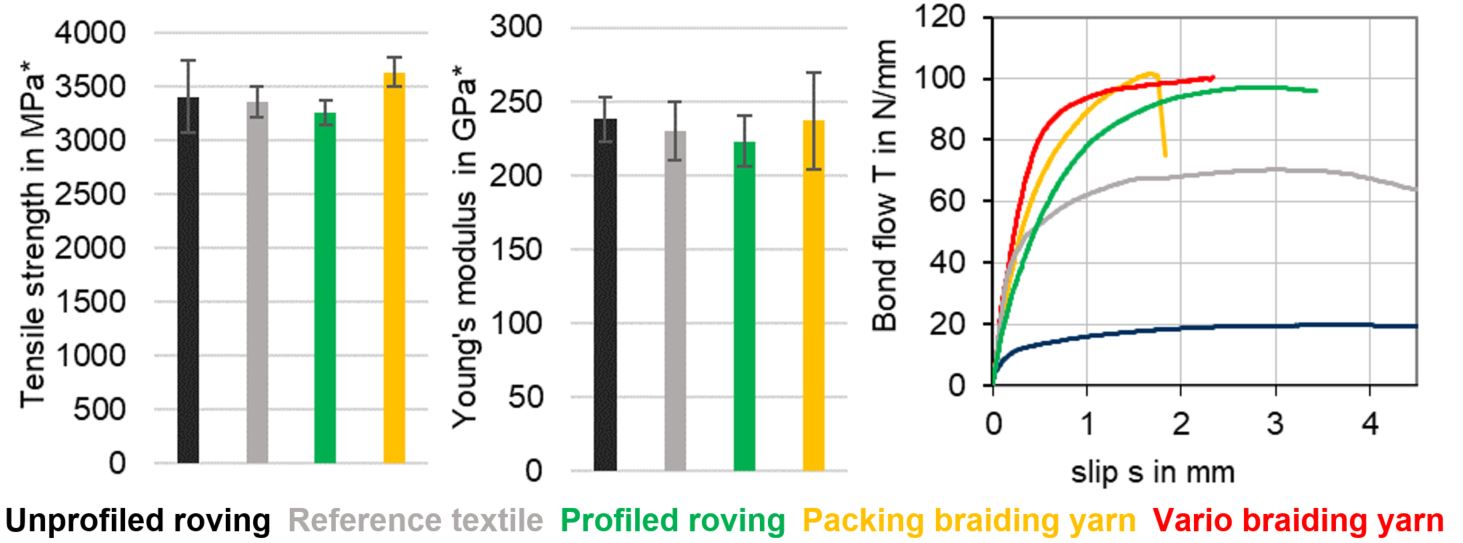
At the ITM of the TU Dresden, new, bond optimized reinforcement yarns were developed on the basis of braiding and forming technology, which can transmit up to 500 % higher bond forces in concrete than yarns without profile. The profiled rovings and braided yarns show at a bond length of only 50 mm a full anchoring. With the forming technology developed at the ITM, profiled rovings could be manufactured which, due to the patented tetrahedral geometry, can almost completely exploit the tensile potential of the carbon fibers. In the course of developing the braiding yarns, a new vario braiding structure was developed, with nearly eliminated structural elongation under load. This made it possible to manufacture profiled reinforcement yarns with very high tensile properties, which is a basic requirement for use in concrete. In addition, the multiaxial warp knitting technology has been further developed in such a way that the new bond optimized reinforcement yarns (profiled rovings and braiding yarns) can be processed without damage into profiled, grid-like textile reinforcements. This results in a significantly higher material efficiency of the textile reinforcement, so that previous necessary disproportionate oversizing and large overlapping lengths can be significantly reduced. This is of enormous importance, especially in view of the energy-intensive production of carbon fibers and consequently for the sustainability goal of the future-oriented carbon concrete technology, in order to make concrete constructions of the future resource saving and sustainable.

The project results achieved also represent a significant contribution to the production of extremely resilient textile-reinforced concrete structures with significantly improves bond properties, arising new prospects in the construction industry for component production in the field of renovation and new construction.

Bericht

Abstract
Building in a resource-saving way and still exploiting a high performance potential, is that even possible? At the Institute for Textile Machinery and High Performance Material Technology (ITM) at the TU Dresden, such composite optimized profiled textile reinforcements for concrete applications and the related manufacturing technology were developed as part of the research project IGF 21375 BR. On the basis of braiding and forming technology, a new generation of profiled reinforcement yarns was developed with the help of simulation-based investigations. Like ribbed steel reinforcements, these profiled yarns have a very high bond with the concrete matrix, but despite the profiling they almost fully exploit the performance potential of the carbon fibers in terms of tensile properties. In this way, the bond length required for complete force transmission between the textile reinforcement and the concrete can be reduced to just a few centimeters, and up to 80 % of the component-dependent oversizing of the textile reinforcement can be saved. The further development of the multiaxial warp knitting technology for the requirement-based and fiber-friendly processing of the profiled yarns into grid-like reinforcement structures enables the production of profiled textile reinforcement structures with the highest bond properties for use in carbon-reinforced concrete components with maximum material and resource efficiency.

Initial situation and problem definition
As is generally known, climate change is the greatest challenge of the 21st century, which can only be successfully overcome by consistently saving resources and CO2 emissions. Since the construction industry, with a share of approx. 38 % of global CO2 emissions, has made a significant contribution to global warming to date, in particular due to the enormous cement consumption [1], a change to more energy and resource efficiency as well as a growing awareness of sustainability is absolutely necessary. In the course of this, a resource-efficient carbon concrete, consisting of a corrosion-resistant textile reinforcement in combination with a significantly reduced concrete cover, is established in the construction industry as a convincing alternative to conventional steel reinforced concrete [2,3].

Due to the high load-bearing capacity of the textile reinforcement with the smaller concrete cross-sections required, the bond between the textile and the concrete is extremely important. So far, R&D has focused on the development of impregnations and impregnation systems for improved material bond with the concrete matrix [4]. However, only small forces with a shear flow of about 5 - 40 N/mm can be transferred, an efficient utilization of the textile reinforcement is not possible. Solutions with profiling of the yarn surface promise significant improvements in the transmission of bond forces [5]. Therefore, new technologies for the continuous and reproducible production of profiled textile high-performance fiber yarns and their further processing into reinforcement structures were developed within a research project at the ITM of the TU Dresden. These innovative, profiled reinforcements are characterized by their ability to transmit significantly higher bond forces in concrete [6,7]. In particular, this was realized by a form-fitting effect between the textile and the concrete, that meets the specific requirements of a stiff and symmetrical surface profile of the reinforcement yarns in order to guarantee a constant and high force transmission. To generate the yarn profiling, solutions based on braiding technology and forming processes were developed and implemented with the help of simulation-supported studies. The premises were a permanently stable textile structure and a profile with a symmetrical structure. The realization of grid-like reinforcement structures, consisting of the profiled reinforcement yarns, was carried out using the multiaxial warp knitting technology. This was developed further on a modular basis with regard to the existing processes (yarn feeding, weft yarn insertion, knitting process, impregnation and winding) in accordance with the necessary adaptation measures for the fiber-friendly and requirement-based further processing of the profiled reinforcement yarns into grid-like structures.

Development of the innovative profiled reinforcement yarns
For the development of bond optimized profiled reinforcement yarns for concrete applications, a simulation-supported yarn development was carried out on the basis of braiding and forming technology. In particular, the main challenge was to realize profiled yarns with minimal structural elongation, so that, an initial force transmission of the textile reinforcement is possible and the concrete crack widths are minimized [3] if the concrete matrix fails at approx. 0.2 % elongation. For this purpose, a new type of varying braiding structure was developed. Moreover the braiding technology was further developed to enable a low-undulation and pre-stabilization of the braiding yarn structure during the braiding process, yet still ensuring further textile processing. As a result, it is now possible to implement novel vario braiding yarns as well as conventional packing braided yarns, consisting of carbon fibers with nearly eliminated structural elongation, minimal fiber damage and the required pre-stabilization of the yarn structure (see Table 1).

...

Performance potential of the new profiled reinforcement yarns
The newly developed profiled reinforcement yarns are characterized by nearly unchanged tensile properties, yet up to 500 % higher bond properties compared to carbon rovings without profile or rovings extracted from reference textiles (see Figure 1). In addition, they do not show any noticeable structural elongation, so that an initial force transmission is possible without additional crack opening after the failure of the concrete matrix. However, an increase in bond strength of more than 500 % from approx. 20 N/mm of the carbon rovings without a profile to over 100 N/mm of the profiled reinforcement yarns was achieved, which is accompanied by a significant increase in material efficiency (see Figure 1). The vario braiding yarns in particular are characterized by very high bond stiffness, which is of particular interest for an initial force transmission. The packing braiding yarns and the profiled rovings with tetrahedral geometry have almost the same bond properties. The bond stiffness is marginally lower compared to the vario braiding yarns, whereas their production is more productive than the vario braiding yarns.

Development of the multiaxial-warp knitting process
To process the newly profiled reinforcement yarns into a grid-like reinforcement structure, a biaxial warp knitting machine Malimo 14022 at the ITM and the corresponding sub-processes (yarn feeding, weft yarn insertion, knitting process, impregnation and winding) were adapted and further developed so that on the one hand the pre-stabilized braiding yarns and the consolidated tetrahedral-shaped profiled rovings can be processed further. For this purpose, the weft thread laying process in particular was modified by developing a new type of weft thread guide for the laying of the pre-stabilized braiding yarns. Since the rigid profiled rovings could not be processed with the conventional weft laying process, a new type stick placement system consisting of a stick magazine and a shaft with profile rollers was developed (see Figure 2). The pre-cut sticks were individually inserted via the stick placement system into a transport chain modified with new fixing elements.

In order to guarantee textile processing, the pre-stabilized braiding yarns were impregnated and consolidated after the warp knitting process, contrary to the rigid profiled rovings, which do not require any further impregnation.. On the basis of extensive production tests, a new type of impregnation system was developed based on the kiss coater process with an additional coating roller for applying an impregnation agent to both sides of the pre-stabilized braiding yarns. Various reinforcement structures were manufactured and characterized with the implemented system technology. Figure 3 shows a new type of profiled textile reinforcement consisting of prefabricated profiled rovings with tetrahedral shape.

Acknowledgments
The IGF research project 21375 BR of the Forschungsvereinigung Forschungskuratorium Textil e. V. is funded through the AiF within the program for supporting the „Industriellen Gemeinschaftsforschung (IGF)“ from funds of the Federal Ministry for Economic Affairs and Climate Action on the basis of a decision by the German Bundestag.

The complete publication is available as download.

AutorInnen: Penzel, Paul; Hahn, Lars; Abdkader, Anwar; Cherif, Chokri

Technische Universität Dresden
Fakultät Maschinenwesen
Institut für Textilmaschinen und Textile Hochleistungswerkstofftechnik (ITM)
01062 Dresden

https://tu-dresden.de/mw/itm

More entries from TU Dresden, Institut für Textilmaschinen und Textile Hochleistungswerkstofftechnik ITM