From the Sector

Reset
(c) Institut für Textiltechnik (ITA) der RWTH Aachen University
26.02.2026

ITA: Pellet press enables thermomechanical textile recycling

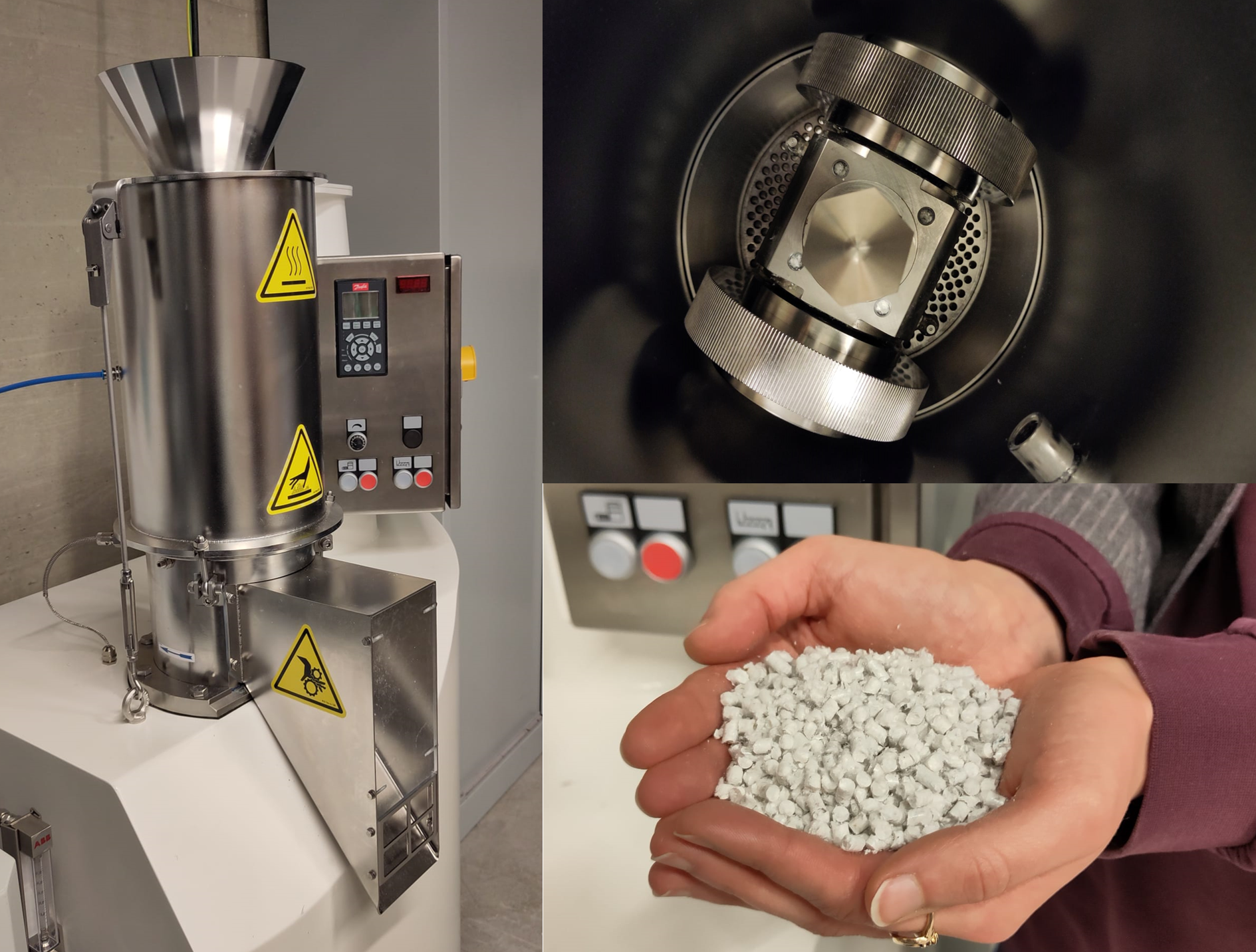
Since the end of 2025, the technical centre of the Institut für Textiltechnik (ITA) of RWTH Aachen University has been equipped with a pellet press from the manufacturer Amandus Kahl GmbH & Co. KG, Reinbek, Germany. This press can efficiently compact shredded synthetic textiles at a throughput of up to 25 kg/h and process them into pellets with a diameter of 4 mm.

The produced pellets are characterised by a homogeneous geometry, defined bulk density and suitable flowability. This enables reliable dosing and continuous feeding into an extruder. In this way, the process-related prerequisite for thermomechanical textile recycling on a pilot scale at the ITA is established.

Current research at the institute includes the thermomechanical recycling of cleaning textiles made from polylactide (PLA). The pellet press was procured as part of the RePLAy research project. The Federal Ministry of Research, Technology and Space is funding the project as part of the BIOTEXFUTURE innovation space. 

Since the end of 2025, the technical centre of the Institut für Textiltechnik (ITA) of RWTH Aachen University has been equipped with a pellet press from the manufacturer Amandus Kahl GmbH & Co. KG, Reinbek, Germany. This press can efficiently compact shredded synthetic textiles at a throughput of up to 25 kg/h and process them into pellets with a diameter of 4 mm.

The produced pellets are characterised by a homogeneous geometry, defined bulk density and suitable flowability. This enables reliable dosing and continuous feeding into an extruder. In this way, the process-related prerequisite for thermomechanical textile recycling on a pilot scale at the ITA is established.

Current research at the institute includes the thermomechanical recycling of cleaning textiles made from polylactide (PLA). The pellet press was procured as part of the RePLAy research project. The Federal Ministry of Research, Technology and Space is funding the project as part of the BIOTEXFUTURE innovation space. 

Stratasys Earns EcoVadis Gold Medal for Sustainability Graphic via Stratasys
26.02.2026

Stratasys Earns EcoVadis Gold Medal for Sustainability

Stratasys Ltd. has earned a Gold Medal from EcoVadis for sustainability, placing the company in the top 5% of 150,000 organizations evaluated globally, improving its status from last year’s Silver rating. Being at the highest level of ESG performance helps strengthen our value proposition to customers and their sustainable goals.

EcoVadis is a leading provider of business sustainability ratings, evaluating companies across four key areas: environment, labor and human rights, ethics, and sustainable procurement.

“Through our Mindful Manufacturing™ commitment, we’re building the evidence-based, data-driven responsible business practices that our customers and strategic stakeholders increasingly expect from a future-ready manufacturing partner,” said Rosa Coblens, Vice President, Sustainability and Communications, Stratasys. “Earning the EcoVadis Gold Medal and ranking in the top 5% globally is an important recognition of the hard and dedicated work our global teams have done to strengthen sustainability infrastructures across the company.”

Stratasys Ltd. has earned a Gold Medal from EcoVadis for sustainability, placing the company in the top 5% of 150,000 organizations evaluated globally, improving its status from last year’s Silver rating. Being at the highest level of ESG performance helps strengthen our value proposition to customers and their sustainable goals.

EcoVadis is a leading provider of business sustainability ratings, evaluating companies across four key areas: environment, labor and human rights, ethics, and sustainable procurement.

“Through our Mindful Manufacturing™ commitment, we’re building the evidence-based, data-driven responsible business practices that our customers and strategic stakeholders increasingly expect from a future-ready manufacturing partner,” said Rosa Coblens, Vice President, Sustainability and Communications, Stratasys. “Earning the EcoVadis Gold Medal and ranking in the top 5% globally is an important recognition of the hard and dedicated work our global teams have done to strengthen sustainability infrastructures across the company.”

Stratasys’ improved rating reflects sustainability excellence, maturity of management systems, and continued progress across enterprise sustainability practices, including reporting emissions across the value chain (Scope 3), increased supplier engagement on ESG, ongoing research on product environmental impacts through Life Cycle Analyses (LCAs), and third party limited assurance processes for carbon reporting.
As a leading 3D printing business partner for future-ready manufacturing enterprises, Stratasys helps customers scale production of parts while supporting more efficient, optimized, and responsible manufacturing.

More information:
Stratasys EcoVadis gold medal
Source:

Stratasys 

Graphic by EDANA
26.02.2026

EDANA warns of consequences of misclassification of PET spunbond imports

EDANA would like to remind its members and industry stakeholders of the legal requirement to comply with the EU rules on customs classification when importing non-wovens from third countries outside the EU. In this regard, it was recently discovered that there appears to be a high level of customs misclassification occurring in the nonwoven’s industry. This could have dangerous and costly consequences for importers. 

Following repeated requests by its members, EDANA worked closely with the European Union and the World Customs Organisation to introduce in 2024 specific customs codes CN code 5603 14 20 and 5603 9420 in order to better monitor imports of certain PET spunbond and staple fibre products. Based on market intelligence, EDANA knows that third country imports of the respective products were in the range of 15,000 to 30,000 MT in 2024 and 2025. However, actual import volumes recorded under the specifically created CN codes were significantly lower. 

EDANA would like to remind its members and industry stakeholders of the legal requirement to comply with the EU rules on customs classification when importing non-wovens from third countries outside the EU. In this regard, it was recently discovered that there appears to be a high level of customs misclassification occurring in the nonwoven’s industry. This could have dangerous and costly consequences for importers. 

Following repeated requests by its members, EDANA worked closely with the European Union and the World Customs Organisation to introduce in 2024 specific customs codes CN code 5603 14 20 and 5603 9420 in order to better monitor imports of certain PET spunbond and staple fibre products. Based on market intelligence, EDANA knows that third country imports of the respective products were in the range of 15,000 to 30,000 MT in 2024 and 2025. However, actual import volumes recorded under the specifically created CN codes were significantly lower. 

“There is a clear mismatch between import volumes observed in the market and what is reported under the correct customs codes. Often, importers continue to use outdated customs codes as a matter of habit not paying due attention to changes of the Combined Nomenclature”, says Jacques Prigneaux from EDANA. “However, this is problematic, especially where certain products are subject to investigations by the EU authorities.” 

EDANA has therefore actively commenced an outreach initiative to raise awareness among its members. They have also contacted the European Commission and the national customs authorities of the EU member states to ask the authorities to enhance import checks. 

Incorrect customs classification not only makes EDANA’s work more difficult to monitor import flows and protect the interests of its members. It can also have severe negative legal consequences for importers. Customs authorities penalize misclassifications with additional duties, administrative fines and even criminal penalties. “To avoid such unpleasant surprises, we recommend that all members and their supply chain regularly review and update their customs classification databases and also instruct their customs agents accordingly” adds Mr Prigneaux. 

Awareness and compliance are in particular important where imports are under enhanced customs control (such as in the framework of import registration during an anti-dumping investigation) or subject to special trade or regulatory regimes (such as duty-free or reduced duty imports from countries with which the EU has special trade arrangements). 

A list of preferential trade regimes can be found on the website of the European Commission (here) and the Access2Markets webpage contains product-specific information for imports of goods into the EU (here). Also, presently, certain PET spunbond from China is subject to an EU anti-dumping investigation and imports were made subject to registration in December 2025 (see here for further information). The exact definition of the product subject to the investigation is: ‘non-woven needle-punched sheets of polyester filaments, whether or not reinforced by glass fibres, weighing more than 70 g/m², of a thickness exceeding 0.5 mm but not exceeding 1.8 mm, impregnated with one or more binders, containing less than 30% of glass fibres by weight, not coated or covered’. All imports of these products must be classified under TARIC code 5603 1390 70, CN code 5603 14 20 or TARIC code 5603 1480 70.

Source:

EDANA

26.02.2026

Minna Rouru (CPCO) leaves Suominen

Suominen Chief People and Communications Officer (CPCO) Minna Rouru has announced her decision to leave Suominen to take on a role in another company. She will leave Suominen at the latest on August 26, 2026. The CPCO succession process has been initiated and will be announced in due course.

“I would like to warmly thank Minna for her significant contribution to Suominen’s transformation. Her expertise, commitment, and positive mindset have been instrumental in advancing our cultural change and strengthening our organization. I wish Minna all success in her next professional projects,” says Charles Héaulmé, President and CEO of Suominen.

Suominen Chief People and Communications Officer (CPCO) Minna Rouru has announced her decision to leave Suominen to take on a role in another company. She will leave Suominen at the latest on August 26, 2026. The CPCO succession process has been initiated and will be announced in due course.

“I would like to warmly thank Minna for her significant contribution to Suominen’s transformation. Her expertise, commitment, and positive mindset have been instrumental in advancing our cultural change and strengthening our organization. I wish Minna all success in her next professional projects,” says Charles Héaulmé, President and CEO of Suominen.

Source:

Suominen Corporation

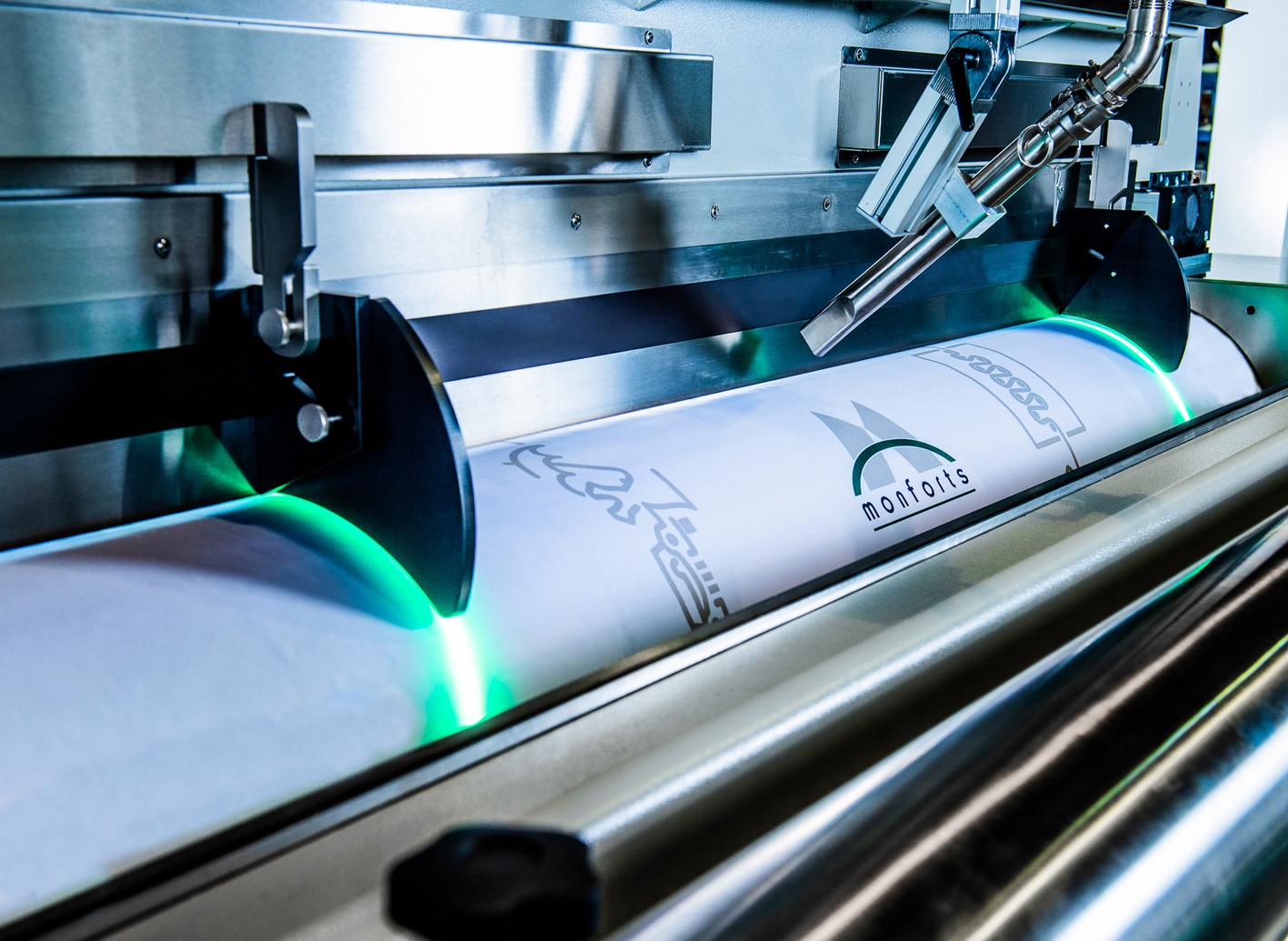
The MontexCoat coater serves a very diverse number of markets. Photo Monforts Textilmaschinen GmbH
The MontexCoat coater serves a very diverse number of markets.
24.02.2026

Monforts with coating solutions at Techtextil 2026

Over the past few years Monforts has significantly advanced its technologies for coating, with the successive introductions of the MontexCoat, coaTTex and VertiDry systems combining flexibility, precision and energy efficiency for the technical textiles market.

Monforts experts will be on hand at the forthcoming Techtextil 2026 in Frankfurt from April 21-24, to discuss the virtually endless possibilities these advanced coating and drying technologies open up for adding functionality and performance to textile substrates.

Applications
In outdoor and architectural textiles, for example, typical coated products include tents, awnings, sailcloth and blackout blinds, with coating providing the desired combinations of water resistance, dimensional stability, opacity or weather durability. 

Over the past few years Monforts has significantly advanced its technologies for coating, with the successive introductions of the MontexCoat, coaTTex and VertiDry systems combining flexibility, precision and energy efficiency for the technical textiles market.

Monforts experts will be on hand at the forthcoming Techtextil 2026 in Frankfurt from April 21-24, to discuss the virtually endless possibilities these advanced coating and drying technologies open up for adding functionality and performance to textile substrates.

Applications
In outdoor and architectural textiles, for example, typical coated products include tents, awnings, sailcloth and blackout blinds, with coating providing the desired combinations of water resistance, dimensional stability, opacity or weather durability. 

A second major field is in transport interiors, particularly automotive upholstery and interior fabrics, with coatings having a positive influence on parameters including abrasion resistance, tactile feel, stain behaviour and long-term durability. Automotive suppliers also demand absolute reproducibility across batches, which Monforts addresses through digitally-stored coating recipes that can be reloaded for identical results every time.

Beyond consumer-visible products, a large share of applications are in industrial applications, with Monforts coating ranges processing materials such as high-temperature filter media, flame-retardant barrier fabrics and heavy membranes for biogas storage systems. The technology is also used for carbon fibre prepregs and composite reinforcement fabrics, where coating precision is the key to mechanical performance. 

MontexCoat
The Monforts flagship MontexCoat coater serves a very diverse number of markets and enables full PVC coatings, pigment dyeing or minimal application surface and low penetration treatments as well as solvent coatings. Knife coating, roller coating or screen printing can also all be accommodated with this system.

In addition, the MontexCoat provides the ultimate in flexibility and the ability to switch quickly from one fabric run to the next, without compromising on the economical use of energy or raw materials.

coaTTex
The coaTTex coating unit is meanwhile exclusively dedicated to air knife and knife-over-roller coating for single-sided application with paste or foam to add properties such as waterproofing, liquid and gas protection and breathability.

Both coating units are suitable for incorporation into existing finishing ranges as well as installation with new Monforts lines, notably the industry-leading MONTEX stenter systems.

VertiDry
A further recently-introduced technology complementing these coating units is the VertiDry, a fully contactless and energy optimised convection dryer.

The VertiDry is intended for use in combination with a stenter, either before or after it, depending on the specific application, for the essential pre-drying of sensitive fabrics, as well as after the coating of airbags, denim fabrics and glass-fibre substrates. Other envisaged applications include the finishing of sportswear, outerwear, carpets, geotextiles and tarpaulins.

Industry standards
For over 40 years, Monforts machines have been manufactured at Montex Maschinenfabrik based in St. Stefan, Austria, and while there is standardisation across series-produced machines, the company is increasingly being called upon to construct bespoke machines with unique designs, according to the special needs of customers in the technical textiles sector.

“MONTEX stenters and THERMEX dyeing systems are the industry standards for the dyeing and finishing of technical textiles, providing a number of advantages in terms of production throughput and especially in energy efficiency and savings,” says Monforts Marketing Manager Nicole Croonenbroek. “These machines remain unmatched in terms of their robustness and long service life, as well as resource-efficient productivity. As a third strand of our business, our coating technologies are now being rapidly adopted by technical textile manufacturers, as the industry recognises their benefits. We look forward to discussing all possibilties for both established and new applications with interested parties in Frankfurt.”

24.02.2026

VIATT 2026: Connecting the ASEAN textile sector - sustainability, trends and technology

Opening this week Thursday, the Vietnam International Trade Fair for Apparel, Textiles, and Textile Technologies (VIATT) is set to welcome visitors from ASEAN’s dynamic textile market and beyond. From 26 to 28 February, VIATT 2026 – the fair’s third editions – will reinforce its strategic proposition with an integrated showcase of the three core sectors of the entire textile value chain. Beyond new sourcing opportunities in Apparel Fabrics & Fashion, Home & Contract Textiles, and Technical Textiles & Technologies, the fair will present an expanded fringe programme. Highlights include the inaugural Trend Forum, alongside an industry summit, local and international fashion shows, interactive workshops, and expert seminars. 

Opening this week Thursday, the Vietnam International Trade Fair for Apparel, Textiles, and Textile Technologies (VIATT) is set to welcome visitors from ASEAN’s dynamic textile market and beyond. From 26 to 28 February, VIATT 2026 – the fair’s third editions – will reinforce its strategic proposition with an integrated showcase of the three core sectors of the entire textile value chain. Beyond new sourcing opportunities in Apparel Fabrics & Fashion, Home & Contract Textiles, and Technical Textiles & Technologies, the fair will present an expanded fringe programme. Highlights include the inaugural Trend Forum, alongside an industry summit, local and international fashion shows, interactive workshops, and expert seminars. 

“As VIATT continues to grow and attract broader international participation, at this edition we are pleased to introduce the inaugural German Pavilion and Türkiye Zone, the Textile Chemicals and Dyes Zone, as well as the Trend Forum, a unified vision exploring all three sub-sectors,” said Ms Wilmet Shea, General Manager of Messe Frankfurt (HK) Ltd. “These additions highlight our commitment to enhancing the fair from multiple perspectives, as we explore new opportunities in diverse yet overlapping textile sectors, while reinforcing VIATT’s dedication to design, sustainability, innovation, and international collaboration – key elements that distinguish this platform as one of ASEAN’s premier industry hubs.”

Covering 18,000 sqm in Halls A and B, VIATT 2026 will host nearly 460 exhibitors from 21 countries and regions. The fair will feature an impressive lineup of international participants, including the returning pavilions from China, India, Taiwan, and the debut of the German Pavilion. The show floor will also include the European Zone, Japan Zone, Vietnam Zone, and the new Türkiye Zone. Econogy Hub will also return, alongside the Garment Display Zone and the Trend Forum, showcasing integrated LIFESTYLE TRENDS across the apparel, home, and technical sectors – a first for a textile trade fair.

In anticipation, visitors from across Asia-Pacific and beyond are preparing to source in Ho Chi Minh City. These include nine buyer delegations from six countries / regions, including Australia, India, Laos, Malaysia, Myanmar, Thailand, and Vietnam. To enhance the sourcing experience, the fair’s Global Exhibitor Search feature will enable buyers to connect efficiently with potential suppliers.

Fringe programme to reinforce connections across the textile spectrum
The fair’s range of fringe events include the inaugural VIATT Trend Forum, Vietnam Textile & Garment Industry Development Strategy Summit (VGTIS), and Textile Industry Exchange. Other featured events include various seminars and workshops designed to provide valuable insights into industry trends and innovations: 

  • Sustainable by Design: The Green Thread (Design & Trends): in this session, the Asia International Hemp Association, Bio-Smart Group, and TOUCHABLE will focus on the transformation of hemp fibre into a premium, eco-friendly material for fashion and home textiles. It addresses technological advancements and sustainability benefits that have facilitated hemp to enter high-value markets, emphasising its role in promoting circular design and reducing environmental impact. 
  • Fashioning a Circular Textile Economy Through Industry Collaboration (Econogy Talks): panellists from Covation Biomaterials, the Hong Kong Research Institute of Textiles and Apparel (HKRITA), RMIT University Vietnam, the UK Fashion and Textile Association (UKFT), and XAVAN will focus on circularity and the importance of solutions such as sustainable manufacturing, circular business models, recycling infrastructure, novel technologies, and more.
  • Vietnam Sourcing Forum: Insights for Suppliers and Buyers (Market Information & Business Strategies): in collaboration with MoveToAsia, this panel discussion provides expert insights for exhibitors and buyers relating to sourcing in Vietnam. It addresses key considerations for overseas stakeholders, including common misconceptions, pain points, and pitfalls faced by first-time buyers, and explores manufacturing operations, sales channels, and Vietnam’s role as a garment manufacturing hub. 
  • Redefining AI’s Role in Automated Textile Material Inspection (Technology & Solutions): in this seminar, AiDLab examines how AI is transforming material inspection within the textile industry. Traditional methods often rely on human checks, leading to inefficiencies. The discussion will focus on the advantages of AI, including enhanced accuracy and real-time inspection in fast-paced production environments. Challenges in adopting AI will also be addressed, along with essential considerations for companies preparing for implementation.

In addition, VIATT 2026 will feature three captivating fashion shows that blend local and international trends: the Local Booming Designer – Phan Dang Hoang will present a collection that fuses Vietnam’s rich cultural heritage with modern aesthetics. The Sustainable, Zero-Waste Fashion Show – KHAAR features a luxury brand that combines heritage craftsmanship with innovation, using circular materials and digital design for sustainable fashion. The third show, the Essence of French Fashion, will feature esteemed brands Royal Mer, a heritage knitwear house known for its timeless sea-inspired garments designed for durability across generations, and Fantaisie Militaire, which draws from military styles to emphasise functionality, timelessness, and the value of ‘Made in France’. Fairgoers can also look forward to the Upcycled Jewellery Workshop, a hands-on experience for participants to transform discarded textiles into unique, handcrafted accessories.

The Vietnam International Trade Fair for Apparel, Textiles and Textile Technologies (VIATT) is organised by Messe Frankfurt (HK) Ltd and the Vietnam Trade Promotion Agency (VIETRADE). VIATT 2026 will be held from 26 – 28 February 2026.

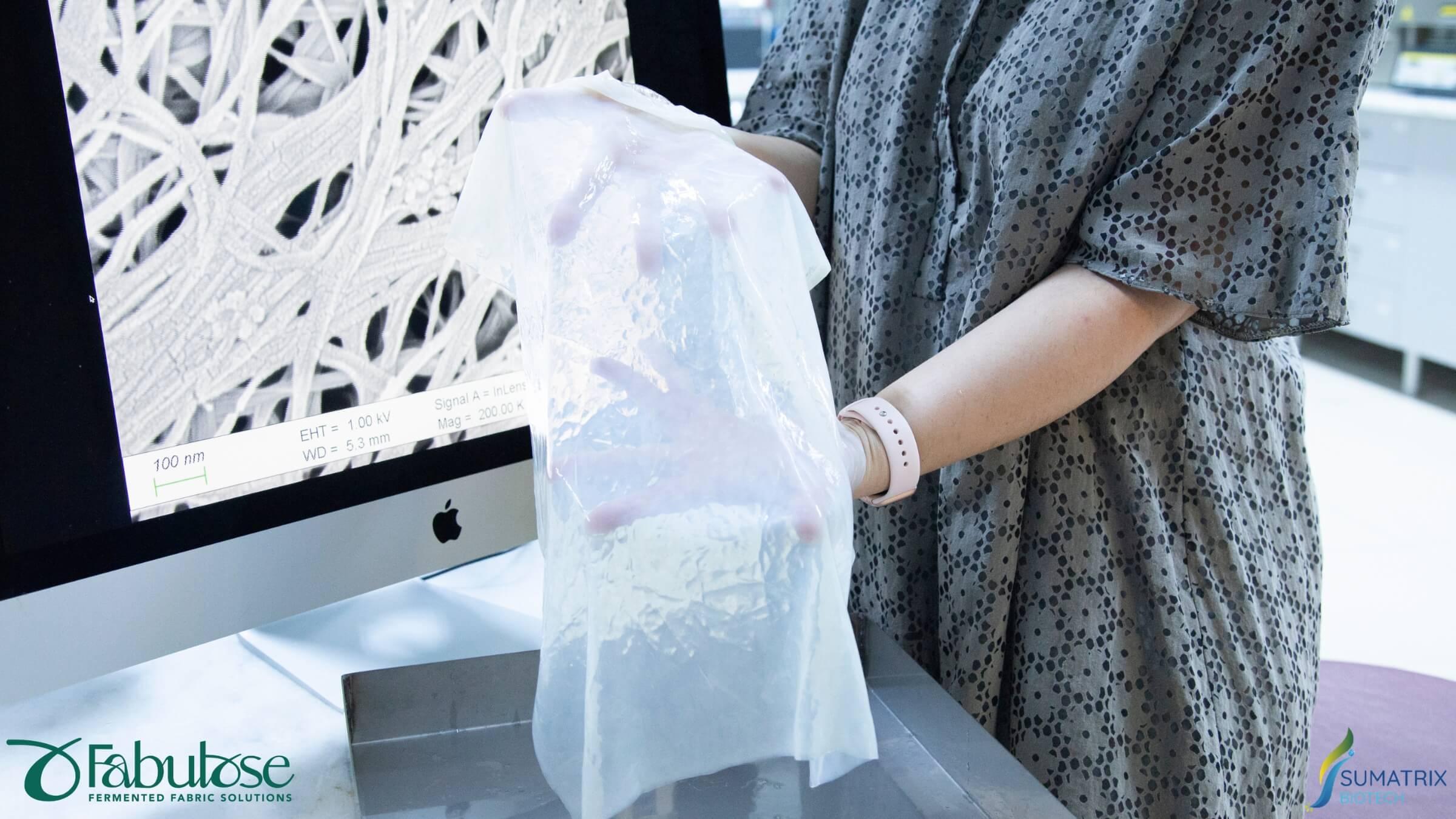
Bacterial cellulose film produced by Sumatrix. Photo: Source: Sumatrix Biotech (CC BY-NC 4.0)
Bacterial cellulose film produced by Sumatrix.
24.02.2026

Fabricating vegan and circular leather alternatives from bio-tech derived cellulose

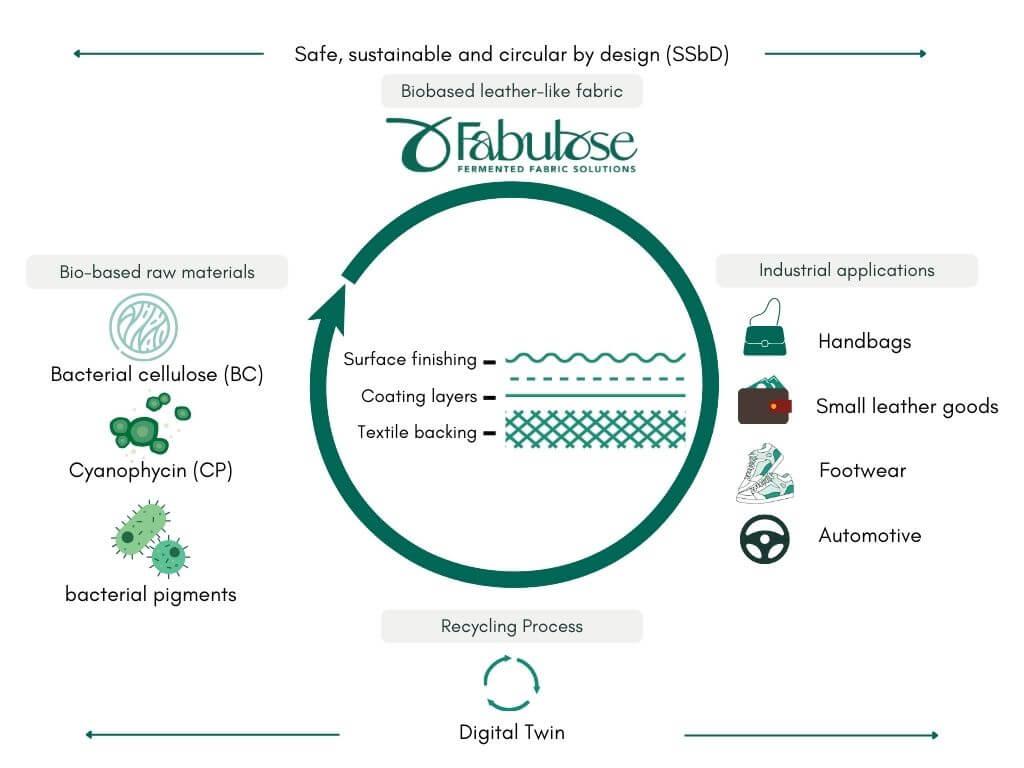
Fabulose is an EU funded project coordinated by the German Institutes of Textile and Fiber Research (DITF). Its consortium consists of leading research institutes, biotech innovators, and industry stakeholders who aim to create high-performance, biobased and recyclable leather-like fabrics, using efficient biotech production routes for bacterial cellulose, cyanophycin and bacterial pigments

Current leather alternatives are either made from petrol-based plastics and non-recyclable, or they are (partly) biobased, but difficult to scale up and recycle. The project, supported by the Circular Bio-based Europe Joint Undertaking (CBE JU), is investigating how animal-based materials can be replaced by environmentally friendly alternatives in industries such as automotive, fashion, and upholstered furniture.

Fabulose is an EU funded project coordinated by the German Institutes of Textile and Fiber Research (DITF). Its consortium consists of leading research institutes, biotech innovators, and industry stakeholders who aim to create high-performance, biobased and recyclable leather-like fabrics, using efficient biotech production routes for bacterial cellulose, cyanophycin and bacterial pigments

Current leather alternatives are either made from petrol-based plastics and non-recyclable, or they are (partly) biobased, but difficult to scale up and recycle. The project, supported by the Circular Bio-based Europe Joint Undertaking (CBE JU), is investigating how animal-based materials can be replaced by environmentally friendly alternatives in industries such as automotive, fashion, and upholstered furniture.

Fabulose uses advanced fermentation techniques, utilizes waste streams as feedstocks, and optimizes processes with the assistace of AI. This enables the environmentally-friendly and efficient production of bacterial cellulose, cyanophycin and pigments. These bio-based materials are combined in a coating formulation that replicates the durability and aesthetics of traditional leather. DITF’s HighPerCell® technology allows for re-spinning of bacterial cellulose to filaments to create recycled textile backings that offer high tensile strength without toxic agents. Instead of processing individual batches, the technology also allows to implement a roll-to-roll production process, thereby simplifying future scale-up to cost-effective mass production.

In addition, market requirements have been collected to select optimal material characteristics, while eco-design and Safe-by-design principles help to assess potential risks and ensure alignment with the safety and sustainability objectives. A digital twin framework will include key process parameters for optimisation and monitoring of material performances.

Summary of the key project innovations:

  • Using fermentation products to enable fast and cost-effective production of raw materials
  • Grow micro-organisms on waste feedstocks and CO2 to reduce production costs and environmental impact
  • Re-spinning bacterial cellulose to filaments to create recyclable, consistent and high-quality fabrics
  • Enabling production of cyanophycin to create durable coatings and finishing
  • Implementing roll-to-roll production process to simplify future scale-up

Project partners
The Fabulose project has a duration of 3,5 years and a budget of ca. 3,5 M euro.

The consortium includes 10 partners from 6 European countries, spanning the entire value chain, from research to real-world applications:

German Institutes of Textile and Fiber Research Denkendorf (DITF) (Germany), Next Technology Tecnotessile Societa Nazionale (Italy), University of Maribor (Slovenia), Sumatrix Biotech (Turkey), VTL GmbH (Austria), Novis GmbH (Germany), Melina Bucher (Germany), Benecke-Kaliko GmbH (Germany), Konrad Hornschuch GmbH (Germany), University of Aveiro (Portugal), and Steinbeis 2i GmbH (Germany).