

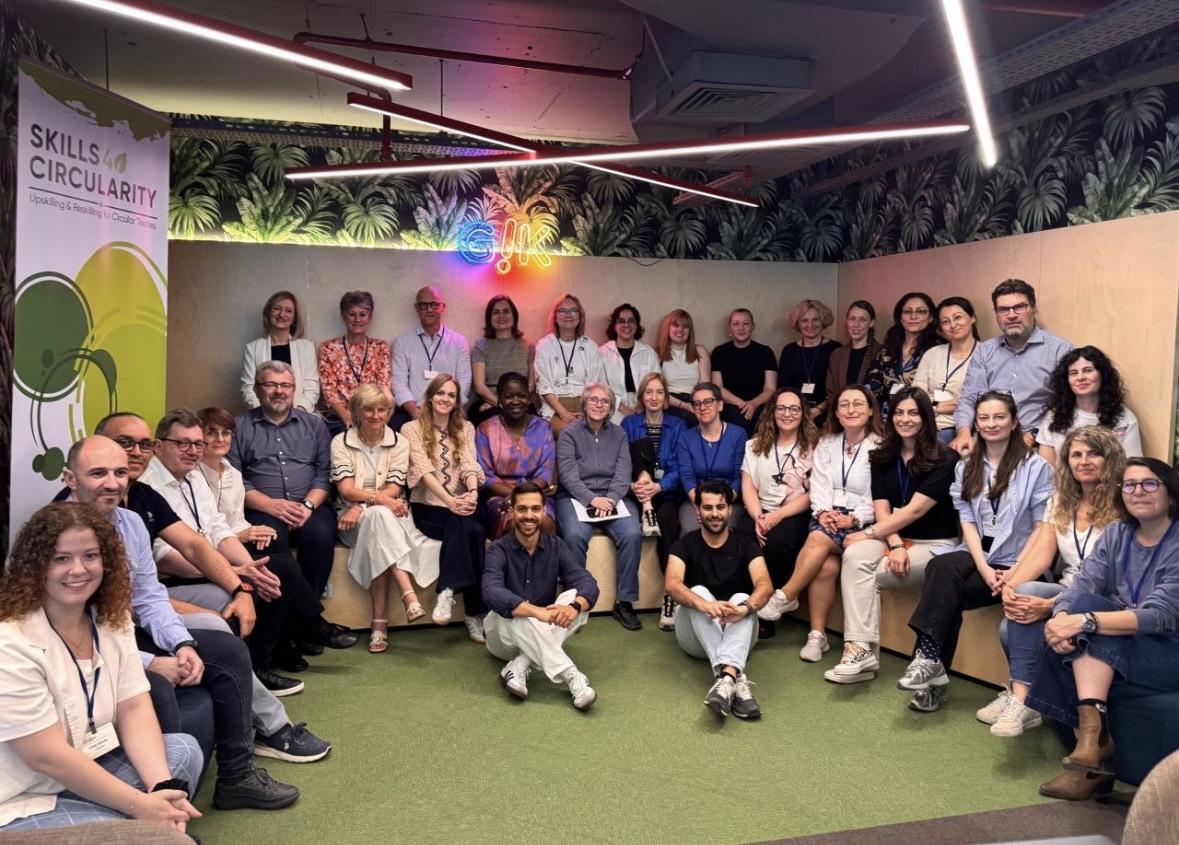


IVGT joins EU project Skills4Circularity
New skills for the circular economy and digitalisation
Recycling, traceability, eco-design and digitalisation are among the key future challenges facing the European textile industry. The Erasmus+ project Skills4Circularity, involving 21 partners from twelve countries, is investigating the skills required to address these challenges.
Skills4Circularity is an Erasmus+ project involving 21 partners from twelve countries. The aim is to prepare the European textile industry for the challenges of the circular economy, recycling, traceability and digitalisation through new training programmes. The IVGT is participating as the German industry partner. The project runs from November 2025 to October 2029 and is developing, among other things, training modules, MOOCs, masterclasses and a European Textile Skills Observatory.
The aim of the project is to identify skills gaps and, building on these, to develop tailor-made training programmes for the circular textile economy. The project is based on a Europe-wide company survey involving 183 participants from twelve countries, 22 expert interviews, and an AI-supported analysis of 313 job advertisements across eleven countries. The results clearly show that the industry’s greatest challenges lie less in a lack of technology and more in a lack of skills. Knowledge of regulatory requirements, the circular economy, life cycle assessments (LCA), data management and process integration is particularly in demand. Traceability, material sorting and sustainable production processes also rank among the industry’s most important areas of expertise.
Sustainability requires systemic thinking
The analysis also highlights that whilst sustainability, the circular economy and technological innovation are recognised as strategic goals regardless of company size, their implementation often takes place incrementally and in isolation. In many cases, measures are not yet viewed as part of a holistic transformation strategy.
There are clear differences between company sizes in this regard. Large companies have extensive technological and organisational resources but face significant regulatory and transformational pressure. Medium-sized companies often drive the functional and sustainable development of textiles but are frequently constrained by economic conditions and customer requirements. Small enterprises score highly on flexibility but have only limited technological capacity. Micro-enterprises often operate as innovative niche providers but are particularly dependent on partnerships and stable market conditions.
A key finding of the research was that the greatest obstacles to implementing circular economy concepts do not stem from a lack of awareness of the issues. Rather, skills gaps, insufficient integration of processes across the entire product life cycle, a lack of data standards, and often inadequate coordination along the value chain are the decisive factors. There is a particularly acute need for specialist knowledge to translate the increasing EU regulations and sustainability requirements into operational practice.
The study also shows that recycling, eco-design and sustainable production are not yet sufficiently integrated within many companies. Furthermore, recycling processes are often outsourced and only considered at the end of the product life cycle. Although eco-design is increasingly being incorporated into product development, it is rarely firmly integrated into standardised development processes. Sustainable production measures often focus on resource efficiency and process optimisation without being systematically linked to circular strategies. As a result, potential for life-cycle-oriented optimisation of materials, products and processes often remains untapped.
Three training modules for the textile transformation
Based on the analysis results, Skills4Circularity is now developing three practice-oriented training modules on the topics of recycling technologies, eco-design for the circular economy and sustainable production.
The ‘Recycling Technologies’ module provides knowledge on legal requirements, material sorting and the processing of textile waste. The aim is to support companies in better structuring recycling processes and improving collaboration along the recycling value chain.
The “Eco-design for the Circular Economy” module focuses on regulatory requirements, life-cycle assessment and traceability systems. Participants will be equipped to systematically integrate circular design principles into product development and to establish the conditions for a functioning circular economy as early as the initial development phases.
The third module is dedicated to sustainable production. The focus is on resource-efficient and low-waste production processes, as well as the organisational embedding of sustainability goals within the company. In particular, the aim is to link production processes more closely with circular strategies and recycling approaches.
With these training programmes, Skills4Circularity aims to support the European textile industry in integrating the circular economy, digitalisation and sustainability more closely into operational practice. Continuing professional development thus becomes a key success factor for the transformation of the sector.
IVGT