From the Sector

Reset
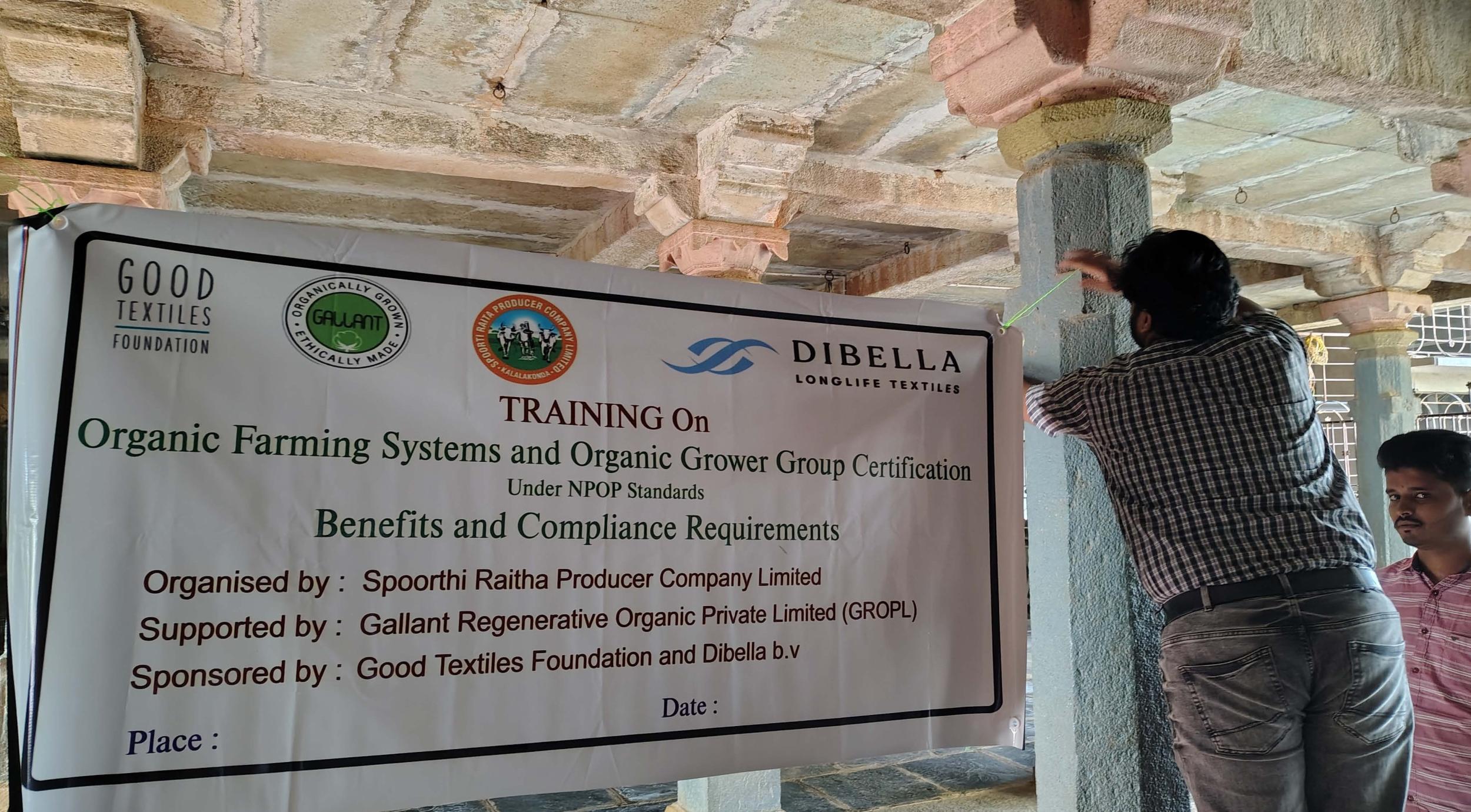
Start of the Training for Common Ground Farmers Photo GoodTextiles Foundation
Start of the Training for Common Ground Farmers
12.05.2026

GoodTextiles Foundation launches “Common Ground” Farmer Initiative in India

The GoodTextiles Foundation, in collaboration with Dibella India, Gallant Regenerative Organic Private Limited, and Spoorthi Raith Producer Company Limited, announces the launch of its new flagship project Common Ground. This initiative marks a significant step toward fostering sustainable, regenerative cotton cultivation among smallholder farmers in southern India. 

A Shared Vision Rooted in the Land 
Set in the rural landscapes of Karnataka’s Haveri district, Common Ground brings together farmers, local communities and agricultural experts with a unified goal: to restore harmony between people and nature through organic and regenerative farming practices. 

The foundation for this initiative was laid as early as 2024 through site visits, farmer dialogues and collaboration with the University of Agricultural Sciences Dharwad. In 2025, the project entered its implementation phase, including soil assessments, team training, community engagement and the registration of participating farmers. 

The GoodTextiles Foundation, in collaboration with Dibella India, Gallant Regenerative Organic Private Limited, and Spoorthi Raith Producer Company Limited, announces the launch of its new flagship project Common Ground. This initiative marks a significant step toward fostering sustainable, regenerative cotton cultivation among smallholder farmers in southern India. 

A Shared Vision Rooted in the Land 
Set in the rural landscapes of Karnataka’s Haveri district, Common Ground brings together farmers, local communities and agricultural experts with a unified goal: to restore harmony between people and nature through organic and regenerative farming practices. 

The foundation for this initiative was laid as early as 2024 through site visits, farmer dialogues and collaboration with the University of Agricultural Sciences Dharwad. In 2025, the project entered its implementation phase, including soil assessments, team training, community engagement and the registration of participating farmers. 

Seven carefully selected villages now form the core of the project. Chosen for their accessibility, strong community structures and development potential, they provide fertile ground for a scalable model that can be replicated across other regions. 

Empowering Farmers Through Knowledge and Structure 
At the heart of Common Ground lies a commitment to people. To date, 510 farmers have been identified, with 475 already in the final stages of enrolment into a newly established Organic Cotton Grower Group (OGG). 

The project combines technical expertise with hands-on support close, continuous support. A dedicated team—comprising an Internal Control System (ICS) Manager and trained field staff—is being steadily expanded to ensure effective on-the-ground implementation. Farmers participate in targeted training sessions that introduce them to organic cultivation practices and certification requirements, equipping them with the knowledge needed for long-term success. 

In parallel, external experts are developing location-specific “Packages of Practice” tailored to local conditions, alongside watershed-level strategies that promote sustainable resource management. To ensure transparency and traceability from the outset, all farms are digitally documented, including GPS-based mapping of agricultural plots.

Beyond Cotton: Building Resilient Futures 
Common Ground goes far beyond sustainable cotton production. It is an investment in the long-term resilience of farming communities. By improving soil health, conserving water resources and enhancing biodiversity, the initiative supports both environmental sustainability and economic opportunity. 

At the same time, it strengthens farmers’ independence and confidence in an agricultural system capable of sustaining livelihoods for generations to come. 

Together the partners are building a scalable model for regenerative value creation – from seed to finished textile. Step by step, a transparent and responsible supply chain is emerging. 

With every field converted, every training delivered and every partnership formed, Common Ground is cultivating more than cotton – it is nurturing a growing community committed to shaping a more sustainable future.

Source:

GoodTextiles Foundation

08.05.2026

ACIMIT: Textile Machinery Orders Index, Q1 2026

In the first quarter of 2026, order intake for Italian textile machinery manufacturers recorded a decrease of 5% compared to the same period in 2025, reflecting a still challenging start to the year. The decline affected foreign markets (-7%), while the domestic market showed growth (+21%).

Compared with the previous quarter (October–December 2025), total order intake increased by 18%. The orders index for the January–March 2026 period stood at 37.3 points (base year 2021=100). In Italy, the index reached 35.3 points, while in foreign markets it stood at 37.6 points.

In the first quarter of 2026, the order backlog guaranteed a workload of approximately 4.5 months.

From a sector perspective, weaving and other manufacturing segments showed relatively more dynamic signals.

Forecasts for the second quarter of 2026 (compared with the previous quarter) indicate pessimism for the domestic market and stability for the foreign one.

In the first quarter of 2026, order intake for Italian textile machinery manufacturers recorded a decrease of 5% compared to the same period in 2025, reflecting a still challenging start to the year. The decline affected foreign markets (-7%), while the domestic market showed growth (+21%).

Compared with the previous quarter (October–December 2025), total order intake increased by 18%. The orders index for the January–March 2026 period stood at 37.3 points (base year 2021=100). In Italy, the index reached 35.3 points, while in foreign markets it stood at 37.6 points.

In the first quarter of 2026, the order backlog guaranteed a workload of approximately 4.5 months.

From a sector perspective, weaving and other manufacturing segments showed relatively more dynamic signals.

Forecasts for the second quarter of 2026 (compared with the previous quarter) indicate pessimism for the domestic market and stability for the foreign one.

Marco Salvadè, President of ACIMIT, commented:
“It is encouraging to see the first positive sign in the domestic market, but forecasts still reveal a degree of pessimism. The difficult international context and the slow actions of government institutional representatives do not allow companies to plan investments. As an Association, we are working in close synergy with the Italian Trade Agency (ICE) to strengthen promotional activities across several strategic markets. We also look with confidence to the upcoming ITMA 2027 in Hannover, which will represent an important opportunity to relaunch the sector, stimulate new investments, and strengthen the international presence of Italian manufacturers.”

ACIMIT (the Association of Italian Textile Machinery Manufacturers) was established in 1945 with the primary aim of promoting the Italian textile machinery industry by supporting its activities both in Italy and abroad. ACIMIT represents an industrial sector comprising around 300 companies (employing approximately 12,500 people) and producing machinery with a total value of approximately €1.9 billion, about 86% of which is exported. Creativity, sustainable technology, reliability, and quality are the key features that have made Italian textile machinery a world leader.

05.05.2026

NCTO: Officer elections for fiscal year 2026

The National Council of Textile Organizations (NCTO), representing the full spectrum of U.S. textiles from fiber through finished sewn products, held its officer elections for fiscal year 2026 at its annual meeting April 14-16.

NCTO has elected Amy Bircher Bruyn, CEO and Founder of MMI Textiles as Chair, and Jay Todd, CEO and Managing Partner of Service Thread, as Vice Chair.

In addition to the appointment of a new chair and vice chair, NCTO elected chairs for each of its five councils. NCTO is comprised of five councils to ensure a broad representation of the industry supply chain. Each council has an allotted number of members who are elected to the association’s Board of Directors, in addition to the Executive Committee.

The National Council of Textile Organizations (NCTO), representing the full spectrum of U.S. textiles from fiber through finished sewn products, held its officer elections for fiscal year 2026 at its annual meeting April 14-16.

NCTO has elected Amy Bircher Bruyn, CEO and Founder of MMI Textiles as Chair, and Jay Todd, CEO and Managing Partner of Service Thread, as Vice Chair.

In addition to the appointment of a new chair and vice chair, NCTO elected chairs for each of its five councils. NCTO is comprised of five councils to ensure a broad representation of the industry supply chain. Each council has an allotted number of members who are elected to the association’s Board of Directors, in addition to the Executive Committee.

“I am pleased to announce NCTO’s 2026 officers, council chairs, and board and executive committee members,” said NCTO President and CEO Kim Glas. “I thank Chair Amy Bircher Bruyn and Vice Chair Jay Todd for stepping into these critical roles. As we navigate a challenging environment, their leadership will be key as we advance policies to preserve preferential treatment under USMCA and CAFTA-DR, strengthen customs enforcement against import fraud, refine tariff policies with carve-outs for inputs and machinery not made in the U.S., expand the Berry Amendment and America-made procurement, and grow our Western Hemisphere co-production chain—while opposing measures that undermine a domestic supply chain supporting more than 450,000 jobs.”

Elected as NCTO Chair and Vice Chair for 2026:

  • Chair – Amy Bircher Bruyn, MMI Textiles
    Ms. Bircher Bruyn is CEO and Founder of MMI Textiles, a global industrial and custom textile supplier based in Brooklyn, Ohio.
  • Vice Chair – Jay Todd, CEO and Managing Director of Service Thread, an industrial yarn and sewing thread manufacturer based in Laurinburg, N.C.

Elected to the NCTO Board of Directors during the various Council meetings were the following:

  • Fiber Council – David Adkins of Lenzing Fibers; Geoffrey Hietpas of The LYCRA Company; and David Poston of Palmetto Synthetics
  • Yarn Council – Justin Ferdinand of Kentwool; Chris Alt of American & Efird; Marc Doyon of Gildan; Charles Heilig of Parkdale; Eddie Ingle of Unifi; and Tim Manson of Meridian Specialty Yarn Group
  • Fabric and Home Products Council –Allen Jacoby of Milliken & Company; Leib Oehmig of Glen Raven Inc.; Bill Rogers of Mount Vernon Mills; Brian Rosenstein of TSG Finishing; Dan Russian of Sage Automotive Interiors; and Walter Spiegel of Standard Textile
  • Finished Textiles and Apparel Products Council – Gabrielle Ferrara of Ferrara (Alternate: Marisa Fumei-South of Two-One-Two New York)
  • Industry Support Council – Todd Bassett of Fi-Tech; Greg Duncan of American Truetzschler; and Jim Reed of YKK Corp.

Elected by their respective Councils to serve on the Executive Committee were:
Justin Ferdinand of Kentwool; Tim Manson of Meridian Specialty Yarn Group; Bill Rogers of Mount Vernon Mills; Allen Jacoby of Milliken & Company; David Adkins of Lenzing Fibers; Gabrielle Ferrara of Ferrara; and Todd Basset of Fi-Tech.

NCTO Chair Amy Bircher Bruyn has appointed additional executives to serve on the Executive Committee: Chuck Hall, Barnet and NCTO immediate past chairman; Anderson Warlick, Parkdale Mills; Jay Self, Greenwood Mills; Marisa Fumei-South, Two One Two New York; and Jackie Ferrari, American Fashion Network.

Elected to chair the Councils:

•    Fiber Council: David Adkins of Lenzing Fibers
•    Yarn Council: Tim Manson of Meridian Specialty Yarn Group
•    Fabric and Home Products Council: Allen Jacoby of Milliken & Company
•    Finished Textiles and Apparel Products Council: Gabrielle Ferrara of Ferrara
•    Industry Support Council: Todd Bassett of Fi-Tech

In addition to the chair and vice chair, NCTO also elected the following officers for the upcoming fiscal year:

•    President & CEO – Kim Glas, NCTO
•    Treasurer – Robin Haynes, NCTO
•    Secretary – Katherine White, NCTO

Source:

National Council of Textile Organizations

04.05.2026

Market Study on Thermoplastic Composites

The European Alliance for Thermoplastic Composites (EATC) has published a comprehensive study on the market, applications and prospects for thermoplastic composites. 

Thermoplastic fibre-reinforced plastics – also known as thermoplastic composites – are becoming increasingly important across a wide range of industries. From the automotive industry and aerospace to construction and sports and leisure products, they offer a compelling combination of high strength, low weight and good recycling prospects. As such, they are regarded as a key material for sustainable and high-performance lightweight construction solutions. 

Against this backdrop, the European Alliance for Thermoplastic Composites (EATC) has commissioned and provided technical support for a new market study on the European market for thermoplastic composites. The aim of the study is to provide a systematic overview of the current situation, developments and future opportunities within this dynamic materials segment. 

The European Alliance for Thermoplastic Composites (EATC) has published a comprehensive study on the market, applications and prospects for thermoplastic composites. 

Thermoplastic fibre-reinforced plastics – also known as thermoplastic composites – are becoming increasingly important across a wide range of industries. From the automotive industry and aerospace to construction and sports and leisure products, they offer a compelling combination of high strength, low weight and good recycling prospects. As such, they are regarded as a key material for sustainable and high-performance lightweight construction solutions. 

Against this backdrop, the European Alliance for Thermoplastic Composites (EATC) has commissioned and provided technical support for a new market study on the European market for thermoplastic composites. The aim of the study is to provide a systematic overview of the current situation, developments and future opportunities within this dynamic materials segment. 

Focus on market structure, applications and growth drivers 
The study analyses the fundamental material properties of thermoplastic composites and highlights the advantages of using them over alternative materials. It also identifies differences between various material classes and outlines the historical development of their industrial applications. 

Particular emphasis is placed on analysing the current size of the European market and the application areas that dominate today. In addition, the study identifies future market potential based on relevant macroeconomic factors. 

In focus: LFT, GMT und CFRTP 
The focus is in particular on LFT (long fibre-reinforced thermoplastics), GMT (glass mat reinforced thermoplastics) and CFRTP (continuous fibre-reinforced thermoplastics). These material groups play a central role in modern structural components with high mechanical requirements. They combine the advantages of thermoplastic matrices – such as short cycle times, efficient processing and new manufacturing possibilities – with the performance of reinforcing fibres. 

A strategic material for European industry 
The findings of the study highlight the growing strategic importance of thermoplastic composites for Europe as an industrial hub. Particularly at a time when demands for resource efficiency, CO₂ reduction and the circular economy are on the rise, thermoplastic composites offer great potential for innovative product solutions. 

Now available
The study is now available in PDF format from AVK upon advance payment. EATC and AVK members can purchase the study for EUR 149,- (plus VAT); for non members, the study is available for EUR 349,- (plus VAT).