From the Sector

Reset
236 results
Ravel - shredded polyester/elastane material ready for processing (c) Ravel
18.09.2026

Ravel raises $8.2m to scale blended-textile recycling

Ravel has closed an oversubscribed $8.2 million seed round led by One Small Planet, with participation from AP Ventures, Overlay Capital, Lichen Ventures and existing investors. The funding is intended to move the Seattle-based recycling company from pilot operation towards commercial readiness.

Its Purification Recycling process is aimed at one of apparel recycling's persistent problems: stretch blends. Elastane is widely used in activewear, denim, underwear and other garments, yet even relatively small percentages can interfere with established recycling routes.

Rather than treating the whole textile as a single feedstock, Ravel is developing a separation and purification route for polyester/elastane blends. The company says recovered material can be converted into recycled plastic pellets for renewed use as a raw material.

The next phase will test more than chemistry. Commercial viability depends on throughput, feedstock variability, separation efficiency, energy and chemical inputs, and the quality of the recovered fractions. Ravel plans to validate the process at production scale with textile partners.

Ravel has closed an oversubscribed $8.2 million seed round led by One Small Planet, with participation from AP Ventures, Overlay Capital, Lichen Ventures and existing investors. The funding is intended to move the Seattle-based recycling company from pilot operation towards commercial readiness.

Its Purification Recycling process is aimed at one of apparel recycling's persistent problems: stretch blends. Elastane is widely used in activewear, denim, underwear and other garments, yet even relatively small percentages can interfere with established recycling routes.

Rather than treating the whole textile as a single feedstock, Ravel is developing a separation and purification route for polyester/elastane blends. The company says recovered material can be converted into recycled plastic pellets for renewed use as a raw material.

The next phase will test more than chemistry. Commercial viability depends on throughput, feedstock variability, separation efficiency, energy and chemical inputs, and the quality of the recovered fractions. Ravel plans to validate the process at production scale with textile partners.

The financing adds capacity at a point where recyclers are increasingly trying to tackle blends that mechanical systems cannot readily return to fibre.

Ben Muller (c) INDA Association of the Nonwoven Fabrics Industry
15.09.2026

INDA Hires Ben Muller as Executive Director

INDA, the Association of the Nonwoven Fabrics Industry, announced today that Ben Muller has joined the association as executive director. Mr. Muller brings more than 20 years of progressive leadership experience spanning nonprofit organizations, corporations and trade associations.

Most recently, Mr. Muller served on the senior executive team of the High Point Market Authority, where he led marketing, public relations and educational programming for one of the world’s largest trade shows. Previously, he held senior brand and marketing leadership positions with Hanesbrands and Kayser-Roth, gaining extensive experience in textile and apparel supply chains. He began his career serving mission-driven organizations, including the American Cancer Society and the National Multiple Sclerosis Society.

Tony Fragnito, INDA’s current president and CEO, will transition to an executive consultant role in January 2027 to support the leadership transition and focus on projects and initiatives designed to expand the reach and participation of the Global Nonwovens Alliance (GNA). His planned retirement will occur in December 2027.

INDA, the Association of the Nonwoven Fabrics Industry, announced today that Ben Muller has joined the association as executive director. Mr. Muller brings more than 20 years of progressive leadership experience spanning nonprofit organizations, corporations and trade associations.

Most recently, Mr. Muller served on the senior executive team of the High Point Market Authority, where he led marketing, public relations and educational programming for one of the world’s largest trade shows. Previously, he held senior brand and marketing leadership positions with Hanesbrands and Kayser-Roth, gaining extensive experience in textile and apparel supply chains. He began his career serving mission-driven organizations, including the American Cancer Society and the National Multiple Sclerosis Society.

Tony Fragnito, INDA’s current president and CEO, will transition to an executive consultant role in January 2027 to support the leadership transition and focus on projects and initiatives designed to expand the reach and participation of the Global Nonwovens Alliance (GNA). His planned retirement will occur in December 2027.

The creation of the executive director position follows the formation of the GNA by INDA and EDANA and represents the next step in the evolution of INDA’s staff leadership to support the alliance. Mr. Muller’s broad leadership experience, strategic marketing expertise and deep understanding of member and industry engagement will be valuable as he leads INDA’s strategic initiatives, oversees operations and represents the interests of the nonwovens industry across the Americas.

“I am honored to join INDA at such a pivotal moment for the industry,” said Mr. Muller. “The formation of the Global Nonwovens Alliance creates an exciting opportunity to strengthen collaboration and expand the value we provide to members. I look forward to listening to our members, learning from their expertise and ensuring INDA continues to be a strong advocate and resource for the industry throughout the Americas.”

“Tony has provided outstanding leadership to INDA during a transformational period for both the association and the global nonwovens industry,” said Mark A. Thornton, chair of the INDA Board of Directors and vice president, Baby Care, Fem Care and Family Care Quality Assurance, The Procter & Gamble Company. “The Board is deeply appreciative of his leadership, commitment to our members and role in helping establish the Global Nonwovens Alliance. As we look ahead, we are confident Ben brings the strategic thinking, industry experience and collaborative leadership needed to build on that strong foundation and guide INDA into its next chapter.”

“Ben’s appointment represents an important step in bringing the vision of the Global Nonwovens Alliance to life,” said Murat Dogru, CEO, GNA. “The strength of the Alliance will depend on combining a truly global perspective with strong regional leadership that understands the priorities of its members. I am very pleased to welcome him and look forward to working closely together as we build the next chapter of the Alliance.”

“Leading INDA has been one of the most rewarding experiences of my career, and I am grateful for the opportunity to work with such a dedicated staff, Board, and membership,” said Fragnito. “It has been a meaningful way to cap off my career, and I look forward to working closely with Ben to ensure a seamless transition of INDA’s business operations and member relationships. I am excited to support him as he helps lead INDA and a partner with Murat as he leads the Global Nonwovens Alliance.”

Source:

INDA Association of the Nonwoven Fabrics Industry

Tacnera: Freudenberg’s innovative technology for silicone-coated secondary foam dressings. © Freudenberg Performance Materials
Tacnera: Freudenberg’s innovative technology for silicone-coated secondary foam dressings.
14.09.2026

Wound care becomes more textile-integrated

Freudenberg Performance Materials and Foshan United Medical Technologies (UMT) will make their first joint appearance at the WUWHS congress in Kuala Lumpur since Freudenberg acquired the Chinese wound-care specialist at the end of July. The combined platform stretches from fibre and nonwoven technologies to finished advanced wound-care solutions.

UMT’s primary dressings include alginate, carboxymethylcellulose (CMC) and chitosan technologies. Alginate variants include silver-containing options for antimicrobial protection, while CMC is used for moisture management and gel formation. Chitosan brings haemostatic and bacteriostatic properties. UMT is also presenting a non-invasive wound-closure system.

Freudenberg Performance Materials and Foshan United Medical Technologies (UMT) will make their first joint appearance at the WUWHS congress in Kuala Lumpur since Freudenberg acquired the Chinese wound-care specialist at the end of July. The combined platform stretches from fibre and nonwoven technologies to finished advanced wound-care solutions.

UMT’s primary dressings include alginate, carboxymethylcellulose (CMC) and chitosan technologies. Alginate variants include silver-containing options for antimicrobial protection, while CMC is used for moisture management and gel formation. Chitosan brings haemostatic and bacteriostatic properties. UMT is also presenting a non-invasive wound-closure system.

Freudenberg complements these primary-care products with Tacnera®, its patented silicone-coated foam-dressing technology. A dual-silicone construction combines secure edge adhesion with a gentler wound-contact layer, while a wave-pattern coating is designed to improve flexibility and exudate management. The wider industrial story is vertical integration: UMT’s capabilities run from fibre production and functionalisation through nonwovens, packaging, sterilisation and regulatory approval.

Source:

Freudenberg Performance Materials Holding GmbH

Photo Richard Harnisch, IÖW
11.09.2026

Lusatia builds a regional fibre economy

A new German research project is exploring how Lusatia can build a regional natural-fibre economy as the former lignite region undergoes structural transformation. Over three years, IÖW and Zittau/Görlitz University of Applied Sciences will examine value chains based on flax, industrial hemp, fibre nettle, miscanthus and residues such as straw and municipal leaves.

The focus is explicitly on industrial applications rather than conventional apparel textiles. Potential outlets include natural-fibre-reinforced plastics, specialty papers, lightweight panels, composites, automotive components and new packaging materials. A regionally resolved material-flow model will map feedstock availability, processing routes, land-use conflicts and possible bottlenecks.

The project treats raw-material availability and industrialisation as one system. Workshops with farmers, processors, manufacturers, municipalities and economic-development actors are intended to produce practical transformation pathways for a circular bioeconomy.


A new German research project is exploring how Lusatia can build a regional natural-fibre economy as the former lignite region undergoes structural transformation. Over three years, IÖW and Zittau/Görlitz University of Applied Sciences will examine value chains based on flax, industrial hemp, fibre nettle, miscanthus and residues such as straw and municipal leaves.

The focus is explicitly on industrial applications rather than conventional apparel textiles. Potential outlets include natural-fibre-reinforced plastics, specialty papers, lightweight panels, composites, automotive components and new packaging materials. A regionally resolved material-flow model will map feedstock availability, processing routes, land-use conflicts and possible bottlenecks.

The project treats raw-material availability and industrialisation as one system. Workshops with farmers, processors, manufacturers, municipalities and economic-development actors are intended to produce practical transformation pathways for a circular bioeconomy.


Source:

Institut für ökologische Wirtschaftsforschung (IÖW) / Hochschule Zittau/Görlitz

11.09.2026

Recycled polyester heads to New York

Indorama Ventures is supplying fabrics woven with deja™ recycled polyester yarn to Thai label KH Editions. Two looks and accessories from the ten-look Spring/Summer 2027 collection will be shown in New York on 15 September during New York Fashion Week.

The collaboration builds on Indorama Ventures’ RECO programme, launched in 2011 and expanded into RECO Collective in 2023. The initiative combines recycled materials and industry support with emerging designers, aiming to demonstrate that circular inputs can meet the quality and aesthetic requirements of internationally presented fashion.

For the wider value chain, the project is a useful example of material innovation being connected to design, brand building and market access rather than remaining a stand-alone recycling story. Commercial scaling will ultimately depend on consistent quality, available volumes and the ability of recycled yarns to work within established fabric and garment production.

Indorama Ventures is supplying fabrics woven with deja™ recycled polyester yarn to Thai label KH Editions. Two looks and accessories from the ten-look Spring/Summer 2027 collection will be shown in New York on 15 September during New York Fashion Week.

The collaboration builds on Indorama Ventures’ RECO programme, launched in 2011 and expanded into RECO Collective in 2023. The initiative combines recycled materials and industry support with emerging designers, aiming to demonstrate that circular inputs can meet the quality and aesthetic requirements of internationally presented fashion.

For the wider value chain, the project is a useful example of material innovation being connected to design, brand building and market access rather than remaining a stand-alone recycling story. Commercial scaling will ultimately depend on consistent quality, available volumes and the ability of recycled yarns to work within established fabric and garment production.

Source:

Indorama Ventures Public Company Limited


11.09.2026

Wool turns sunlight into clean water

Cornell University researchers have demonstrated that polydopamine-dyed wool can serve as a low-cost, renewable material for solar-driven water purification. The approach uses interfacial solar vapor generation, concentrating solar heat at the water surface while a textile structure transports water and converts it into vapor.

The strongest configuration used ultrablack wool positioned vertically and illuminated from both sides. It produced 2.43 kilograms of water per square metre of fabric per hour, while polydopamine-only wool achieved 2.21 kilograms. Both rates were nearly twice those reported for conventional horizontal two-dimensional evaporation systems. The material also operated continuously for ten hours without salt accumulation.

Performance depends on fibre choice, dye chemistry, surface structure and textile geometry acting together. Salt levels in the collected water were below the World Health Organization drinking-water threshold. Future work will test rainwater and wastewater and improve water-collection designs.


Cornell University researchers have demonstrated that polydopamine-dyed wool can serve as a low-cost, renewable material for solar-driven water purification. The approach uses interfacial solar vapor generation, concentrating solar heat at the water surface while a textile structure transports water and converts it into vapor.

The strongest configuration used ultrablack wool positioned vertically and illuminated from both sides. It produced 2.43 kilograms of water per square metre of fabric per hour, while polydopamine-only wool achieved 2.21 kilograms. Both rates were nearly twice those reported for conventional horizontal two-dimensional evaporation systems. The material also operated continuously for ten hours without salt accumulation.

Performance depends on fibre choice, dye chemistry, surface structure and textile geometry acting together. Salt levels in the collected water were below the World Health Organization drinking-water threshold. Future work will test rainwater and wastewater and improve water-collection designs.


Source:

Cornell University / Cornell Chronicle

A matrix for recycled-fiber quality Graphic: (c) Uster Technologies AG
10.09.2026

A matrix for recycled-fiber quality

Uster Technologies has introduced a structured matrix for assessing mechanically recycled fibers. The approach is intended to help spinners deal with the wider variability of recycled feedstocks and relate measured fiber properties more directly to processing decisions and intended end uses.

Mechanically recycled cotton typically shows greater variation than virgin material because fiber length is reduced and input streams differ in origin and processing history. A consistent assessment framework can therefore support bale management, blending decisions and the adjustment of spinning parameters. Uster positions the Recycled Fiber Matrix as a practical bridge between increasing recycled-content targets and reliable quality control.

This matters for circularity at industrial scale. More recycling capacity alone does not guarantee usable yarn feedstock; recycled fibers also need to enter established production systems with predictable performance. Testing and data interpretation are becoming part of the infrastructure required to move textile-to-textile recycling from availability to repeatable production.

Uster Technologies has introduced a structured matrix for assessing mechanically recycled fibers. The approach is intended to help spinners deal with the wider variability of recycled feedstocks and relate measured fiber properties more directly to processing decisions and intended end uses.

Mechanically recycled cotton typically shows greater variation than virgin material because fiber length is reduced and input streams differ in origin and processing history. A consistent assessment framework can therefore support bale management, blending decisions and the adjustment of spinning parameters. Uster positions the Recycled Fiber Matrix as a practical bridge between increasing recycled-content targets and reliable quality control.

This matters for circularity at industrial scale. More recycling capacity alone does not guarantee usable yarn feedstock; recycled fibers also need to enter established production systems with predictable performance. Testing and data interpretation are becoming part of the infrastructure required to move textile-to-textile recycling from availability to repeatable production.

PITAKA's Brand Event in Berlin: 'Signals in the Wind' Photo (c) PITAKA
PITAKA's Brand Event in Berlin: 'Signals in the Wind'
07.09.2026

PITAKA turns aramid fibre into a deliberately irregular woven surface

PITAKA has introduced a new weaving technique for aramid fibre at a brand event in Berlin. The company is best known for thin smartphone cases and accessories made with aramid. Its new “Trace Form” technique is intended to avoid a completely uniform programmed surface: selected fibres are allowed to drift from their prescribed path so that texture emerges from controlled irregularity.

The first application is the “Wind Over Wheat Trace Form Edition”, with a surface intended to evoke wind moving across a wheat field and offered in three finishes. PITAKA presents the method as an interaction between industrial precision, material response and human judgement. For textile and material developers, the notable point is that a high-performance fibre normally valued for strength and low weight is being used as the visible aesthetic element of the product itself.

PITAKA has introduced a new weaving technique for aramid fibre at a brand event in Berlin. The company is best known for thin smartphone cases and accessories made with aramid. Its new “Trace Form” technique is intended to avoid a completely uniform programmed surface: selected fibres are allowed to drift from their prescribed path so that texture emerges from controlled irregularity.

The first application is the “Wind Over Wheat Trace Form Edition”, with a surface intended to evoke wind moving across a wheat field and offered in three finishes. PITAKA presents the method as an interaction between industrial precision, material response and human judgement. For textile and material developers, the notable point is that a high-performance fibre normally valued for strength and low weight is being used as the visible aesthetic element of the product itself.

The release leaves important technical questions unanswered. It provides no fibre fineness, weave parameters, mechanical data or quantified performance difference versus earlier aramid constructions. It would therefore be misleading to describe the launch as a new performance class. What can be stated is that PITAKA is translating a deliberately variable woven structure into a commercial aramid product and broadening the interface between technical fibres, composite structures and lifestyle design.

The limited Trace Form edition is scheduled to launch on 17 September. For textile-industry coverage, the relevant angle is not the consumer-electronics accessory itself but the material strategy: technical fibres can acquire additional value through construction, surface appearance and tactile expression beyond their conventional performance role.

More information:
PITAKA aramid
Source:

PITAKA  

The LYCRA Company Reimagines the Trade Show Experience at Intertextile Photo via Lycra
31.08.2026

LYCRA: New fibre technologies for performance, stretch and renewable content

The LYCRA Company is presenting several fibre technologies in commercial apparel applications at Intertextile Shanghai. COOLMAX CloakFX for woven fabrics is designed to mask the appearance of sweat, improve wet and dry opacity and provide moisture management; the company says the fibre is made from 100% recycled PET and certified to the Global Recycled Standard. LYCRA FiT400 is being shown for knits and wovens, combining non-spandex mechanical stretch with cooling functionality. RENEWABLE LYCRA fibre contains 70% renewable content derived in part from field corn grown in the US Midwest. The technologies are presented in a 356-square-metre co-creation district with Asian textile partners, illustrating how ingredient-brand technologies are translated into workwear, denim, performance and everyday apparel.

The LYCRA Company is presenting several fibre technologies in commercial apparel applications at Intertextile Shanghai. COOLMAX CloakFX for woven fabrics is designed to mask the appearance of sweat, improve wet and dry opacity and provide moisture management; the company says the fibre is made from 100% recycled PET and certified to the Global Recycled Standard. LYCRA FiT400 is being shown for knits and wovens, combining non-spandex mechanical stretch with cooling functionality. RENEWABLE LYCRA fibre contains 70% renewable content derived in part from field corn grown in the US Midwest. The technologies are presented in a 356-square-metre co-creation district with Asian textile partners, illustrating how ingredient-brand technologies are translated into workwear, denim, performance and everyday apparel.

31.08.2026

Circ and Shenghong move textile-recycled polyester into commercial filament yarn production


US textile-to-textile recycler Circ has entered into a partnership with Shenghong Chemical Fiber New Material for the commercial production of polyester filament yarn using Circ’s recycled material. Shenghong will purchase Circ PET chip and manufacture recycled-content filament yarn at commercial scale. For Circ, the agreement expands access to one of China’s major fibre producers and creates an additional route to market for polyester recovered from textile waste. For brands and mills, the key point is that textile-to-textile feedstock is moving closer to established high-volume yarn manufacturing structures. The partnership also underlines that scaling chemical recycling depends not only on polymer recovery but on robust downstream relationships with fibre and yarn producers.


US textile-to-textile recycler Circ has entered into a partnership with Shenghong Chemical Fiber New Material for the commercial production of polyester filament yarn using Circ’s recycled material. Shenghong will purchase Circ PET chip and manufacture recycled-content filament yarn at commercial scale. For Circ, the agreement expands access to one of China’s major fibre producers and creates an additional route to market for polyester recovered from textile waste. For brands and mills, the key point is that textile-to-textile feedstock is moving closer to established high-volume yarn manufacturing structures. The partnership also underlines that scaling chemical recycling depends not only on polymer recovery but on robust downstream relationships with fibre and yarn producers.

31.08.2026

Better Cotton and Avalo use AI to accelerate climate-resilient cotton breeding

The Better Cotton Initiative (BCI) has partnered with agricultural technology company Avalo to accelerate the breeding of more climate-resilient cotton. Avalo uses an AI-enabled platform to identify genetic traits relevant to locally adapted plants that require less water and fertiliser. According to BCI, the approach can shorten the time needed to develop new varieties, an increasingly important factor as heat, water scarcity and shifting rainfall patterns affect cotton-growing regions. Avalo has already worked with BCI to enrol a significant number of new producers for the 2026 season and has tested a digital platform for collecting and reporting programme data. The partnership therefore connects plant breeding, digital data management and the requirements of an international cotton standard.

The Better Cotton Initiative (BCI) has partnered with agricultural technology company Avalo to accelerate the breeding of more climate-resilient cotton. Avalo uses an AI-enabled platform to identify genetic traits relevant to locally adapted plants that require less water and fertiliser. According to BCI, the approach can shorten the time needed to develop new varieties, an increasingly important factor as heat, water scarcity and shifting rainfall patterns affect cotton-growing regions. Avalo has already worked with BCI to enrol a significant number of new producers for the 2026 season and has tested a digital platform for collecting and reporting programme data. The partnership therefore connects plant breeding, digital data management and the requirements of an international cotton standard.

Source:

Better Cotton Initiative

Cinte Techtextil China Photo: Messe Frankfurt
28.08.2026

Cinte Techtextil China 2026 to open next week

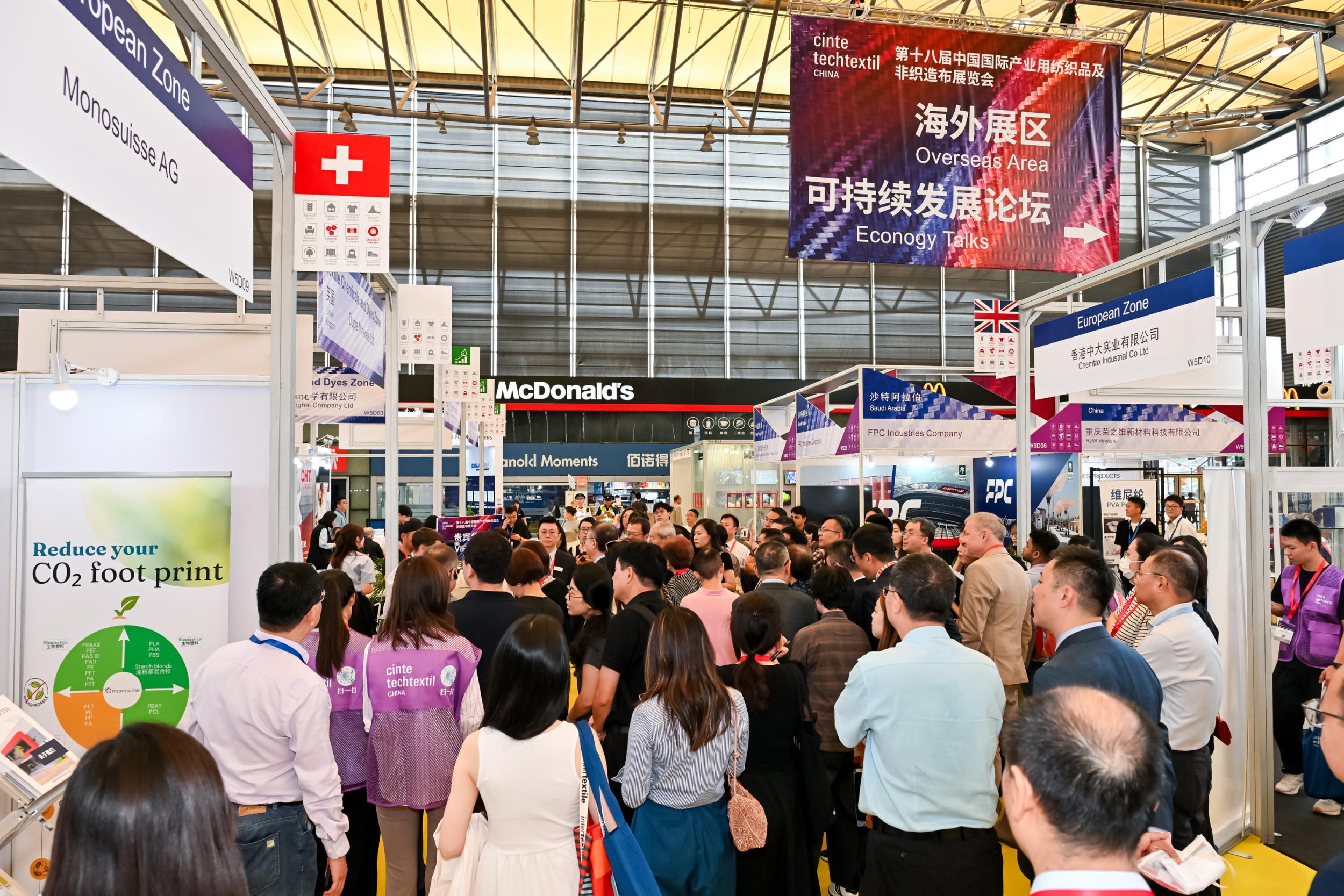
As Asia’s premier platform catering to the evolving needs in technical textiles and nonwovens, Cinte Techtextil China will open next week at the Shanghai New International Expo Centre, gathering over 300 exhibitors from 15 countries and regions. Across Halls W3 to W5, this edition will create chances for fast-growing sectors and emerging trends – such as Mobiltech, Medtech & Protech, Indutech and more. The curated zones, pavilions, and fringe programme are designed to better connect exhibitors with targeted buyers from across China, Asia-Pacific, and further afield. Meanwhile, the Association Village will gather international industry associations to foster even more global collaboration.

As a hub for global innovation, the fair will feature a strong contingent of international industry leaders in Hall W5’s Overseas Zone, including Andritz (China) Ltd, Groz-Beckert (Germany), A.Celli SPA (Italy), and Dilo (Germany), while others such as Picanol NV (Belgium) will showcase in Hall W4.

As Asia’s premier platform catering to the evolving needs in technical textiles and nonwovens, Cinte Techtextil China will open next week at the Shanghai New International Expo Centre, gathering over 300 exhibitors from 15 countries and regions. Across Halls W3 to W5, this edition will create chances for fast-growing sectors and emerging trends – such as Mobiltech, Medtech & Protech, Indutech and more. The curated zones, pavilions, and fringe programme are designed to better connect exhibitors with targeted buyers from across China, Asia-Pacific, and further afield. Meanwhile, the Association Village will gather international industry associations to foster even more global collaboration.

As a hub for global innovation, the fair will feature a strong contingent of international industry leaders in Hall W5’s Overseas Zone, including Andritz (China) Ltd, Groz-Beckert (Germany), A.Celli SPA (Italy), and Dilo (Germany), while others such as Picanol NV (Belgium) will showcase in Hall W4.

The sought-after European and German Zones will also be in Hall W5, featuring high-performance solutions from such markets. Key suppliers in the European Zone will include Monosuisse Group (Switzerland) and Comerio Ercole S.p.A (Italy), while the German Zone will include IBENA Textilwerke GmbH and Mahlo GmbH + Co KG. Nearby, the Textile Chemicals and Dyes Zone will return to offer advanced solutions for diverse technical applications.

A key highlight of Hall W5 is the Association Village, designed to showcase expertise, foster international trade networks and collaboration, as well as present the latest trends that shape the industry’s future. Key organisations anchoring this feature include the Asia International Hemp Federation (AIHF) (Thailand), UK Fashion and Textile Association (UKFT), Government of Tamil Nadu India, and Nonwoven Federation of India (NWFI).

Targeted solutions displayed across high-demand application areas
With the technical textiles and nonwovens markets evolving, exhibitors are presenting advances engineered for critical application areas across the show floor:

  • Mobiltech: highlighted suppliers include JR Ltd (Korea) and Eastex Industrial Science & Technology (China). Also on the domestic side, Tiandingfeng Holdings Co Ltd will showcase high-strength PET filament needle-punched nonwovens. The Mobiltech Zone, set to feature other key exhibitors, will also be in Hall W4.
  • Medtech: featuring first-time exhibitor NIPPON Paper Industries Co Ltd (Japan) with its Cu-TOP product – a functional material derived from wood pulp combined with copper technology. The Reifenhauser Group from Germany will also be in Hall W5, with Reifenhauser Reicofil presenting full nonwoven production lines, and Reifenhauser Enka Tecnica the service components that aid their longevity. Joining the lineup, Yixiang Health Technology Co Ltd and Zhejiang Kingsafe Hygiene Materials Technology Co Ltd will both showcase medical and hygiene nonwovens.
  • Protech: key Protech exhibitors include a new exhibitor Tepar Tekstil San Ve Tic A S (Turkiye), and Dawnsens New Materials (Xiamen) Co Ltd (China), both showcasing advanced safety materials.
  • Indutech: IMAE Industries Ltd (Japan) will make its debut at the fair. The company specialises in thermal insulation fibre products and supplies fine ceramics for heavy industry, automotive, iron and steel, chemical, power generation and more.

Other first-time international brands will include Care Holdings Pte Ltd (Singapore) and Texbond Nonwovens (India); while China’s innovation will be spotlighted with domestic pavilions in Hall W3 featuring medical and hygiene textiles and in Hall W4 featuring filtration and separation textiles. Exhibitors are set to be greeted by a wide range of industry visitors.

Before the fair, overseas visitor pre-registrations have risen notably compared to the same period last year. These include 139 VIP buyers from 27 countries and regions, such as Hyundai Motor Company and Sejong Healthcare (Korea), Meditec Japan Co Ltd (Japan), ALSICO (Belgium), Focus Industries Limited (Hong Kong), Freudenberg Performance Materials Service GmbH and MöllerWerke GmbH (Germany), seeking high-demand solutions across Mobiltech, Medtech and Protech, Indutech, and more. In addition, seven international buyer delegations, from industry hubs across Asia-Pacific and beyond, will add to the fair’s global business appeal.

Fringe events explore innovation, emerging markets, and automotive trends in Halls W4 and W5 

  • Panel Discussion (Day 1 morning) (W5 E20): the discussion topic, Industrial Hemp Fibre – Building the Future of Sustainable Materials, will take Thailand as a successful example to explore the use of advanced hemp fibre materials through cross-sector innovation and international investment. Complemented by the AIHF display area (W5 B20), featuring the evolution of raw hemp stalks into modern bioplastics, composites, mobility components, lifestyle products and other engineered applications.
  • 2026 Nonwovens Industry High-Quality Development Conference (Day 1 afternoon) (W4 D38): under the theme ‘Redefine the growth paradigm’, Ms Guimei Li, President of China Nonwovens & Industrial Textiles Association, will show China’s nonwovens development during the 15th Five-Year Plan. Guest speaker Mr Anshumali Jain, Vice President of the Nonwoven Federation of India, will discuss the situation and opportunities of India’s industrial ecosystem, while Mr Tony Fragnito, President of the Association of the Nonwoven Fabrics Industry, will explore the state of the US market.
  • Automotive textile panel (Day 2 afternoon) (W5 E20): titled “Defining the Future Cabin: Multi-functional Evolution of Nonwoven Materials in Automotive”, the panel will include automotive end users, Tier-1 automotive interior suppliers, and upstream nonwoven technology providers. The Mobiltech Display Area (W4 F25) will complement the panel, with exhibits from Groz-Beckert, AIHF, Care Holdings Pte Ltd, Swisstulle (Qingdao) Co Ltd, and more.

Other key events include a presentation on sustainability by UKFT and the Sustainability Tour by Mr Karl Borgschulze, Managing Director of Consulting Service Intl Ltd (both on Day 2 morning) (W5 E20); other guided tours led by industry experts (covering medical, protective, automotive, and tents & coverings); Technology Innovation and Product Development for Future Technical Textiles; Deeyeo Flushable Wipes Scientific Consensus Release and Industry High-Quality Development Dialogue; and a display zone dedicated to Industrial Textiles in the 15th Five-Year Plan.

The fair’s product categories cover 12 application areas, which comprehensively span a full range of potential uses in modern technical textiles and nonwovens. These categories also cover the entire industry, from upstream technology and raw materials providers to finished fabrics, chemicals and other solutions. This scope of product groups and application areas ensures that the fair is an effective business platform for the entire industry.

Valmet 3D Fiber technology combines high capacity and speed, automation, and resource efficiency to produce high-quality molded fiber packaging. Photo by VALMET
Valmet 3D Fiber technology combines high capacity and speed, automation, and resource efficiency to produce high-quality molded fiber packaging.
28.08.2026

Valmet and Metsä scale 3D fibre forming to commercial production

Metsä Group has selected Valmet to supply what the companies describe as the world’s first commercial-scale production line for Valmet’s 3D Fiber technology. The line will be installed in Äänekoski and is scheduled to start up in 2028, with a nominal capacity of more than 100 million three-dimensional fibre products per year.

The process converts cellulose fibres directly into lightweight yet rigid end products. Valmet combines fibre processing, forming, automation and final packing in an integrated production chain. The technology has been co-developed with Metsä Spring since 2020 and was initially validated in a demonstration plant.

Although packaging is the primary target market, the development is relevant to the textile and fibre sector because it demonstrates how fibre-based structures and forming technologies are moving into three-dimensional industrial applications.

Metsä Group has selected Valmet to supply what the companies describe as the world’s first commercial-scale production line for Valmet’s 3D Fiber technology. The line will be installed in Äänekoski and is scheduled to start up in 2028, with a nominal capacity of more than 100 million three-dimensional fibre products per year.

The process converts cellulose fibres directly into lightweight yet rigid end products. Valmet combines fibre processing, forming, automation and final packing in an integrated production chain. The technology has been co-developed with Metsä Spring since 2020 and was initially validated in a demonstration plant.

Although packaging is the primary target market, the development is relevant to the textile and fibre sector because it demonstrates how fibre-based structures and forming technologies are moving into three-dimensional industrial applications.

Source:

VALMET

Dyneema SK80 fiber Photo (c) Avient Corporation
Dyneema SK80 fiber
28.08.2026

Dyneema SK80 targets significantly longer service life for mooring lines

Avient is introducing Dyneema SK80, a new HMPE fibre grade for mooring lines and offshore applications. According to the company, the fibre was engineered at polymer level to deliver at least twice the durability and fatigue resistance of Dyneema SK78 in demanding mooring applications.

The technological emphasis is therefore less on headline tensile strength than on service life under cyclic loading. In mooring systems, repeated load cycles, abrasion, bending stress and environmental exposure are major failure drivers. Improved fatigue resistance can therefore have a direct effect on maintenance intervals, operational safety and lifecycle costs.

The new fibre will be presented at SMM in Hamburg in early September. For Textination, the development is relevant because high-performance fibres are increasingly being positioned not only through weight and strength advantages, but through durability, reliability and the total cost of technical textile systems.

Avient is introducing Dyneema SK80, a new HMPE fibre grade for mooring lines and offshore applications. According to the company, the fibre was engineered at polymer level to deliver at least twice the durability and fatigue resistance of Dyneema SK78 in demanding mooring applications.

The technological emphasis is therefore less on headline tensile strength than on service life under cyclic loading. In mooring systems, repeated load cycles, abrasion, bending stress and environmental exposure are major failure drivers. Improved fatigue resistance can therefore have a direct effect on maintenance intervals, operational safety and lifecycle costs.

The new fibre will be presented at SMM in Hamburg in early September. For Textination, the development is relevant because high-performance fibres are increasingly being positioned not only through weight and strength advantages, but through durability, reliability and the total cost of technical textile systems.

EDANA’s OUTLOOK™ returns to Cascais to shape a changing industry Graphic by Edana
20.08.2026

EDANA’s OUTLOOK™ returns to Cascais to shape a changing industry

The market does not wait, and it does not grant easy answers. Across the absorbent hygiene, personal care, and wipes sectors, business is undergoing a period of intense, necessary adjustment. New European rules on packaging, single-use items, product safety, and end-of-life are forcing companies to drop old assumptions about materials and performance. At the same time, producers must keep their goods safe, reliable, and affordable for the babies and aging adults, who rely on them every day. 

From 22 to 24 September 2026, EDANA’s OUTLOOK™ returns to the Hotel Miragem in Cascais, Portugal, for its twenty-fifth edition of the conference. 

OUTLOOK™ began in Monaco in 2001. It focused then on baby diapers and menstrual protection. Over a quarter of a century, the work expanded. It grew to cover adult incontinence, wipes, complex international product safety, and strict environmental compliance. In 2007, the conference met in Cascais. Returning to the Portuguese coast this September marks a milestone, but the focus remains squarely on the work ahead. 

The three-day programme takes on the hardest questions in the supply chain directly: 

The market does not wait, and it does not grant easy answers. Across the absorbent hygiene, personal care, and wipes sectors, business is undergoing a period of intense, necessary adjustment. New European rules on packaging, single-use items, product safety, and end-of-life are forcing companies to drop old assumptions about materials and performance. At the same time, producers must keep their goods safe, reliable, and affordable for the babies and aging adults, who rely on them every day. 

From 22 to 24 September 2026, EDANA’s OUTLOOK™ returns to the Hotel Miragem in Cascais, Portugal, for its twenty-fifth edition of the conference. 

OUTLOOK™ began in Monaco in 2001. It focused then on baby diapers and menstrual protection. Over a quarter of a century, the work expanded. It grew to cover adult incontinence, wipes, complex international product safety, and strict environmental compliance. In 2007, the conference met in Cascais. Returning to the Portuguese coast this September marks a milestone, but the focus remains squarely on the work ahead. 

The three-day programme takes on the hardest questions in the supply chain directly: 

Day 1 Keynote — Global Macroeconomics & Shocks: Henry Curr, Economics Editor at The Economist, will open the plenary with his keynote presentation, "The Teflon world economy and what could finally break it." Curr oversees global economics coverage for The Economist and has written some 30 cover stories on labour markets, public debt, the future of global commerce, and the risks of "homeland economics" and green protectionism. Drawing on discussions with top policymakers and executives, he will explore how global markets have absorbed successive crises—from geopolitical conflicts to AI-driven labour disruption—and what structural risks could still disrupt demand and capital investment.

Session 1 — Market Drivers in a Challenging Environment: Moderated by Jacques Prigneaux (Market Analysis & Economic Affairs Director, EDANA), this session examines the pivotal market drivers redefining the competitive landscape. Industry specialists Kaushik Mitra (Chemical Market Analytics by Dow Jones), Dr. Annika Trümpler (Schlegel und Partner), and Natalia Bezrebra (Euromonitor) will address shifting polyolefin supply, pricing downslides, post-crisis supply chains, and the strategic expansion of major Chinese hygiene manufacturers entering the European market. 

Session 2 — Global Product Safety Compliance Panel: Moderated by Luminita Barbu (Regulatory Affairs Director, EDANA), this high-level panel addresses the complex matrix of international consumer product safety regulations, compliance standards, and policy trends. Featuring legal and regulatory authorities—including Claudio Mereu and Natalie Konings, Partners at Bird & Bird—the discussion will highlight the practical implications of international initiatives such as the UN Principles for Consumer Product Safety, alongside regulatory divergence and convergence across the EU, US, and China. 

Day 2 Keynote — Future Retail Trends & Consumer Shifts: Renowned retail futurist Theresa Schleicher opens Day 2 with her keynote, "Next Growth: The Bigger Consumer Shifts on the Horizon." Widely regarded as one of Europe's leading retail futurists, Schleicher is a former Managing Director at Hirschen Group, an author of acclaimed retail trend studies, a retail start-up investor, and a strategic sparring partner for Germany's Federal Ministry for Economic Affairs and Energy, the Zukunftsinstitut, and global giants like Procter & Gamble, L'Oréal, and Beiersdorf. Her session will uncover macro consumer trends, economic resilience, and emerging opportunities in absorbent hygiene. 

Session 3 — The Consumer Lens: Redefining Value in Absorbent Hygiene: Moderated by Murat Dogru, this senior leadership panel puts the consumer perspective at the centre of innovation. Featuring senior leaders including Sara Järup (Global Material Development Director at Essity), Matrice Jackson (Director, Global R&D at Kimberly-Clark Corporation), and Giulia Antonioli (Head of Communications, Reputation & Public Affairs, Baby Care Europe at Procter & Gamble), the panel examines how consumer expectations around sustainability, dignity, and transparency are redefining value across femcare, adult incontinence, and baby care. 

Session 4 — The Transition in Wipes & Interactive Q&A: Focusing on "Wipes: The Pros and Cons of Going Plastic-Free," this session brings together technical and public affairs experts—including Brieuc Lits (EDANA), Wolfgang Tenbusch (Albaad Deutschland), Sergio Rosales Calderon and Sebastien Monges (BCNonwovens), and Elisabeth Swennenhuis (Magnera Corporation)—to evaluate EU policy tools (SUPD, EMPCO, EPR schemes), Total Cost of Ownership (TCO), and the performance trade-offs of pulp versus viscose spunlace. The session concludes with a dedicated live Q&A and open floor discussion with the audience. 

Session 5 — Can Absorbent Hygiene Products Become Circular? Led by EDANA’s Sustainability Director, Rawaa Ammar, this forward-looking session explores actionable circularity for the nonwovens sector. Featuring insights from Jeff Stubbe, CEO of Woosh, the session shares real-world operational lessons on closing the diaper loop and demonstrating that circularity can operate as an economically viable business model rather than a small-scale trial. 
    
Exhibition, Business Meetings & Networking 
Beyond the conference hall, OUTLOOK™ 2026 provides extensive commercial and networking platforms: 

Tabletop Exhibition: A dedicated showcase featuring 20 innovative companies presenting advanced technologies, materials, and services.     

Private Meeting Rooms: Dedicated business spaces designed for private discussions and commercial partnerships. 
    
Evening Social Programme: Delegates will connect during the welcome cocktail at Hotel Miragem and an evening reception at the historic Valverde Sintra Palácio, set in the scenic hills of Sintra. 

OUTLOOK™ 2026 is built for decision-makers. Alongside the plenary sessions, the event hosts a curated tabletop exhibition of 20 innovators, dedicated private meeting rooms for commercial discussions, and structured networking. Delegates will also gather for an evening reception at the historic Valverde Sintra Palácio in the Sintra hills. 

More than 500 senior leaders across the value chain—raw material suppliers, machine builders, converters, brand owners, and retailers—will attend. You can track industry shifts from behind a desk, but you cannot replace being present when the sector evaluates itself and decides its course.

(c) Eastman Naia™
18.08.2026

Naia™ from Eastman: First appearance at Apparel Sourcing Show Guatemala

At Booth 50, Eastman will present U.S.-produced Naia™ staple fibers and filament yarns for casualwear and activewear, supporting closer collaboration across the regional value chain.

As brands and retailers explore more diversified and responsive sourcing networks, the Naia™ from Eastman brand is strengthening its engagement with the textile and apparel value chain across the western hemisphere. From August 18 to 20, the company will participate for the first time in Apparel Sourcing Show Guatemala, a regional meeting point for apparel sourcing, manufacturing and nearshoring.

Produced in the United States, Naia™ offers regional manufacturers, brands and sourcing teams a cellulosic fiber option within the western hemisphere, creating opportunities for direct dialogue and new collaborations across the regional textile and apparel supply chain.

At Booth 50, Eastman will present U.S.-produced Naia™ staple fibers and filament yarns for casualwear and activewear, supporting closer collaboration across the regional value chain.

As brands and retailers explore more diversified and responsive sourcing networks, the Naia™ from Eastman brand is strengthening its engagement with the textile and apparel value chain across the western hemisphere. From August 18 to 20, the company will participate for the first time in Apparel Sourcing Show Guatemala, a regional meeting point for apparel sourcing, manufacturing and nearshoring.

Produced in the United States, Naia™ offers regional manufacturers, brands and sourcing teams a cellulosic fiber option within the western hemisphere, creating opportunities for direct dialogue and new collaborations across the regional textile and apparel supply chain.

At Booth 50, Eastman will showcase both Naia™ staple fiber and filament yarn offerings for casualwear and activewear. A key focus of the presentation will be Naia™ On The Move, an application designed for active, everyday wear and built around Naia™ Renew staple fiber, made with 40% GRS-certified recycled materials* and 60% sustainably sourced wood pulp. The application demonstrates how Naia™ fiber blends can deliver next-to-skin comfort, breathability and a soft hand feel, together with moisture management and quick-dry performance. 

Developed to help garments stay fresh and comfortable throughout the day, Naia™ On The Move highlights the versatility needed for urban lifestyles, where changing temperatures, humidity and active routines call for adaptable apparel solutions. 

“The western hemisphere is becoming an increasingly important part of the sourcing conversation,” said Chad Doub, Global Segment Market Manager, Casual Wear and Home at Eastman. “Our participation in Guatemala gives us the opportunity to build new relationships and explore how Naia™ staple fibers and filament yarns can support innovative fabric developments for casualwear and activewear. We believe Naia™ On The Move, our application designed for this segment, is particularly well suited to the needs of the region and of the brands sourcing here, where versatility, comfort and performance are increasingly important.”

The Apparel Sourcing Show brings together businesses operating across the textile and apparel supply chain, including textiles, machinery, accessories, services and manufacturing. Eastman’s participation also builds on its engagement with the Americas Apparel Producers’ Network.

Following the 2026 pro:Americas Annual Conference in May, the Guatemala show represents another step in the company’s efforts to connect with businesses developing more integrated supply chains across the region.

World of Wipes® International Conference 2027 Graphic by INDA
18.08.2026

World of Wipes®: Call for Abstracts for the 2027 International Conference

Wipes industry professionals are invited to share their expertise, June 7-10 in Indianapolis: INDA, the Association of the Nonwoven Fabrics Industry, is now accepting abstracts for the 2027 World of Wipes® (WOW) International Conference, taking place June 7-10, 2027, in Indianapolis, IN.

Professionals from across the wipes supply chain are invited to submit abstracts highlighting new products, technologies, materials, market developments, research, and other insights shaping the future of the wipes industry. Abstracts are due January 22, 2027.

Prospective presenters should submit a concise abstract of one to two paragraphs describing their proposed presentation and its relevance to wipes, wipe manufacturing, or the broader wipes marketplace. Abstracts may be submitted online through the WOW website at https://www.worldofwipes.org/call-for-papers.

Topics of interest include, but are not limited to:

Wipes industry professionals are invited to share their expertise, June 7-10 in Indianapolis: INDA, the Association of the Nonwoven Fabrics Industry, is now accepting abstracts for the 2027 World of Wipes® (WOW) International Conference, taking place June 7-10, 2027, in Indianapolis, IN.

Professionals from across the wipes supply chain are invited to submit abstracts highlighting new products, technologies, materials, market developments, research, and other insights shaping the future of the wipes industry. Abstracts are due January 22, 2027.

Prospective presenters should submit a concise abstract of one to two paragraphs describing their proposed presentation and its relevance to wipes, wipe manufacturing, or the broader wipes marketplace. Abstracts may be submitted online through the WOW website at https://www.worldofwipes.org/call-for-papers.

Topics of interest include, but are not limited to:

  • Dry and Wet Wipes
  • End-Use Markets
  • Market Statistics and Data
  • Raw Materials and Fibers
  • Sustainability
  • Fabric Formation
  • Ingredients, Formulations, and Lotions
  • Flexible and Rigid Packaging
  • Machinery and Equipment
  • Flushability
  • Single-Use Plastics
  • Labeling and Regulations
  • Circular Economy

Presenting at WOW 2027 provides an opportunity to share expertise and innovation with an engaged audience of wipes professionals while building connections across the entire supply chain, from raw material and technology suppliers to converters, brands, and retailers. Presenters will contribute to the conversations, ideas, and developments shaping the future of the global wipes industry.

Hygienix™ 2026 Conference Program Graphic (c) INDA
12.08.2026

INDA: Hygienix™ 2026 Conference Program

INDA, the Association of the Nonwoven Fabrics Industry, announced that the conference program is now available for Hygienix™ 2026, the premier global event for the absorbent hygiene and personal care markets. Hygienix will take place Nov. 16–19 at the Hyatt Regency Houston in Houston, Texas.

Conference Program
The conference program will feature the future of absorbent hygiene products, materials, manufacturing, and consumer care. Key topics include:

INDA, the Association of the Nonwoven Fabrics Industry, announced that the conference program is now available for Hygienix™ 2026, the premier global event for the absorbent hygiene and personal care markets. Hygienix will take place Nov. 16–19 at the Hyatt Regency Houston in Houston, Texas.

Conference Program
The conference program will feature the future of absorbent hygiene products, materials, manufacturing, and consumer care. Key topics include:

  • Global energy, economic, and market trends influencing raw material costs, supply chains, product affordability, and business strategy
  • Emerging consumer expectations, adult incontinence solutions, product insecurity, and opportunities to improve comfort, dignity, and access
  • Advances in absorbent cores, superabsorbent materials, polymers, nonwovens, adhesives, fluid management, skin health, and next-generation product design
  • Sustainability, biodegradability, manufacturing efficiency, and end-of-life considerations driving material and product innovation
  • Evolving regulatory, legislative, reimbursement, and industry standards affecting absorbent hygiene manufacturers and suppliers

Event Highlights
Pre-Conference Workshops – Monday, Nov. 16
Hygienix will offer three interactive pre-conference workshops:

  • “Inside the Absorbent Core: A Hands-On Systems Approach to Fluid Control” – Jim Robinson, Principal, Absorbent Hygiene Insights, LLC
  • “Inside Sustainable Hygiene: A Hands-On Reality Check for Materials, Claims, End-of-Life, and U.S. Compliance” – Heidi Beatty, Chief Executive Officer, Crown Abbey, LLC
  • “Inside the Diaper Market: Hands-On Benchmarking, Performance, and Trends” – Natalia Richer, Director of Business Development, and Irene Richer, Director of Laboratory Operations, Diaper Testing International

Networking Opportunities
Attendees will have multiple opportunities to build relationships, exchange ideas, and connect with absorbent hygiene industry leaders and solution providers, including:

  • Lunch Around – An extended networking lunch designed to encourage meaningful conversations with industry leaders; seating is limited
  • Lightning Talks – Five-minute exhibitor presentations highlighting new technologies, products, and capabilities
  • Evening Receptions and Exhibits – Opportunities to meet leading suppliers serving the absorbent hygiene and personal care markets
  • Welcome Reception – A lively opening-night event bringing attendees together to kick off Hygienix

Lifetime Service Awards
Carl Cucuzza and Pricie Hanna, the 2025 and 2026 Lifetime Service Award recipients, respectively, will be recognized during a presentation on Tuesday, Nov. 17, at 4:15 p.m.

The Lifetime Service Award recognizes individuals who have provided longstanding service to the absorbent hygiene and personal care industry and contributed to its growth and advancement.

Hygienix Innovation Award™
The Hygienix Innovation Award™ will recognize an innovative technology that is advancing the absorbent hygiene and personal care industry. Finalists will present their technologies on Tuesday, Nov. 17, and the winner will be announced during the closing session on Thursday, Nov. 19. Nominations for the 2026 Hygienix Innovation Award close Sept. 14.

The 2025 award recipient, Confitex Technology Ltd., was recognized for its Washable Nonwoven Sanitary Pad, designed to provide a sustainable and scalable solution without the use of superabsorbent polymers.

Mr.Aloke Lohia Photo: (c) Indorama Ventures Public Company Limited
11.08.2026

Indorama Ventures: Strong first-half 2026 earnings

Indorama Ventures Public Company Limited (IVL), a global sustainable chemical producer, reported significantly stronger first-half 2026 earnings, reflecting favorable market conditions together with continued progress in strengthening the Company’s operating fundamentals. 

For the first half of 2026, the Company reported revenue of THB 245.3 billion, up 4% year-on-year, and EBITDA of THB 29.7 billion, up 61%. Second-quarter EBITDA was particularly strong, with all four business segments delivering year-on-year improvement. Operating cash flow after maintenance capital expenditure increased 78% to THB 25.9 billion. Strong cash generation supported further deleveraging, with Net Debt-to-Equity improving to 1.56x, reaching the Company's Capital Markets Day target for 2026 ahead of schedule. 

Indorama Ventures Public Company Limited (IVL), a global sustainable chemical producer, reported significantly stronger first-half 2026 earnings, reflecting favorable market conditions together with continued progress in strengthening the Company’s operating fundamentals. 

For the first half of 2026, the Company reported revenue of THB 245.3 billion, up 4% year-on-year, and EBITDA of THB 29.7 billion, up 61%. Second-quarter EBITDA was particularly strong, with all four business segments delivering year-on-year improvement. Operating cash flow after maintenance capital expenditure increased 78% to THB 25.9 billion. Strong cash generation supported further deleveraging, with Net Debt-to-Equity improving to 1.56x, reaching the Company's Capital Markets Day target for 2026 ahead of schedule. 

Management’s continued execution of IVL 2.0 self-help actions, including Sales & Operations Execution (S&OE), inventory discipline and working capital management, also supported stronger cash conversion, with inventory turnover improving to 5.0x in the second quarter from 4.7x at the end of 2025. Operating rates were prudently managed to align production with inventory targets and protect margin quality in a period of volatile pricing. 

Looking ahead, Indorama Ventures expects some of the exceptionally strong second-quarter market tailwinds to normalize. The Company’s priorities for the remainder of 2026 are to deliver sustainable earnings under normalized spreads, convert those earnings into free cash flow, reduce absolute net debt, and improve returns on capital. 

Mr. Aloke Lohia, Group CEO of Indorama Ventures, said, “Our first-half performance reflects both supportive market conditions and the progress we are making through the self-help actions we have taken to strengthen Indorama Ventures. Markets will normalize, so the more important test is whether we can convert the advantages of the platform we have built over three decades - our scale, integration, global footprint, local-for-local operating model and customer positions, into more consistent earnings, stronger cash generation and higher returns through the cycle. 
We are beginning to see that translation in our performance. Greater discipline in how we manage our operations, inventory and working capital is improving cash generation, while our portfolio actions are strengthening the quality of the business and improving returns on capital. Together, these actions are building a more agile and financially resilient Indorama Ventures. 
We remain confident in our 2026 expectations and 2028 ambitions. Our focus is to continue executing on what we can control, strengthen our balance sheet and improve returns, while retaining the flexibility to capture growth opportunities as markets evolve.” 

The earnings improvement was led by Combined PET, supported by favorable market conditions and the benefits of Indorama Ventures’ integrated global platform and local-for-local operating model. Indovida continued its growth momentum, supported by its market-leading packaging position, customer intimacy and organic growth initiatives. Indovinya delivered strong performance across both High Value Applications and Essentials, supported by commercial excellence initiatives. Fibers improved sequentially in the second quarter supported by stable Hygiene demand and transformation efforts, despite continued weakness in Lifestyle and Mobility end markets.

Source:

Indorama Ventures Public Company Limited

03.08.2026

SGL Carbon & X-energy: Capacity expansion for Nuclear-Grade Graphite

SGL Carbon and X-energy announced a binding agreement to double SGL’s production capacity for medium-grain isotropic graphite (“NBG-18”), a specialized material central to X-energy’s Xe-100 high-temperature gas-cooled reactor. X-energy and SGL Carbon’s agreement would expand the supply chain for a critical long-lead material, supporting execution of X-energy’s commercial pipeline.

Under the agreement, X-energy will invest up to $8 million in milestone-based payments to support new facilities and equipment upgrades at SGL’s site in Chedde, France, enabling the facility to produce graphite billets for up to eight new Xe-100 reactors per year. SGL Carbon has concurrently agreed to expand U.S. capacity for machining of billets into graphite blocks, helping to ensure greater supply chain continuity for a safety-critical material. Full execution would double European manufacturing capacity for NBG-18 by 2030, with additional capacity investments under consideration across multiple regions to further debottleneck initial billet production.

SGL Carbon and X-energy announced a binding agreement to double SGL’s production capacity for medium-grain isotropic graphite (“NBG-18”), a specialized material central to X-energy’s Xe-100 high-temperature gas-cooled reactor. X-energy and SGL Carbon’s agreement would expand the supply chain for a critical long-lead material, supporting execution of X-energy’s commercial pipeline.

Under the agreement, X-energy will invest up to $8 million in milestone-based payments to support new facilities and equipment upgrades at SGL’s site in Chedde, France, enabling the facility to produce graphite billets for up to eight new Xe-100 reactors per year. SGL Carbon has concurrently agreed to expand U.S. capacity for machining of billets into graphite blocks, helping to ensure greater supply chain continuity for a safety-critical material. Full execution would double European manufacturing capacity for NBG-18 by 2030, with additional capacity investments under consideration across multiple regions to further debottleneck initial billet production.

The expansion builds on a 10-year Supplier Framework Agreement established in January 2026, which included an initial three-year award valued at over $100 million for X-energy’s first commercial projects. The first NBG-18 graphite blocks produced under this award at SGL’s site in Chedde have since been shipped to SGL sites in the United States, for machining into components. This follows a successful prototyping campaign which began earlier this year, consisting of non-nuclear testing and validation at X-energy’s Technology and Advancement Center in Frederick, Maryland (USA) in advance of final production.

“Commercializing new nuclear at scale rests first and foremost on our ability to significantly expand the new nuclear supply chain, a challenge that extends beyond any one company, supplier, or nation,” said J. Clay Sell, CEO of X-energy. “We look forward to driving this work forward with SGL, and to engaging with potential partners who share our bold vision for a robust, resilient, U.S. and allied nuclear supply chain.”

“By jointly expanding our production capacity for nuclear-grade graphite, we are reinforcing the importance of our partnership and ensuring reliable supply to X-energy. For SGL Carbon, this agreement is a strategically important step that strengthens our position in the highly specialized growth market for nuclear-grade graphite, underscores the importance of our graphite expertise for safety-critical applications, and opens up attractive opportunities for further growth,” said Andreas Klein, CEO of SGL Carbon.

NBG-18 is a nuclear-grade graphite central to the Xe-100 design, functioning as a neutron moderator, and a structural component of the pebble-bed core. The material was first developed for South Africa's Pebble Bed Modular Reactor program, and later the U.S. Department of Energy's (“DOE”) Next Generation Nuclear Plant project, two direct predecessors to X-energy’s Xe-100. Through these, X-energy’s and SGL Carbon’s own initiatives, NBG-18 has undergone extensive qualification work for commercial nuclear operation, gathering operational data that helps to validate the material’s performance over decades of high-temperature operation.

Initial NBG-18 production is intended to support X-energy’s first commercial deployment of the Xe-100 reactor, a proposed four-unit plant in partnership with Dow Chemical Company under the Advanced Reactor Demonstration Program of the United States Department of Energy (DOE), with additional capacity secured for follow-on projects to support manufacturing readiness for safety-critical, long-lead materials. SGL Carbon’s and X-energy’s partnership is part of a growing, diversified portfolio of experienced suppliers supporting Xe-100 deployment, as well as the continued development of a global industrial supply chain.

Source:

SGL Carbon SE