
From the Sector

Reset
544 results
Junshu Furusawa (c) Asahi Kasei Fibers Italia
Junshu Furusawa
27.08.2025

New CEO of Asahi Kasei Fibers Italia

2025 marks the beginning of a new chapter for Bemberg™ in Italy. Following the return of Koji Hamada to Japan, after leading the European division for four years, Junshu Furusawa — with 19 years working at Bemberg™ Division and 4 years in Italy — has been appointed as the new CEO of Asahi Kasei Fibers Italia. With a strong background in innovation, product development and strategic vision within Bemberg Division of Asahi Kasei, Junshu Furusawa brings renewed energy and a deep understanding of the fiber’s technical and responsible value proposition. His commitment to transparent communication and partner engagement will continue to drive Bemberg™’s growth across the European fashion and textile industry. Under Junshu Furusawa’s leadership, Bemberg™ reaffirms its commitment to responsible innovation, design excellence, and long-term partnerships, maintaining its role as a key ingredient in the next generation of luxury fashion. 

2025 marks the beginning of a new chapter for Bemberg™ in Italy. Following the return of Koji Hamada to Japan, after leading the European division for four years, Junshu Furusawa — with 19 years working at Bemberg™ Division and 4 years in Italy — has been appointed as the new CEO of Asahi Kasei Fibers Italia. With a strong background in innovation, product development and strategic vision within Bemberg Division of Asahi Kasei, Junshu Furusawa brings renewed energy and a deep understanding of the fiber’s technical and responsible value proposition. His commitment to transparent communication and partner engagement will continue to drive Bemberg™’s growth across the European fashion and textile industry. Under Junshu Furusawa’s leadership, Bemberg™ reaffirms its commitment to responsible innovation, design excellence, and long-term partnerships, maintaining its role as a key ingredient in the next generation of luxury fashion. 

Source:

C.L.A.S.S. Eco Hub

27.08.2025

ECHA announces timeline for PFAS restriction evaluation

The European Chemicals Agency (ECHA) aims to complete its scientific evaluation of the proposed EU-wide restriction on per- and polyfluoroalkyl substances (PFAS) by the end of 2026. 

In a note, published today, ECHA provides an update on its assessment of the proposal and clarifies the expected timeline. This follows the publication of the updated restriction proposal, which took place on 20 August 2025.

The European Chemicals Agency’s (ECHA) scientific committees for Risk Assessment (RAC) and for Socio-Economic Analysis (SEAC) have been evaluating the proposal to restrict PFAS in the EU/EEA since March 20231. This restriction proposal covers more than 10 000 substances and many sectors of application. Following its submission to ECHA, the subsequent six-month consultation has resulted in more than 5 600 responses from allstakeholder groups (Industry, NGOs, institutions, academia, national authorities, agencies, civil society actors, citizens etc.).

The European Chemicals Agency (ECHA) aims to complete its scientific evaluation of the proposed EU-wide restriction on per- and polyfluoroalkyl substances (PFAS) by the end of 2026. 

In a note, published today, ECHA provides an update on its assessment of the proposal and clarifies the expected timeline. This follows the publication of the updated restriction proposal, which took place on 20 August 2025.

The European Chemicals Agency’s (ECHA) scientific committees for Risk Assessment (RAC) and for Socio-Economic Analysis (SEAC) have been evaluating the proposal to restrict PFAS in the EU/EEA since March 20231. This restriction proposal covers more than 10 000 substances and many sectors of application. Following its submission to ECHA, the subsequent six-month consultation has resulted in more than 5 600 responses from allstakeholder groups (Industry, NGOs, institutions, academia, national authorities, agencies, civil society actors, citizens etc.).

The Committees’ evaluation is being carried out in batches, focusing on the 14 different sectors2 analysed in the originally submitted restriction proposal, as well as PFAS manufacturing and horizontal issues. In parallel, the national authorities of Denmark, Germany, the Netherlands, Norway and Sweden, who prepared the proposal (the Dossier Submitter), have progressively updated their initial report to address the significant number of responses received during the consultation, sector by sector. This updated report, called the Background Document, forms the basis for the Committees’ opinions.

The information from the consultation has also led to the identification of a further eight sectors3. These sectors have been assessed by the Dossier Submitter and incorporated into the now completed Background Document, which has been received by ECHA on 24 June 2025 and made available to RAC and SEAC and to the public on ECHA’s website4.

It is the collective goal of ECHA, the Dossier Submitter and the European Commission to allow for appropriate action to be taken to protect human health and the environment, as soon as is practicably possible. The European Commission, in the Chemicals Industry Action Plan adopted on 8 July 2025, has also communicated that ‘The scientific assessment of the Universal PFAS restriction by the ECHA’s committees is ongoing and scheduled to conclude in 2026. The Commission is committed to presenting a proposal as soon as possible after receiving ECHA’s opinion, with the overall objective of minimising PFAS emissions’.

Considering the sheer scale of this complex restriction proposal, RAC and SEAC have already made good progress in their opinion making on the 14 sectors covered by the original restriction proposal, plus PFAS manufacturing and horizontal issues. However, including a further 8 sectors into the Committees’ evaluations now would require significant time beyond 2026 to finalise the opinion with these sectors. Therefore, in the ongoing procedure, the Committees will not carry out a sector specific evaluation of these further eight sectors. However, the evaluation of horizontal issues will cover, amongst others, the hazard assessment and risk management measures of general applicability that are able to monitor and limit emissions of PFAS to the environment (e.g. reporting requirements, PFAS management plan).

Source:

European Chemicals Agency

Digicafé: Espresso meets Industry 4.0 (c) ITA
Digicafé: Espresso meets Industry 4.0
26.08.2025

Espresso meets Industry 4.0

Drink coffee and learn about Industry 4.0 in a fun way – that's what ITA PhD student Rosario Othen has made possible with his digital espresso machine. Rosario equipped the Quickmill espresso machine with a proportional-integral-derivative (PID) controller, programmable pump, integrated scale and current measurement.

All components are networked via the Message Queuing Telemetry Transport (MQTT) protocol, enabling process data such as temperature, time, flow rate, weight and energy consumption to be digitally recorded, analysed and visualised. The system is supplemented by a digital simulation model of the machine.

The coffee machine clearly demonstrates how existing systems can be digitised through targeted retrofitting – without expensive new purchases. This allows processes to be analysed, energy consumption and quality to be evaluated, and optimised through targeted parameter adjustment.

Drink coffee and learn about Industry 4.0 in a fun way – that's what ITA PhD student Rosario Othen has made possible with his digital espresso machine. Rosario equipped the Quickmill espresso machine with a proportional-integral-derivative (PID) controller, programmable pump, integrated scale and current measurement.

All components are networked via the Message Queuing Telemetry Transport (MQTT) protocol, enabling process data such as temperature, time, flow rate, weight and energy consumption to be digitally recorded, analysed and visualised. The system is supplemented by a digital simulation model of the machine.

The coffee machine clearly demonstrates how existing systems can be digitised through targeted retrofitting – without expensive new purchases. This allows processes to be analysed, energy consumption and quality to be evaluated, and optimised through targeted parameter adjustment.

The entire development process, from technical retrofitting and data connection to digital modelling, was carried out at ITA Institut für Textiltechnik of RWTH Aachen University. The demonstrator has been used at trade fairs and training courses since 2023 to provide a low-threshold introduction to the Internet of Things (IoT), retrofitting and digital process optimisation. It has been continuously developed since then.

The project was implemented as part of the publicly funded Mittelstand-Digital Zentrum Smarte Kreisläufe (SME Digital Centre for Smart Cycles) and is a prime example of practical digitalisation in an SME context. It can be viewed or brought along at any time – please contact Rosario Othen (rosario.othen@ita.rwth-aachen.de).

Source:

ITA – Institut für Textiltechnik of RWTH Aachen University

Kraig Biocraft Laboratories Inc., Imgae by Kraig Biocraft Laboratories Inc.
26.08.2025

Kraig Labs: Second Production Rearing Center in Southeast Asia

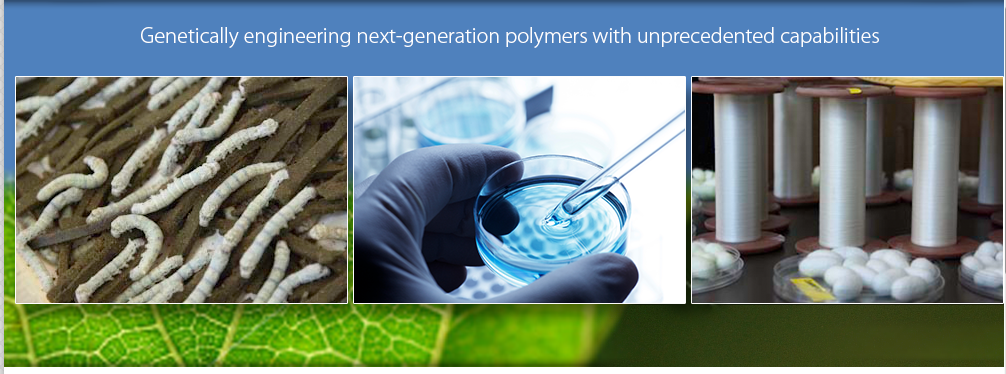
Kraig Biocraft Laboratories Inc., a leader in spider silk technology, announces that its second production rearing center in Southeast Asia is now fully operational.

With two active production facilities, the Company has established parallel operations designed to ensure continuous rearing cycles of its specialized recombinant spider silk silkworms. This dual-site capacity increases resilience and scalability, providing greater consistency in material output as Kraig Labs advances its commercialization strategy.

Teams are now active at both rearing centers, working with the company’s established parental lines for BAM-1 production hybrids, as well as three additional parental lines introduced earlier this summer. These new genetic lines represent a significant expansion of Kraig Labs’ breeding program and are expected to further enhance production efficiencies.

These facilities are designed to create efficient redundancy to avoid bottlenecks the company experienced in the past. This is a major leap forward in terms of creating sustained production.

Kraig Biocraft Laboratories Inc., a leader in spider silk technology, announces that its second production rearing center in Southeast Asia is now fully operational.

With two active production facilities, the Company has established parallel operations designed to ensure continuous rearing cycles of its specialized recombinant spider silk silkworms. This dual-site capacity increases resilience and scalability, providing greater consistency in material output as Kraig Labs advances its commercialization strategy.

Teams are now active at both rearing centers, working with the company’s established parental lines for BAM-1 production hybrids, as well as three additional parental lines introduced earlier this summer. These new genetic lines represent a significant expansion of Kraig Labs’ breeding program and are expected to further enhance production efficiencies.

These facilities are designed to create efficient redundancy to avoid bottlenecks the company experienced in the past. This is a major leap forward in terms of creating sustained production.

“Becoming fully operational at our second rearing center is a milestone that strengthens the foundation of our spider silk production platform,” said Kim Thompson, Kraig Labs founder and CEO. “Having parallel operations allows us to maintain continuous cycles of rearing, diversify our breeding program, and accelerate the development of next-generation hybrids. This expanded capacity is essential as we push forward in scaling production and bringing our recombinant spider silk to market.”

The opening of this second rearing facility reflects Kraig Labs’ ongoing commitment to building a robust, reliable, and scalable spider silk production system in Southeast Asia, positioning the company to meet growing demand from diverse markets and industries.

Source:

Kraig Biocraft Laboratories Inc.