From the Sector

Reset
Solar-powered plastic recycling at real-world scale © University of Cambridge
Solar-powered plastic recycling at real-world scale
03.07.2026

Solar-powered plastic recycling at real-world scale

Researchers demonstrate how to use the power of the sun to turn plastic waste, such as drinks bottles, into clean hydrogen fuel at a scale large enough to be genuinely useful in the real world using a scalable approach.

The researchers, from the University of Cambridge, have previously demonstrated that a solar-powered reactor can convert plastic waste into clean hydrogen fuel and valuable industrial chemicals, but only at laboratory scale. 

Now, they have shown a clear path for converting this technology to a commercial scale, in outdoor, real-world conditions. 

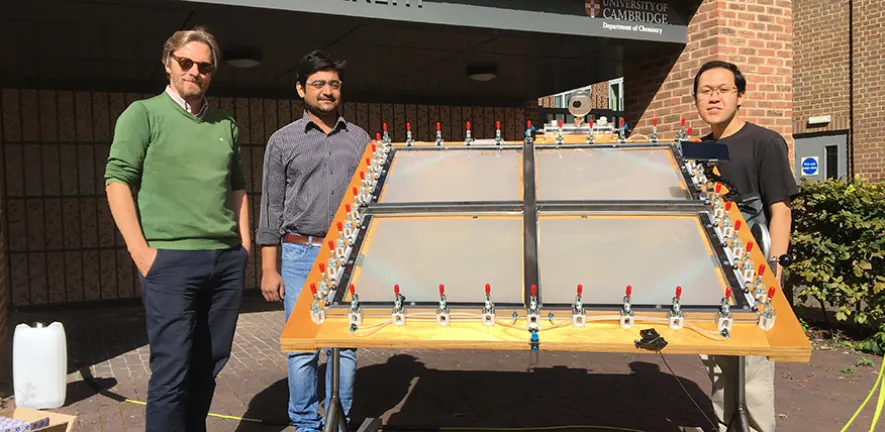
While previous demonstrations have used a small reactor (catalyst) about 25cm square, the new device is significantly larger – about one metre square – which they tested under natural sunlight outside Cambridge’s Chemistry Department. This is the first time that this technology has been successfully used in outdoor conditions using scalable techniques. 

Instead of generating electricity like a conventional solar panel, the Cambridge devices drives a chemical reaction that converts waste into useful products while converting water to release clean hydrogen.

Researchers demonstrate how to use the power of the sun to turn plastic waste, such as drinks bottles, into clean hydrogen fuel at a scale large enough to be genuinely useful in the real world using a scalable approach.

The researchers, from the University of Cambridge, have previously demonstrated that a solar-powered reactor can convert plastic waste into clean hydrogen fuel and valuable industrial chemicals, but only at laboratory scale. 

Now, they have shown a clear path for converting this technology to a commercial scale, in outdoor, real-world conditions. 

While previous demonstrations have used a small reactor (catalyst) about 25cm square, the new device is significantly larger – about one metre square – which they tested under natural sunlight outside Cambridge’s Chemistry Department. This is the first time that this technology has been successfully used in outdoor conditions using scalable techniques. 

Instead of generating electricity like a conventional solar panel, the Cambridge devices drives a chemical reaction that converts waste into useful products while converting water to release clean hydrogen.

Earlier versions of the solar-powered panels required high temperatures, harsh chemicals, or complicated manufacturing processes. Typically, this involved small particles suspended in solution and deposited onto a substrate. 

“When we started trying to scale this technology up, we quickly found out that what seems simple on a small scale is not simple at all when you’re trying to make it at scale,” said co-first author Ariffin Bin Mohamad Annuar, from Cambridge’s Yusuf Hamied Department of Chemistry. “We can’t really have giant vats of solution to make these panels – it’s just not practical at scale.”

“If we’re really going to change the way we deal with the twin problems of plastic pollution and clean energy generation, we’ve got to develop a very scalable way to make these photocatalyst materials and reactors — and show that they really work outdoors,” said Professor Erwin Reisner, who led the research. 

The new panels can be assembled at room temperature without specialist equipment: first the light-absorbing material is sprayed onto a glass panel, and then the panel is coated with specially designed molecules containing cobalt and zirconium.

Co-author Professor Dominic Wright’s team, also from the Department of Chemistry, did the work to make the molecular precursor material. These precursors were then used by Reisner’s team for loading into a sprayer– like a household paint sprayer – so that the coating could be sprayed directly onto a glass panel. 

“What surprised me was, after all the optimisation, just how simple it is,” said Mohamad Annuar. “We just have this huge panel, we spray our catalyst on it, put it into our solution, put it under the sun, and it produces hydrogen and other valuable chemicals just from plastic waste. It’s just simple and scalable.”

The researchers showed the reactor works on materials ranging from cellulose to PET plastic bottles: the kind used for fizzy drinks. They also carried out a cost analysis to show what it would realistically take to scale the technology up commercially, which they say is a first for this type of research.

The spray-coating method developed by the Cambridge researchers dramatically reduces the cost to produce the reactors, which is vital to producing them at scale. However, the researchers say they still need to improve the durability and efficiency of the reactors before they are ready for commercial production. 

A patent for the technology has been filed with Cambridge Enterprise, the University’s innovation arm. The research was supported in part by the UK Department of Science, Innovation and Technology, the Royal Academy of Engineering, and Petronas. Erwin Reisner is a Fellow of St John’s College, Cambridge. Ariffin Bin Mohamad Annuar is a Member of Clare College, Cambridge.

Source:

University of Cambridge

Photo Catalyst Club
03.07.2026

Florence: Where Conversations Become Catalysts for Change

The first chapter of Catalyst Club debuted in Florence, bringing together creative directors, entrepreneurs, manufacturers, journalists and innovators from across the fashion and textile industry for an evening of dialogue, exchange and connection.

Hosted at the Soko Innovation Hub and developed in partnership with Pioneer Denim, the gathering took place around a single long table, bringing guests together in an informal and convivial setting designed to encourage open conversation and the sharing of ideas.

During his opening speech at the dinner, Matteo Urbini, MD of Soko Chimica, expressed his enthusiasm for the initiative: "It’s a real pleasure to host an evening where we can finally move past virtual networking and connect in person. Getting together live is still the best way to build authentic relationships and make real things happen."

The first chapter of Catalyst Club debuted in Florence, bringing together creative directors, entrepreneurs, manufacturers, journalists and innovators from across the fashion and textile industry for an evening of dialogue, exchange and connection.

Hosted at the Soko Innovation Hub and developed in partnership with Pioneer Denim, the gathering took place around a single long table, bringing guests together in an informal and convivial setting designed to encourage open conversation and the sharing of ideas.

During his opening speech at the dinner, Matteo Urbini, MD of Soko Chimica, expressed his enthusiasm for the initiative: "It’s a real pleasure to host an evening where we can finally move past virtual networking and connect in person. Getting together live is still the best way to build authentic relationships and make real things happen."

Set within a relaxed and convivial environment, free from presentations, panels and formal agendas, the evening encouraged guests to engage openly, allowing ideas, perspectives and future visions to flow naturally. Conversations touched on sustainability, creativity, manufacturing and innovation, generating valuable connections and opportunities for collaboration while introducing the purpose of Catalyst Club: a community designed to bring together the people shaping the future of fashion, denim and innovation through dialogue, exchange and shared inspiration.

The first chapter was realized with the support of Pioneer Denim, whose commitment to innovation and industry collaboration reflects the values at the heart of the initiative.

The Florence gathering represents the beginning of a journey that will continue through future chapters, expanding a network of professionals united by the belief that meaningful change starts with connection.

About Catalyst Club Catalyst Club is a curated community that brings together the people shaping the future of fashion, denim and innovation. Through intimate gatherings and meaningful conversations, it creates opportunities for ideas, perspectives and collaborations to emerge and evolve.

About Soko Soko is an innovation-driven chemical company serving the global fashion and textile industry. Through research, partnerships and its Soko Innovation Hub, the company promotes collaboration, sustainability and knowledge-sharing across the supply chain. Soko is the creator and organizer of Catalyst Club.

About Pioneer Denim Pioneer Denim is a leading denim manufacturer recognized for its commitment to innovation, quality and responsible production, supporting global brands through advanced technologies and sustainable practices.

Iluna Group Photo Iluna Group
02.07.2026

ROICA: A New Phase at Milano Unica

ROICA™ by Asahi Kasei returns to Milano Unica, entering a new phase in its evolution as a global premium stretch fiber brand.
Following the launch of its renewed global brand identity under the message “STRETCH YOUR FUTURE,” ROICA™ brings a strengthened focus on advanced stretch expertise and collaborative development, offering solutions designed to reduce environmental impact.

At the upcoming Milano Unica, ten selected European partners — Brugnoli, Eusebio, Iluna Group, Innova Fabrics, Inter Jersey Milano, Maglificio Ripa, Reda, Sitip, Tessitura Colombo Antonio and Tiba Tricot, — will present their latest collections integrating ROICA™ across a diverse range of textile applications.
Rather than standing alone, ROICA™ expresses its value through each partner’s creation — offering refined comfort, reliable stretch performance, and thoughtful material solutions that respond to the evolving needs of the apparel industry.

ROICA™ by Asahi Kasei returns to Milano Unica, entering a new phase in its evolution as a global premium stretch fiber brand.
Following the launch of its renewed global brand identity under the message “STRETCH YOUR FUTURE,” ROICA™ brings a strengthened focus on advanced stretch expertise and collaborative development, offering solutions designed to reduce environmental impact.

At the upcoming Milano Unica, ten selected European partners — Brugnoli, Eusebio, Iluna Group, Innova Fabrics, Inter Jersey Milano, Maglificio Ripa, Reda, Sitip, Tessitura Colombo Antonio and Tiba Tricot, — will present their latest collections integrating ROICA™ across a diverse range of textile applications.
Rather than standing alone, ROICA™ expresses its value through each partner’s creation — offering refined comfort, reliable stretch performance, and thoughtful material solutions that respond to the evolving needs of the apparel industry.

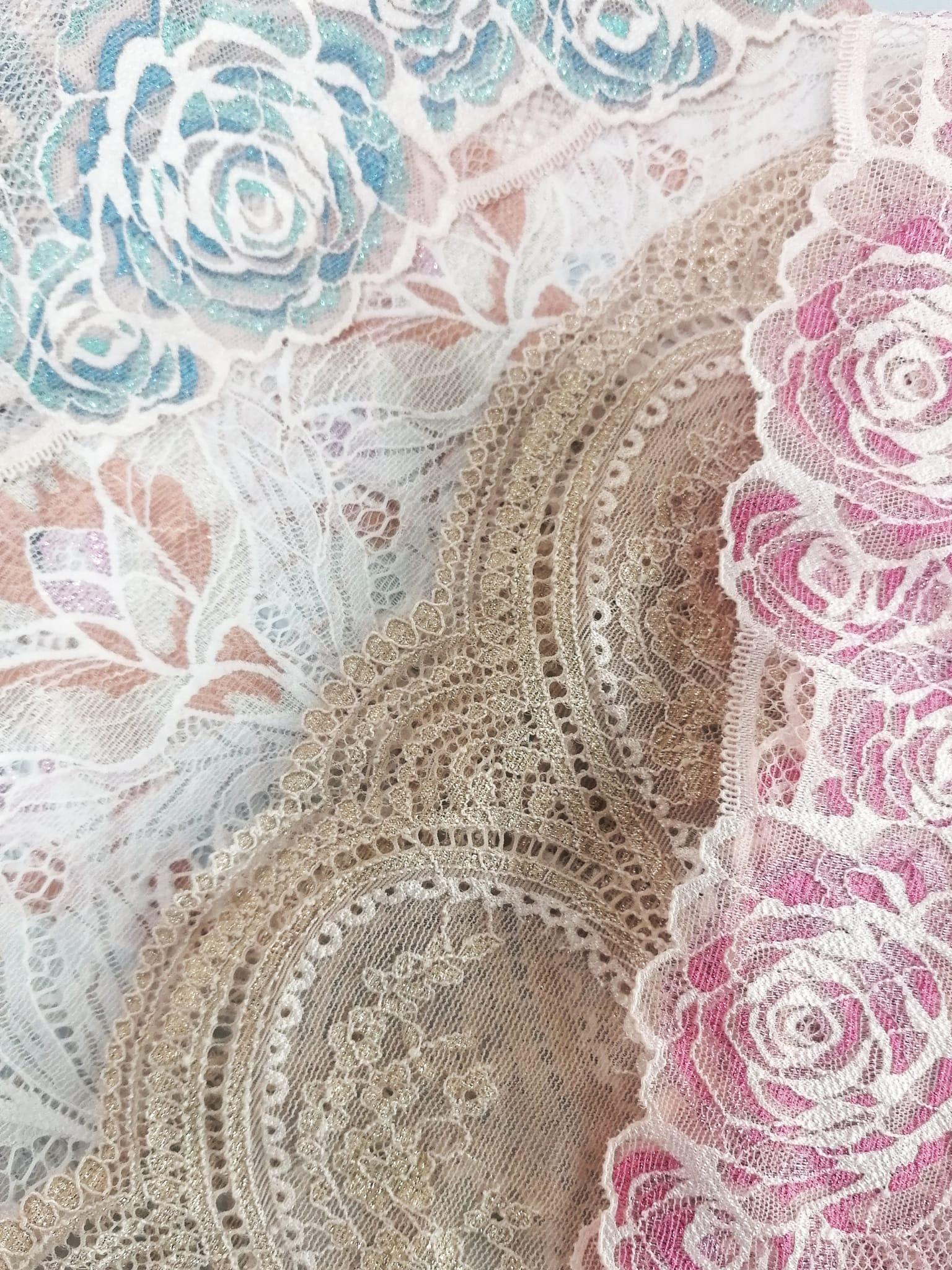
Iluna Group brings its distinctive vision of stretch lace to Milano Unica, where creativity, craftsmanship, and responsible material choices come to-gether to shape contemporary textile expressions. Building on its expertise in Jacquardtronic lace, the company presents a refined selection of ul-tralight developments designed to combine visual delicacy with technical performance. This season’s highlights include ultralight Jacquardtronic laces enriched with luminous LUREX™ color effects from ILUNA’s Green Label line. These creations offer a sophisticated interplay of lightness, tex-ture, and subtle brilliance, expanding the expressive potential of lace across lingerie, fashion, and ready-to-wear applications. The collection also incorporates Evo™, a bio-based polyamide yarn by Fulgar, further enhancing the material approach with innovative fiber solutions. Combined with degradable ROICA™ V550, these textiles deliver refined stretch, softness, and versatility, supporting designs that balance aesthetics with thoughtful material choices for contemporary apparel.

Source:

Asahi Kasei 

Grphic by Edana
02.07.2026

Associations on Single-Use Plastic Directive

The undersigned associations, representing several European industrial sectors, call on EU institutions to maintain the current legal text of the Single-Use Plastic Directive (SUPD), adopted in 2019. While the signatories recognise the importance of ensuring that the SUPD delivers measurable and meaningful environmental outcomes, reopening the Directive now will create legal uncertainty, add disproportionate burden for economic operators that are already navigating partial and often divergent national transpositions, and increase the risk of regulatory overlaps or contradictions with existing and upcoming legislation. Moreover, there is currently insufficient evidence on the effectiveness of the current SUPD to justify a revision, as described below: 

The undersigned associations, representing several European industrial sectors, call on EU institutions to maintain the current legal text of the Single-Use Plastic Directive (SUPD), adopted in 2019. While the signatories recognise the importance of ensuring that the SUPD delivers measurable and meaningful environmental outcomes, reopening the Directive now will create legal uncertainty, add disproportionate burden for economic operators that are already navigating partial and often divergent national transpositions, and increase the risk of regulatory overlaps or contradictions with existing and upcoming legislation. Moreover, there is currently insufficient evidence on the effectiveness of the current SUPD to justify a revision, as described below: 

  • Insufficient evidence to inform a revision of the SUPD. 
    An impact assessment of the SUPD cannot be carried out at a moment when several of its provisions are not yet in place. While a first report on the state of implementation of the SUPD was published in April 2026, it remains partial, and reporting is not harmonised, preventing meaningful comparison of data across countries. Taking the example of consumption reduction targets, Member States and other EEA countries only reported data on SUP products placed on the market in 2022 and, even for this report, did so using different indicators. Crucially, since the target on consumption reduction is set for 2026, no data are yet available on whether that target has been achieved. In summary, the partial application of the SUPD and the limited data available suggest that a revision of the SUPD would be premature at this time. 
  • Preventing further fragmentation and gold-plating. 
    The transposition of the SUPD has produced significant regulatory fragmentation, uneven enforcement, and widespread instances of gold plating, creating persistent uncertainty for companies active across multiple Member States. The result is a patchwork of national rules that undermines the integrity of the Single Market, inflates compliance costs, and fails to deliver proportionate environmental benefits. These structural shortcomings must be fully recognised in the evaluation of the SUPD and effectively addressed prior to considering a reopening of the Directive. 
  • Ensuring legal certainty for economic operators. 
    A revision of the SUPD would create legal uncertainty for companies and Member States that are still implementing several of its provisions. While the SUPD entered into force in mid-2021, the date of application for most of its provisions is at a later stage. Furthermore, the EU Commission has only recently adopted some of the implementing decisions and guidelines on the current SUPD. Any change to the SUPD at a moment when companies are still adapting to new obligations, and Member States are still in the process of implementing some key provisions, would create legal uncertainty for economic operators who do not know whether targets or the scope of the SUPD may change. Legal uncertainty carries significant economic costs for economic operators, notably in terms of investment delays likely to persist throughout the entire SUPD revision process (2–3 years). 
  • Avoiding overlaps with other legislation. 
    Revising the SUPD while the Ecodesign and Packaging Regulations are still being implemented, and as negotiations on the Circular Economy Act (CEA) begin, increases the risk of regulatory overlaps and contradictions. These frameworks cover intersecting areas and a revision of the SUPD in parallel with the CEA would almost inevitably lead to duplicative or conflicting provisions. Even if the EU Commission ensured full coherence in its proposal, the co-legislators could still introduce provisions that diverge from or contradict the SUPD framework, further undermining legal certainty and the functioning of the Single Market. 

At a time when EU leaders have made regulatory simplifications and a fully integrated Single Market central to Europe’s competitiveness agenda, we urge EU policymakers to focus legislative efforts where they are most needed and avoid reopening a framework that has yet to deliver concrete results.

Source:

Edana 

The Mallard gilet Photo The Mallard gilet. Ponda.
The Mallard gilet
30.06.2026

New Imperial-branded clothing line with BioPuff®

Ponda, a UK-based biomaterials company with roots at Imperial College London, has partnered with the university to make branded clothing from wetland-grown plants.

The first products in this collaboration – a Mallard gilet and a Fern cap – are insulated with BioPuff®, a material made from bulrush grown on restored wetlands rather than oil or animal products. The clothing will be on sale exclusively at the Imperial College Union campus shop and online store this autumn.

Full circle collaboration
The world produces around 92 million tonnes of textile waste every year. That is the equivalent of a bin lorry of clothing burned or landfilled every second. Branded merchandise sits at a difficult intersection of this problem: it often relies on conventional materials with significant environmental impacts, yet is discarded long before the end of its useful life. BioPuff® offers an alternative approach, using plant-based insulation designed to connect product manufacturing with wetland restoration, and lower-impact material systems. Importantly, it also outperforms premium synthetics on warmth.

Ponda, a UK-based biomaterials company with roots at Imperial College London, has partnered with the university to make branded clothing from wetland-grown plants.

The first products in this collaboration – a Mallard gilet and a Fern cap – are insulated with BioPuff®, a material made from bulrush grown on restored wetlands rather than oil or animal products. The clothing will be on sale exclusively at the Imperial College Union campus shop and online store this autumn.

Full circle collaboration
The world produces around 92 million tonnes of textile waste every year. That is the equivalent of a bin lorry of clothing burned or landfilled every second. Branded merchandise sits at a difficult intersection of this problem: it often relies on conventional materials with significant environmental impacts, yet is discarded long before the end of its useful life. BioPuff® offers an alternative approach, using plant-based insulation designed to connect product manufacturing with wetland restoration, and lower-impact material systems. Importantly, it also outperforms premium synthetics on warmth.

The collaboration between Ponda and Imperial is part of Sustainable Imperial, the university’s commitment to lead on climate change, biodiversity loss and pollution through research, education, operations and community action. But the ambition runs wider than one campus.

Professor Anna Korre, Imperial’s Associate Provost (Sustainability), said: "This partnership will give Imperial's community the chance to directly back climate friendly fashion innovation. We're proud to celebrate this collaboration as part of our strategy launch. Ponda's story is a powerful example of how Imperial aims to maximise its positive impact on people and planet by giving our students and innovators the tools they need to find solutions to some of the world's most pressing challenges."

About the innovative insulation
Ponda’s BioPuff® has already been used by fashion companies Stella McCartney, Berghaus, Ahluwalia and Sheep Inc. The team exhibited at the Sustainable Markets Initiative CEO Summit at Hampton Court Palace, where they met King Charles III and were recognised by the King’s Terra Carta Design Lab.
The first-of-its-kind insulation, which outperforms premium synthetics on warmth, is made from Typha (bulrush) and grown through paludiculture, the farming of wetland crops on rewetted peatlands.

Each BioPuff®-insulated gilet has the equivalent impact of restoring four square metres of healthy wetland. That represents approximately:

  • 9kg of CO2e in avoided emissions each year
  • 800 litres of water stored
  • three times the bird density of drained land

Wetlands hold more than twice the carbon of all the world’s trees combined. The millions of hectares of drained peatlands emit approximately 1.9 gigatonnes of CO2 a year, roughly twice the total emissions of the global fashion industry.

Source:

Imperial College London; Andrew Youngson, Simon Levey

RE&UP at Textiles Recycling Expo Photo RE&UP
RE&UP at Textiles Recycling Expo
30.06.2026

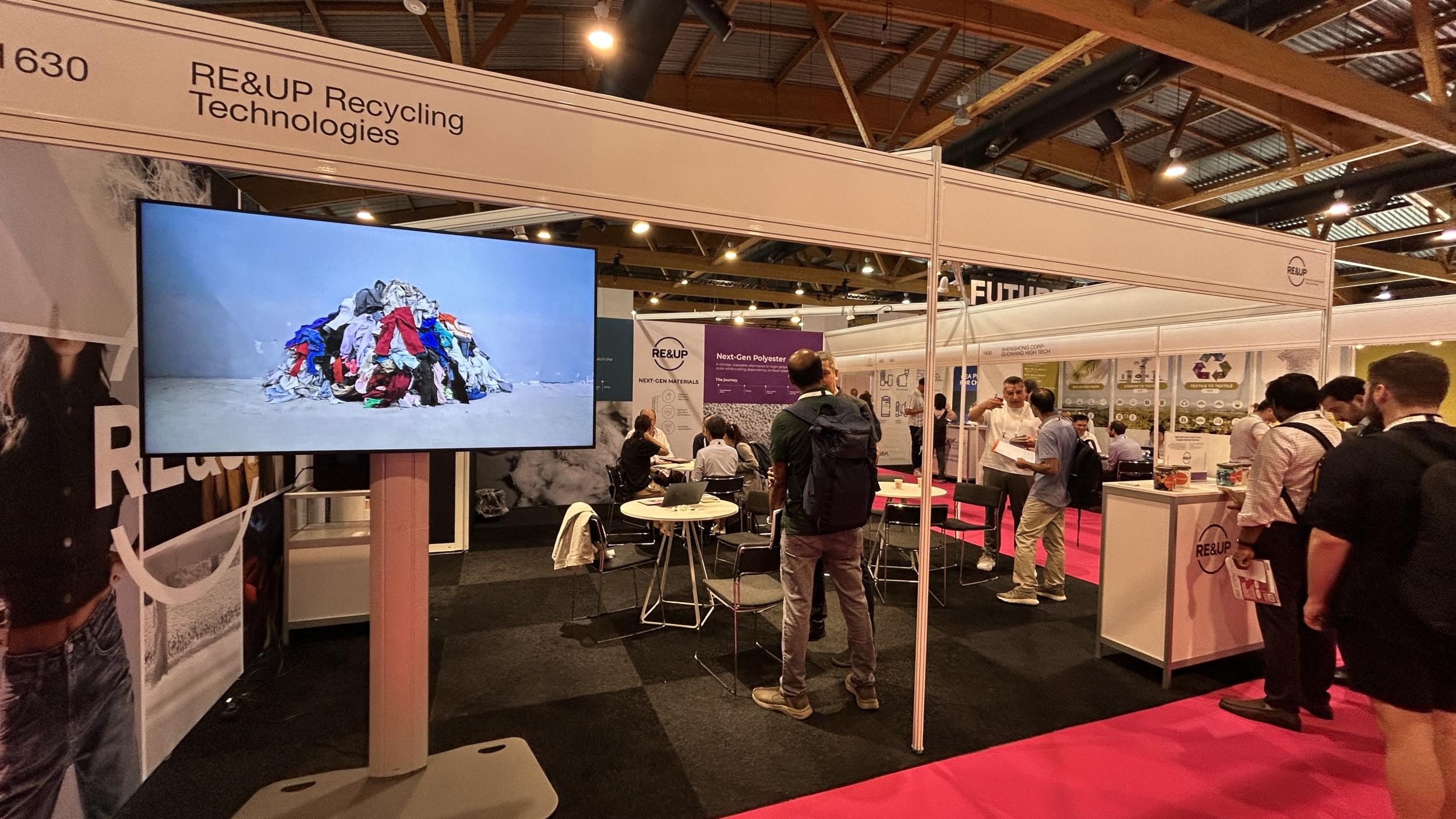
RE&UP establishes Fiber Club consortium to scale Next-Gen material sourcing

Originally developed as an umbrella framework by innovation platform Fashion for Good, the RE&UP Fiber Club aims to accelerate the commercial adoption of circular Next-Gen materials across the global fashion ecosystem. 

Shifting the paradigm of fashion sustainability from isolated capsule collections to structural, industrial-scale reality, RE&UP announced the official launch of RE&UP and its Fiber Club. This landmark initiative introduces a collaborative consortium framework, originally developed as an umbrella framework by innovation platform Fashion for Good, designed to dismantle traditional supply chain barriers and accelerate the global adoption of premium recycled materials. 

For years, the integration of high-quality, next-generation recycled textiles has been hindered by fragmented supply chains, restrictive minimum order quantities (MOQs), and prohibitive upfront costs, frequently trapping sustainability initiatives in a perpetual "pilot phase". RE&UP is changing the rules. 

Originally developed as an umbrella framework by innovation platform Fashion for Good, the RE&UP Fiber Club aims to accelerate the commercial adoption of circular Next-Gen materials across the global fashion ecosystem. 

Shifting the paradigm of fashion sustainability from isolated capsule collections to structural, industrial-scale reality, RE&UP announced the official launch of RE&UP and its Fiber Club. This landmark initiative introduces a collaborative consortium framework, originally developed as an umbrella framework by innovation platform Fashion for Good, designed to dismantle traditional supply chain barriers and accelerate the global adoption of premium recycled materials. 

For years, the integration of high-quality, next-generation recycled textiles has been hindered by fragmented supply chains, restrictive minimum order quantities (MOQs), and prohibitive upfront costs, frequently trapping sustainability initiatives in a perpetual "pilot phase". RE&UP is changing the rules. 

The journey within RE&UP and its Fiber Club is engineered to be straightforward and structurally de-risked, guiding brand partners through four clear operational phases: 

  1. Consortium structure & alignment: Establishing the framework and aligning key supply chain stakeholders. 
  2. Initial material sampling: Reviewing standardized material specifications and aligning on specific supply terms. 
  3. Pilot collection development: Designing and launching an initial commercial collection at the individual brand level. 
  4. Long-Term partnership: Securing long-term fiber purchase commitments at predictable, discounted rates, successfully transitioning brands to a permanent circular supply chain. 

"The technology to recycle textiles is only half the battle; the real hurdle is commercial alignment. With RE&UP and its Fiber Club, the baseline for high-volume, compliant circularity is active and operationally ready today. We are giving forward-thinking brands the plug-and-play infrastructure required to stop experimenting with sustainability and start scaling it," said Andreas Dorner, General Manager of RE&UP.

Photo Myyaz Studio
30.06.2026

New Designers Bringing Fresh Perspectives to Scoop

As Scoop returns to Olympia National from 19–21 July 2026, Founder and Creative Director Karen Radley introduces a new cohort of international designers making their debut at the show, each bringing a distinctive perspective on how fashion, accessories and lifestyle are evolving.

As Scoop returns to Olympia National from 19–21 July 2026, Founder and Creative Director Karen Radley introduces a new cohort of international designers making their debut at the show, each bringing a distinctive perspective on how fashion, accessories and lifestyle are evolving.

Carefully selected from across Europe and beyond, the latest additions to the Scoop line-up reflect a growing movement away from fast-moving trends and towards collections rooted in craftsmanship, creativity and individuality. Spanning footwear, accessories, resortwear and contemporary fashion, the designers share a common desire to create products with purpose, personality and a strong sense of identity.
 
Among the strongest themes emerging from this season's new arrivals is a renewed appreciation for craftsmanship and the human touch. Italian designer XIWIKJ combines European creativity with traditional artisan techniques from Jaipur, creating richly detailed collections that celebrate the beauty of handmade production. A similar philosophy underpins London-based Myyaz Studio, where handcrafted footwear and accessories place making and experimentation at the heart of the design process. Together, they represent a growing appreciation for collections that value artistry, authenticity and the stories behind the finished product.
 
Alongside craftsmanship comes a commitment to more thoughtful production. French designer LO NEEL demonstrates how contemporary luxury and responsible design can work hand in hand through collections crafted from innovative ethical materials, while Korè Collections embraces limited production runs, organic fabrics and hand-painted prints inspired by Mediterranean living. Their arrival at Scoop reflects the increasing demand for collections that balance creativity with conscious decision-making, without compromising on design appeal.
 
Elsewhere, personality and self-expression take centre stage. Never A Wallflower brings a vibrant approach to contemporary dressing through bold colour, confident silhouettes and an unapologetically optimistic aesthetic. Footwear designer Good News similarly challenges convention through a fresh approach to trainer design, reflecting a wider appetite for products that offer individuality and character in an increasingly crowded marketplace.
 
Fresh perspectives also emerge through a diverse mix of accessories, footwear and lifestyle designers, each responding to the growing consumer appetite for products with both purpose and personality. From Hindbag's considered approach to everyday accessories and Gondolina's commitment to craftsmanship, to Hagase's refined detailing and Cacatoès' playful interpretation of contemporary summer style, the collections bring a distinctive energy to the show floor. Together with Alessandra Salvatore and MRP Star, they demonstrate how functionality, creativity and individuality are increasingly shaping modern retail. 

For Karen Radley, these designers represent exactly the kind of discovery that has always defined Scoop.  Karen said: “What excites me most is finding designers who bring something genuinely different to the conversation. Buyers today are looking for collections with a strong identity and a story behind them. They want products that feel considered, authentic and distinctive.

“When I look at this season's new arrivals, what I see is a group of designers who are approaching fashion in very different ways, but who share a commitment to creativity, quality and individuality. They are creating collections with personality, and I think that resonates strongly with both retailers and consumers today.”

As retailers continue to seek differentiation in an increasingly competitive market, Scoop's newest arrivals offer a timely reminder that innovation does not always come from scale. Whether through artisanal craftsmanship, responsible production, bold creativity or a fresh approach to design, these debut designers demonstrate the breadth of talent emerging across the international fashion and lifestyle landscape.

Together, they reinforce Scoop's reputation as a destination for discovery, providing buyers with access to fresh perspectives, exciting new talent and the collections shaping the next chapter of contemporary retail.

Source:

Scoop

30.06.2026

Italian Textile Machinery Excellence Makes a Double Stop in Bangladesh

Technological upgrading and the transition toward higher value-added production are driving the new Italian industrial mission to Bangladesh. This year, the mission will split between the country’s two main manufacturing hubs, where Italian manufacturers will meet the leaders of the local textile supply chain in two strategic stages: July 7th in Dhaka and July 9th in Chittagong.

The double appointment shines a spotlight on a market that confirms itself as a true cornerstone for Italian exports in Asia—a geographical area that alone absorbs 40% of the sector’s foreign sales, reaching a value of 667 million euros. Bangladesh’s role has grown steadily, culminating in 2025 with a turnover of 71 million euros and posting a double-digit increase (+17% compared to the previous year).

Production flexibility and the ability to create customized technological niches are the hallmarks of the roughly 300 companies making up the Italian textile machinery industry—a highly internationalized sector that exports 86% of its production to 130 countries.

Technological upgrading and the transition toward higher value-added production are driving the new Italian industrial mission to Bangladesh. This year, the mission will split between the country’s two main manufacturing hubs, where Italian manufacturers will meet the leaders of the local textile supply chain in two strategic stages: July 7th in Dhaka and July 9th in Chittagong.

The double appointment shines a spotlight on a market that confirms itself as a true cornerstone for Italian exports in Asia—a geographical area that alone absorbs 40% of the sector’s foreign sales, reaching a value of 667 million euros. Bangladesh’s role has grown steadily, culminating in 2025 with a turnover of 71 million euros and posting a double-digit increase (+17% compared to the previous year).

Production flexibility and the ability to create customized technological niches are the hallmarks of the roughly 300 companies making up the Italian textile machinery industry—a highly internationalized sector that exports 86% of its production to 130 countries.

“The 2025 figures speak clearly: the 17% growth testifies that the Bangladeshi textile industry views Italian manufacturers as an irreplaceable partner to win the global challenge of quality and efficiency,” comments Marco Salvadè, President of ACIMIT. “The decision to visit both Dhaka and Chittagong with this workshop stems from our desire to closely support the country’s two industrial engines, offering tailored solutions capable of generating an immediate technological upgrade and guiding local players toward more sustainable models. This journey also represents an ideal springboard ahead of ITMA Hanover 2027, the global stage where we will showcase the next major evolutions of our technology.”

The workshop—promoted by the Italian Trade Agency (ICE) and ACIMIT and organized with the valuable support of the Embassy of Italy in Dhaka—will be structured to maximize networking opportunities through targeted B2B business meetings and in-depth technical seminars in both cities. It will feature the participation of the following Italian companies:

COLOR SERVICE, CORINO MACCHINE, DANTI, DURST, L.A.I.P., LAWER, MONTI – MAC, MS PRINTING SOLUTIONS, ROJ, PENTEK, PINTER CAIPO, REGGIANI MACCHINE, SALVADE’, TECNORAMA, UGOLINI.

Source:

Association of Italian Textile Machinery Manufacturers