From the Sector

from to
Reset
870 results
EDANA's OUTLOOK™ conference (c) Edana
EDANA's OUTLOOK™ conference
09.09.2025

OUTLOOK™ 2025: The Chain Bridge made by EDANA

Before Széchenyi’s Chain Bridge opened in 1849, there were two cities on the Danube: Buda and Pest. For much of the year, the great river was a barrier that kept people, businesses, and ideas apart. The bridge changed everything. It physically connected the two sides to create something new and stronger: Budapest. 

EDANA's OUTLOOK™ conference serves the same purpose. It connects not two, but multiple sides of the industry, bringing together professionals across the absorbent hygiene and wipes sectors. 

With over 400 participants already confirmed from 173 companies, the event is set to be a unique platform for networking and business development. Alongside 18 exhibitors -with only two exhibition spaces still available- delegates will also benefit from 23 dedicated meeting rooms, creating the perfect setting for more private and focused discussions with clients and suppliers. 

This year’s OUTLOOK™ programme brings together 20 international speakers, two evening cocktail receptions, and plenty of opportunities to connect with peers from across the sector. 

Before Széchenyi’s Chain Bridge opened in 1849, there were two cities on the Danube: Buda and Pest. For much of the year, the great river was a barrier that kept people, businesses, and ideas apart. The bridge changed everything. It physically connected the two sides to create something new and stronger: Budapest. 

EDANA's OUTLOOK™ conference serves the same purpose. It connects not two, but multiple sides of the industry, bringing together professionals across the absorbent hygiene and wipes sectors. 

With over 400 participants already confirmed from 173 companies, the event is set to be a unique platform for networking and business development. Alongside 18 exhibitors -with only two exhibition spaces still available- delegates will also benefit from 23 dedicated meeting rooms, creating the perfect setting for more private and focused discussions with clients and suppliers. 

This year’s OUTLOOK™ programme brings together 20 international speakers, two evening cocktail receptions, and plenty of opportunities to connect with peers from across the sector. 

The agenda features three keynote addresses: Ambassador Ivo H. Daalder will reflect on shifting global alliances and their impact on international business; McKinsey & Company will present the latest insights into grocery retail trends and consumer behaviour; and Roover Consulting will explore how artificial intelligence can be applied to innovation and product development. 

Alongside these highlights, the conference will cover market developments, sustainability, financing opportunities, and consumer dynamics in absorbent hygiene products and wipes – just two weeks to go.

More information:
OUTLOOK™ Edana Conference
Source:

Edana

Source FET
08.09.2025

BTMA at ITMA Asia + CITME: From microsurgery to aircraft wings

At the forthcoming ITMA Asia + CITME exhibition in Singapore, specialists from a 20-strong delegation of British Textile Machinery Association (BTMA) companies will be on hand to discuss some of the highly advanced industries they are now actively supporting.

The manufacture of medical sutures, for example, is a very specialised process and because these items are implanted directly into the human body, every stage of production is tightly controlled to ensure safety, sterility and reliable performance.

Absorbable sutures are usually made from polymers that degrade safely within the body, such as polyglycolic acid, polylactic acid or polydioxanone, while non-absorbable sutures use durable materials like nylon, polypropylene, polyester, silk or even stainless steel. All of these must be of medical grade and fully biocompatible.

At the forthcoming ITMA Asia + CITME exhibition in Singapore, specialists from a 20-strong delegation of British Textile Machinery Association (BTMA) companies will be on hand to discuss some of the highly advanced industries they are now actively supporting.

The manufacture of medical sutures, for example, is a very specialised process and because these items are implanted directly into the human body, every stage of production is tightly controlled to ensure safety, sterility and reliable performance.

Absorbable sutures are usually made from polymers that degrade safely within the body, such as polyglycolic acid, polylactic acid or polydioxanone, while non-absorbable sutures use durable materials like nylon, polypropylene, polyester, silk or even stainless steel. All of these must be of medical grade and fully biocompatible.

The UK’s Fibre Extrusion Technology (FET) is a world leader in both the fibre selection and production technologies behind this industry and in Singapore will highlight a groundbreaking new parallel technology for the medical sector based on supercritical CO2. Further developments in the field of automation and control in advanced fibre production will be highlighted by BTMA members including Autofoam, James Heal, Roaches, Strayfield, Verivide and Wira Instrumentation.

AFP and ATL
From the micro to the macro, sophisticated aerospace technologies such as automated fibre placement (AFP) and automated tape laying (ATL) meanwhile involve the precise placement of carbon fibre tapes or tows on a mould surface, which are then cured to form lightweight yet strong components. 
AFP allows for complex geometries by steering individual tows, making it ideal for fuselage sections, wing skins and other curved structures. ATL, on the other hand, is more efficient for larger, flatter surfaces such as wing covers or stabilisers, where wider tapes can be laid down at high speed with minimal gaps or overlaps. Together, these technologies significantly reduce material waste, improve repeatability and deliver structural performance beyond what traditional hand lay-up methods can achieve.

The UK’s Cygnet Texkimp has developed a new technology to greatly assist this industry which will be unveiled in Singapore.

Collaboration
“High value industries such as aerospace, defence, renewable energy, automotive and the medical sector are areas of high growth and opportunity and an important factor underpinning the success of our companies here is the strong collaboration between industry and the many universities and institutes in the UK,” says BTMA CEO Jason Kent. “Machine builders can also be important in driving material developments as well as technologies.”

UHMWPE
A good example of this is the flexible new process for manufacturing ultra high molecular weight polyethylene (UHMWPE) that will be introduced in Singapore by FET.

UHMWPE is prized in many industries due to its extraordinary properties, being for example, ten times stronger than steel by weight. It is increasingly used in medical implants, but the current systems for manufacturing it are on a huge scale, with very complex processing routes.

This restricts the opportunity for new product development – a disadvantage that is fully addressed with FET’s series lab and small scale gel spinning system, which is already industrialised.

“We have supplied many extrusion systems to the biomedical market and in exploring what else we could do for the same customers it became clear that there was a need for smaller quantities of UHMWPE fibres in bespoke sizes.” explains FET Managing Director Richard Slack. “We believe our introduction of a patented batch system for solvent extraction exploiting supercritical CO2 is a game changer.”

Early stage development
Cygnet Texkimp has meanwhile just introduced a next-generation, production-scale prepreg tape slitting machine at its UK Innovation Centre in Northwich.

This enables organisations to trial the slitting of continuous thermoset, thermoplastic and ceramic prepreg tapes for AFP and AFL processes in real-world conditions using their own materials or those produced on Cygnet Texkimp’s in-house R&D prepreg machines on the machine. The technology can slit tapes at speeds of up to 60 metres per minute, subject to the input material.

“We’re pleased to be able to offer partners the opportunity to engage with us at an early stage in process development, to test out their concepts, explore machine parameters, assess output quality and validate performance with support from our expert team,” says Graeme Jones, wide web product director at Cygnet Texkimp.

Splicing portfolio
Also providing back up services to the aerospace industry is Airbond, with splicing technologies which ensure resource efficiency in the processing of extremely expensive carbon and aramid fibres. Pneumatic yarn splicing is a process established in the textile industry for joining yarns and works by intermingling individual filaments closely together, to make joint which are stronger and flatter than knots.

“We are continuing to find new partners in the wind turbine, hydrogen and aerospace industries and are doing a lot of developmental work with research institutes and universities,” says technical director Carwyn Webb. “This is leading to us expanding our portfolio and we are currently working on systems for carbon tape splicing, for example, as well as an automated system for full weaving beams.”

Further developments for the technical textiles and composites sectors will be showcased by BTMA members including Garnett Controls, Roaches International, Slack & Parr and Tatham.

Spirit of openness
“Many BTMA members are currently developing new technologies, either in-house or increasingly through joint projects, and we have much to reveal in Singapore,” says Jason Kent in conclusion. “There’s a new spirit of openness and adventurous interaction in the UK right now – especially in the fields of advanced fibres and technical textiles – which is very encouraging for the future.”

(c) Kraig Biocraft Laboratories
08.09.2025

Kraig Biocraft Laboratories Appoints Kenneth Le as Managing Director of Prodigy Silk

Kraig Biocraft Laboratories, Inc., a leader in spider silk technology, is appointed Kenneth Le as Managing Director of its wholly owned recombinant spider silk production subsidiary, Prodigy Silk Ltd.
 
Le has been an integral leader in The Company’s Southeast Asian operations for many years, overseeing the expansion of its specialized spider silk rearing and production systems. Under his guidance, Kraig Labs and Prodigy Silk have grown from pilot-scale operations to full-scale commercial rearing centers that continue to set records for spider silk production.
 
Le brings extensive management experience, operational oversight, and team development expertise. His leadership has been instrumental in creating the foundation for Prodigy Silk’s current production successes, ensuring that the Company's advanced biotechnology is translated into reliable and sustainable silk output.
 

Kraig Biocraft Laboratories, Inc., a leader in spider silk technology, is appointed Kenneth Le as Managing Director of its wholly owned recombinant spider silk production subsidiary, Prodigy Silk Ltd.
 
Le has been an integral leader in The Company’s Southeast Asian operations for many years, overseeing the expansion of its specialized spider silk rearing and production systems. Under his guidance, Kraig Labs and Prodigy Silk have grown from pilot-scale operations to full-scale commercial rearing centers that continue to set records for spider silk production.
 
Le brings extensive management experience, operational oversight, and team development expertise. His leadership has been instrumental in creating the foundation for Prodigy Silk’s current production successes, ensuring that the Company's advanced biotechnology is translated into reliable and sustainable silk output.
 
"Ken has been at the center of our growth story in Southeast Asia. His ability to combine operational expertise with a deep understanding of our recombinant spider silk technology makes him the ideal choice to lead Prodigy Silk," said Kim Thompson, Founder and CEO of Kraig Labs. "With Ken at the helm, we expect Prodigy Silk to accelerate production, expand capacity, and deliver on the tremendous promise of our technology."
 
As Managing Director, Le will continue to strengthen Prodigy Silk's production capabilities, optimize rearing operations, strengthen our integration with production partners, and drive forward the Company's mission of bringing recombinant spider silk to global markets.
 
"I am honored to take on this new role and to continue building on the successes we've achieved," said Le. "We have an extraordinary team, a proven technology, and the momentum to make spider silk a scalable and commercially viable super material. I look forward to leading Prodigy Silk into this next phase of growth."
 
Kraig Labs' believes Le's leadership will continue to accelerate the pace of innovation and production, positioning Prodigy Silk as the cornerstone of its commercial spider silk operations in Southeast Asia.

Source:

Kraig Biocraft Laboratories, Inc

(c) Teijin Carbon Europe GmbH
05.09.2025

NCAMP Qualification for Teijin

Teijin Carbon announced the NCAMP (National Center for Advanced Materials Performance) qualification of its Tenax™ IMS65 E23 24K non-crimp fabrics (NCF) and woven unidirectional (UD) materials, in conjunction with the Syensqo PRISM® EP2400 epoxy resin system. This milestone marks the first NCAMP qualification of dry carbon reinforcements using vacuum assisted resin transfer molding (VARTM) as a standalone and process-separable infusion route.

The Teijin Carbon materials are formally qualified under material specification NMS 241 and process specification NPS 82401 and are accompanied by a publicly available NCAMP material property data report. The NCAMP program is sponsored by the U.S. Federal Aviation Administration.

The NCAMP database supports proof of equivalence across various types of infusion equipment and techniques, opening the door for broader aerospace adoption of out-of-autoclave (OoA) composite manufacturing.

Teijin Carbon announced the NCAMP (National Center for Advanced Materials Performance) qualification of its Tenax™ IMS65 E23 24K non-crimp fabrics (NCF) and woven unidirectional (UD) materials, in conjunction with the Syensqo PRISM® EP2400 epoxy resin system. This milestone marks the first NCAMP qualification of dry carbon reinforcements using vacuum assisted resin transfer molding (VARTM) as a standalone and process-separable infusion route.

The Teijin Carbon materials are formally qualified under material specification NMS 241 and process specification NPS 82401 and are accompanied by a publicly available NCAMP material property data report. The NCAMP program is sponsored by the U.S. Federal Aviation Administration.

The NCAMP database supports proof of equivalence across various types of infusion equipment and techniques, opening the door for broader aerospace adoption of out-of-autoclave (OoA) composite manufacturing.

Partnership with Mississippi State University Enhances Implementation
To support practical implementation of the qualified system and part development, Teijin Carbon and Syensqo have partnered with Mississippi State University’s Advanced Composites Institute (MSU-ACI) in Starkville. With its advanced VARTM capabilities and scalable tooling strategies, MSU-ACI plays a key role in validating process robustness and material consistency. The institute helps give manufacturers confidence that they can achieve aerospace-grade quality with accessible, cost-effective production methods.

This collaboration reflects Teijin Carbons’s commitment to facilitating the adoption of infusion technologies by reducing learning curves and enabling faster design-to-certification pathways through NCAMP-qualified data.

Material Benefits for Structural Aerospace Applications
The newly qualified Tenax™ non-crimp facric based on IMS65 E23 24K combined with the Syensqo PRISM® EP2400 epoxy resin system deliver:

  • Out-of-autoclave processing with autoclave-comparable mechanical performance
  • High fiber volume with near-zero void content
  • Long out-life dry preforms — ideal for large, complex components
  • Global availability of all components by sea, land, or air
  • Accelerated FAA certification with publicly available B-basis allowables

This qualification offers aerospace OEMs and tier suppliers a scalable and robust alternative to traditional prepreg processing. It is suitable for small to extra-large primary or secondary structures as well as integrated parts such as control surfaces, access panels, fairings, in commercial and defense platforms. This processing method can contribute to efficient and resource-conscious manufacturing aligned with the aerospace industry's sustainability goals.

Teijin Carbon and Syensqo will continue to collaborate under the partnership with Mississippi State University to provide the world with advanced composite material solutions that can shape a more efficient, resilient, and sustainable future for aerospace.

Source:

Teijin Carbon Europe GmbH

05.09.2025

Indorama Ventures: Ready for low-carbon PET fibers - certified supply chain enables bio-based textiles at scale

Indorama Ventures Public Company Limited, a global sustainable chemical company, is accelerating the textile industry’s transition to lower-carbon materials with its scalable, high-performance bio-based PET fibers and yarns under the deja™ Bio portfolio. 

At the upcoming Dornbirn Global Fiber Congress later in September, Claire Mattelet, Global Sustainability Program Head for Indorama Ventures’ Fibers Business, will share the company’s experience in developing a fully certified, low-carbon supply chain at scale. 

Her presentation will explore several challenges, such as 

  • securing reliable sources of renewable feedstocks to produce bio-based PTA and MEG inhouse or sourcing bio-based chemicals such as bio-based MEG from trusted partners 
  • converting feedstock into PET chips, yarns, and fibers 
  • and navigating complex certification requirements 

As a result, Indorama Ventures is now able to offer customers and brand owners an integrated, fully certified supply chain through mass balance at scale. 

Indorama Ventures Public Company Limited, a global sustainable chemical company, is accelerating the textile industry’s transition to lower-carbon materials with its scalable, high-performance bio-based PET fibers and yarns under the deja™ Bio portfolio. 

At the upcoming Dornbirn Global Fiber Congress later in September, Claire Mattelet, Global Sustainability Program Head for Indorama Ventures’ Fibers Business, will share the company’s experience in developing a fully certified, low-carbon supply chain at scale. 

Her presentation will explore several challenges, such as 

  • securing reliable sources of renewable feedstocks to produce bio-based PTA and MEG inhouse or sourcing bio-based chemicals such as bio-based MEG from trusted partners 
  • converting feedstock into PET chips, yarns, and fibers 
  • and navigating complex certification requirements 

As a result, Indorama Ventures is now able to offer customers and brand owners an integrated, fully certified supply chain through mass balance at scale. 

Using a mass-balance approach means that renewable feedstocks, such as used cooking oil, are blended with fossil-based raw materials in existing production systems. 
The renewable content is then allocated to final products using certified methods like ISCC+, ensuring traceability throughout the value chain and compliance with chain-of-custody requirements. 

By leveraging existing infrastructure, coupled with R&D capabilities and proven technologies, Indorama Ventures enables rapid market deployment of bio-based PET fibers and yarns 
that are chemically identical to their fossil counterparts. This ensures customer processes remain the same, performance metrics such as durability, dyeability, and strength are equal to virgin solutions, 
and brand owners and converters can speed up qualification lead times and immediately reduce scope 3 emissions to seamlessly upgrade their existing product lines. 

Indorama Ventures invites brand owners, manufacturers, and industry partners to explore the deja™ Bio portfolio and join the movement toward a lower-carbon textile industry. 
The technology is proven, the supply chain is built. 

Source:

Indorama Ventures

Eastman Naia™: New cellulose acetate filament yarn Photo Eastman Naia™
Eastman Naia™: New cellulose acetate filament yarn
04.09.2025

Eastman Naia™: New cellulose acetate filament yarn at Intertextile Shanghai 2025

A result of Eastman’s recently announced strategic partnership with Huafon Chemical, the new filament yarn features even higher tenacity, making it the perfect solution for premium lightweight fabrics. 

On August 13, Eastman and Huafon Chemical jointly announced a formal strategic partnership to establish a joint facility to produce cellulose acetate yarn. The facility will be dedicated to localized production and product innovation of Eastman Naia™ cellulose acetate filament yarns in China. This collaboration demonstrates Eastman’s long-term commitment to the Chinese market and further deepens its market presence in China by enabling a more agile supply chain response to meet the market demand for high-quality, innovative, and sustainable textile materials in the region.

With the vision to make sustainable textiles accessible to all, the Eastman Naia™ portfolio offers responsibly sourced, biobased cellulosic fibers and yarns. These eco-friendly options empower mills, designers, and brands to create textiles that do not compromise on comfort, quality, or appearance. 

A result of Eastman’s recently announced strategic partnership with Huafon Chemical, the new filament yarn features even higher tenacity, making it the perfect solution for premium lightweight fabrics. 

On August 13, Eastman and Huafon Chemical jointly announced a formal strategic partnership to establish a joint facility to produce cellulose acetate yarn. The facility will be dedicated to localized production and product innovation of Eastman Naia™ cellulose acetate filament yarns in China. This collaboration demonstrates Eastman’s long-term commitment to the Chinese market and further deepens its market presence in China by enabling a more agile supply chain response to meet the market demand for high-quality, innovative, and sustainable textile materials in the region.

With the vision to make sustainable textiles accessible to all, the Eastman Naia™ portfolio offers responsibly sourced, biobased cellulosic fibers and yarns. These eco-friendly options empower mills, designers, and brands to create textiles that do not compromise on comfort, quality, or appearance. 

Naia™ acetate filament yarn is widely recognized and used by both high-end luxury and high-street fashion brands in China and around the world. It is favored for ready-to-wear fashion and linings because of its luxurious silky hand feel, beautiful drape, and rich luster. Beyond aesthetics, Naia™ delivers superior comfort, durability, and ease of care. 

Eastman has developed a robust network of mills and fabric trading partners in China, collaboratively driving innovation to develop some of the most advanced acetate-based fabrics in the global textile market today.

Combing preparation – OMEGAlap E 40 Photo (c) Rieter
Combing preparation – OMEGAlap E 40
04.09.2025

Rieter: On the way to fully automated spinning mill

Rieter at ITMA Asia 2025: The Fully Automated Spinning MillPrecision, speed and cost efficiency are all indispensable, especially in challenging times. Rieter has put together a powerful portfolio for ITMA ASIA + CITME 2025 that gives spinning mills the chance to actively shape the future through intelligent automation. By applying smart machine networking, process optimization and increased production efficiency, the portfolio facilitates the comprehensive transformation of spinning mills while reinforcing their competitiveness. This, in turn, enables customers to further consolidate their leading market positions. At the same time, the portfolio is a key milestone on the way to achieving Rieter’s vision 2027 – the fully automated spinning mill.

Rieter at ITMA Asia 2025: The Fully Automated Spinning MillPrecision, speed and cost efficiency are all indispensable, especially in challenging times. Rieter has put together a powerful portfolio for ITMA ASIA + CITME 2025 that gives spinning mills the chance to actively shape the future through intelligent automation. By applying smart machine networking, process optimization and increased production efficiency, the portfolio facilitates the comprehensive transformation of spinning mills while reinforcing their competitiveness. This, in turn, enables customers to further consolidate their leading market positions. At the same time, the portfolio is a key milestone on the way to achieving Rieter’s vision 2027 – the fully automated spinning mill.

Automation and digitization – the smart gateway to the future 
Rieter will be presenting solutions that enable the step-by-step implementation of the fully automatic spinning mill for the production of ring and compact yarn. Highlights include efficient bale transport, automated can transport and fully automatic packaging solutions, such as steaming, palletizing and labeling. In the field of digitization, Rieter offers various ESSENTIAL modules to meet different requirements. This gives spinning mill employees – from management to machine operators – a solid basis for making decisions on how to optimize yarn production. 

Combing preparation – the OMEGAlap E 40 
The new combing preparation machine OMEGAlap E 40 produces 800 kg/h, 33% more than its predecessor – thanks to the rapid lap changing. At the same time, it boasts 30% lower energy consumption and 63% lower compressed air consumption. Maintenance and cleaning are especially easy, representing a clear advantage for operating personnel. 

The precision winding machine NEO-BD – faster and better 
The new precision winding machine NEO-BD produces packages twice as fast as the previous model – and to a higher quality. Absolute precision is guaranteed: from the optimally adjustable package density and the yarn length that can be defined and reproduced with maximum accuracy to the exact weight of each individual package.

Efficient air-jet spinning of carded cotton 
The air-jet spinning machine J 70 is designed for cost-effective carded fiber spinning – a unique feature made possible thanks to a newly developed twist element: it takes the production speed to a new level and ensures maximum return when it comes to raw material utilization. Spinning mills also benefit from the use of this innovation in other raw material applications. 

The spindle that saves energy – eNASA 
The new Novibra spindle eNASA reduces a spinning machine’s power consumption by 2% to 4% compared to conventional spindles. The high-precision technology is particularly effective at high speeds. The new spindle is compatible with all Novibra clamping crowns. 

Technological expertise in recycled yarn 
Rieter works closely with partners and fiber manufacturers on the topic of recycled yarn. As part of this, different projects and end products will be presented. One new way to significantly increase the recycled content of ring yarn involves the use of sustainable, synthetic cellulosic fibers – described in detail in a new technology publication. 

New Rieter Webshop – the smarter, faster way to source spare parts 
The state-of-the-art platform is a smart solution enabling customers to procure spare parts for spinning and winding machines, upgrades and retrofit solutions. The one-stop shop experience simplifies and optimizes ordering for every spinning mill.

Shri Pachaiamman Spinners (based in Coimbatore): Turns more than 50 percent pre-consumer waste into hosiery yarn (Ne 10 to 30), producing 13 tons per day and using 100 percent recycled materials. (c) Trützschler
Shri Pachaiamman Spinners (based in Coimbatore): Turns more than 50 percent pre-consumer waste into hosiery yarn (Ne 10 to 30), producing 13 tons per day and using 100 percent recycled materials.
04.09.2025

Trützschler: State-of-the-art TRUECYCLED installations in India

Demand for recycled yarn is growing. And the number of TRUECYCLED installations in India is growing too! More and more future-facing companies are driving progress toward a more sustainable textiles industry by producing high-quality yarn from waste through specialized equipment and process know-how from Trützschler. The TRUECYCLED installations in India join a growing group of companies around the globe. This includes Trützschler customers in Türkiye as well as across Europe. 

Demand for recycled yarn is growing. And the number of TRUECYCLED installations in India is growing too! More and more future-facing companies are driving progress toward a more sustainable textiles industry by producing high-quality yarn from waste through specialized equipment and process know-how from Trützschler. The TRUECYCLED installations in India join a growing group of companies around the globe. This includes Trützschler customers in Türkiye as well as across Europe. 

TRUECYCLED is Trützschler’s complete solution for state-of-the-art recycling of pre-consumer and postconsumer textile waste. It encompasses all process steps – from cutting and tearing textile waste through to carding and drawing secondary fibers. Trützschler’s technological expertise enables partner companies to produce recycled yarns with the best possible quality from hard textile waste. In India, USHA YARN was awarded as the first TRUECYCLED reference customer in 2023. Now ten more reference customers are celebrated. TRUECYCLED is gaining traction in India, where demand for recycled yarn is growing rapidly. 
 
The TRUECYCLED pioneers in India are taking action to promote more sustainable, circular value chains in the textile industry. Their yarns contain a substantial amount of textile hard waste, manufactured in a line of Trützschler machinery configured specifically for recycling. All use the T-BLEND blow room line and Trützschler carding machines. 
 

  • Anangoor Textile Mills (based in Kangayam): Produces 30 tons of blended open-end yarn (Ne 20 to Ne 40) per day, using more than 50 percent raw materials from pre-consumer waste. 
  • Eco spin yarn (based in Derabassi): Specialized in 100 percent cotton and poly-cotton blended yarn. This company produces 18 tons of recycled yarn (Ne 10 to Ne 40) per day. It mainly uses 100 percent pre-consumer waste for cotton and up to 20 percent rPET fibers for poly-cotton blends. 
  • Fabtech International Hosieries (based in Tirupur): Manufactures 8 tons of blended open-end yarn (Ne 20 to Ne 40) per day, using more than 50 percent raw materials from pre-consumer waste. 
  • KS Spinning Mills (based in Panipat): Specializing in cotton and poly-cotton blended yarns with a capacity of 36 tons per day, this company produces a wide range of recycled open-end yarns from Ne 1 to Ne 40. For cotton yarn, the company uses 100 percent raw materials from preconsumer waste. Poly-cotton blended yarns are produced with a blend of up to 20 percent recycled polyester and up to 80 percent pre-consumer waste. 
  • Maatrishakti Cotspin (based in Panipat): An open-end yarn expert, manufacturing 18 tons of cotton and poly-cotton blends per day (Ne 10 to Ne 40), using 70 to 80 percent raw materials from pre-consumer waste. 
  • Oasis Textiles (based in Derabassi): Each day, this producer makes 36 tons of recycled yarn – using more than 70 percent raw material from pre-consumer waste (Ne 10 to Ne 40). 
  • Shreeji Cotfab (based in Neemarana): Produces 18 tons per day of open-end yarn made from cotton and poly-cotton blends (Ne 10 to Ne 30), primarily using more than 70 percent of recycled materials. 
  • Shri Pachaiamman Spinners (based in Coimbatore): Turns more than 50 percent preconsumer waste into hosiery yarn (Ne 10 to 30), producing 13 tons per day and using 100 percent recycled materials. 
  • Sri Velayudhaswamy Spinning Mills (based in Dindigul): This customer produces 14 tons of recycled yarn (Ne 20 to Ne 40) per day from a blend of recycled cotton and polyester, using more than 50 percent pre-consumer waste. 
  • Tirumalai Textiles (based in Coimbatore): Using more than 50 percent of pre-consumer waste, this manufacturer produces 17.5 tons of open-end yarn (Ne 10 to Ne 30) per day for weaving and hosiery applications. 
Source:

Trützschler

Cinte Techtextil China (c) Messe Frankfurt (HK) Ltd
Cinte Techtextil China
01.09.2025

Cinte Techtextil China 2025 opens this week

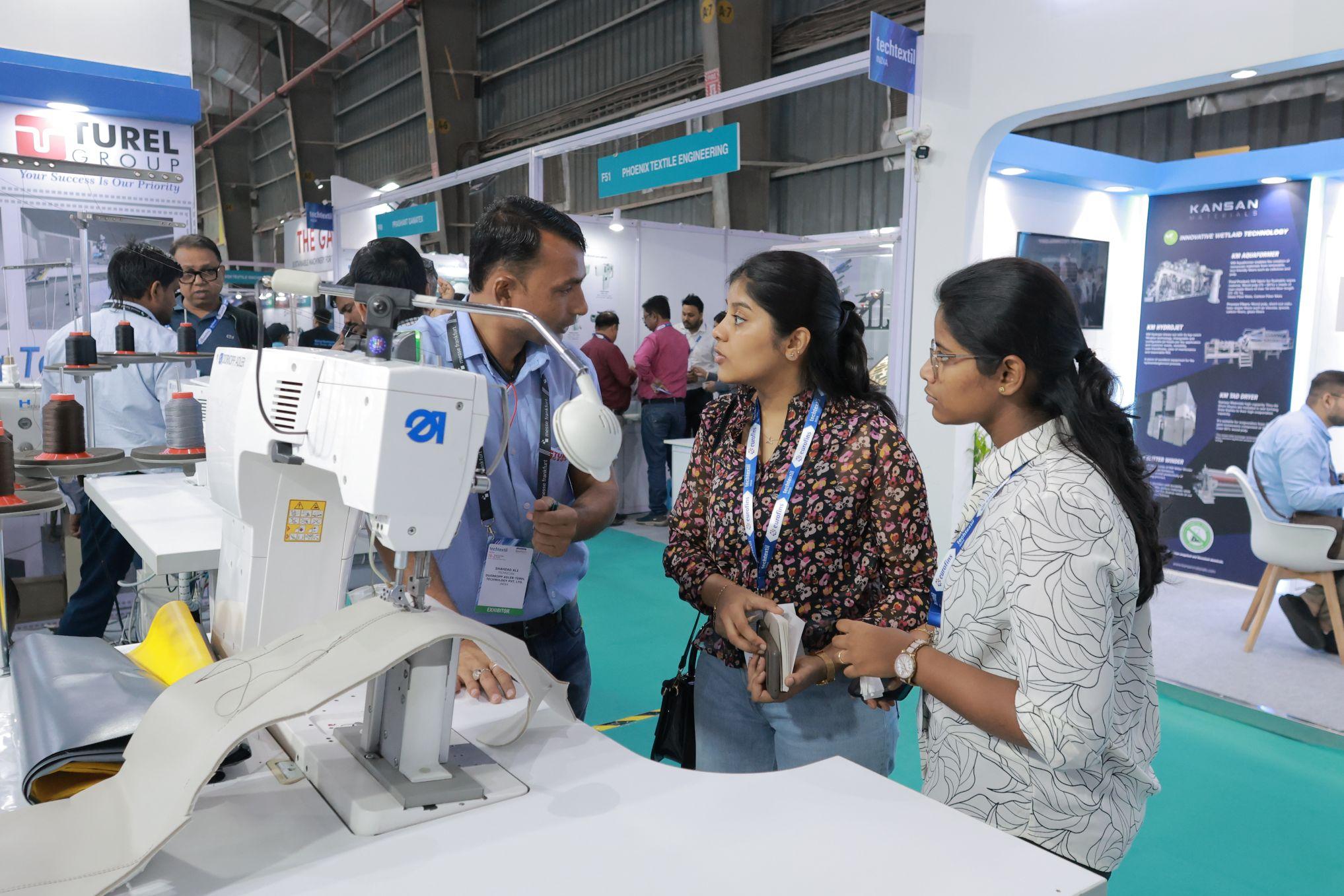
International and domestic exhibitors are relishing the chance to present their curated products at Cinte Techtextil China, when the fair opens from 3 to 5 September 2025, spanning three halls and 32,000 sqm at the Shanghai New International Expo Centre. As Asia’s only dedicated show for the full spectrum of technical textiles and nonwovens, Cinte Techtextil China is set to present a comprehensive roster of global exhibitors across the three-day show period.

The International Hall W5 will feature a debut zone for textile chemicals and dyes, the returning European and German Zones, as well as first-time and prominent exhibitors in key application areas of technical textiles and nonwovens. 

Several domestic pavilions will be set up in Halls W3 and W4, highlighting noteworthy products in automotive, medical & hygiene, and filtration & separation segments. Meanwhile, the fair’s upgraded fringe programme will include the Econogy Tour and Sustainability Forum, the forward-looking AI Panel Discussion, the annual China International Nonwovens Conference (CINC) and more, adding insights to the platform’s business exchange.

International and domestic exhibitors are relishing the chance to present their curated products at Cinte Techtextil China, when the fair opens from 3 to 5 September 2025, spanning three halls and 32,000 sqm at the Shanghai New International Expo Centre. As Asia’s only dedicated show for the full spectrum of technical textiles and nonwovens, Cinte Techtextil China is set to present a comprehensive roster of global exhibitors across the three-day show period.

The International Hall W5 will feature a debut zone for textile chemicals and dyes, the returning European and German Zones, as well as first-time and prominent exhibitors in key application areas of technical textiles and nonwovens. 

Several domestic pavilions will be set up in Halls W3 and W4, highlighting noteworthy products in automotive, medical & hygiene, and filtration & separation segments. Meanwhile, the fair’s upgraded fringe programme will include the Econogy Tour and Sustainability Forum, the forward-looking AI Panel Discussion, the annual China International Nonwovens Conference (CINC) and more, adding insights to the platform’s business exchange.

Speaking ahead of the show’s opening, Ms Wilmet Shea, General Manager of Messe Frankfurt (HK) Ltd, said: “In general, China’s textile industry has maintained stable performance despite international economic turbulence. Like its host country, Cinte Techtextil China has exhibited its resilience, with increased overseas visitor pre-registration numbers. Hosting a number of leading exhibitors this year, we invite visitors to take advantage of the unique sourcing opportunities, and the range of international experts who will present as part of our fringe programme – as we navigate uncertain times, this fair remains as important as ever to drive innovation and business exchange in the industry.”
 
Enhanced fringe programme to complement fair’s product offerings
Committed to innovation and sustainability, Cinte Techtextil China organises a number of fringe events every year to foster collaboration and knowledge sharing. On Day 2 of the fair, key events will centre around the theme of sustainability, starting with the Econogy Tour in the morning, and ending with the Sustainability Forum in the afternoon.
 
The Econogy Tour (10:30 – 11:30) will begin with a presentation on Techtextil Frankfurt 2026 by Ms Sabine Scharrer, Director of Brand Management for Technical Textiles & Textile Processing of Messe Frankfurt Exhibition GmbH, at Econogy Talks. The attendees will then be guided by sustainability expert Mr Karl Borgschulze, to explore exhibitors who have passed the Econogy Check, which is a stringent third-party audit that checks the suppliers’ sustainability certificates.
 
At the Sustainability Forum (13:30 – 16:00), participants will be able to discover insights and practical case studies, featuring experts from academia and well-known brands, led by Dr Guoxiang Yuan, Graduate Supervisor of Donghua University and Research Fellow of The Hong Kong Polytechnic University.
 
The Technical Innovation Exchange Conference on Automotive Textiles will also take place on Day 2, following a brief tour of three key Mobiltech exhibitors, namely Swisstulle AG, JCT Industries and Dr Karl Wetekam GmbH & Co KG. There will also be an automotive textiles showcase at W4, displaying key products such as automotive interior materials, lightweight composite materials, smart sensing fabrics, and acoustic insulation materials.
 
Events on Day 1 include the AI Panel Discussion hosted by AiDLab, discussing the challenges and opportunities involved when applying AI technology for automated textile material inspection; the China International Nonwovens Conference (CINC), aiming to shed light on the industry’s efforts to evolve its competitive landscape; the Innovation Product Award and Presentation; and more.
 
Meanwhile, the number of overseas visitor pre-registrations has already exceeded last year’s total, and includes 95 VIP buyers from 32 countries and regions. Leading visiting companies include Alpha Engineered Composites from Singapore, Delfim from Brazil, Lazwi Engineering 8 from South Africa, and Milliken Europe from Belgium.
 
The fair is organised by Messe Frankfurt (HK) Ltd; the Sub-Council of Textile Industry, CCPIT; and the China Nonwovens & Industrial Textiles Association (CNITA).

More information:
Cinte Techtextil China visitors
Source:

Messe Frankfurt (HK) Ltd

Textile Institute World Conference 2025 in Porto Graphic AWOL
27.08.2025

Textile Institute World Conference 2025 in Porto

The full programme for the 93rd Textile Institute World Conference (TIWC 2025) has been announced, with over 100 presentations to be delivered in parellel sessions at the event, which takes place from October 7-10 at the Porto Palácio Hotel and Spa in Porto, Portugal.

In a comprehensive and international programme, the close collaboration between researchers on separate continents will be highlighted, with a major focus on the further development of technologies and practices assisting in the need for advanced fibre-to-fibre recycling as a means of accelerating a circular textiles economy.

Research teams working continents apart are arriving at strikingly similar solutions – circularity, digital integration, cleaner chemistry and human-centred reform are all critical. These interlocking themes will define this year’s conference.

Circularity will be one of the most prominent concepts underpinning the programme and researchers from Manchester in the UK, for example, will share their evaluation of end-of-life garments and show how almost half of those currently sent to waste could be channelled into advanced recycling. 

The full programme for the 93rd Textile Institute World Conference (TIWC 2025) has been announced, with over 100 presentations to be delivered in parellel sessions at the event, which takes place from October 7-10 at the Porto Palácio Hotel and Spa in Porto, Portugal.

In a comprehensive and international programme, the close collaboration between researchers on separate continents will be highlighted, with a major focus on the further development of technologies and practices assisting in the need for advanced fibre-to-fibre recycling as a means of accelerating a circular textiles economy.

Research teams working continents apart are arriving at strikingly similar solutions – circularity, digital integration, cleaner chemistry and human-centred reform are all critical. These interlocking themes will define this year’s conference.

Circularity will be one of the most prominent concepts underpinning the programme and researchers from Manchester in the UK, for example, will share their evaluation of end-of-life garments and show how almost half of those currently sent to waste could be channelled into advanced recycling. 

From Chemnitz in Germany, new knitting technology will be presented that allows higher proportions of recycled content in cotton fabrics while retaining softness and durability. 

Case studies from Bangladesh and Pakistan will meanwhile explore how local enterprises are already adopting closed-loop systems and circular business innovations, with recycled yarns reaching the supply chains of major global brands. 

Taken together, the many presentations addressing circularity will demonstrate how waste is beginning to shift from a burden to a new raw material, while also pointing to the infrastructure and policies that will be needed to make such systems commercially viable.

Alongside this, the conference will also highlight the revolution now taking place in digitalisation. 

Far from being a niche domain of design software, digital tools are becoming the backbone of sustainability itself. Work will be presented on blockchain, digital product passports and RFID systems that trace garments throughout their lifecycle, strengthening consumer trust and helping businesses meet new regulatory requirements. 

New methods of digital textile printing and open-source knitting software will also be discussed, offering designers the ability to localise production and work with greater creative agency.  

The message of these projects is clear – digitalisation is not an add-on to sustainability but one of its primary enablers.

Perhaps most significant at TWIC 2025 will be the attention given to the human dimension of sustainability. 

In Sri Lanka, small and medium-sized apparel manufacturers will be shown to face critical health and safety risks as climate change brings rising temperatures, air pollution and extreme weather. A new assessment tool will be introduced which is helping firms build resilience and protect workers. 

The Sustainable Fibre Alliance will also demonstrate how cashmere herders, traders and processors in Mongolia are being engaged in a collective effort to reduce rangeland degradation and safeguard livelihoods. 

UK fashion educators will further share approaches to preparing the next generation to embrace circular models and ethical consumerism, equipping future designers to balance profit with responsibility. At the consumer end, new research will reveal misalignments between brand recommendations for garment care and the behaviour actually adopted by wearers, showing that communication must evolve. 

“These examples will remind delegates that technology and recycling alone cannot deliver sustainability without parallel shifts in culture, education and policy,” says Textile Institute CEO Stephanie Dick. “The global nature of the challenges facing textiles is already widely acknowledged and climate change, waste, toxic chemicals, unsafe labour practices and consumer overconsumption have combined to make fashion and textiles one of the world’s most scrutinised industries. What will emerge from this conference, however, is an unmistakable sense of convergence and solid progress.”

Junshu Furusawa (c) Asahi Kasei Fibers Italia
Junshu Furusawa
27.08.2025

New CEO of Asahi Kasei Fibers Italia

2025 marks the beginning of a new chapter for Bemberg™ in Italy. Following the return of Koji Hamada to Japan, after leading the European division for four years, Junshu Furusawa — with 19 years working at Bemberg™ Division and 4 years in Italy — has been appointed as the new CEO of Asahi Kasei Fibers Italia. With a strong background in innovation, product development and strategic vision within Bemberg Division of Asahi Kasei, Junshu Furusawa brings renewed energy and a deep understanding of the fiber’s technical and responsible value proposition. His commitment to transparent communication and partner engagement will continue to drive Bemberg™’s growth across the European fashion and textile industry. Under Junshu Furusawa’s leadership, Bemberg™ reaffirms its commitment to responsible innovation, design excellence, and long-term partnerships, maintaining its role as a key ingredient in the next generation of luxury fashion. 

2025 marks the beginning of a new chapter for Bemberg™ in Italy. Following the return of Koji Hamada to Japan, after leading the European division for four years, Junshu Furusawa — with 19 years working at Bemberg™ Division and 4 years in Italy — has been appointed as the new CEO of Asahi Kasei Fibers Italia. With a strong background in innovation, product development and strategic vision within Bemberg Division of Asahi Kasei, Junshu Furusawa brings renewed energy and a deep understanding of the fiber’s technical and responsible value proposition. His commitment to transparent communication and partner engagement will continue to drive Bemberg™’s growth across the European fashion and textile industry. Under Junshu Furusawa’s leadership, Bemberg™ reaffirms its commitment to responsible innovation, design excellence, and long-term partnerships, maintaining its role as a key ingredient in the next generation of luxury fashion. 

Source:

C.L.A.S.S. Eco Hub

Kraig Biocraft Laboratories Inc., Imgae by Kraig Biocraft Laboratories Inc.
26.08.2025

Kraig Labs: Second Production Rearing Center in Southeast Asia

Kraig Biocraft Laboratories Inc., a leader in spider silk technology, announces that its second production rearing center in Southeast Asia is now fully operational.

With two active production facilities, the Company has established parallel operations designed to ensure continuous rearing cycles of its specialized recombinant spider silk silkworms. This dual-site capacity increases resilience and scalability, providing greater consistency in material output as Kraig Labs advances its commercialization strategy.

Teams are now active at both rearing centers, working with the company’s established parental lines for BAM-1 production hybrids, as well as three additional parental lines introduced earlier this summer. These new genetic lines represent a significant expansion of Kraig Labs’ breeding program and are expected to further enhance production efficiencies.

These facilities are designed to create efficient redundancy to avoid bottlenecks the company experienced in the past. This is a major leap forward in terms of creating sustained production.

Kraig Biocraft Laboratories Inc., a leader in spider silk technology, announces that its second production rearing center in Southeast Asia is now fully operational.

With two active production facilities, the Company has established parallel operations designed to ensure continuous rearing cycles of its specialized recombinant spider silk silkworms. This dual-site capacity increases resilience and scalability, providing greater consistency in material output as Kraig Labs advances its commercialization strategy.

Teams are now active at both rearing centers, working with the company’s established parental lines for BAM-1 production hybrids, as well as three additional parental lines introduced earlier this summer. These new genetic lines represent a significant expansion of Kraig Labs’ breeding program and are expected to further enhance production efficiencies.

These facilities are designed to create efficient redundancy to avoid bottlenecks the company experienced in the past. This is a major leap forward in terms of creating sustained production.

“Becoming fully operational at our second rearing center is a milestone that strengthens the foundation of our spider silk production platform,” said Kim Thompson, Kraig Labs founder and CEO. “Having parallel operations allows us to maintain continuous cycles of rearing, diversify our breeding program, and accelerate the development of next-generation hybrids. This expanded capacity is essential as we push forward in scaling production and bringing our recombinant spider silk to market.”

The opening of this second rearing facility reflects Kraig Labs’ ongoing commitment to building a robust, reliable, and scalable spider silk production system in Southeast Asia, positioning the company to meet growing demand from diverse markets and industries.

Source:

Kraig Biocraft Laboratories Inc.

DNFI World Natural Fibre Update August 2025 (c) Discover Natural Fibres Initiative
DNFI World Natural Fibre Update August 2025
25.08.2025

DNFI World Natural Fibre Update August 2025

Depending on the continent and climate zone, natural fibers grow all year round. The dependence on local and global weather influences changes the quality and quantity of the fibers at the time of harvest or during and after cleaning and processing.

Geopolitical or regional events are other factors affecting the availability of natural fibers. In the case of statistical evaluations, it must be taken into account that some regional harvest periods also take place at the turn of the year.

The estimate of 2025 world natural fibre production is lowered to 32.1 million tonnes in August, about 700,000 tonnes less than production in 2024 and 600,000 tonnes less than the July estimate. Over the past month, prospects for production in 2025 have weakened for abaca, cotton and jute. The estimate of world cotton production issued by USDA is 25.4 million tonnes, down 400,000 tonnes from July. World production of jute is estimated at 2.6 million tonnes, down 200,000 tonnes from July. Wool and coir production are estimated at around one million tonnes each, and all other natural fibres combined are estimated at two million tonnes.

Depending on the continent and climate zone, natural fibers grow all year round. The dependence on local and global weather influences changes the quality and quantity of the fibers at the time of harvest or during and after cleaning and processing.

Geopolitical or regional events are other factors affecting the availability of natural fibers. In the case of statistical evaluations, it must be taken into account that some regional harvest periods also take place at the turn of the year.

The estimate of 2025 world natural fibre production is lowered to 32.1 million tonnes in August, about 700,000 tonnes less than production in 2024 and 600,000 tonnes less than the July estimate. Over the past month, prospects for production in 2025 have weakened for abaca, cotton and jute. The estimate of world cotton production issued by USDA is 25.4 million tonnes, down 400,000 tonnes from July. World production of jute is estimated at 2.6 million tonnes, down 200,000 tonnes from July. Wool and coir production are estimated at around one million tonnes each, and all other natural fibres combined are estimated at two million tonnes.

Source:

Discover Natural Fibres Initiative

25.08.2025

Lenzing: Accelerated energy transition through expansion of renewable energies

The Lenzing Group, a provider of regenerated cellulose fibers for the textile and nonwoven industries, expands its photovoltaic capacities at its Lenzing site. Together with VERBUND, a new PV plant with a capacity of 1.3 megawatts peak (MWp) has been commissioned, increasing the total capacity of the PV plant park to 8.3 MWp. Lenzing is thereby investing in a stable and diversified energy supply and is also making an active contribution to the energy transition. VERBUND is accompanying Lenzing on its path to energy independence and, as a partner, is providing significant support for the expansion of renewable energies. 
 

The Lenzing Group, a provider of regenerated cellulose fibers for the textile and nonwoven industries, expands its photovoltaic capacities at its Lenzing site. Together with VERBUND, a new PV plant with a capacity of 1.3 megawatts peak (MWp) has been commissioned, increasing the total capacity of the PV plant park to 8.3 MWp. Lenzing is thereby investing in a stable and diversified energy supply and is also making an active contribution to the energy transition. VERBUND is accompanying Lenzing on its path to energy independence and, as a partner, is providing significant support for the expansion of renewable energies. 
 
In recent years, Lenzing has continuously invested in the expansion of renewable electricity and energy sources. In addition to its PV plant park, the company operates numerous other sustainable energy projects, including three small hydropower plants with a total output of 2.3 MW. In addition, several supply contracts have been concluded in recent years, for example with WLK energy for the purchase of around 13 MW of wind energy, and with green electricity producers Enery and Energie Steiermark to finance a photovoltaic plant with a capacity of 5.5 MWp in the district of Deutschlandsberg. 
 
“To ensure our long-term competitiveness, we are focusing on a sustainable energy mix of biomass, photovoltaics, wind energy, and hydropower. Investments in renewable energies and production that is as energy autonomous as possible are central components of our strategy. Political support – for example, through electricity price subsidies – is equally essential in order to achieve our ambitious sustainability and climate goals,” explains Christian Skilich, member of the Lenzing Group Executive Management. 
 
Martin Wagner, Managing Director of VERBUND Energy4Business, emphasizes the importance of this strategic cooperation: “The partnership with Lenzing is an important step for us toward a sustainable energy future. Together, we are not only shaping energy independence of companies, but also actively contributing to the energy transition. The new photovoltaic system is further proof that we are driving forward the transformation of the energy market through cooperation. VERBUND remains a reliable partner in supporting companies such as Lenzing on their path to a more sustainable future.” 
 
Lenzing is thus also steadily moving closer to its net-zero target. The group updated their climate targets for 2024 to align its commitment to climate protection with the goals of the Paris Agreement to limit global temperature rise to 1.5 degrees Celsius. The Science Based Targets Initiative (SBTi), the leading authority on climate-related target setting, reviewed and confirmed the target increase. Lenzing is the only producer of regenerated cellulose fibers with a scientifically confirmed net-zero target.

Source:

Lenzing AG

19.08.2025

Loop Industries launches traceable circular polyester resin made entirely from textile waste

  • A branded, circular polyester resin made entirely from textile waste and completely traceable from feedstock to final product.
  • Virgin-quality resin for high-performance applications including fashion, sportswear, and home textiles.
  • Low environmental footprint with significant reduction of CO₂ emissions.

Loop Industries, Inc. a clean technology company accelerating circularity in plastic and fiber markets, announced the launch of Twist™, a branded circular polyester resin made entirely from textile waste. Loop is currently advancing its discussions with apparel brands for offtake from its planned India JV and will supply Twist™ as its branded product offering. Originally developed as Loop’s fiber-grade PET resin, the product has now been rebranded to reflect its role in helping the textile industry transition from linear to circular systems, shifting away from virgin materials and from bottle-to-textile recycling, to give global brands a high-performance solution that embodies both sustainability and next-gen material innovation.

  • A branded, circular polyester resin made entirely from textile waste and completely traceable from feedstock to final product.
  • Virgin-quality resin for high-performance applications including fashion, sportswear, and home textiles.
  • Low environmental footprint with significant reduction of CO₂ emissions.

Loop Industries, Inc. a clean technology company accelerating circularity in plastic and fiber markets, announced the launch of Twist™, a branded circular polyester resin made entirely from textile waste. Loop is currently advancing its discussions with apparel brands for offtake from its planned India JV and will supply Twist™ as its branded product offering. Originally developed as Loop’s fiber-grade PET resin, the product has now been rebranded to reflect its role in helping the textile industry transition from linear to circular systems, shifting away from virgin materials and from bottle-to-textile recycling, to give global brands a high-performance solution that embodies both sustainability and next-gen material innovation.

Utilizing Loop’s globally patented depolymerization technology, Twist™ is produced by breaking down polyester textile waste into its base monomers, DMT and MEG, which are then purified back to their initial purity, before being polymerized into Twist™ resin. This process removes all dyes, colorants, contaminants, and blends, delivering a resin that is chemically identical to virgin polyester. Textile-to-textile recycling allows apparel companies to mitigate the increasing environment impact of textile waste.  

Twist™ achieves the highest purity, color and dyability consistency and increases production efficiency, making it fully compatible with existing spinning and manufacturing infrastructure. 

The production of Twist™ saves up to 418,600 tonnes of CO₂ emissions annually1 and reduces greenhouse gas (GHG) emissions by up to 81%2 when compared to fossil fuel-based resin. This has been independently validated by Franklin Associates, a division of ERG who completed an LCA study of Loop’s technology. 418,600 tonnes of CO₂ emissions are the equivalent of more than 1 billion miles driven by an average gasoline-powered passenger vehicle.

Twist™ is set to transform textile recycling as the first textile-to-textile polyester resin offering complete traceability. Embedded chemical tracers allow customers to track finished products directly back to their original waste textile inputs. This transparency meticulously verifies every step of the recycling and manufacturing process, building crucial trust in the circular economy and setting a new standard for accountability in sustainable textile production. With full traceability from waste input to finished product, Twist™ empowers brands to confidently meet growing regulatory, and consumer demands for transparency and circularity.

Twist™ will be expanded from Loop’s Terrebonne facility and produced at the Infinite Loop™ India facility, a strategically located manufacturing platform designed to serve global textile and apparel brands. The facility will provide Twist™ at competitive pricing levels. This combination of performance, price, traceability and sustainability positions Twist™ as a key material for brands seeking to lead on circularity and meet evolving sustainability targets.

Source:

Loop Industries

Tapes for high-performance applications made from recycled carbon fibers Photo DITF
Tapes for high-performance applications made from recycled carbon fibers
19.08.2025

4.2 million euros for research into textile recycling

Around the world, used textiles are still rarely recycled and pile up into huge mountains of waste. A recent study by the Boston Consulting Group (BCG) drew attention to this problem. However, the low recycling rate is also due to the fact that only a small percentage of used textiles are actually suitable for recycling into high-quality materials and for demanding applications. The German Institutes of Textile and Fiber Research Denkendorf (DITF) are addressing this problem with their research. Europe's largest textile research center has launched two research projects with a total project volume of over 4.2 million euros.

Around the world, used textiles are still rarely recycled and pile up into huge mountains of waste. A recent study by the Boston Consulting Group (BCG) drew attention to this problem. However, the low recycling rate is also due to the fact that only a small percentage of used textiles are actually suitable for recycling into high-quality materials and for demanding applications. The German Institutes of Textile and Fiber Research Denkendorf (DITF) are addressing this problem with their research. Europe's largest textile research center has launched two research projects with a total project volume of over 4.2 million euros.

To promote the recycling of high-performance fibers such as carbon and glass fibers, the DITF will establish a center for the development of high-performance fiber composite structures based on recycled high-performance fibers (HiPerReF) over the next two years. There, scientists are developing a complete process chain for the industrial-scale production of highly oriented semi-finished products from recycled carbon and glass fibers. In order to achieve maximum performance in the component, the interaction of all machines and equipment is being optimized to produce commercially available semi-finished products such as prepreg and non-porous composite plastics with a fiber volume fraction of over 45 percent.

The CYCLOTEXUM project focuses on recycling classic textile waste into high-quality yarns. The aim is to intelligently combine existing mechanical, physical, and chemical process steps so that fine, uniform yarns can be produced from secondary raw materials. The Material Flow and Cost Accounting (MFCA) developed at the DITF makes it possible to review all technological developments for economic efficiency and sustainability.

The research work of the two centers provides the national and global textile industry with effective tools and solutions for an effective textile circular economy.

Source:

Deutsche Institute für Textil- und Faserforschung Denkendorf

Kevin Conroy Photo INDA
Kevin Conroy
19.08.2025

INDA Adds Kevin Conroy to Government Affairs Team

INDA, the Association of the Nonwoven Fabrics Industry, announced that experienced policy expert Kevin Conroy has joined the association’s government and regulatory affairs staff as Senior Manager of Government and Regulatory Affairs.

Conroy brings extensive experience in government, politics, and public service to his new role at INDA. He most recently served on the staff of former Maryland Governor Larry Hogan, where he held multiple senior positions over the course of Hogan’s eight years in office, including Director, Chief of Staff, and Assistant Secretary of Agriculture for the State of Maryland.

“We are excited to welcome Kevin to the INDA team,” said INDA President Tony Fragnito, “his wealth of experience will expand our government and regulatory affairs impact at the state and federal levels while positioning INDA for even more proactive advocacy for the nonwovens sector.”

INDA, the Association of the Nonwoven Fabrics Industry, announced that experienced policy expert Kevin Conroy has joined the association’s government and regulatory affairs staff as Senior Manager of Government and Regulatory Affairs.

Conroy brings extensive experience in government, politics, and public service to his new role at INDA. He most recently served on the staff of former Maryland Governor Larry Hogan, where he held multiple senior positions over the course of Hogan’s eight years in office, including Director, Chief of Staff, and Assistant Secretary of Agriculture for the State of Maryland.

“We are excited to welcome Kevin to the INDA team,” said INDA President Tony Fragnito, “his wealth of experience will expand our government and regulatory affairs impact at the state and federal levels while positioning INDA for even more proactive advocacy for the nonwovens sector.”

Conroy began his career on Capitol Hill in the office of Congressman Chris Shays before working for Congressman David Dreier and the House Rules Committee. He has managed numerous political campaigns at both the state and federal levels, building coalitions and executing successful strategies in competitive races.

“Kevin’s wealth of experience will allow us to hit the ground running on several issues important to the industry, including EPA rulemaking, state and federal PFAS and chemical regulations, and plastics,” added Wes Fisher, INDA Director of Government Affairs.

With a career spanning legislative, executive, and electoral arenas, Conroy brings a deep understanding of public policy, intergovernmental affairs, and political strategy to his new position at INDA. He will be working on the INDA team out of the greater Washington, D.C. area.

More information:
INDA Government Affairs staff
Source:

INDA

Huafon Chemical Photo Huafon Chemical
Huafon Chemical
14.08.2025

Eastman & Huafon Chemical: Cellulose acetate yarn manufacturing facility in China

Eastman announced a formal strategic partnership with Huafon Chemical to establish a joint facility to produce cellulose acetate yarn. The facility will be dedicated to localized production and product innovation of Eastman Naia™ cellulose acetate filament yarns in China.

“China is the world’s largest textile supply chain hub and a frontier for product and technology innovation,” said Ruth Farrell, general manager of Eastman’s textiles business. “This strategic partnership will provide us with greater capacity and further enhance the innovation and product development capabilities of Naia™ yarn while enabling Eastman to fulfill its brand promise of making sustainable textiles accessible to all.”   

This collaboration demonstrates Eastman’s long-term commitment to the Chinese market and further deepens its market presence in China by enabling a more agile supply chain response to meet the market demand for high-quality, innovative and sustainable textile materials in the region.  

Eastman announced a formal strategic partnership with Huafon Chemical to establish a joint facility to produce cellulose acetate yarn. The facility will be dedicated to localized production and product innovation of Eastman Naia™ cellulose acetate filament yarns in China.

“China is the world’s largest textile supply chain hub and a frontier for product and technology innovation,” said Ruth Farrell, general manager of Eastman’s textiles business. “This strategic partnership will provide us with greater capacity and further enhance the innovation and product development capabilities of Naia™ yarn while enabling Eastman to fulfill its brand promise of making sustainable textiles accessible to all.”   

This collaboration demonstrates Eastman’s long-term commitment to the Chinese market and further deepens its market presence in China by enabling a more agile supply chain response to meet the market demand for high-quality, innovative and sustainable textile materials in the region.  

“Through cooperation with Eastman, we look forward to combining local advantages with international resources to achieve a fully localized chain — from technological innovation, product development and production to service — and jointly promoting the sustainable development of the textiles industry,” said Congdeng Yang, director of the Huafon-Eastman collaboration program.

Source:

Eastman Chemical Company

Deakin University & Samsara Eco: World-first enzyme-powered textile recycling Photo Deakin & Samsara Eco
Deakin University & Samsara Eco: World-first enzyme-powered textile recycling
14.08.2025

Deakin University & Samsara Eco: World-first enzyme-powered textile recycling

Australia’s war on waste has a powerful new ally, Deakin University’s Recycling and Clean Energy Commercialisation Hub (REACH). 

REACH has joined forces with Samsara Eco to fast-track world-first technology that could recycle plastics and textiles, previously considered unrecyclable, that would take centuries to eliminate from the environment.   

Textile waste is one of the world’s most persistent environmental issues, driven by fast fashion, high consumption and poor disposal practices. In Australia, synthetic fibres like nylon and polyester make up almost 60 per cent of the materials used in clothing, yet with less than one per cent of discarded garments recycled into new clothes, most end up in landfill or are incinerated, adding to pollution and harmful emissions. 

Samsara Eco’s AI-designed enzymes break down fossil-fuel derived materials like synthetic fibres, including nylon 6,6 and polyethylene terephthalate (PET) into their original building blocks or monomers – allowing them to be rebuilt into new products with virgin-quality performance.  

Australia’s war on waste has a powerful new ally, Deakin University’s Recycling and Clean Energy Commercialisation Hub (REACH). 

REACH has joined forces with Samsara Eco to fast-track world-first technology that could recycle plastics and textiles, previously considered unrecyclable, that would take centuries to eliminate from the environment.   

Textile waste is one of the world’s most persistent environmental issues, driven by fast fashion, high consumption and poor disposal practices. In Australia, synthetic fibres like nylon and polyester make up almost 60 per cent of the materials used in clothing, yet with less than one per cent of discarded garments recycled into new clothes, most end up in landfill or are incinerated, adding to pollution and harmful emissions. 

Samsara Eco’s AI-designed enzymes break down fossil-fuel derived materials like synthetic fibres, including nylon 6,6 and polyethylene terephthalate (PET) into their original building blocks or monomers – allowing them to be rebuilt into new products with virgin-quality performance.  

The collaboration will see Samsara Eco lean into Deakin’s advanced chemical analysis and polymer processing expertise to better understand and find recycling solutions for specific additives like dyes, finishes and coatings present in textile waste. 

‘We are laser-focused on creating true circularity and that means finding a solve for all plastics,’ said Founder and CEO at Samsara Eco Paul Riley. ‘This research supports our efforts to make this a reality. We’ve already come a long way with our enzymatic recycling technology, which can infinitely recycle PET and nylon 6,6 plastics used for clothing and other textiles, including mixed fibres and plastics. Our research collaboration with Deakin will support our efforts to recycle more waste at speed, scale and with precision.’  

Unlike mechanical recycling, which degrades the quality of materials and limits recyclability, Samsara Eco’s enzymatic depolymerisation technology is making it possible to rebuild worn or contaminated textiles into virgin-equivalent materials.  

Distinguished Professor Colin Barrow, Chair in Biotechnology at Deakin’s School of Life and Environmental Sciences said:  

‘Our research tackles a critical challenge in textile recycling – understanding how dyes, textile finishes, coatings and other chemical treatments affect the breakdown and rebuilding of synthetic fibres, including other types of polyester and nylon to repurpose into new products.  

‘We are exploring solutions by analysing these contaminants and determining their impact on textile recycling processes, to make it possible to produce high-performance recycled materials from all types of waste feedstock.’  

Associate Professor Chris Hurren from Deakin’s Institute for Frontier Materials is also collaborating on the project and said:  

‘By testing how these materials perform in real-world polymerisation and processing, we’re helping to refine the recycling pipeline and bring closed-loop textile recycling closer to commercial reality.’  

With growing global pressure on the textile industry to cut emissions and reduce waste, Associate Professor Hurren says this technology could revolutionise the sector – delivering both environmental and economic benefits.  

‘We’re working to unlock a scalable, circular future for fashion – one that reduces reliance on harmful inputs and keeps textiles out of landfill.’  

Samsara Eco has a 10-year agreement with global activewear brand lululemon to support approximately 20 per cent of its overall fibre portfolio with its recycled materials. This builds on previous collaborations between the two, launching the world’s first enzymatically recycled nylon 6,6 garment, recreating their iconic Swiftly top, and a limited-edition Packable Anorak jacket – the first retail garment made from enzymatically recycled polyester.  

With their first commercial facility set to open in Jerrabomberra later this year, Samsara Eco’s 2030 vision is to recycle half a billion clothing items and 10 billion plastic bottles annually, avoiding hundreds of thousands of tonnes of carbon emissions. 

‘We’re uniquely positioned to recycle mixed plastics and fibres,’ said Mr Riley. ‘We’re taking post-industrial and post-consumer waste to create new products and are already working with helping brands to swap virgin inputs for our low carbon, enzymatically recycled materials, which plug directly into existing supply chains. 

‘Together with Deakin’s researchers, we can find further recycling solves to keep more out of landfill and in circulation.’ 

Source:

Deakin University

INDA at 2025 NCSL Legislative Summit Photo INDA
INDA at 2025 NCSL Legislative Summit
14.08.2025

INDA: Nonwovens Education at the 2025 NCSL Legislative Summit

INDA, the Association of the Nonwoven Fabrics Industry, recently attended the 2025 NCSL Legislative Summit hosted in Boston, Massachusetts. Wes Fisher, Director of Government Affairs, and Kevin Conroy, Senior Manager of Government Affairs, connected with hundreds of state legislators, their staff, international delegates, and many who visited INDA’s booth amongst the thousands of attendees.

Attendees were eager to learn more about flushability, the California Collection Study, the ins and outs of the nonwovens industry, the federal WIPPES Act, and state legislation on wipes. Wes and Kevin provided hands-on demonstrations and educational discussions to help policymakers understand how nonwoven products are made, used, and regulated — and the importance of accurate wipes labeling for consumers and the environment. This year marked the second time in recent years that INDA has exhibited at the event.

INDA, the Association of the Nonwoven Fabrics Industry, recently attended the 2025 NCSL Legislative Summit hosted in Boston, Massachusetts. Wes Fisher, Director of Government Affairs, and Kevin Conroy, Senior Manager of Government Affairs, connected with hundreds of state legislators, their staff, international delegates, and many who visited INDA’s booth amongst the thousands of attendees.

Attendees were eager to learn more about flushability, the California Collection Study, the ins and outs of the nonwovens industry, the federal WIPPES Act, and state legislation on wipes. Wes and Kevin provided hands-on demonstrations and educational discussions to help policymakers understand how nonwoven products are made, used, and regulated — and the importance of accurate wipes labeling for consumers and the environment. This year marked the second time in recent years that INDA has exhibited at the event.

“Having a booth at the 2025 NCSL Legislative Summit allowed us to engage directly with state legislators, policy stakeholders, and many of the thousands of attendees on wipes labeling, the WIPPES Act, and other key issues shaping the nonwovens industry today,” said Wes Fisher. “The meaningful conversations and hands-on product demonstrations showcased the essential role nonwoven fabrics play in everyday life, from consumer households to critical industrial applications.”

The annual NCSL Legislative Summit hosts one of the nation's largest and most influential gatherings of state legislators, staff, corporations, government agencies, and trade associations. State and national media publications cover the event, disseminating news and stories across the country.

Source:

INDA